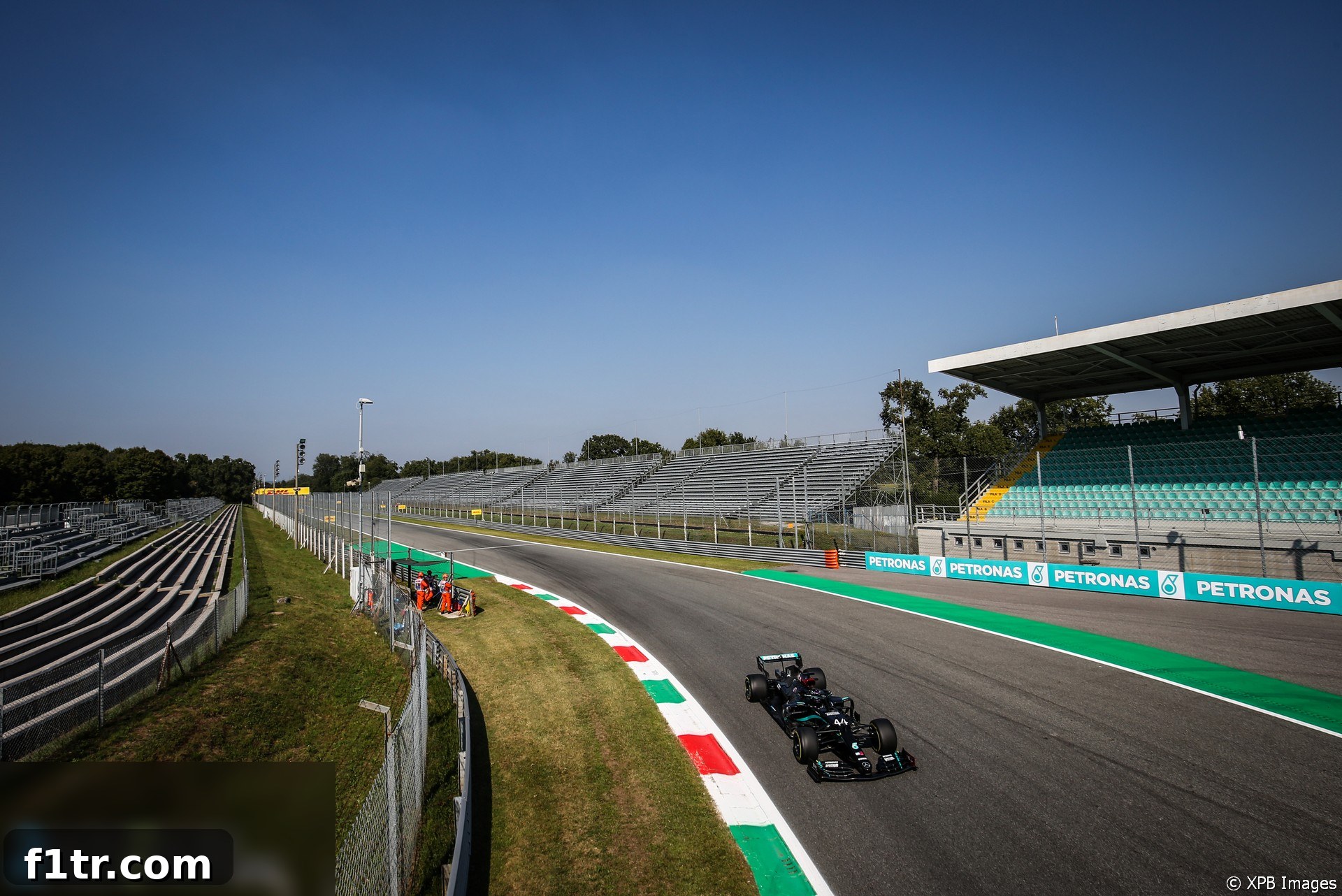
Lewis Hamilton Shatters Monza Lap Record: A New Benchmark in Formula 1 Speed
The hallowed tarmac of the Autodromo Nazionale Monza, affectionately known as the “Temple of Speed,” witnessed history being made as Lewis Hamilton obliterated the fastest lap ever driven in a Formula 1 car. For the second time in just three years, the record books were rewritten at Monza, a testament to the relentless march of technological advancement and driver skill in the pinnacle of motorsport. Hamilton’s awe-inspiring performance firmly establishes a new benchmark for speed on this legendary Italian circuit, captivating fans and sending ripples through the F1 paddock.
This remarkable achievement comes at a particularly fascinating juncture in Formula 1’s evolution. The iconic parkland circuit’s configuration has remained largely unchanged for two decades, with only minor cosmetic adjustments. Yet, the current generation of V6 hybrid turbo machines are nearly five seconds quicker per lap compared to the V10 engines that raced here 20 years prior. This astonishing leap in performance is all the more impressive considering today’s cars are approximately 150 kilograms (or 25%) heavier, highlighting the incredible efficiency and power delivery of modern F1 engineering.
The Record-Breaking Lap: Precision and Raw Speed
Lewis Hamilton’s record-setting lap was a masterclass in controlled aggression and precision. He posted an astonishing time of 1 minute 18.887 seconds, dismantling the previous ultimate average lap speed record held by Kimi Raikkonen. Raikkonen’s 2018 benchmark stood at 1 minute 19.119 seconds, achieved at an average speed of 263.587 kph. Hamilton expertly shaved a significant 0.232 seconds off this formidable time, pushing the average speed to an incredible 264.362 kph. This minor increment in time translates to a substantial increase in average speed, underscoring the marginal gains that define modern Formula 1.
To put this into perspective, 264.362 kph translates to approximately 164.267 mph. This figure provides a crucial point of comparison to some of Formula 1’s most revered benchmarks for ultimate performance. The psychological barrier of averaging over 160 mph on a track was first officially shattered in 1985 at Silverstone by the legendary Keke Rosberg. Driving a Williams, Rosberg’s record-breaking lap was a watershed moment, marking a new era of outright speed in the sport and standing as a testament to the raw power of the turbocharged machines of that period.
Monza: The Legendary “Temple of Speed”
Monza is more than just a circuit; it’s a living museum of motorsport history, steeped in tradition and legendary moments. Known globally as the “Temple of Speed,” its layout is characterized by impossibly long straights punctuated by tight chicanes, demanding a unique blend of aerodynamic efficiency and brute engine power. Drivers spend over 80% of a lap at full throttle, making it the fastest circuit on the F1 calendar and a true test of a car’s top-end speed and braking capability. For decades, Monza has been the venue where the fastest F1 cars truly spread their wings, pushing the limits of speed and engineering.
The fact that the circuit’s fundamental configuration has remained unchanged for two decades, save for minor safety enhancements and aesthetic updates, makes comparisons across eras particularly poignant. It allows for a direct evaluation of how car technology has evolved over time. While the iconic Parabolica corner has seen minor re-profiling to enhance safety, the essence of Monza – its high-speed character and challenge – remains intact. This consistent layout provides a stable canvas upon which the ever-advancing F1 machinery continually paints new records, making each new benchmark at Monza a clear indicator of the sport’s technical progression.
Evolution of F1 Engineering: From V10s to Hybrid Turbos
The astonishing pace of modern F1 cars, as exemplified by Hamilton’s record, is a direct result of relentless innovation in engineering. The V6 hybrid turbo-era cars are technological marvels, vastly different from their V10 predecessors. While the older V10s were renowned for their high-revving, deafening power delivery, the current 1.6-litre V6 hybrid power units combine a turbocharged internal combustion engine with sophisticated energy recovery systems (ERS). These systems harvest kinetic energy during braking and exhaust heat, deploying it as additional power, resulting in unprecedented levels of efficiency and instantaneous torque.
Despite being significantly heavier than the V10 machines (a mandated increase for safety and structural reasons), the sheer power and aerodynamic efficiency of today’s cars allow them to overcome this weight penalty. Advances in aerodynamics, tire technology, and suspension design have played an equally crucial role. Sophisticated computational fluid dynamics (CFD) and wind tunnel testing have allowed engineers to sculpt bodies that generate immense downforce with minimal drag, crucial for both cornering speed and top-end performance at a circuit like Monza. Tire compounds, developed in collaboration with Pirelli, offer superior grip and durability, enabling drivers to push harder for longer. This holistic approach to design and engineering is what truly underpins the record-breaking capabilities of modern Formula 1 cars.
A Legacy of Speed: F1’s Fastest Laps Through History
The pursuit of ultimate speed is woven into the very fabric of Formula 1, and the history of lap records serves as a thrilling timeline of its technological advancements. Keke Rosberg’s groundbreaking 1985 lap at Silverstone, where he became the first driver to average over 160 mph, was achieved in a Williams powered by a formidable 1.5-litre Honda V6 turbo engine. That record stood for an impressive 17 years, a testament to the incredible power-to-weight ratio and aerodynamic simplicity of the cars of that era, which had fewer restrictions on turbo boost and downforce.
It was Juan Pablo Montoya who finally eclipsed Rosberg’s long-standing benchmark in 2002. Like Rosberg, Montoya was also at the wheel of a Williams, though his machine was powered by a potent 3.0-litre BMW V10 engine. Montoya’s lap at Monza ushered in a new chapter of speed, showcasing the peak performance of the naturally aspirated V10 era before hybridisation. These historical comparisons highlight that while F1 has taken three-and-a-half decades to increase average lap speeds by approximately 6 kph, this seemingly modest increase belies the astonishing rate of technical development within the sport. The progression has been anything but linear, often constrained by deliberate measures taken for safety.
Balancing Performance and Safety: F1’s Regulatory Landscape
The modest increase in average lap speeds over several decades, despite monumental technological leaps, is not a reflection of stagnation but rather a testament to Formula 1’s unwavering commitment to safety. For years, the sport has proactively introduced regulations designed to deliberately constrain outright speeds. These measures include changes to both the cars themselves and the circuits they race on.
Car regulations have seen continuous evolution, limiting factors like aerodynamic downforce, engine power, and overall car dimensions, all aimed at preventing speeds from escalating to potentially unsafe levels. For instance, the introduction of grooved tires in the late 1990s, followed by limitations on front wing widths and floor designs, were all safety-driven interventions. Simultaneously, circuits have undergone significant modifications, with the addition of chicanes, increased run-off areas, and improved barrier systems, particularly at high-speed tracks like Monza. These proactive safety measures ensure that while the engineering arms race continues unabated, the welfare of drivers and spectators remains paramount, preventing the machines from becoming too fast for human control or track infrastructure.
The ‘Quali Mode’ Ban: An Unforeseen Boost for Lap Times?
Adding another layer of intrigue to Hamilton’s record-breaking performance is the fact that it occurred despite the recent banning of high-power engine ‘quali modes.’ These specialized engine settings, previously employed by teams solely during qualifying sessions, allowed for a temporary burst of extra power, optimizing lap times over a single flying lap. The ban was introduced with the intention of leveling the playing field, reducing the performance gap between teams in qualifying, and promoting closer racing, particularly during the Grand Prix itself.
However, Hamilton’s record at Monza, one of the most power-sensitive circuits, suggests that the removal of ‘quali modes’ has not necessarily slowed down the fastest cars, but rather pushed engineers to find even greater overall efficiency and performance throughout the car’s setup. It implies that teams are now running closer to their optimal performance envelope for the entire weekend, rather than relying on a short-lived power boost. This development makes the upcoming race dynamics particularly fascinating. With teams now operating at similar performance levels from qualifying to the Grand Prix, it will be intriguing to observe whether they can maintain qualifying-like speeds towards the end of the race when fuel loads are significantly reduced, especially if strategic pit stops for fresh tires come into play. This could lead to even more intense battles and closer finishes.
Team Dynamics: Who Gained and Who Struggled at Monza
While Mercedes undoubtedly led the charge with Hamilton’s record-breaking lap, a closer look at the year-on-year performance improvements reveals a varied landscape across the grid, especially at F1’s fastest circuit. Three other teams managed to make bigger performance gains compared to their 2019 outings at Monza, indicating significant development work paying off. These improvements underscore the constant competitive pressure in F1, where even marginal gains can translate into crucial tenths of a second on the stopwatch.
Conversely, some teams faced considerable challenges. All three Ferrari-powered teams – Ferrari, Haas, and Alfa Romeo – found themselves slower than the previous year. This performance deficit was particularly stark for the Scuderia Ferrari itself, which not only lagged behind its 2019 pace but was also over a second off Kimi Raikkonen’s record-setting time from just two years prior. This highlighted the deep-seated issues the Italian team was grappling with, particularly concerning engine performance and aerodynamic efficiency. Renault also found themselves fractionally off their 2019 pace, suggesting a more nuanced struggle to extract maximum performance from their package. These disparities in team performance add another layer of strategic depth and narrative to each Grand Prix weekend, as teams constantly strive to optimize their machinery and driver capabilities.
The Driver’s Edge: Hamilton’s Mastery at High Speed
While technological advancements are undeniably the backbone of modern Formula 1’s speed, the human element—the driver’s skill, courage, and precision—remains absolutely indispensable. Lewis Hamilton’s record lap at Monza is not merely a testament to the Mercedes W11’s engineering prowess but also a profound demonstration of his unparalleled mastery behind the wheel. At a circuit where average speeds are the highest of the season, and reactions must be instantaneous, the smallest error can cost crucial tenths or lead to catastrophic consequences.
Hamilton’s ability to consistently extract the absolute maximum from his machinery, navigating the fine line between grip and adhesion through Monza’s high-speed chicanes and sweeping curves, showcases his extraordinary talent. His intuitive understanding of the car’s limits, combined with immense bravery to hold the throttle open through corners that demand unwavering commitment, is what truly separates the elite. This synergy between cutting-edge technology and exceptional human performance is the essence of Formula 1, and Hamilton’s new record stands as a shining example of this perfect partnership.
Conclusion: A New Chapter in F1’s Pursuit of Perfection
Lewis Hamilton’s record-breaking lap at Monza is more than just a new entry in the history books; it represents a significant milestone in Formula 1’s ongoing pursuit of perfection. It underscores the incredible advancements in V6 hybrid turbo technology, demonstrating that even with increased weight and regulatory constraints like the ‘quali mode’ ban, engineers and drivers continue to find new frontiers of speed. The blend of Hamilton’s sublime driving talent, Mercedes’ dominant engineering, and Monza’s unique high-speed character created a moment that will be remembered as a definitive highlight of the season.
As Formula 1 looks towards future regulations aimed at further leveling the playing field and enhancing sustainability, records like these serve as powerful reminders of the sport’s enduring appeal: the relentless quest for speed, the marvel of human and mechanical collaboration, and the thrill of pushing boundaries. The “Temple of Speed” will undoubtedly see more records fall in the years to come, but Hamilton’s latest achievement at Monza has firmly etched his name deeper into the annals of this magnificent sport, setting a new, formidable target for all who dare to challenge the limits of what’s possible.