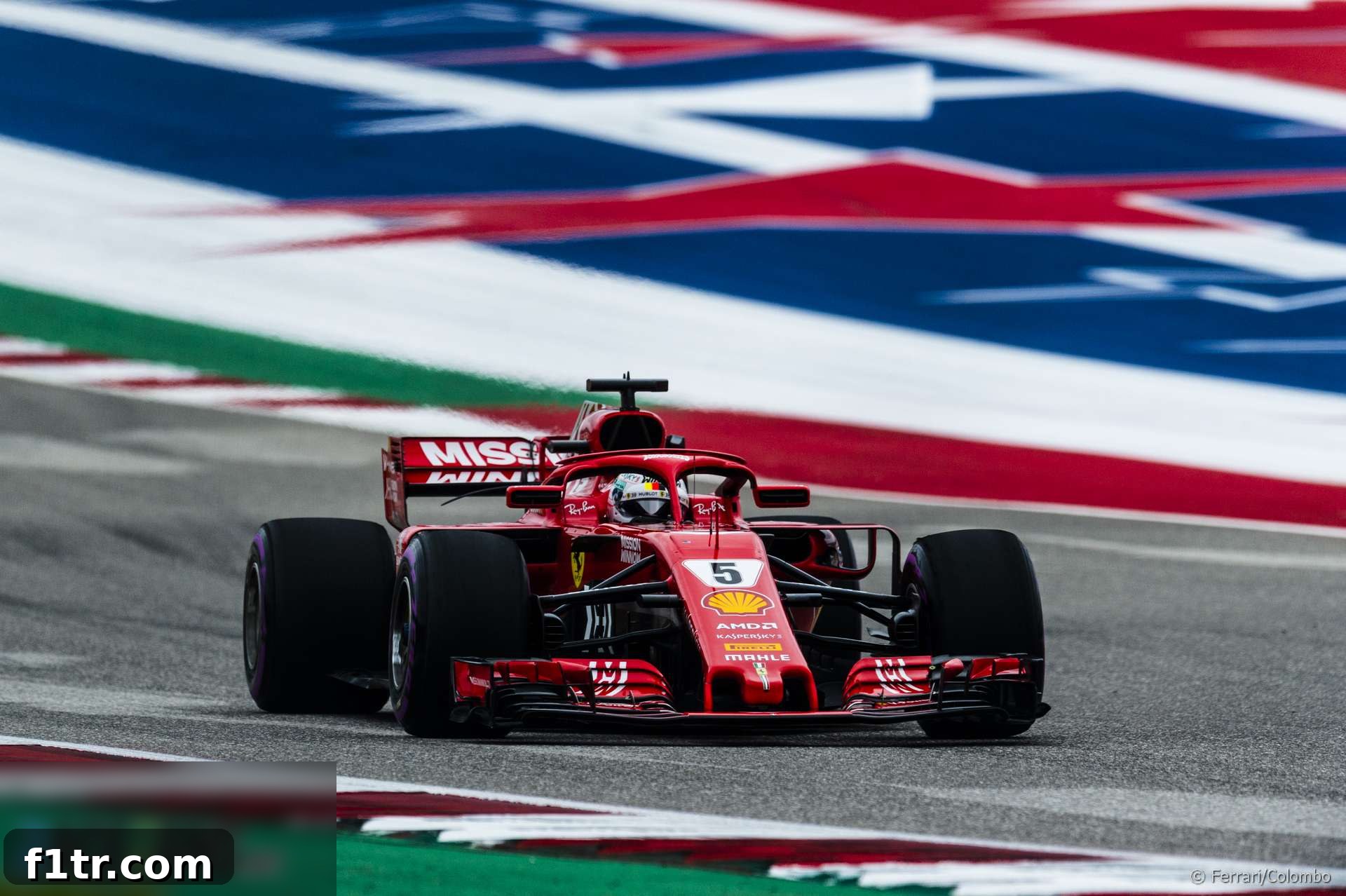
In a dramatic turnaround that sent ripples through the Formula 1 paddock, Sebastian Vettel revealed that Ferrari’s decision to discard a “major” aerodynamic upgrade was the pivotal factor behind their sudden surge in competitiveness at the United States Grand Prix. The German driver, known for his meticulous approach and candid assessments, expressed profound satisfaction with the car’s performance after qualifying, marking a significant departure from Ferrari’s recent struggles.
The highly anticipated qualifying session saw Vettel navigate the challenging Circuit of the Americas with remarkable skill, placing his Ferrari just six-hundredths of a second shy of Mercedes rival Lewis Hamilton, who ultimately clinched pole position for Sunday’s race. This razor-thin margin underscored Ferrari’s rediscovered pace and the immediate positive impact of their strategic decision to revert to an older specification.
“I would have liked it to be a bit closer and the other way around,” Vettel quipped after qualifying, hinting at his unwavering competitive spirit. Yet, his overall sentiment was one of clear relief and optimism. “I was pretty happy with the car, obviously a lot better than in recent weeks,” he added, acknowledging the period of uncertainty and underperformance that had plagued the Scuderia leading up to Austin.
The team’s weekend started under a cloud of doubt, with a wet Friday practice session seeing Ferrari struggling to match the pace of Red Bull, let alone Mercedes. The initial indications pointed towards another challenging Grand Prix. However, as the track dried out for Saturday’s crucial qualifying sessions, Ferrari’s true potential was unleashed. They immediately found themselves on par with Mercedes, showcasing a stark contrast to their Friday form and highlighting the dramatic improvement facilitated by the team’s bold decision.
“I think we have our issues,” Vettel conceded, speaking with characteristic honesty. “A day like yesterday, I think, showed that we are not entirely understanding what’s going on.” This admission is a common refrain in the high-stakes world of Formula 1, where the complexity of modern machinery often presents baffling challenges even to the brightest engineering minds. Teams constantly grapple with correlating simulator data and wind tunnel results with real-world track performance, a process that can sometimes lead to unforeseen complications with new components.
The pivotal moment, as Vettel explained, was the reversion to an earlier car specification. “We went back with major parts and it seems better that way, so there’s a lot of understanding we have to do,” he elaborated. This decision to remove rather than add an upgrade is almost counter-intuitive in Formula 1, where development is a relentless, forward-moving process. It speaks volumes about the extent of the performance deficit Ferrari might have been experiencing with the newer package, and the bravery required by the technical team to admit a misstep and backtrack. Often, such moves are made only when a team is confident that the problematic component is actively hindering performance, rather than simply failing to deliver the expected gains.
While Ferrari had introduced a new floor for the United States Grand Prix weekend, which presumably performed as intended, it appears other upgrades that the team had recently brought to races had not yielded the desired gains. In the relentless pursuit of tenths of a second, teams often bring a raft of minor and major updates to each race. When these updates fail to perform as expected, or worse, introduce unforeseen balance issues, it can set a team back significantly, creating a complex web of diagnostic challenges.
Vettel openly admitted that the dramatic turnaround in Ferrari’s performance had instilled a renewed sense of optimism within him for the race. “It’s been very close. Obviously, the last weeks you’d probably say no because Mercedes was a lot faster. But today has been giving some hope and hopefully, we can have that hope tomorrow as well.” This newfound belief is crucial for a driver, especially when challenging for a championship. The confidence in the car’s balance, predictability, and outright speed can unlock precious tenths of a second and allow a driver to push closer to the limits.
However, Sebastian Vettel’s challenge for victory in Austin had already been compromised before the lights even went out. A three-place grid penalty, incurred for failing to slow sufficiently for red flags during the first practice session, meant his exceptional qualifying performance would not translate directly to a front-row start. Such penalties are a constant reminder of the stringent safety regulations in Formula 1, designed to protect drivers and marshals during incidents on track.
“It’s quite annoying,” Vettel stated, reflecting the frustration of any driver facing a setback due to a technical infringement. “With the rules we have, maybe you are better off stamping on the brakes to comply with the rules rather than look around and see what is going on.” This comment highlights a common dilemma for drivers: the instinct to assess the situation and avoid further hazards versus the absolute requirement to adhere to strict speed limits under red flag conditions. The rules are in place to remove any ambiguity in potentially dangerous situations, demanding an immediate and measurable reduction in speed.
Despite his annoyance, Vettel displayed a pragmatic understanding of the regulations. “But same rules for everyone, it hit other people before me, now it hit me, it’s the name of the game.” This philosophical acceptance underscores the professionalism required in Formula 1, where every driver is subject to the same strict interpretations of the rulebook. While frustrating, it’s a part of the sport’s fabric.
The three-place drop would see Vettel start further down the grid than his pace deserved, placing him in the thick of the midfield battle rather than at the front. At a circuit like COTA, known for its flowing corners and challenging elevation changes, gaining positions from a compromised grid slot can be an uphill battle, especially against strong competitors from Mercedes and Red Bull.
Vettel’s Post-Qualifying Team Radio: A Glimpse into Raw Emotion
The raw, unvarnished emotion of Formula 1 qualifying was perfectly encapsulated in Sebastian Vettel’s post-session team radio exchange. Having pushed his Ferrari to the absolute limit, only to fall short by a mere six-hundredths of a second, his frustration was palpable.
| To Vettel: | P2 Sebastian, P2. |
| Vettel: | How much did we miss it? How much did we miss it by? |
| To Vettel: | 60 thousandths. |
| Vettel: | Oh for fuck’s sake. For fuck’s sake. |
| To Vettel: | Kimi P3 for a few thousandths. 32.2 for Kimi. And Bottas 33.6, Ricciardo 33.4. |
| Vettel: | Sorry guys I tried everything. Six hundredths. Yeah, I had a snap in eight, it wasn’t ideal. Scheisse. |
| To Vettel: | Go to the grid on the second position. |
| Vettel: | P1 and P0. |
| To Vettel: | Copy that. Thank you, grazie a tutti. |
| Vettel: | Grazie a noi. |
The immediate reaction of “Oh for f***’s sake” followed by “Scheisse” (German for ‘shit’) perfectly illustrates the fine margins and intense pressure drivers operate under. These are the moments that define championships and careers, where fractions of a second can separate triumph from agonising near-misses. His immediate self-analysis, pinpointing “a snap in eight” (referring to turn eight) as a contributing factor, further demonstrates the incredible mental processing power and self-awareness required at the pinnacle of motorsport.
The dialogue with his engineer also provides critical information, not just about his own performance but also that of his teammate Kimi Räikkönen and key rivals Valtteri Bottas and Daniel Ricciardo. This immediate feedback helps a driver contextualize their performance within the broader competitive landscape. Despite the clear disappointment, Vettel’s “Sorry guys I tried everything” shows his commitment and dedication to the team, even in the heat of the moment.
The United States Grand Prix thus promised to be a compelling strategic battle for Sebastian Vettel and Ferrari. While their qualifying pace had rekindled hopes of challenging Mercedes, the grid penalty added a layer of complexity. The ability to manage tyres, execute overtakes efficiently, and navigate through the pack would be paramount. The championship narrative of 2018, which saw Ferrari and Mercedes locked in a fierce contest, meant every point was crucial, and every decision, especially one as significant as reverting an upgrade, could dramatically alter the course of the season.
Ultimately, Ferrari’s bold gamble to undo recent development seemed to pay dividends in terms of raw pace at COTA. While the grid penalty was a frustrating obstacle, the team and Vettel had demonstrated resilience and a willingness to make tough decisions in pursuit of performance. The focus now shifted to race day, where Vettel aimed to convert his car’s newfound speed into a strong points finish, despite starting from a compromised position, further cementing the thrilling unpredictability of Formula 1.
2018 F1 season
- F1 feared “death knell” for Drive to Survive after Ferrari and Mercedes snub
- McLaren staff told us we were “totally crazy” to take Honda engines in 2018 – Tost
- ‘It doesn’t matter if we start last’: How Red Bull’s junior team aided Honda’s leap forward
- Honda’s jet division helped F1 engineers solve power unit problem
- McLaren Racing losses rise after Honda split
Browse all 2018 F1 season articles