Mercedes’ British Grand Prix Puzzle: Wolff and Hamilton on McLaren’s Unforeseen Dominance
The 2023 British Grand Prix delivered an exhilarating spectacle for Formula 1 fans, yet left Mercedes team principal Toto Wolff and star driver Lewis Hamilton with a perplexing question: how did McLaren manage to hold off their charge after the Safety Car period? Despite a seemingly advantageous tyre strategy, Mercedes found themselves unable to challenge the resurgent McLarens, a development that came as a significant surprise to the Brackley-based team.
Advert | Become a Supporter & go ad-free
As the Safety Car peeled into the pits, setting the stage for a dramatic restart at Silverstone, Mercedes drivers Hamilton and George Russell were strategically positioned on soft tyres. Ahead of them, McLaren’s Lando Norris and Oscar Piastri were running on the less grippy hard compound. Conventional wisdom, coupled with the inherent performance advantage of soft tyres over hards at a restart, painted a clear picture for Mercedes: a strong opportunity to vault past the papaya machines and potentially even threaten Max Verstappen’s lead. However, the reality that unfolded on track was starkly different, leaving Wolff and Hamilton to grapple with McLaren’s unexpected surge in pace.
The Post-Safety Car Conundrum: Mercedes’ Expectations vs. Reality
The Safety Car intervention during the British Grand Prix offered a pivotal moment, shifting the strategic landscape dramatically. For Mercedes, it presented what they believed to be a golden opportunity. Both Lewis Hamilton, running in third, and George Russell, in fifth, had pitted for fresh soft tyres under the Safety Car. Ahead of them, Lando Norris and Oscar Piastri, in second and fourth respectively, remained on their worn hard compounds. The expectation within the Mercedes garage was palpable: the superior grip and performance of the soft tyres would allow their drivers to swiftly dispatch the McLarens and consolidate podium positions, if not challenge for victory.
Toto Wolff openly admitted his firm conviction at that moment. “To be honest, when the Safety Car was deployed, I was pretty sure, if not convinced, that we would be eating up the McLarens and finish with a P2 and P3 or maybe even challenge up the road,” Wolff stated in response to media inquiries. This sentiment underscored the widely held belief that fresh soft tyres would provide a decisive edge on a track like Silverstone, known for its high-speed corners where grip is paramount. The strategic call seemed sound, designed to maximize their chances against cars on older, harder rubber.
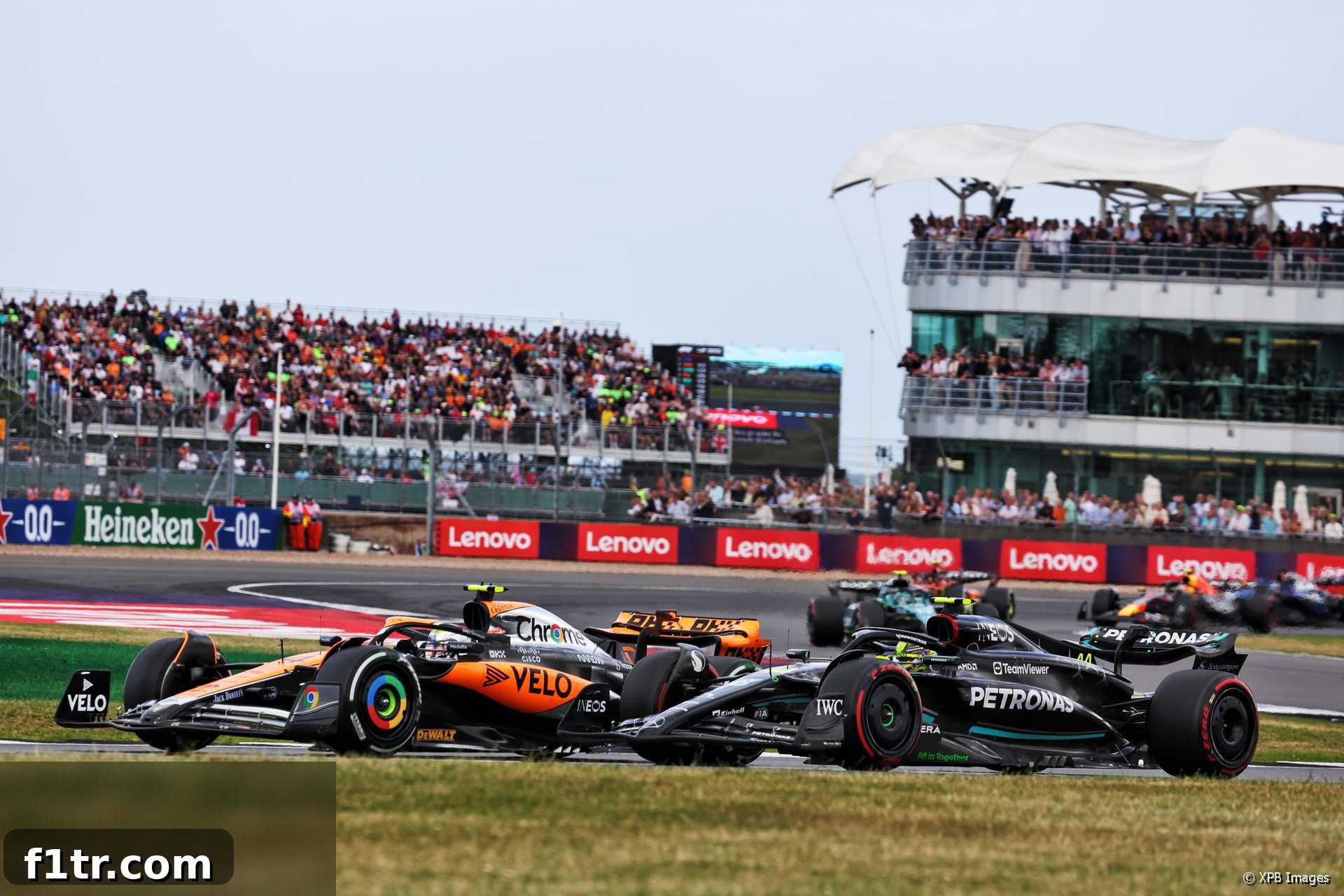
However, the immediate laps following the restart presented a stark contradiction to Mercedes’ high hopes. Despite Hamilton’s best efforts to challenge Norris and Russell pushing to close the gap on Piastri, the McLarens demonstrated an astonishing turn of pace. Not only did they maintain their positions, but they also showed formidable resistance, particularly through the circuit’s iconic high-speed sections. “So you see just how strong their car was,” Wolff conceded, acknowledging that McLaren’s performance exceeded all pre-restart forecasts. The anticipated tyre advantage for Mercedes simply failed to materialize in the way they had envisioned, turning a perceived opportunity into a frustrating deadlock.
McLaren’s Resurgence: The Upgraded MCL60 Defies Expectations
The true shock of the British Grand Prix wasn’t just Mercedes’ inability to overtake, but the sheer, unyielding strength of the McLarens. What made their performance even more remarkable was that they achieved it on harder and, in Piastri’s case, older tyres. This unprecedented display of pace, especially through the high-speed corners and on the straights, caught everyone off guard, including Toto Wolff, who admitted it “came as a surprise.”
The upgraded MCL60, featuring a significant package of aerodynamic revisions, proved to be a revelation. While McLaren had shown glimmers of improvement in previous races, their sustained performance at Silverstone, a circuit demanding peak aerodynamic efficiency and high-speed stability, indicated a profound step forward. Their car exhibited superior “efficiency and top speed through the high-speed corners and on the straights,” as Wolff observed. These are precisely the areas where a well-balanced and aerodynamically refined car truly shines, allowing drivers to carry immense speed through corners and maintain momentum onto the following straights. Such characteristics are crucial at a track like Silverstone, which features iconic sequences like Maggotts and Becketts.
This newfound prowess meant that even with the supposed tyre advantage, Mercedes found themselves unable to make a meaningful impression. “We could have had a go in the first few laps, but they both raced a very strong hand,” Wolff elaborated. “With their efficiency and top speed through the high-speed corners and on the straights, there was just no way in passing them.” This statement highlights the comprehensive nature of McLaren’s improvement; it wasn’t just raw pace, but an overall package that delivered consistent performance across critical sections of the track, effectively neutralizing Mercedes’ strategic gamble.
Advert | Become a RaceFans supporter andgo ad-free
Hamilton’s Intense Battle and Gracious Acknowledgment
From the cockpit, Lewis Hamilton experienced McLaren’s unexpected surge firsthand. Having been in similar situations throughout his illustrious career, Hamilton understood the dynamics of a Safety Car restart with varying tyre compounds. “Knowing what it’s like to be on the hards in the restart at the end with someone on the softs behind, I knew that it would be difficult,” he reflected, referring to Norris’s predicament. This initial understanding gave him confidence that he could exploit his soft tyres’ grip to make a decisive move.
However, what he encountered was a McLaren that was a vastly different beast from what he’d anticipated. “I hadn’t, obviously, had any running with the McLaren, so I had no idea how strong they were earlier on in the stint or in the race,” Hamilton explained. It was only in the direct wheel-to-wheel combat after the restart that the true extent of McLaren’s upgrades became apparent. “It wasn’t until that moment that I started to see some of their strengths and them get stronger and stronger over the laps.”
Hamilton’s description of the battle vividly painted the picture of McLaren’s superior package. “I threw it up the inside and I tried to get past but we have a little bit more drag down the straights. And then through the high-speed that’s where they were just murdering us,” he candidly admitted. The term “murdering us” underscored the significant performance deficit Mercedes faced in critical parts of the circuit, particularly where aerodynamic efficiency and raw speed are paramount. Despite the frustration, Hamilton also found enjoyment in the intense, albeit short-lived, struggle. “So, difficult. But it was fun for those first few laps. I wish we could have stayed in that close battle for many more laps but it wasn’t meant to be and I look forward to hopefully having some more of those battles in the future.”
Ultimately, Hamilton did not shy away from acknowledging McLaren’s achievement. He firmly believes “one hundred percent” that McLaren had a quicker car than Mercedes at Silverstone, and even in the week prior. This marks a significant turning point, not just for McLaren, but for the competitive landscape of Formula 1. “But this is the first time in a long time and they deserve to have the performance they have. As I said, we’ve got to do a better job. They’ve now done a better job than us,” Hamilton graciously concluded, setting a clear challenge for his own team.
The Evolving Landscape of F1: A Closer Competition for the Fans
Despite the immediate disappointment for Mercedes at the British Grand Prix, Lewis Hamilton expressed an encouraging and optimistic outlook on the broader state of Formula 1. He views the closer competition emerging across the grid as one of the most exciting developments in the sport in years, a direct testament to the effectiveness of the new regulations introduced over the past two seasons.
“This is one of the most exciting times I think we’ve seen in the sport where we’re finally started to see the regs pull people closer,” Hamilton enthused. The primary objective of the latest aerodynamic and budgetary regulations was to reduce the dominance of a few top teams and create a more level playing field, leading to tighter racing and unpredictable outcomes. The evidence from Silverstone and previous races suggests these regulations are beginning to bear fruit, fostering a dynamic and engaging championship.
Hamilton highlighted several examples of teams making significant strides, demonstrating that competitive performance is no longer exclusive to the traditional front-runners. “The other day you’ve seen that the Williams is up there with Albon, you’ve seen the McLarens, now the Astons,” he noted. Alexander Albon’s impressive qualifying and race performances for Williams, consistently battling for points, signify a genuine step up for a team that has long struggled at the back of the grid. Similarly, Aston Martin’s transformation from a midfield contender to a regular podium challenger earlier in the season, and now McLaren’s stunning resurgence, paint a picture of a sport where the competitive order is far more fluid and harder to predict.
This convergence of performance creates “a lot of teams getting very, very close, small gaps between qualifying, which is exactly what we need,” Hamilton added. Close qualifying sessions often translate into thrilling races, with multiple teams and drivers vying for positions and strategy playing an even more crucial role. For the fans, this means an increase in on-track action, unexpected heroes, and a championship narrative that remains compelling throughout the season, rather than being decided prematurely.
Looking ahead, Hamilton’s enthusiasm is palpable: “So I’m looking forward to seeing the rest of the year evolve.” The expectation is that this trend of increasing competitiveness will continue, challenging established hierarchies and potentially leading to more multi-team battles for wins and podiums. Mercedes themselves will be spurred on by McLaren’s performance, recognizing that the challenge for supremacy is now coming from more directions than ever before. This evolving landscape promises a thrilling future for Formula 1, keeping teams on their toes and fans on the edge of their seats.
Advert | Become a RaceFans supporter andgo ad-free
Conclusion: A New Era of F1 Competition
The 2023 British Grand Prix served as a stark, yet ultimately encouraging, reminder of Formula 1’s ever-evolving nature. For Mercedes, it was a moment of humbling reflection, forcing Toto Wolff and Lewis Hamilton to confront the unexpected pace of McLaren. Their inability to capitalize on a seemingly advantageous tyre strategy underscored the significant leap forward made by the Woking-based outfit, particularly with their upgraded MCL60 demonstrating formidable performance in high-speed sections.
Lewis Hamilton’s gracious acknowledgment of McLaren’s superior car at Silverstone, and his subsequent optimism about the sport’s direction, highlight a crucial shift. The new F1 regulations are demonstrably achieving their goal of fostering a more competitive and unpredictable environment. The rise of teams like Williams, Aston Martin, and now McLaren, creating “small gaps between qualifying,” points to a healthier, more engaging sport for both competitors and fans.
While Mercedes will undoubtedly redouble their efforts to understand and counter McLaren’s newfound speed, the broader narrative is one of excitement. This closer competition promises more thrilling battles, more strategic gambles, and a championship that remains open and captivating. The British Grand Prix wasn’t just a race; it was a potent symbol of Formula 1’s vibrant future, where any team, with the right upgrades and execution, can challenge at the sharp end of the grid.
2023 British Grand Prix – Related Articles
- Norris is “growing” closer to the champion who inspired him to race
- Second supplier part failure ‘a frustrating issue we must solve’ – Alpine
- Albon ‘surprised’ to be quicker than Alonso at end of British GP
- Bottas admits Alfa Romeo ‘were expecting to be better than this’ in 2023
- McLaren now “finding performance quicker” after emulating Red Bull’s design
Browse all 2023 British Grand Prix articles