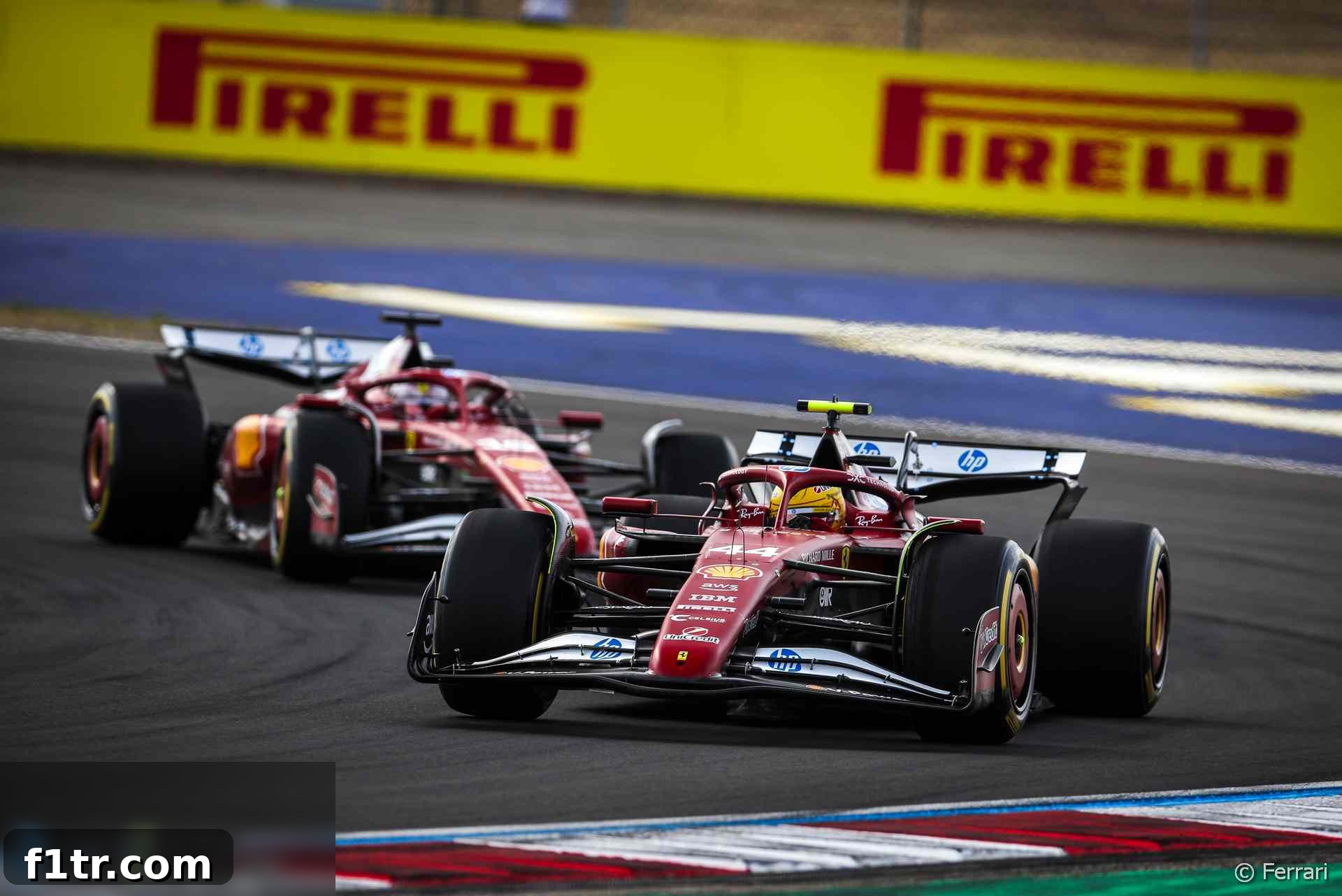
The fast-paced world of Formula 1 is often a crucible of high-stakes decisions, intense competition, and the occasional flashpoint of controversy. During the recent Chinese Grand Prix, an incident involving Lewis Hamilton and his Ferrari team ignited a significant debate, raising questions not only about driver compliance with team orders but also about the accuracy and fairness of live broadcast editing in the sport. At the heart of the matter lay a series of radio communications that, when presented selectively, painted a potentially misleading picture of Hamilton’s actions, suggesting a refusal to obey a direct instruction from his team to let teammate Charles Leclerc pass.
Advert | Become a Supporter & go ad-free
The initial impression, widely circulated among fans who followed the live Formula 1 broadcast, was that Lewis Hamilton had explicitly defied Ferrari’s request. However, a deeper dive into the complete radio transcripts reveals a more nuanced and complex scenario. It suggests that while there was indeed a delay in the execution of the team swap, the narrative of outright disobedience was largely a product of how Ferrari’s radio messages were edited and presented by Formula One Management (FOM) during the crucial moments of the race. This selective broadcasting created a false impression, leading many to believe Hamilton had acted against his team’s wishes without full context. Understanding the full exchange is critical not only to clarifying Hamilton’s role but also to highlighting the communication challenges within the team and the powerful impact of media representation in F1.
A meticulous comparison between the actual, full radio transmissions and the snippets aired on the world feed paints a clearer picture. Ferrari could, with good reason, argue that Formula One Management misrepresented the unfolding situation, potentially damaging the team’s image and Hamilton’s reputation. Spectators who relied solely on the broadcasted segments would have easily formed the wrong impression, leading to premature judgments about team cohesion and driver conduct. This incident underscores the profound responsibility of broadcasters in sports to present information accurately, especially in a sport as intensely scrutinized as Formula 1, where every word and action is magnified.
However, examining Ferrari’s radio messages in their entirety does more than just expose the broadcast’s selective nature; it also illuminates the root cause of the initial confusion and the subsequent public outcry. Moreover, the full transcript reveals that Charles Leclerc, through no fault of his own, had to endure a significantly longer wait to be let past his teammate than was evident from the fragmented world feed. This prolonged delay, obscured from the general public, adds another layer of complexity to an already intricate situation, indicating potential internal miscommunications or differing interpretations of strategy between the drivers and the pit wall.
The situation began to unfold dramatically on lap 18 of the Chinese Grand Prix. Both Ferrari drivers, Lewis Hamilton and Charles Leclerc, had just completed their first pit stops. Hamilton had pitted first, benefiting from what is known as the ‘undercut’ – a strategy where a driver pits early on fresh tires to gain lap time over competitors who are still on older tires. Despite this advantage, Hamilton found himself losing valuable time navigating traffic, particularly while attempting to overtake Liam Lawson. Meanwhile, Leclerc, who had pitted shortly after, managed to clear the Red Bull of Lawson with greater efficiency and speed. This allowed him to quickly close the gap, arriving directly on the tail of his teammate, who was now engaged in a struggle to pass Oliver Bearman, another backmarker.
By lap 17, both Ferraris had successfully cleared Bearman and were steadily closing in on Lance Stroll. The race pace and strategic implications were intensifying. It was on the subsequent lap, lap 18, that Lewis Hamilton conveyed a rather unusual and somewhat equivocal message to his race engineer, Riccardo Adami. Hamilton indicated that he was “considering whether to let Charles by,” explicitly stating his internal struggle and the potential need for a team swap. Crucially, this message, which would have provided vital context to Hamilton’s subsequent actions, was conspicuously omitted from the Formula 1 world feed. This omission played a pivotal role in shaping the public’s understanding of the events that followed, creating a vacuum of information that was later filled by an incomplete narrative.
Advert | Become a RaceFans supporter andgo ad-free
| Lap: 16/56 LEC: 1’55.134, HAM: 1’37.942 | |||||||||||||||||||||||||||||||||||||||||||||||||||
| Bozzi | Next car is Lewis. | Adami | Mind your tyres in the high-speed. | ||||||||||||||||||||||||||||||||||||||||||||||||
| Adami | Charles car behind, 0.4. Hamilton passes Bearman at turn 14 |
||||||||||||||||||||||||||||||||||||||||||||||||||
| Lap: 17/56 LEC: 1’37.426, HAM: 1’37.531 | |||||||||||||||||||||||||||||||||||||||||||||||||||
| Adami | Target… | ||||||||||||||||||||||||||||||||||||||||||||||||||
| Hamilton | I don’t seem to have plenty of rear. | ||||||||||||||||||||||||||||||||||||||||||||||||||
| Adami | Understood. Target 100 metre, lift and coast, total. B-bal 58. | ||||||||||||||||||||||||||||||||||||||||||||||||||
| Lap: 18/56 LEC: 1’38.380, HAM: 1’37.834 | |||||||||||||||||||||||||||||||||||||||||||||||||||
| Bozzi | SOC seven. | Hamilton | I think I’m going to let Charles go, because I’m struggling. | ||||||||||||||||||||||||||||||||||||||||||||||||
| Leclerc | Copy that. | Adami | Understood. Manage more the tyres in high speed. | ||||||||||||||||||||||||||||||||||||||||||||||||
Hamilton’s message, “I think I’m going to let Charles go, because I’m struggling,” while a clear indication of his willingness to yield, carried a tentative tone. It was a suggestion, a consideration, rather than an immediate commitment to a specific action or timeline. However, Ferrari’s response was swift and decisive. Interpreting Hamilton’s thought as an immediate opportunity, the team reacted almost instantly, issuing an order to both drivers to swap positions on that very lap. The instruction was clear: Hamilton was to back off at Turn 14 to allow Leclerc through. This immediate, firm command from the pit wall seemed to override Hamilton’s more measured approach, creating an immediate divergence in expectations and execution. Understandably, Hamilton was not prepared to comply with such an abrupt instruction right away. He drove past Turn 14 without easing off, signaling his intention to manage the swap on his own terms and possibly at a more opportune moment, rather than an instant, forced move. This subtle but significant friction between driver intention and team directive set the stage for the unfolding drama.
| Bozzi | Exit turn 10 And we will swap the cars in turn 14. |
Adami | We’re going to swap the cars into turn 14, one-four. |
| Bozzi | And Lewis will let you by into turn 14. |
As the race progressed into the next lap, Ferrari reiterated their instruction, repeating the same process and, perhaps predictably, eliciting a similar outcome. The team again called for a position swap at Turn 14, but Hamilton, steadfast in his approach, communicated his ongoing condition for the maneuver: he was waiting for Leclerc to close the gap further before executing the swap. This repeated insistence on his part highlighted a clear difference in strategy or perception between the driver and the pit wall. Hamilton likely believed he needed to manage the swap in a way that minimized lost time for both cars, or perhaps he was still trying to maintain his own rhythm until Leclerc was absolutely on his gearbox. By the end of lap 19, Charles Leclerc had patiently been waiting for two full laps to make the pass. Crucially, during this entire period, those watching the world television feed received no radio messages that would have indicated this ongoing situation, leaving them entirely unaware of the delayed swap and the communications taking place within the Ferrari camp. This lack of transparency from the broadcast further fueled the eventual misinterpretation of events.
Advert | Become a RaceFans supporter andgo ad-free
| Lap: 19/56 LEC: 1’36.907, HAM: 1’37.075 | |||||||||||||||||||||||||||||||||||||||||||||||||||
| Bozzi | Exit turn 13 We will swap the cars into turn 14. |
Adami | Diff mid three, suggestion. And George ahead lap time 38.8 | ||||||||||||||||||||||||||||||||||||||||||||||||
| Adami | We are swapping cars, turn 14. | ||||||||||||||||||||||||||||||||||||||||||||||||||
| Hamilton | I will when he’s closer. | ||||||||||||||||||||||||||||||||||||||||||||||||||
It wasn’t until lap 20 that Formula One Management finally broadcast the first radio message indicating any discussion of a potential position swap within Ferrari. This particular message, however, was from the *previous* lap, lap 19, during which Riccardo Adami had explicitly told Hamilton, “We are swapping cars turn 14.” Hamilton’s response, “When he’s closer, yeah,” was also included. While this snippet finally gave viewers a glimpse into the ongoing team order situation, it was presented devoid of crucial preceding context. Anyone watching the televised feed, without access to the full, unedited radio communications, would have been completely unaware that Hamilton himself had initially suggested the position swap two laps earlier. Furthermore, they would have remained oblivious to the fact that Ferrari had informed Leclerc shortly after Hamilton’s initial suggestion that the swap was imminent. This significant delay in broadcasting relevant information, coupled with the selective nature of the chosen clips, skillfully manipulated the public narrative, painting Hamilton in a potentially negative light as someone reluctant to follow team instructions, rather than a driver negotiating the optimal moment for a strategic maneuver he himself initiated.
The pattern continued into lap 20. For the third consecutive lap, Ferrari issued an instruction for a position swap at Turn 14, and for the third consecutive time, the swap did not occur as commanded. This persistent non-compliance from Hamilton’s side, whether due to strategic disagreement or a tactical delay, was visibly frustrating the team. At this point, the tension on the radio began to build. Hamilton, still firm in his approach, communicated his ongoing condition for the maneuver, implying he retained control over the exact timing of the swap. This exchange, coming after multiple delayed attempts, brought the internal conflict to a head, culminating in a direct assertion of agency from Hamilton that further complicated Ferrari’s management of the situation.
| Lap: 20/56 LEC: 1’37.299, HAM: 1’37.469 | |||||||||||||||||||||||||||||||||||||||||||||||||||
| Leclerc | (Unclear) | Hamilton | Pit straight If he can’t get the cars ahead, he can let us… out his way. Right now I’m closing up a little bit. |
||||||||||||||||||||||||||||||||||||||||||||||||
| Bozzi | This is what he’s been told. | Adami | Okay understood. | ||||||||||||||||||||||||||||||||||||||||||||||||
| Adami | Exit turn 12 Do we want to swap this now? |
||||||||||||||||||||||||||||||||||||||||||||||||||
| Hamilton | I’ll tell you when we’re going to swap. | ||||||||||||||||||||||||||||||||||||||||||||||||||
The definitive moment arrived shortly after this exchange, with Hamilton’s assertive “I’ll tell you when we’re going to swap.” This seemingly defiant statement, broadcast around the world, immediately provoked a visibly disappointed reaction from Charles Leclerc. Leclerc’s frustration was palpable, broadcast almost simultaneously with Hamilton finally allowing him through, not at the designated Turn 14 as instructed repeatedly, but instead at Turn 1. This unexpected location for the swap added another layer of intrigue and demonstrated Hamilton’s resolve to execute the maneuver on his own terms, rather than simply obeying the repeated, unfulfilled commands from the pit wall. The combination of Hamilton’s delayed action, his definitive radio message, and Leclerc’s subsequent audible disappointment created a dramatic narrative that, without the full context of prior communications, strongly implied insubordination. The incident quickly became a talking point, fueling discussions about driver autonomy versus team hierarchy and the nuanced complexities of F1 strategy.
Advert | Become a RaceFans supporter andgo ad-free
| Lap: 21/56 LEC: 1’37.160, HAM: 1’39.319 | |||||||||||||||||||||||||||||||||||||||||||||||||||
| Leclerc | This is a shame. The pace is there. Hamilton lets Leclerc past in turn one |
Adami | B-bal 59, suggestion. | ||||||||||||||||||||||||||||||||||||||||||||||||
| Bozzi | Well done, sorry about that. Keep pushing. SOC 6 when you want. | ||||||||||||||||||||||||||||||||||||||||||||||||||
| Bozzi | So you are the fastest car out there. Let’s go, Charles. | ||||||||||||||||||||||||||||||||||||||||||||||||||
It becomes abundantly clear, upon reviewing the complete radio communications, that the impression Formula One Management created regarding Hamilton’s messages was, at best, misleading, and at worst, deliberately deceptive. This selective presentation of audio clips crafted a narrative that served to sensationalize the incident, potentially at the expense of accuracy and fairness. What makes this situation particularly concerning is that it occurred mere days after Hamilton himself had publicly expressed his frustration over the negative public reaction to clips of his radio exchanges played during the Australian Grand Prix. Those earlier edits had arguably given the impression that his relationship with his race engineer, Riccardo Adami, was strained or not functioning optimally. The repeated pattern of selective broadcasting raises serious questions about FOM’s editorial policies and their impact on driver reputations and team dynamics. In a sport where narratives can profoundly influence public perception and fan sentiment, the responsibility to present information impartially and comprehensively is paramount. The Chinese Grand Prix incident serves as a potent reminder of how easily context can be lost and how carefully curated snippets can distort reality, leading to widespread misinterpretations of critical race events.
However, while the broadcast’s portrayal was indeed misleading, the full exchange also sheds light on a fundamental disconnect: Hamilton’s original, somewhat equivocal message was notably at odds with Ferrari’s immediate and forceful reaction. Hamilton, having initiated the idea of a swap, likely expected to retain some agency, dictating the optimal timing and conditions for the position change on his own terms. He was thinking strategically about tire management, track position, and minimizing overall time loss for the team. Ferrari, on the other hand, interpreted his initial suggestion as a green light for an immediate swap, eager to execute the position change without delay, perhaps driven by real-time strategic data or a desire to quickly optimize their car lineup for the segment. This mismatch in expectations and communication styles ultimately led to the prolonged back-and-forth, creating an avoidable tension that played out publicly. It underscores the critical importance of clear, unambiguous communication between drivers and the pit wall, especially when dealing with sensitive team order situations that can impact both race outcomes and team harmony.
This incident, while magnified by the broadcast, is not an isolated one for Ferrari, nor is it a new problem that has mysteriously emerged since Lewis Hamilton’s impending arrival was announced. The Scuderia has a documented history of struggling with nuanced team order management and internal communication issues. A pertinent example can be drawn from the Las Vegas Grand Prix last year, where Charles Leclerc himself was visibly aggravated by how the team managed his race strategy and his interactions with his then-teammate. Such past occurrences suggest a systemic challenge within the team’s operational framework concerning driver coordination and strategic directives. Ferrari needs to critically evaluate and significantly improve how it handles this type of communication, ensuring that driver input is effectively integrated into real-time decision-making, and that directives are understood and agreed upon by all parties. Clearer protocols and a more adaptive communication strategy would undoubtedly mitigate such public misunderstandings and foster a more cohesive and efficient team environment, crucial for success at the pinnacle of motorsport.
Advert | Become a RaceFans supporter andgo ad-free
Don’t Miss a Moment from RaceFans
Get a daily email with all our newest articles and exclusive content. No marketing, no ads, just pure F1 news directly to your inbox. Sign up now:
Explore More from the 2025 Chinese Grand Prix
- Norris Names China and Canada as Biggest Missed Opportunities This Year
- Red Bull Reassure Verstappen Over ‘When We’ll Have a Winning Car Again’ in Meeting
- Mercedes Explain Impact of Antonelli’s Floor Damage on His Chinese GP Performance
- “I Gave a Lot of Lap Time Away in That First Stint”: Verstappen’s Full Chinese GP Radio
- Stats: Chinese Grand Prix Saw Most Disqualifications in an F1 Race for 21 Years
Browse All 2025 Chinese Grand Prix Articles