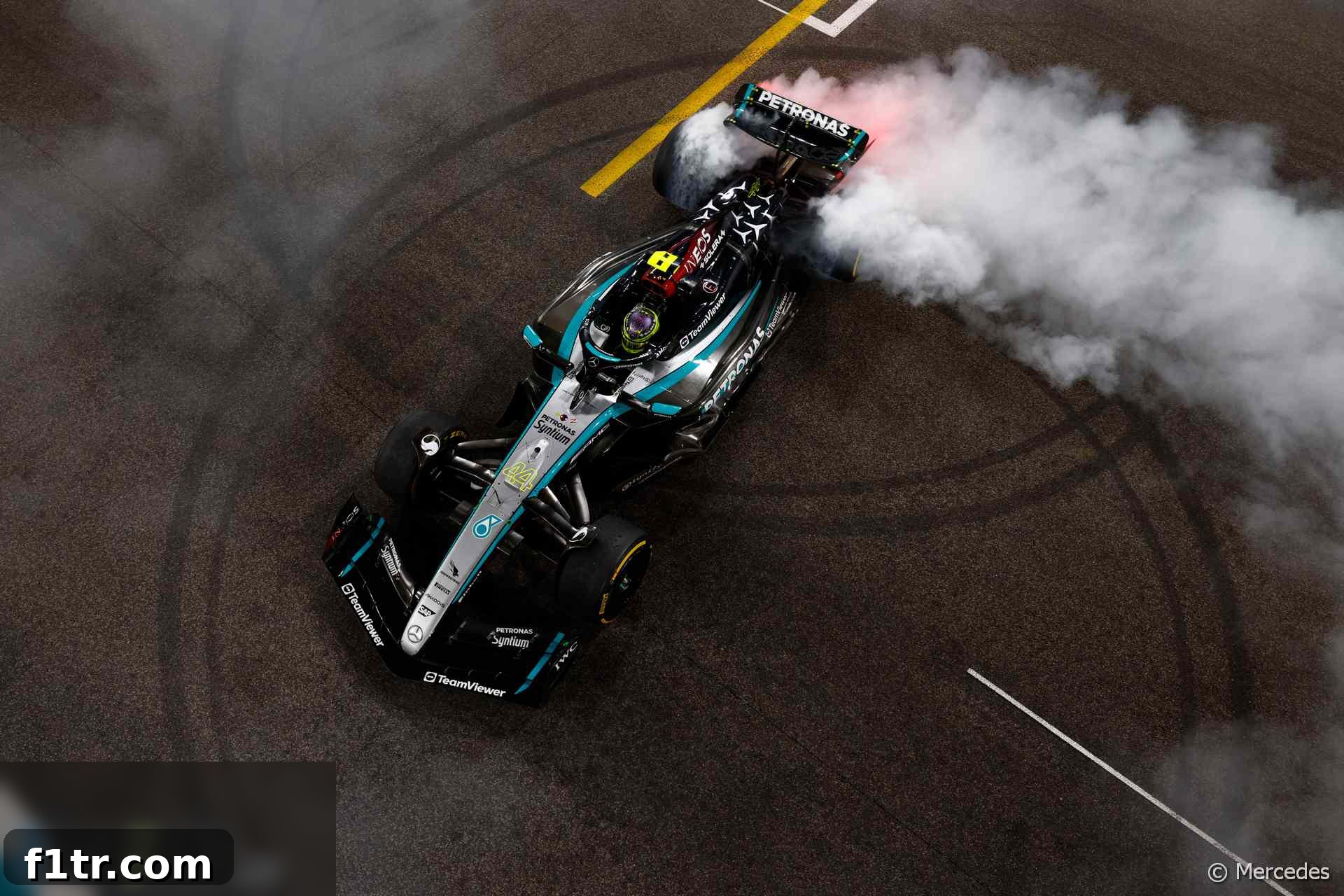
The Unseen Obstacle: How a Bollard Derailed Lewis Hamilton’s Farewell Mercedes Victory Hopes
The final chapter of Lewis Hamilton’s illustrious 12-year journey with Mercedes was meant to be a grand celebration, a poignant farewell marked by a strong performance. Instead, his qualifying session for his last race with the Silver Arrows was marred by a bizarre incident involving a stray bollard, an event his team principal, Toto Wolff, firmly believes robbed him of a genuine shot at victory.
The incident unfolded during the crucial first round of qualifying (Q1), leaving Hamilton shockingly eliminated and facing a daunting 16th place start on the grid. Wolff expressed significant frustration over the team’s strategy, which saw both Mercedes drivers sent out late in Q1. While this approach was designed to capitalize on improving track conditions, it inherently exposed them to the unpredictable chaos of heavy traffic, a gamble that ultimately backfired spectacularly for Hamilton.
Qualifying Chaos: The Bollard Blunder and Its Costly Impact
Despite the late start, Hamilton appeared to be on course to significantly improve his lap time on his final attempt. However, as he navigated Turn 14, he encountered Kevin Magnussen. The Haas driver, in an effort to get out of Hamilton’s way, took to the run-off area at the inside of the corner. In doing so, Magnussen inadvertently dislodged a trackside bollard, sending it flying directly into the path of Hamilton’s rapidly approaching Mercedes.
Hamilton’s W15 made unavoidable contact, collecting the errant bollard squarely on the front of its floor. While seemingly minor at first glance, this collision had significant repercussions. It critically disrupted the car’s delicate aerodynamics, a cornerstone of Formula 1 performance, and caused subtle yet impactful damage. Mercedes mechanics quickly identified the issue, replacing the right-hand side front wheel deflector on his car before the Grand Prix, a clear indication of the aerodynamic integrity compromise.
The consequences were immediate and severe. Hamilton failed to advance to Q2 by an agonizingly small margin – less than a tenth of a second separated him from progression. In stark contrast, his teammate George Russell successfully navigated Q1 and went on to secure a respectable sixth place on the starting grid. This meant Hamilton, a seven-time world champion renowned for his qualifying prowess, would begin his final race for Mercedes a staggering 10 places behind his younger teammate, a testament to the unforeseen impact of the bollard incident.
Toto Wolff’s Conviction: A Victory Foreshadowed, Then Lost
Despite the significant grid disadvantage, Hamilton’s performance on race day was nothing short of spectacular. Demonstrating the grit and strategic acumen that have defined his career, he systematically carved his way through the field. Remarkably, despite starting so far apart, Hamilton not only caught Russell but passed him on the very final lap to secure an impressive fourth-place finish, trailing race winner Lando Norris by 36 seconds.
For Toto Wolff, Hamilton’s incredible recovery drive only underscored the magnitude of what was lost in qualifying. He firmly believes that had Hamilton avoided the unfortunate bollard encounter and started further up the grid, the outcome of the race could have been dramatically different. “Without the bollard getting in Lewis’s way yesterday in qualifying, I think he could have fought for victory,” Wolff stated emphatically. “He was quick throughout today and made the alternative strategy work well.”
Wolff’s sentiment reflects a deep understanding of Hamilton’s innate speed and race craft. He envisioned Hamilton battling directly with Norris and the formidable Ferrari drivers who ultimately occupied the podium positions. The team principal’s praise for Hamilton was unequivocal: “He drove like a world champion. That is befitting of our time together and a real statement.” This strong declaration highlights the belief within the Mercedes camp that, but for an isolated, freak incident, Hamilton was primed for a fairytale ending to his Mercedes tenure.
A Masterclass in Recovery: Hamilton’s Strategic Brilliance
The frustration of Saturday’s qualifying was palpable, but the Mercedes team, under the guidance of trackside engineering director Andrew Shovlin, quickly shifted focus to damage limitation and strategic execution. Shovlin lauded the team’s resilience and Hamilton’s exceptional drive. “We can hold our heads high in how we responded,” he noted, emphasizing the collective effort to turn adversity into opportunity.
Hamilton’s race strategy was a masterclass in aggressive yet controlled driving. Opting for an offset hard-medium tire strategy, he leveraged the durability of the hard compound in his initial stint, allowing him to extend his run and gain track position as others pitted. Shovlin detailed his methodical approach: “Lewis completed a drive worthy of our incredible 12-year journey together. He used the offset hard-medium strategy to great effect, calmly and methodically working his way through the field, before deploying the medium compound in the final stint.”
His progress through the field was marked by a series of decisive overtakes, showcasing his unparalleled ability to manage tires while maintaining blistering pace. He systematically worked his way past multiple cars, leaving competitors in his wake. A particularly significant moment came as he dropped the Red Bull of Max Verstappen, a testament to his car’s performance and his own strategic execution. The climax of his charge came on the final lap, executing a brilliant move to snatch P4, a truly remarkable achievement considering his starting position.
A Bittersweet Farewell: A Legacy Forged in Battle
While the podium finish that Toto Wolff believed was possible eluded them, the manner of Hamilton’s recovery provided a powerful testament to his enduring talent and fighting spirit. The fourth-place finish, earned against considerable odds, resonated deeply within the team. Shovlin acknowledged the collective desire for a final podium, but reflected on the deeper meaning of the performance: “Whilst we would have all loved to have been on the podium one final time, a battling drive against the odds seems an apt sign-off for our time together.”
This “battling drive” perfectly encapsulated the spirit of Hamilton’s extraordinary 12 years with Mercedes. It was a partnership defined by relentless pursuit of excellence, overcoming challenges, and rewriting the record books. From his maiden victory with the team in 2013 to his multiple world championships, Hamilton and Mercedes forged an unbreakable bond, achieving unprecedented success together.
The Abu Dhabi Grand Prix, therefore, became a bittersweet finale. It wasn’t the triumphant, champagne-soaked send-off many had hoped for, but it was arguably something more profound: a raw, authentic display of a champion’s resilience. The incident with the bollard, while unfortunate, provided the canvas for Hamilton to paint one last masterpiece of determination, reminding everyone of the unwavering passion and skill that has made him a legend of the sport.
As Lewis Hamilton now prepares for a new chapter in his illustrious career, his final race for Mercedes will be remembered not just for the unforeseen obstacle that denied him a potential victory, but for the champion’s spirit that shone brightest in adversity, solidifying his legacy as one of Formula 1’s greatest competitors.
Further Reading:
- Analyzing Driver Performance: Tsunoda vs. Lawson
- McLaren’s Close Call: A Championship Battle Dissected
- F1 2025 Season Preview: Team Changes and Driver Lineups
- The Definitive Ranking: 2024 F1 Cars Performance Analysis
- McLaren’s Unique Championship: A Statistical Anomaly?
- Explore More from the 2024 Abu Dhabi Grand Prix