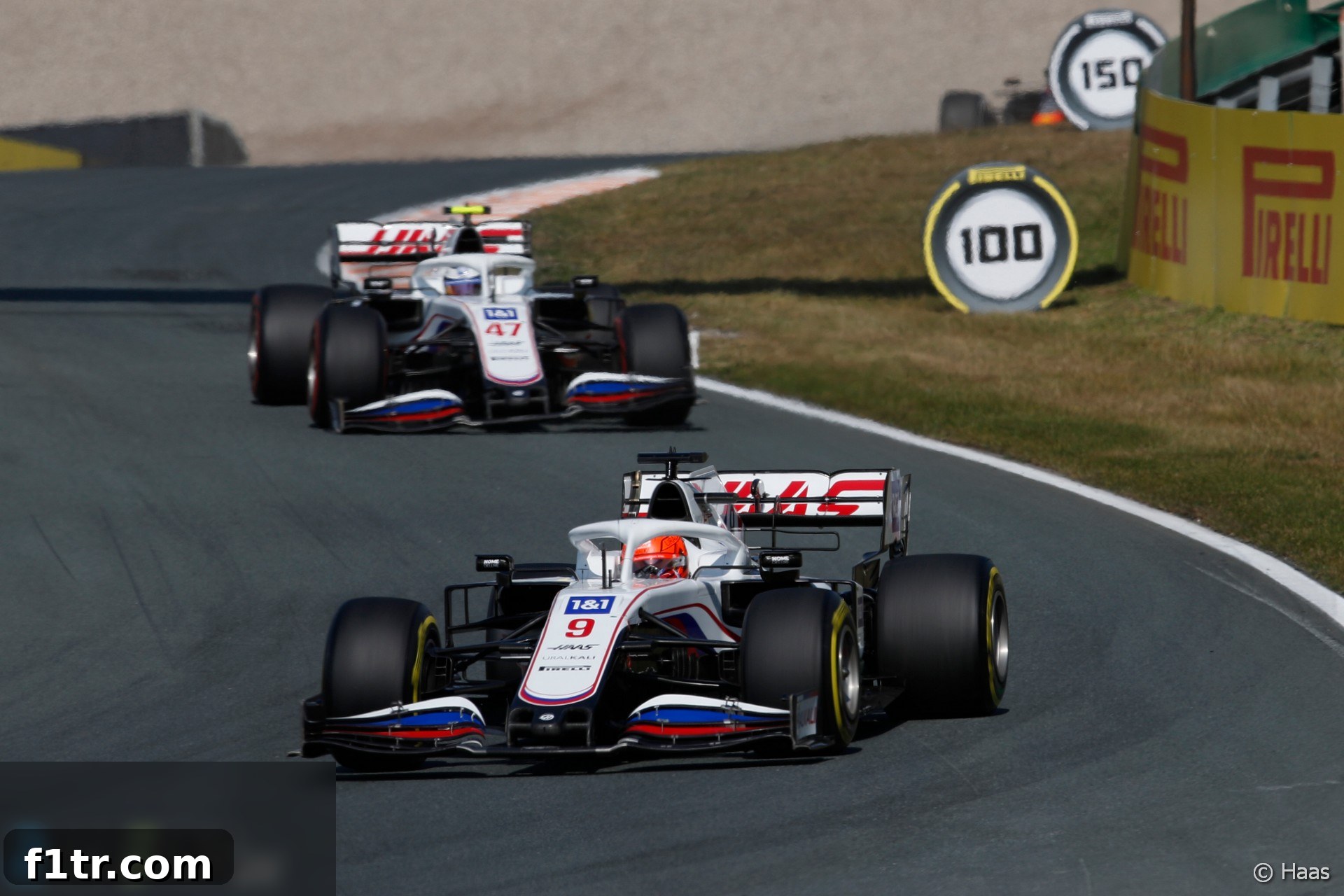
In the high-stakes world of Formula 1, the dynamic between teammates is often a delicate balance of competition and cooperation. For the Haas F1 team, the relationship between its two rookie drivers, Nikita Mazepin and Mick Schumacher, has been a consistent point of contention, characterized by a series of on-track incidents. Following the latest controversial clash at the Dutch Grand Prix, Nikita Mazepin has firmly stated that there will be no alterations to the “rules of engagement” governing their racing conduct, a declaration that sheds light on the internal workings and future challenges for the American outfit.
The Recurring Haas Driver Conflict: Dutch Grand Prix Incident Revisited
The Zandvoort circuit, renowned for its challenging corners and undulating layout, became the backdrop for the most recent flare-up of tension between the Haas teammates. Early in the Dutch Grand Prix, as the race was just beginning to unfold, Mick Schumacher made an assertive move to overtake Nikita Mazepin at the start of the second lap. As Schumacher drew alongside his teammate, Mazepin’s car notably moved towards him, compelling Schumacher to take a tighter line towards the inside of the track. This maneuver culminated in Schumacher striking the pit lane entry bollard, a minor but potentially damaging incident that epitomized the ongoing friction.
A Flashpoint at Zandvoort: Understanding the Dynamics
The incident at Zandvoort wasn’t just another racing skirmish; it was a clear demonstration of the intense competition, perhaps even antagonism, between the two young drivers. Schumacher, eager to make progress and assert his position, found his path aggressively defended by Mazepin. Forcing a competitor towards the pit lane entry bollard raises questions about spatial awareness, racing etiquette, and the fine line between robust defense and potentially dangerous driving. While Schumacher’s car appeared to sustain minimal damage, such encounters can significantly impact a driver’s confidence, strategy, and overall race performance. The perception of whether such a move is a legitimate defense or an overly aggressive block often depends on individual interpretation and, crucially, the viewpoint of race officials.
A Pattern Emerges: Echoes from Baku
The Dutch Grand Prix clash was far from an isolated event. This incident joins a growing list of close encounters between Mazepin and Schumacher, signaling a deeper, perhaps systemic, issue within the Haas garage. Notably, a similar move by Mazepin occurred on the very last lap of the Azerbaijan Grand Prix earlier in the season. In Baku, Mazepin again moved to aggressively defend his position against Schumacher, drawing strong criticism and raising eyebrows across the F1 paddock. These repeated instances suggest a persistent pattern of behavior from Mazepin, characterized by an unyielding approach to on-track battles, even when facing his own teammate. The cumulative effect of these incidents not only creates tension between the drivers but also presents a considerable management challenge for the team principal, Guenther Steiner, who must balance fostering healthy competition with maintaining team cohesion and preventing costly mistakes.
Haas F1’s Internal Review: Mazepin Cleared
In the aftermath of the Dutch Grand Prix incident, the Haas F1 team conducted an internal review to assess the actions of its drivers. Following these discussions, Nikita Mazepin emerged with the clear message that the team found no wrongdoing on his part. Speaking at the FIA press conference in Monza, Mazepin expressed satisfaction, stating, “It’s good to know that I’m not in the bad books, so that’s positive.” This internal clearance signifies a significant stance by the team, effectively legitimizing Mazepin’s aggressive driving style in the eyes of his employer, at least in this particular instance.
Behind Closed Doors: Team Discussions and Driver Feedback
Mazepin was careful to emphasize the confidential nature of the team’s internal deliberations. “But I want to respect the privacy of those discussions. The doors were closed and I don’t think it will be comfortable for all parties if it was an open discussion,” he noted. This statement highlights the sensitive nature of team dynamics, particularly when tensions run high between drivers. While the public often craves transparency, teams typically conduct such discussions privately to manage internal relationships and avoid further fueling media speculation or driver animosity. The outcome, however, is clear: the team has opted not to intervene with specific directives or “rules of engagement” that would alter how the two drivers are permitted to race each other.
Navigating FIA Sporting Regulations and Driver Conduct
Mazepin further clarified that the team’s decision not to change their guidance stems from the belief that his actions did not contravene any official regulations. “They have not because we’ve deemed that I have not broken any sort of rules or violation within the FIA sporting and racing regulations. Therefore we’re going to work as a team to try and fix that,” he explained. This position underscores the often-debated difference between what might be considered overly aggressive or unsporting behavior by some, and what officially constitutes a breach of the FIA’s strict sporting and racing regulations.
The Fine Line: Aggression vs. Illegality in F1
Formula 1 regulations are designed to ensure fair play and safety, stipulating clear rules regarding blocking, weaving, and dangerous driving. However, the interpretation of these rules can often be subjective, particularly in the heat of a racing battle. A driver moving to defend their position is generally permissible, but the manner and extent of that defense are crucial. The fact that the stewards did not investigate the incident further lends credence to Haas’s internal assessment that Mazepin’s move, while aggressive, may not have met the threshold for an official penalty or rule violation. Race Director Michael Masi, when questioned about the clash on Sunday evening, admitted he hadn’t seen the incident at the time and would need to review it with “a fresh set of eyes,” suggesting that it wasn’t immediately flagged as a potential infringement. This lack of immediate action by the stewards or Masi further complicated any external pressure on Haas to alter their approach.
Mazepin himself offered a pointed counter-argument regarding the incident, subtly shifting responsibility. “But perhaps sometimes you need to lift when you see that there is a bollard in front of you instead of damaging your car.” This comment can be interpreted in several ways: as a tactical defense of his racing line, a subtle jab at Schumacher’s perceived lack of caution, or a broader philosophical stance on driver responsibility. In racing, “lifting” (reducing throttle) is often a necessary evasive action to avoid a collision or protect the car. Mazepin’s remark implies that Schumacher should have exercised greater judgment and prioritized avoiding contact with the bollard, even if it meant yielding the position. This perspective highlights the mental chess match and differing philosophies that often play out between competitive drivers on track.
External Commentary and Internal Perceptions
The on-track rivalry between Mazepin and Schumacher hasn’t gone unnoticed by external observers, particularly those with a deep understanding of Formula 1’s intricate dynamics.
Ralf Schumacher’s Strong Criticism and Family Ties
One of the most vocal critics of Mazepin’s driving has been Mick Schumacher’s uncle, Ralf Schumacher, a former Formula 1 driver with significant experience in top-tier motorsport. Ralf strongly condemned Mazepin’s actions after the Dutch Grand Prix, articulating concerns about the nature of his driving and its implications for safety and sportsmanship. His criticism carries weight, not only due to his professional background but also because of his familial connection to Mick, naturally making him a protective advocate for his nephew.
Mazepin’s Defiant Response: “Protecting Family”
When confronted with Ralf Schumacher’s comments, Nikita Mazepin’s response was both dismissive and provocative. He alluded to a common English phrase regarding opinions, then directly addressed the family dynamic. “It just seems like he’s obviously protecting his family. And what can I say? If his family needs protection in Formula 1, then I’m more than happy to listen to those things.” This retort, delivered with a mix of sarcasm and defiance, suggests Mazepin views Ralf’s critique as biased and potentially attempts to undermine Mick Schumacher’s perceived vulnerability. It reinforces Mazepin’s reputation as a driver who is not easily intimidated and is willing to engage in verbal sparring off-track as well as aggressive battles on it. This exchange further underscores the personal dimension that has developed in the Haas driver dynamic, moving beyond mere sporting competition into a more emotionally charged rivalry.
The Road Ahead for Haas: Managing Driver Relations in Formula 1
The ongoing saga between Nikita Mazepin and Mick Schumacher presents a multifaceted challenge for the Haas F1 team. As a team at the back of the grid, their focus should ideally be on development, data gathering, and building a foundation for future competitiveness. However, continuous intra-team clashes divert attention and resources, potentially hindering progress. Managing two ambitious rookie drivers, both eager to prove their worth, requires a delicate balance. While some level of internal competition is healthy and drives performance, repeated incidents risk damaging team morale, equipment, and public perception. The team’s decision to not alter its “rules of engagement” could be seen as an endorsement of hard, uncompromising racing, which might be a strategy to push both drivers to their limits. Conversely, it could also be viewed as a missed opportunity to instill clearer boundaries and foster a more collaborative environment.
For Nikita Mazepin, the team’s clearance reinforces his belief in his racing style. For Mick Schumacher, a driver known for his measured approach, these incidents test his resolve and potentially force him to adapt a more aggressive stance to defend himself. The impact on their long-term careers and relationship within Formula 1 remains to be seen, but the tension at Haas is undeniably a significant storyline in the current F1 season. The team must navigate these internal dynamics carefully, ensuring that the pursuit of individual glory does not overshadow the collective goal of improving the team’s performance and reputation in the highly competitive world of Formula 1.
Browse all 2021 Italian Grand Prix articles
Other relevant articles:
- Who was to blame for Hamilton and Verstappen’s collision at Monza?
- Hamilton-Verstappen crash was ‘a racing incident, no danger’ – Alonso
- Hamilton pleased stewards “set a precedent”, Verstappen “doesn’t fully agree”
- Ricciardo didn’t need title rivals’ latest clash for stunning Monza win
- Why Verstappen’s grid penalty differed from Hamilton’s Silverstone sanction
Find out more about F1 personalities: Ralf Schumacher