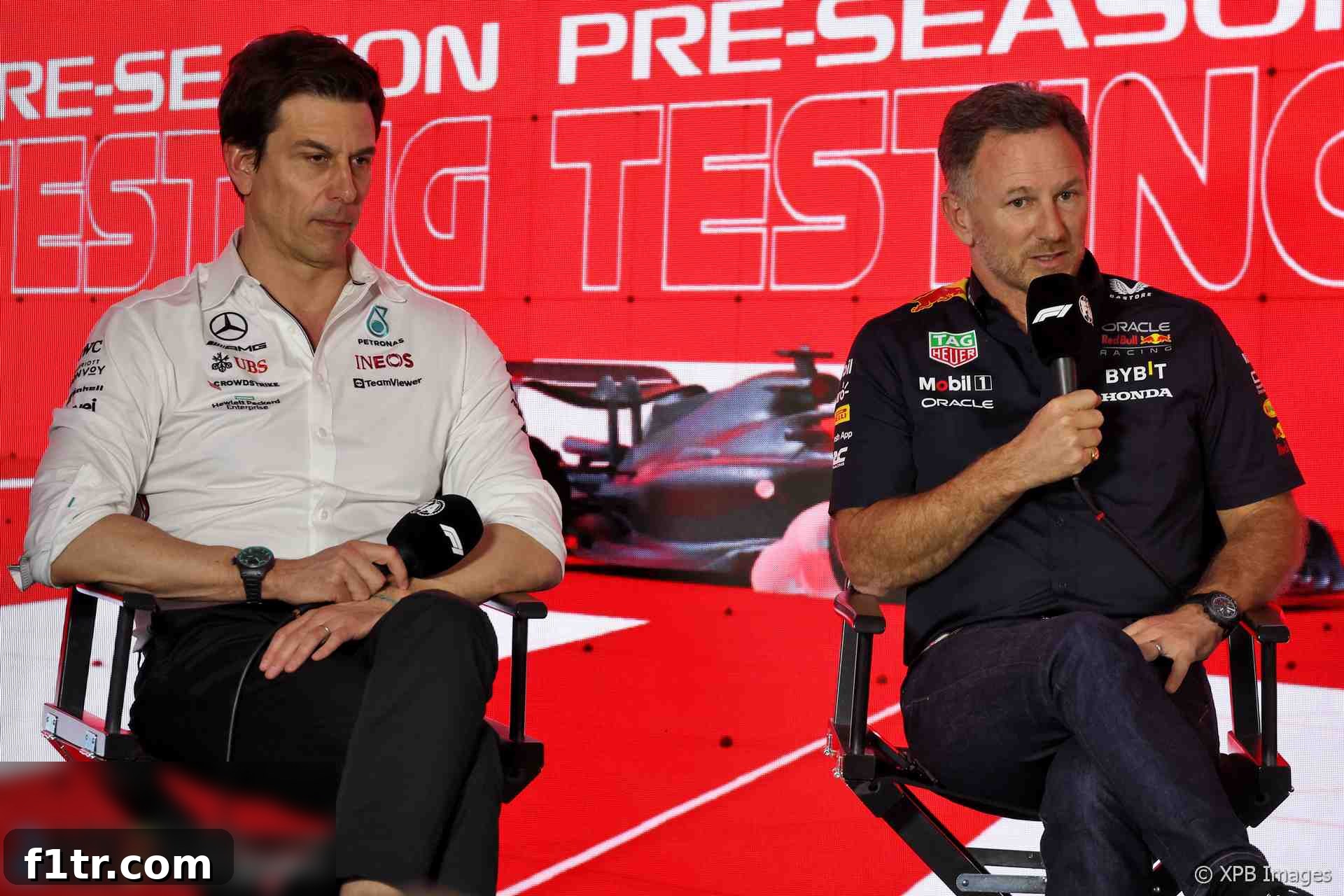
In the high-stakes world of Formula 1, where rivalries are as intense off-track as they are on it, a recent skirmish between two of the sport’s most prominent team principals, Mercedes’ Toto Wolff and Red Bull’s Christian Horner, has once again brought their long-standing feud into sharp focus. Wolff has openly criticized Horner’s reaction to a brief but highly controversial FIA investigation last December, reigniting a war of words that underscores the deep-seated competitive tension between their respective teams.
The incident in question revolved around a short-lived probe by the FIA’s Compliance Department concerning an alleged conflict of interest. The investigation, which unfolded rapidly over just 48 hours in December of the previous year, centered on an F1 team principal and a member of Formula One Management. It was widely understood in the paddock that the subjects of this scrutiny were Toto Wolff and his wife, Susie Wolff, who holds the significant position of CEO for the F1 Academy, an all-female junior racing series. The swift conclusion of the investigation, which saw the FIA declare no wrongdoing and effectively drop the matter, only served to fuel further speculation and debate within the sport.
Advert | Become a Supporter & go ad-free
Wolff did not mince words when discussing Horner’s conduct during this period. “I don’t think you can rely on what he says,” Wolff remarked in a candid interview with The Guardian, an exchange that coincided with the promotion of a new book detailing the Mercedes team’s journey. This pointed comment reflects a deeper level of distrust and ongoing animosity that has characterized the relationship between these two figures for many years, particularly since the explosive 2021 championship battle.
The FIA’s abrupt decision to close its investigation came just a day after an unprecedented show of unity from Mercedes’ rivals. All nine other Formula 1 teams publicly issued statements denying they had lodged any concerns regarding the alleged conflict of interest. This collective response was seen as a powerful endorsement of the Wolffs and a subtle rebuke to the FIA’s handling of the situation. Toto Wolff expressed immense gratitude for the swift and coordinated action of his counterparts, highlighting the solidarity shown by a usually fiercely competitive group.
Wolff recounted how the rallying of support unfolded. “The response was great,” he stated. “I didn’t make a single phone call to any team. Fred [Vasseur, Ferrari team principal] took it into his hands and said: ‘This is just so unfair’.” This initiative, led by Ferrari’s Frederic Vasseur, quickly gained traction, demonstrating a rare collective stand against what many perceived as an unjust inquiry. From figures like Guenther Steiner, then team principal of Haas, to James Vowles, Mercedes’ former strategy chief now leading Williams, the F1 paddock demonstrated a united front. “Everybody jumped on to this,” Wolff added, underscoring the widespread sentiment of support.
However, according to Wolff, this unity was not initially unanimous. He claimed that Christian Horner initially showed reluctance to append his signature to the joint statement that the other eight teams were prepared to issue. “They were all ready, but for Christian, to sign a document in our support,” Wolff asserted, suggesting a deliberate hesitation on Horner’s part. This alleged reluctance further exacerbated the long-standing tensions between the two principals, revealing a deeper layer of political maneuvering and personal rivalry.
Wolff detailed Horner’s alleged initial stance: “As far as I understand it he said: ‘I’m having my own Sky interview and I’m going to say I’m not part of it. I’m not signing the document.’” This account paints a picture of Horner attempting to distance himself from the collective show of support, perhaps seeking to avoid aligning with a direct rival in a politically charged situation. However, Wolff suggested that external counsel ultimately persuaded Horner to change his mind. “The other nine teams said: ‘Fine.’ But obviously he was advised that wouldn’t look great and he should be part of the statement.” This indicates that even in competitive F1, optics and maintaining a unified front, especially against perceived external overreach, can sometimes take precedence over individual team rivalries.
The saga continued, with Wolff claiming that Horner attempted to subtly alter the statement’s wording during a second iteration. “In the second iteration, he tried to get the word ‘official’ in the statement,” Wolff explained. “He wanted a note to say that no one [among the team principals] officially complained to the FIA.” This perceived attempt to soften the declaration, perhaps to leave a loophole or manage Red Bull’s own relationship with the FIA, was also met with a firm response from the other teams. “The other teams said: ‘Fine. We do our declaration and you do your own.’ At the end, he signed it,” Wolff concluded, highlighting Horner’s eventual capitulation but also his persistent efforts to shape the narrative.
Advert | Become a RaceFans supporter andgo ad-free
The fallout from the December investigation extends beyond the initial statements and criticisms. Susie Wolff herself has initiated legal proceedings in France, taking a firm stance against the implications of the probe. In March, she confirmed her decision to pursue legal action “in relation to the statements made about me by the FIA last December.” This development signifies the seriousness with which the Wolff family views the incident and their determination to clear her name and seek accountability for the events that transpired. Furthermore, adding another layer to the controversy, it was reported last week that Paolo Basarri, who was the head of the FIA’s Compliance Division during the investigation into Mercedes, has since departed the governing body. This departure has led to further speculation within the F1 community about potential internal repercussions and the political complexities surrounding the short-lived probe.
The rivalry between Toto Wolff and Christian Horner is not new; it has been a defining feature of Formula 1’s recent history, having only slightly abated since its fervent peak in 2021. That year, their respective star drivers, Max Verstappen and Lewis Hamilton, engaged in one of the most memorable and contentious world championship battles in the sport’s history. This on-track rivalry translated directly into an equally fierce off-track battle between the team principals, characterized by public spats, tactical maneuvering, and a palpable tension that often spilled over into media narratives. Their competitive dynamic extends far beyond mere racing, encompassing strategic recruitment, political influence, and a relentless pursuit of dominance.
Even now, with Mercedes facing a period of adjustment following Lewis Hamilton’s announced departure to Ferrari, the competitive chess game between Wolff and Horner continues. It is widely understood that Toto Wolff has been actively exploring options to secure a top-tier replacement for Hamilton, with reigning world champion Max Verstappen reportedly being a key target. This pursuit is particularly intriguing given Verstappen’s official contract with Red Bull Racing extends until 2028, underscoring the audacious nature of Wolff’s strategic moves and his willingness to challenge Red Bull’s stronghold on their star driver.
In a reciprocal move that perfectly encapsulates their tit-for-tat rivalry, Christian Horner has also engaged in similar mind games. In September, Horner publicly suggested that Red Bull could potentially target Mercedes driver George Russell as a replacement for the struggling Sergio Perez. This comment, whether genuine or a calculated jab, was met with a characteristic swift and sharp retort from Wolff, who accused his opposite number of “stirring shit up.” Such exchanges are typical of their relationship, demonstrating a constant undercurrent of competitive one-upmanship and psychological warfare, where every public statement is scrutinized for its underlying strategic intent.
These ongoing clashes between the two most influential team principals highlight the intricate political landscape of Formula 1. The December investigation and its aftermath serve as a stark reminder that the battle for supremacy in F1 is waged not just on the racetrack, but also in the boardroom, the media, and within the halls of motorsport’s governing body. The perceived lack of transparency, the quick resolution, and the subsequent legal actions raise questions about governance and accountability within the sport. For fans, this enduring rivalry between Wolff and Horner adds another fascinating dimension to Formula 1, providing endless drama and narrative richness beyond the pure racing spectacle. As the sport continues to evolve, the dynamics between these two powerful figures will undoubtedly remain a central theme, shaping not only the fortunes of their respective teams but also the broader political narrative of F1.
Miss nothing from RaceFans
Get a daily email with all our latest stories – and nothing else. No marketing, no ads. Sign up here:
Formula 1
- One of F1’s greatest races happened 15 years ago today. Or did it?
- “Overtaking is overtaking”: Domenicali denies F1’s yo-yo racing is “artificial”
- The crashes F1 is trying to prevent may be rare – but the danger is obvious
- F1 returning to India soon after 2027 sounds like wishful thinking
- Verstappen loathes F1’s new generation of cars – but what do his rivals reckon?
Browse all Formula 1 articles