Williams F1: From Rock Bottom to Resurgence? A Glimmer of Hope for the Future
After enduring what team principal Claire Williams candidly described as an “annus horribilis” in 2019, the venerable Williams Formula 1 team has begun to show encouraging signs of recovery. While it’s still very early in the 2020 season, the initial pre-season testing indicated a significant turnaround, suggesting the team is well on its way to regaining some of its lost competitiveness and dignity. This potential resurgence offers a glimmer of hope not just for the team, but for fans who cherish the rich history of one of Formula 1’s most iconic outfits.
The Shadow of 2019: A Season of Unprecedented Struggle
The 2019 season was a brutal affair for Williams. The team arrived in Barcelona for pre-season testing last year with aspirations of bouncing back from a bruising 2018 campaign, which had seen them slump to last place in the constructors’ championship. Instead, they faced an unprecedented embarrassment: a failure to produce a car for the first day of testing. This disastrous start was followed by the grim realization that the FW42 was potentially even worse than its predecessor, a car already considered one of the team’s least competitive.
Reflecting on that period, Claire Williams articulated the despair felt throughout the team: “We hit rock bottom.” The subsequent season only offered further confirmation of their plight. The FW42 was consistently the slowest car on the grid, lacking both pace and reliability. The team’s only championship point came in the chaotic German Grand Prix, a result achieved only after two competitors were disqualified for technical infringements. This solitary point, on the 40th anniversary year of the team’s first Grand Prix victory, felt less like an achievement and more like a cruel reminder of how far they had fallen.
Dispelling Doubts: A Strong Start to 2020 Pre-Season Testing
Given the calamitous start to 2019, rumors inevitably swirled before the 2020 pre-season tests, suggesting Williams was again in similar dire straits. Whispers even hinted that their test car might be dispatched to Barcelona as “a box of bits,” destined to be hastily assembled in the garage. Such speculation, fueled by past failures and the team’s financial struggles, naturally heightened anxieties among fans and within the paddock. However, these rumors proved to be utterly unfounded.
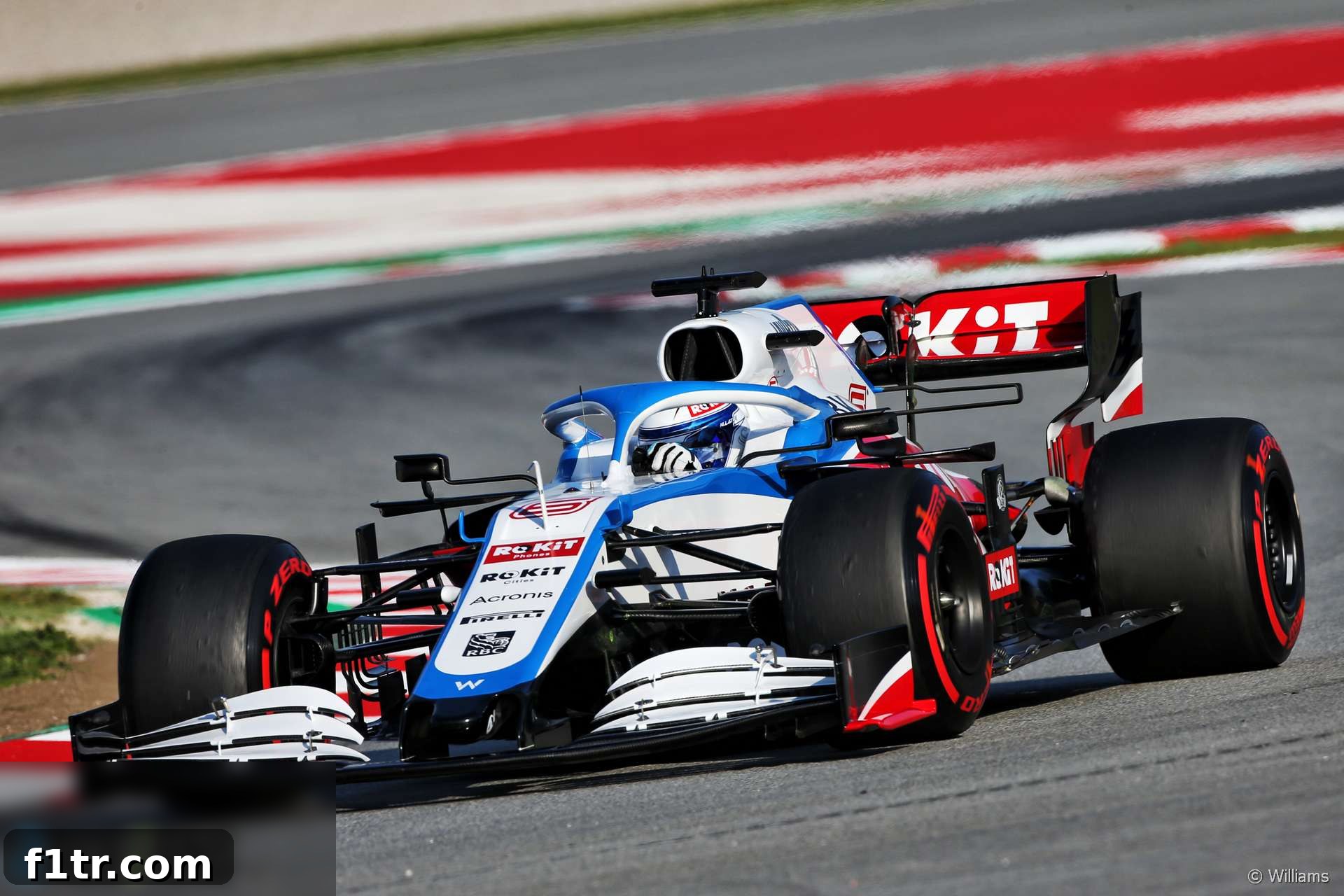
In a significant demonstration of improved organization and planning, a spy picture of the FW43 emerged as early as Friday before testing officially began. The car was not only ready but had been sent to Spain over the weekend and undergone its shakedown by the team on Monday, a full two days before testing was scheduled to commence. This stark contrast to the previous year’s scramble immediately set a positive tone and signaled a fundamental shift in the team’s operational efficiency.
When the Circuit de Catalunya opened for action at 9 am on Wednesday, it was George Russell’s blue, white, and red FW43 that was at the sharp end, being the very first car onto the track. While the team understandably downplayed the symbolic significance, for many, it was a profoundly moving and fitting reward for the dedicated individuals who had endured so much heartbreak and frustration in the preceding year. It wasn’t just about being first; it was about being organized, prepared, and ready to face the challenges ahead, a testament to the immense hard work put in behind the scenes.
Reliability and Pace: Early Indicators of Progress
Of course, being the first car out of the box in pre-season testing provides only “brownie points,” not championship points. However, the consistent performance that followed over the subsequent three days truly underscored Williams’s progress. With George Russell and Nicholas Latifi alternating at the wheel, the team ran faultlessly, logging significant mileage and valuable data. Beyond the odd minor sensor issue, routine repairs to running damage, and a power unit data “spike” – all typical occurrences in testing – the FW43 performed without major hiccups.
The contrast with the previous year’s testing mileage was staggering. Over the first three days of testing in 2019, Williams covered a mere 107 kilometers. At the same stage in 2020, the FW43 had completed more than 1,500 kilometers, a monumental increase that speaks volumes about the car’s reliability and the team’s preparedness. This massive accumulation of mileage is crucial for understanding the car’s behavior, gathering data, and allowing drivers to build confidence. More importantly, the team had already lapped almost a second quicker than they did during the 2019 Spanish Grand Prix weekend, a truly impressive leap in performance. George Russell, one of F1’s most promising young talents, expressed bullish optimism, particularly highlighting the significant strides made in every area of car performance since the last race of 2019. This improvement, measured against their own recent past, is the true gauge of their progress.
Claire Williams’ Vision: Rebuilding from the Ground Up
On the final day of the first pre-season test, Claire Williams, the de facto boss of the eponymous outfit founded by her father, Frank Williams, faced the press with a demeanor dramatically different from a year prior. In 2019, she had faced tough questions, and the pressure was palpable. This time, she was visibly smiling, a stark contrast to the previous year’s grim expressions. When asked by RaceFans how she felt, she simply stated, “I’m smiling,” before candidly admitting that the year-on-year target was straightforward: “make progress.”
Claire Williams is under no illusions regarding the monumental task ahead. The road to full recovery, to restore the team to its former title-winning status, will be long and arduous. However, she has clearly delivered on a promise she made in an exclusive interview in August of the previous year. At that time, she pledged to get to “the root” of the team’s deep-seated problems and to foster “a new culture” within the Grove-based operation. Her leadership through such challenging times has been a defining factor in this early turnaround.
She had insisted back then that the comprehensive changes being implemented would yield results. “I think the work that we have put in that people don’t get to see, because it is all behind-the-scenes stuff, then you want to believe that the work, the change that has gone on at Williams, which I am so proud of, that it’s all going to shape the future,” she had stated. This quiet confidence in the unseen work is now manifesting in tangible on-track improvements, validating her strategic direction.
Addressing a Decade of Obsolete Practices
The core of Williams’s transformation has been a forensic scrutiny and complete overhaul of its entire car production process. This includes everything from the initial concept and design phases through to manufacturing, assembly, testing, racing, and ongoing development. Wide-ranging changes have been implemented to bring the team’s operations up to the exacting standards required in modern Formula 1. In essence, the team had, for a significant period, operated with practices that were arguably a decade out of date. This systemic lag contributed directly to its slow, agonizing slide down the grid as the sport rapidly evolved and became exponentially more sophisticated. Each season had brought another retrograde step, further entrenching their position at the back.
As Claire Williams explained, “Behind the scenes at Grove over the past 12 months, we’ve all undergone huge transformation and change. And what we would like to see now is the rewards of that change, because the business really is unrecognisable from where we were, from everything, whether it be structures, processes, policies, et cetera.” This complete restructuring touches every facet of the organization, from how ideas are conceptualized and translated into designs, to the efficiency of the manufacturing line, the rigor of quality control, and the seamless flow of communication between departments. This commitment to fundamental change, rather than superficial fixes, is what gives the current recovery its depth and potential for sustainability.
The Road Ahead: Overcoming Legacy Challenges
Despite the encouraging signs, the team acknowledges that there is still a long and challenging road ahead. Williams’s current position highlights some unique constraints when contrasted with other teams, even fellow Mercedes power unit customers like Racing Point. Racing Point, once a direct competitor on the grid, has taken a dramatically different approach for the final season under F1’s current regulations. Benefiting from new ownership and a strategic partnership, they built a completely new car, drawing on different design philosophies and leveraging external collaborations.
Williams, on the other hand, has effectively updated its FW42 chassis, incorporating updated aerodynamic parts and running gear – essentially an ‘FW42B.’ Furthermore, Williams remains the only team on the grid to utilize a cast aluminum gearbox housing, while Renault, the last of the others, transitioned to a composite casing three years prior. This technical conservatism is a direct consequence of Williams’s long-standing ‘complete constructor’ model, where the team designs and manufactures almost every component in-house. While this offers independence, it also points to a relative lack of collaboration with major teams beyond merely sourcing power units from Mercedes. Racing Point, for instance, sources at least a complete rear end from Mercedes, a level of external reliance that Claire Williams has stated she is still unwilling to consider.
That said, when the primary objective is to achieve lap time gains measured in whole seconds rather than mere tenths, priorities shift significantly when it comes to constructing the approximately 26,000 parts that comprise a modern Formula 1 car. For Williams, the initial focus has rightly been on fundamental reliability, operational efficiency, and addressing the most significant performance deficits. However, to remain competitive in the long term, Williams will eventually need to adapt to contemporary F1 practices in this — and other — regards. Such strategic shifts, however, necessitate a substantial budget, which for 2020 is expected to be at a similar level to 2019, significantly lower than in 2018. This financial reality continues to be a major hurdle for the team.
A Quiet Confidence: Recruiting for a Brighter Future
A particularly telling indicator of Williams’s renewed confidence came from a rival team boss who confided to RaceFans that two teams were intensively (and successfully) recruiting personnel: Racing Point and Williams. This observation speaks volumes. While Racing Point has benefited from massive budget boosts courtesy of its new owners and its tie-up with Aston Martin, the fact that Williams is actively and effectively navigating the competitive job market points to a quiet, yet firm, confidence that has not been seen around Grove for several years. It suggests that despite financial constraints, the team’s vision, culture, and progress are attractive enough to draw top talent, laying crucial groundwork for future development.
Setting Sights on 2020 and Beyond: The Crucial Transition
Therefore, the crucial task for Williams in 2020 will be to maintain this momentum, keep their heads above water, and robustly prepare for the monumental regulatory changes arriving in 2021. The new regulations aim to level the playing field, if not entirely, then at least to a significant degree, offering an unprecedented opportunity for teams like Williams to close the gap to the front-runners. In the interim, securing at least ninth place in the constructors’ championship is a realistic and vital target, one that the pre-season testing performance suggests should be well within reach.
Achieving ninth place alone would be a just and significant reward for all the tireless hard work, restructuring, and cultural transformation undertaken over the past 12 months. It would represent a clear step forward, a validation of Claire Williams’s leadership and the dedication of every team member. Any further improvement beyond that would undoubtedly be considered a bonus, reinforcing the trajectory of recovery. This season is not just about points; it’s about rebuilding a foundation, restoring pride, and positioning Williams for a more competitive and sustainable future in Formula 1.