The exhilarating conclusion of a motorsport race is not merely the most critical juncture of any sporting event, but often its most anticipated and thrilling segment. As the tension mounts and the stakes escalate with each passing lap, there is arguably nothing more captivating than a fierce battle for victory in the final moments, where competition reaches its absolute climax. Fans worldwide tune in, eager to witness drivers push the limits, make decisive overtakes, or defend their positions with expert precision, all culminating in that iconic sprint to the chequered flag.
However, this quintessential experience is sometimes denied to spectators when circumstances prevent a race winner from being decided under full racing speeds. A significant accident or track obstruction in the closing stages can trigger a late Safety Car deployment, effectively neutralizing the field and bringing the race to a premature end before its full distance is covered. This often results in cars merely cruising around the track in formation, ticking off the remaining laps until the chequered flag falls, an outcome that many find unsatisfying and anticlimactic.
This situation presents a significant dilemma, and not every major racing series is comfortable with it. For nearly two decades, NASCAR has famously implemented its ‘overtime’ procedure, previously known as a ‘green-white-chequer’ finish. This innovative rule extends the race beyond its advertised distance, specifically designed to ensure that the final lap, at minimum, begins under a green flag. This commitment to a racing finish underscores NASCAR’s philosophy of maximizing excitement and competitive intensity right up to the very end.
IndyCar has also grappled with similar scenarios, occasionally utilizing red flag stoppages to halt races and allow for accident clear-up, rather than letting valuable laps expire under caution. A notable example occurred in the closing stages of the 98th Indy 500 in 2014, where a red flag allowed for a dramatic restart and a racing finish. Yet, IndyCar’s application of this approach hasn’t always been consistent. Scott Dixon, for instance, openly expressed his surprise and disappointment that the 2020 Indy 500 was not red-flagged under comparable circumstances, a decision he felt deprived him of a genuine opportunity to challenge eventual winner Takuma Sato for the victory.
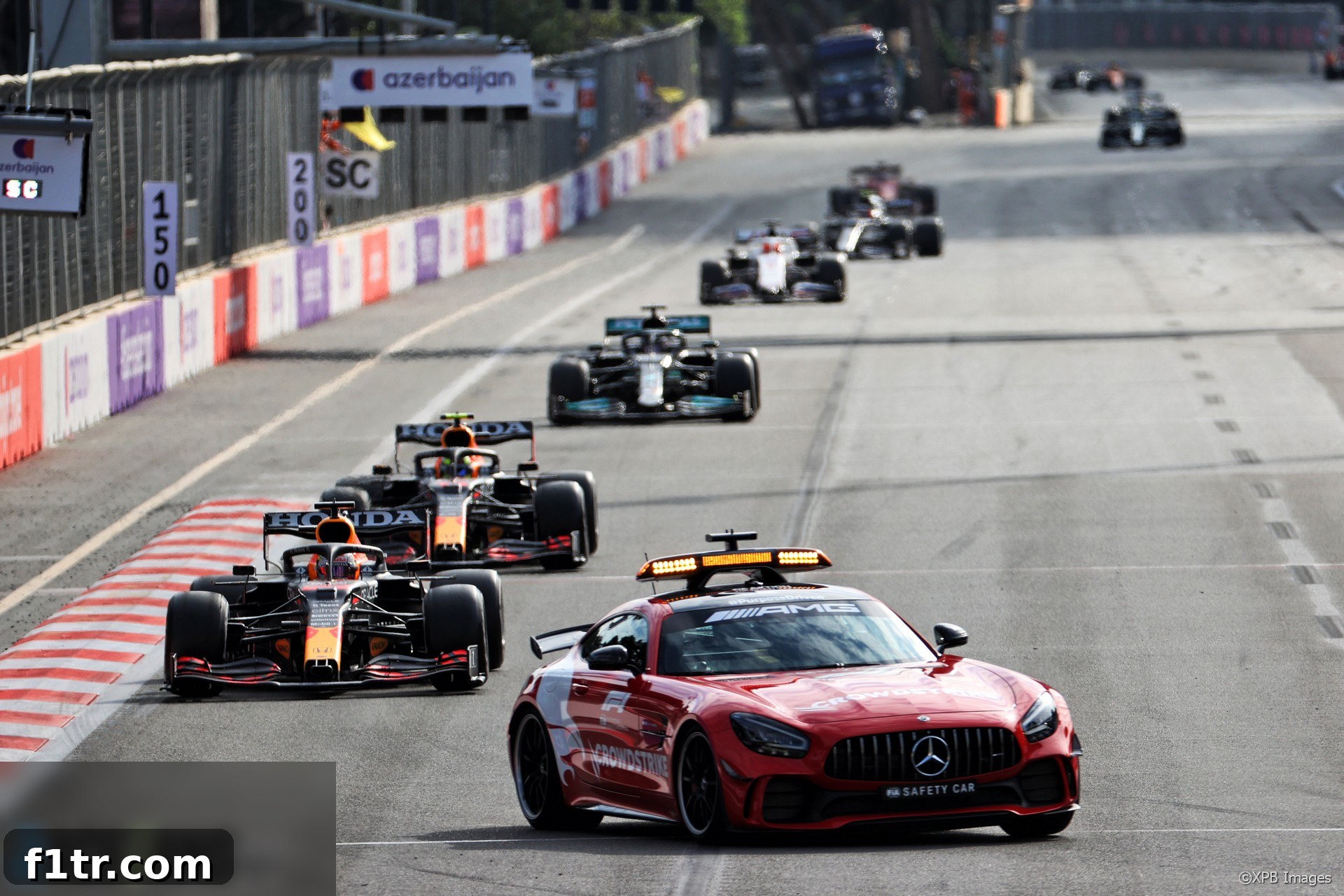
Over the past year, several high-profile incidents across FIA world championships, including Formula 1 and Formula E, have ignited fierce debates regarding the appropriate use of Safety Cars. The 2021 Azerbaijan Grand Prix was famously red-flagged following Max Verstappen’s dramatic puncture, setting up a thrilling three-lap sprint to the finish instead of a lengthy procession behind the Safety Car. And, of course, the events of the championship-deciding Abu Dhabi Grand Prix in December 2021 remain etched in memory, serving as a powerful focal point for discussions on race finishes under Safety Car conditions. Even more recently, Formula E’s second race in Diriyah, while technically concluding under a green flag, only did so for the final corner, after the preceding nine minutes of competitive time had been spent under the Safety Car, highlighting the ongoing tension between safety and spectacle.
Ultimately, whether one finds Safety Car finishes acceptable or genuinely abhorrent often boils down to a fundamental philosophical question about the nature of racing: What level of obligation do racing series hold to provide fans – and indeed, the competitors themselves – with a flying finish under green flag conditions? This question delves into the very core of what defines a fair, exciting, and ultimately satisfying conclusion to a race.
Arguments For Safety Car Finishes
A primary argument in favor of allowing races to conclude under Safety Car conditions centers on the adherence to established race regulations and the finite nature of scheduled events. All FIA world championship races are meticulously planned to run over a specific distance or to a maximum time limit. If a race is stipulated to be 60 laps long, then, logically, the driver who crosses the finish line first at the end of the 60th lap should be declared the winner, irrespective of whether they do so behind the Safety Car. Introducing a mandatory green flag finish, detractors argue, would create an artificial distinction, treating the final laps with a completely different set of priorities than those that preceded them. After all, seldom does anyone object to laps being lost or the field being neutralized by a Safety Car in the early phases of a race, even though the first ten laps can be just as crucial in shaping the eventual outcome as the final ten.
Furthermore, Safety Cars themselves are already a significant artificial intervention in the natural ebb and flow of a race. They inherently impact competitive dynamics: drivers can gain or lose a substantial number of positions based purely on the timing and circumstances of a Safety Car deployment. Even a minute-long gap meticulously built by a leader can be instantly erased as following cars are allowed to catch up. Considering the existing strategic complexities teams navigate – compulsory tire changes, fuel management, and numerous other factors – to then impose an additional requirement of forcing a green flag finish by any means necessary is, for many, an unnecessary and potentially overreaching step. Such a rule could introduce an element of unpredictability that undermines the strategic efforts and hard-earned advantages accumulated throughout the race, fundamentally altering the competitive landscape based on external safety measures.
Arguments Against Safety Car Finishes
While racing is undeniably a competition of skill, speed, and strategy, it is also, fundamentally, a spectacle designed to entertain. The infamous 2005 US Grand Prix at Indianapolis, for instance, remains highly controversial not because the rules were technically misapplied, but because having only six starters deprived thousands of fans, who had paid good money, of the thrilling and enthralling race they expected to see. The competitive aspect must always be balanced with the entertainment value that draws in viewers and sustains the sport’s popularity.
If motorsport were solely compelling enough to draw and absorb viewers purely by watching drivers lap a circuit for nearly two hours, then fan engagement initiatives like “rate the race” polls after every Grand Prix would be entirely superfluous. But as passionate fans, we crave racing – direct, wheel-to-wheel competition. Surely, it is preferable to have a guaranteed racing finish, ensuring a dramatic climax, rather than being denied what could be an unforgettable conclusion simply because an unfortunate incident occurs at the most inopportune moment? The expectation of a dynamic finish is a core part of the racing experience, and denying it can lead to disillusionment.
There’s also a robust case to be made from a purely competitive standpoint. A Formula 1 Grand Prix covers just over 300 kilometers. However, a late Safety Car deployment can effectively mean that the race result is decided with 10, 20, or even 30 kilometers still remaining. Is it truly equitable for a driver to be denied a legitimate opportunity to challenge a leader for a potential race victory, simply because the final five or so laps must be neutralized due to the appearance of the Safety Car? This scenario can negate efforts built over an entire race, removing the agency of drivers to influence the outcome on track in critical final moments, potentially leading to unfair or unmerited results in the eyes of many competitors and fans alike.
Finding the Right Balance: A Path Forward
It comes as no surprise that the optimal solution to this complex debate likely lies somewhere between the two extreme viewpoints. Accidents and hazards are an inherent, unpredictable part of motorsport, and as always, safety must remain the absolute, non-negotiable priority. Race control must deploy the Safety Car without any hesitation, regardless of the race circumstances, external pressures, or the amount of time or laps remaining. If an accident necessitates substantial clearing and marshals require a neutralized field to ensure their safety and efficiently clear the track, then the Safety Car call is undeniably correct and essential.
One could reasonably argue that “protecting” the final laps of a race above and beyond earlier phases is arbitrary and potentially illogical, given that a leader’s total race time is the sum of every lap completed from start to finish. However, time is linear, particularly for us race-watching humans. Incidents or delays in the early stages of a race tend to matter far less in the grand scheme, purely because there is so much of the race remaining for circumstances to evolve, for strategies to play out, and for the state of the race to completely turn on its head. The early laps offer ample opportunity for recovery and dynamic changes.
Conversely, in the critical final 50 kilometers or so, every overtakes, every minor mistake, and every collision becomes exponentially more critical. Neutralizing a race under a Safety Car in these crucial moments fundamentally prevents those kinds of decisive, race-changing moments from being able to happen. It’s also true that if a race is neutralized or even stopped with only a handful of laps left, while it might wipe away existing gaps, the order drivers are in at that moment is a direct result of everything that has come before it. Yes, restarting a race with a three-lap sprint might indeed alter the final results compared to if the cars had simply completed those laps under caution. But crucially, in the former scenario, the final results are derived from the completion of the final scheduled lap under competitive conditions, not from an effective finish four, five, or six laps prematurely.
Mandating a rule that every race must conclude under a green flag might be a step too far, potentially forcing unsafe scenarios or unduly extending races beyond reasonable limits. However, this does not mean there is no merit in striving to reasonably ensure races do not end in such an anticlimactic fashion, with drivers passively crawling to a predetermined lap count. The finish of the 2021 Azerbaijan Grand Prix perhaps offers a compelling and positive example of how Formula 1 and other FIA world championships could approach this challenge in the future. By judiciously utilizing red flags to temporarily stop the clock, allowing the circuit to be made thoroughly safe, and then resuming the race for its conclusion under natural racing conditions, a more satisfactory outcome can be achieved. Of course, in such circumstances, some drivers might lose out on advantages, while others might benefit from unexpected opportunities. However, the critical point is that the final order would have been determined on the track, through genuine competition, which aligns with the spirit of motorsport.
Lucas di Grassi, a prominent figure in Formula E, articulated a sentiment shared by many when he argued that Formula E’s current rules regarding race time extension required “fine-tuning.” This is an agreeable stance. Perhaps Formula 1 would similarly benefit from a comprehensive review of its current red flag and Safety Car regulations. Revisions could aim to actively encourage more racing finishes, while simultaneously ensuring that such interventions do not become an unpredictable “wildcard” that fundamentally introduces unfairness for its competitors. Striking this balance is paramount to maintaining both the integrity and the excitement of the sport.
Ultimately, as with almost any question pertaining to sporting rules and regulations, the paramount key is unwavering consistency. Whatever approach Formula 1, its teams, and its governing body collectively decide they want to implement regarding the use of Safety Cars and the promotion of thrilling racing finishes, it absolutely needs to be applied in precisely the same manner in every single race. From the high-stakes opening round of the season to the championship-deciding finale, uniform and predictable application of the rules is essential to foster trust, ensure fairness, and uphold the credibility of the sport for all involved – drivers, teams, and fans alike.
Debates and Polls on Race Finishes and Regulations
- What must Formula 1 fix with its new rules – and what should it leave unchanged?
- ADUO: Do F1 teams who fall behind deserve to get help to catch up?
- F1 is considering doubling its sprint races. Do you want more or fewer?
- Will this be a fight or a rout? 20 questions for the 2026 Formula 1 season
- Which Formula 1 team has the best-looking car – and the worst – for the 2026 season?
Browse all debates and polls