In the high-octane world of Formula 1, achieving complete dominance in any aspect of the sport is a rare and revered feat. One such accomplishment, a clean sweep of pole positions in a single season, has historically eluded even the most dominant teams. As Mercedes continues its formidable run, securing its tenth pole position from as many races in Sochi, the prospect of etching their name in the record books as the first team to claim every single pole position in a World Championship season looms large. This article delves into the fascinating history of teams that have come tantalizingly close to this unparalleled achievement, highlighting the legendary cars and drivers who nearly conquered qualifying entirely.
The Elusive Quest: A History of Near-Perfect Qualifying Seasons in F1
The pursuit of perfection in Formula 1 is a relentless journey, and qualifying offers the first battleground. To start every race from the coveted P1 spot demonstrates not only supreme car performance but also unyielding driver skill and strategic brilliance. Yet, the history books are filled with stories of teams that came within a whisker of this ultimate qualifying supremacy, only to be denied by unexpected rivals or the sheer unpredictability of motorsport.
Early Aspirations: Alfa Romeo, Ferrari, and the Indianapolis Anomaly
The very dawn of the Formula 1 World Championship in the 1950s saw Alfa Romeo and Ferrari almost achieve this remarkable feat. In 1950, Alfa Romeo dominated, securing pole in all six European rounds. However, the championship’s inclusion of the Indianapolis 500 – a race run to different regulations and largely ignored by European F1 teams – prevented a clean sweep. That year, the pole at Indianapolis went to Walt Faulkner in an American car, not an Alfa Romeo. Ferrari faced a similar scenario in 1952, taking pole at all seven Grand Prix races but missing out at Indianapolis, where F1 machinery was unsuited, and the American roadsters reigned supreme. While Alberto Ascari notably competed at Indianapolis in 1952, his Ferrari was not competitive for pole against the specialist machines, marking a technical rather than a competitive miss.
McLaren-Honda’s Turbocharged Reign (1988-1989)
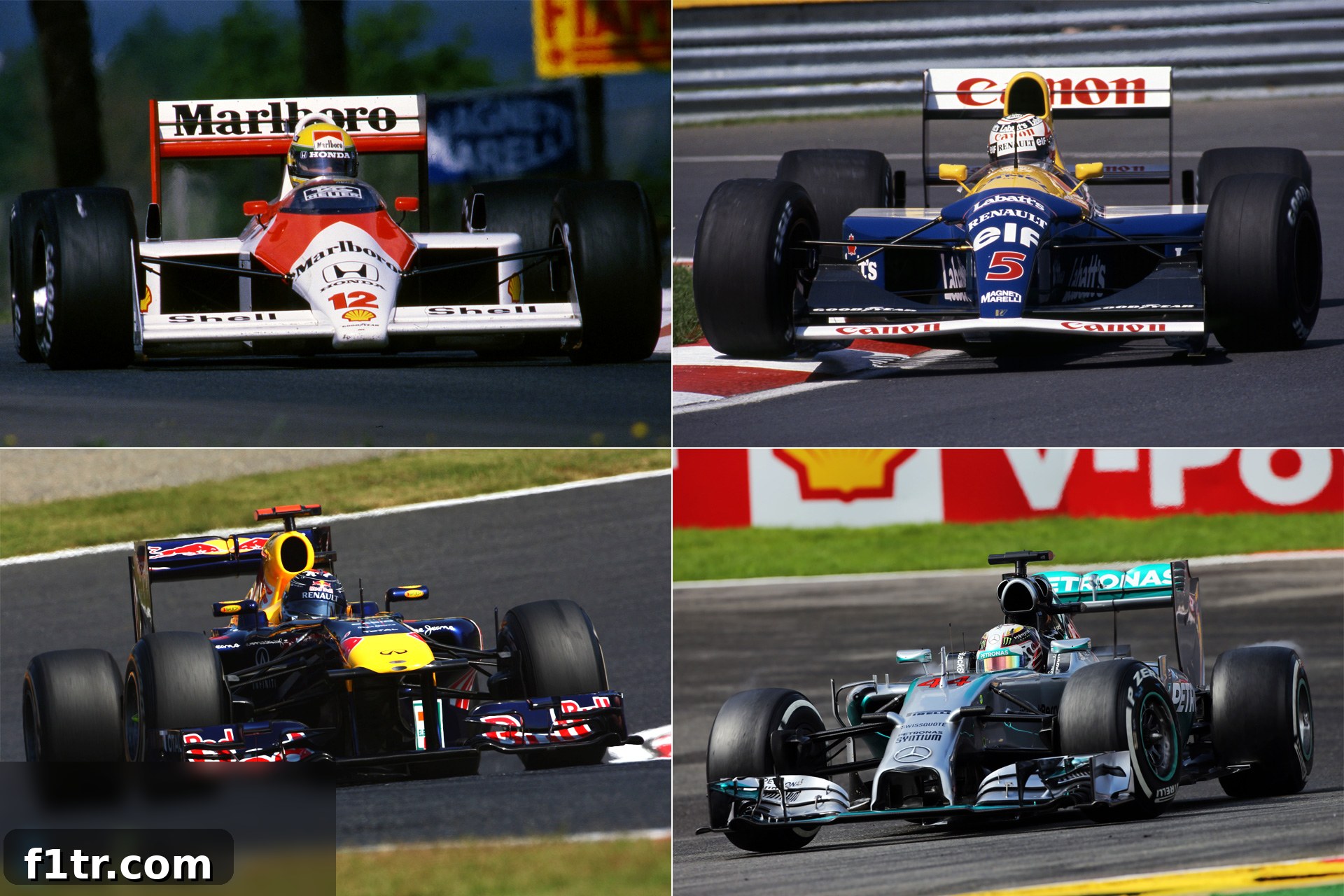
For decades, as the Formula 1 calendar expanded, the idea of one team dominating every single qualifying session seemed increasingly remote. However, the late 1980s heralded an era where such dominance became a realistic possibility once more, thanks to the potent combination of Honda engines and the formidable McLaren team. Having endured a pole-less 1987 with their aging TAG-Porsche power units, McLaren made a game-changing switch to Honda for 1988. This move, coupled with the arrival of the revolutionary low-slung MP4/4 chassis and the dream driver pairing of Ayrton Senna and Alain Prost, created an unstoppable force. The MP4/4, designed by Steve Nichols and Gordon Murray, was an aerodynamic marvel, perfectly integrating with Honda’s mighty 1.5-litre V6 turbo engine. They secured an astonishing 15 pole positions out of 16 races in 1988, demonstrating unparalleled qualifying prowess.
Their incredible run was broken only on home ground at Silverstone, where Gerhard Berger’s Ferrari managed to snatch pole. Despite having the same Honda engines and three-time world champion Nelson Piquet, rivals like Lotus were consistently a second or more off McLaren’s pace, a testament to the MP4/4’s complete package. The following year, despite a wholesale change in regulations to 3.5-litre normally aspirated engines, Honda remained the benchmark, and McLaren continued their qualifying supremacy, again missing only one pole. This time, it was Williams-Renault who broke their streak at the Hungaroring, hinting at the future power shifts in the sport.
Williams’ Technological Marvels (1992-1993)
The early 1990s witnessed another period of incredible dominance, this time spearheaded by the Adrian Newey and Patrick Head-designed Williams cars, powered by Renault V10 engines. The FW14B, introduced in 1992, was a technological masterpiece, combining groundbreaking aerodynamics with advanced electronic driver aids such as active suspension, traction control, and semi-automatic gearboxes. This car was revolutionary, setting a new standard for Formula 1 engineering. It was often described as comically quicker than anything else on the track, making Nigel Mansell’s 1992 season a procession of poles and victories.
Mansell took pole at 14 of the 16 races that year. His qualifying run was only interrupted at the Canadian Grand Prix by the sheer genius of Ayrton Senna, who, in his less advanced McLaren, delivered a legendary lap to snatch pole position from the dominant Williams of Riccardo Patrese, bumping Mansell off the front row for the only time all season. The following year, Williams iterated on this design with the FW15C, maintaining their status as the class of the field. As the 1993 season approached its climax, Williams had started every single race from pole position, on the verge of an unprecedented clean sweep. However, at the final Grand Prix in Adelaide, the incredible Ayrton Senna once again played the spoiler, taking pole for McLaren. Famously, Senna achieved this despite a radio mishap that left him unaware he was running dangerously low on fuel, a testament to his extraordinary talent.
The Shifting Sands of Qualifying Formats
The purity of qualifying as a raw test of one-lap speed was somewhat diluted by rule changes in the mid-1990s. Following the reintroduction of refuelling in 1994, by the early 2000s, drivers were required to qualify with their starting fuel loads. This meant that outright speed was often compromised by race strategy, making a true test of ultimate one-lap pace a rarity. It wasn’t until 2010 that “proper” qualifying, focused solely on raw speed without fuel considerations, returned with the three-part knockout format we largely recognize today.
Red Bull’s Modern Era Challenge (2011)
With the return of pure qualifying, another Adrian Newey creation, the Red Bull RB7, powered by a Renault engine, came agonizingly close to sweeping every pole position in 2011. Sebastian Vettel, in a season of staggering dominance, racked up an incredible 15 pole positions – a record that still stands to this day for the most poles in a single season. The RB7 was a beautifully balanced car, and Vettel exploited its potential to perfection. However, at round 16 in South Korea, he was denied the top spot by a blistering lap from Lewis Hamilton in his McLaren, once again highlighting that even in eras of overwhelming dominance, individual brilliance or unexpected circuit characteristics can disrupt the seemingly inevitable.
Mercedes’ Hybrid Era Near Misses (2014-2016)
The advent of the V6 hybrid turbo power unit regulations in 2014 ushered in an era of unprecedented dominance for Mercedes. With Lewis Hamilton now at the team, they were perfectly poised to capitalize on their benchmark-setting power unit and chassis. Mercedes absolutely crushed the competition in 2014, 2015, and 2016, but remarkably, each year they were denied a clean sweep of pole positions by a different rival.
In 2014, it was Williams who broke the streak, courtesy of a stellar lap from Felipe Massa at the Red Bull Ring in Austria. Both Hamilton and Nico Rosberg made uncharacteristic errors on their final laps, opening the door for Massa to claim a popular pole. Despite this, Mercedes-powered cars (including Williams) still took pole at all 19 rounds that year, underscoring the sheer superiority of their engine.
The 2015 season saw Mercedes once again dominant, but in Singapore, a bizarre dip in form saw them bafflingly 1.4 seconds off the pace. Sebastian Vettel, now with Ferrari, capitalized on Mercedes’ mysterious struggles to take pole, confining the Silver Arrows to the third row of the grid. This rare and inexplicable defeat meant Mercedes fell one short of equaling the record of 24 consecutive poles set by Williams in 1993, a record they still hold.
Finally, in 2016, an inspired qualifying lap from Daniel Ricciardo in Monaco put his Red Bull on pole position, just a tenth of a second ahead of Nico Rosberg’s Mercedes. Monaco, with its unique demands and high-stakes qualifying, often produces unexpected results, and Ricciardo delivered a masterclass. For the third year in a row, a clean sweep of pole positions had frustratingly eluded Mercedes, proving that even with overwhelming machinery, the variables of Formula 1 can never be entirely controlled.
The Current Quest: Mercedes W11 in 2020
As the 2020 season unfolded under unusual circumstances, with a shorter, 17-round championship calendar, Mercedes once again found themselves on the precipice of history. Having secured every pole position up to the Sochi Grand Prix, their W11 chassis, paired with the potent Mercedes power unit, has proven to be an almost invincible qualifying weapon. The closest any rival has come to dethroning them was at Mugello, where Max Verstappen’s Red Bull was 0.365 seconds slower than the pole-winning W11. This gap, while not insurmountable, highlights the consistent advantage Mercedes has held. The shortened calendar, ironically, presents them with fewer opportunities to be tripped up, making this year perhaps their best chance yet. The question remains: can Max Verstappen, or another competitor, pull off a heroic lap and deny Mercedes this historic record, just as others have done so many times before in Formula 1’s rich history?
Go ad-free for just £1 per month>> Find out more and sign up
The 10 Times a Team Almost Set Pole in Every Race
| Year | Races | Team | Poles | Race missed |
|---|---|---|---|---|
| 1950 | 7 | Alfa Romeo | 6 | Indianapolis (Agajanian) |
| 1952 | 8 | Ferrari | 7 | Indianapolis (Cummins) |
| 1988 | 16 | McLaren | 15 | Silverstone (Ferrari) |
| 1989 | 16 | McLaren | 15 | Hungaroring (Williams) |
| 1992 | 16 | Williams | 15 | Circuit Gilles Villeneuve (McLaren) |
| 1993 | 16 | Williams | 15 | Adelaide (McLaren) |
| 2011 | 19 | Red Bull | 18 | Korea International Circuit (McLaren) |
| 2014 | 19 | Mercedes | 18 | Red Bull Ring (Williams) |
| 2015 | 19 | Mercedes | 18 | Singapore (Ferrari) |
| 2016 | 21 | Mercedes | 20 | Monaco (Red Bull) |
F1 History
- When did F1 last have a mid-season break longer than five weeks? 1990
- Did Norris actually win Formula 1’s closest championship fight of all time?
- Hamilton is Ferrari’s first new driver in 44 years to complete season without a podium
- Ferrari are on course to lose an F1 record they’ve held since 2004
- Red Bull in 2010 or Ferrari in 1979? Past title fights illustrate McLaren’s current dilemma
Browse all history articles