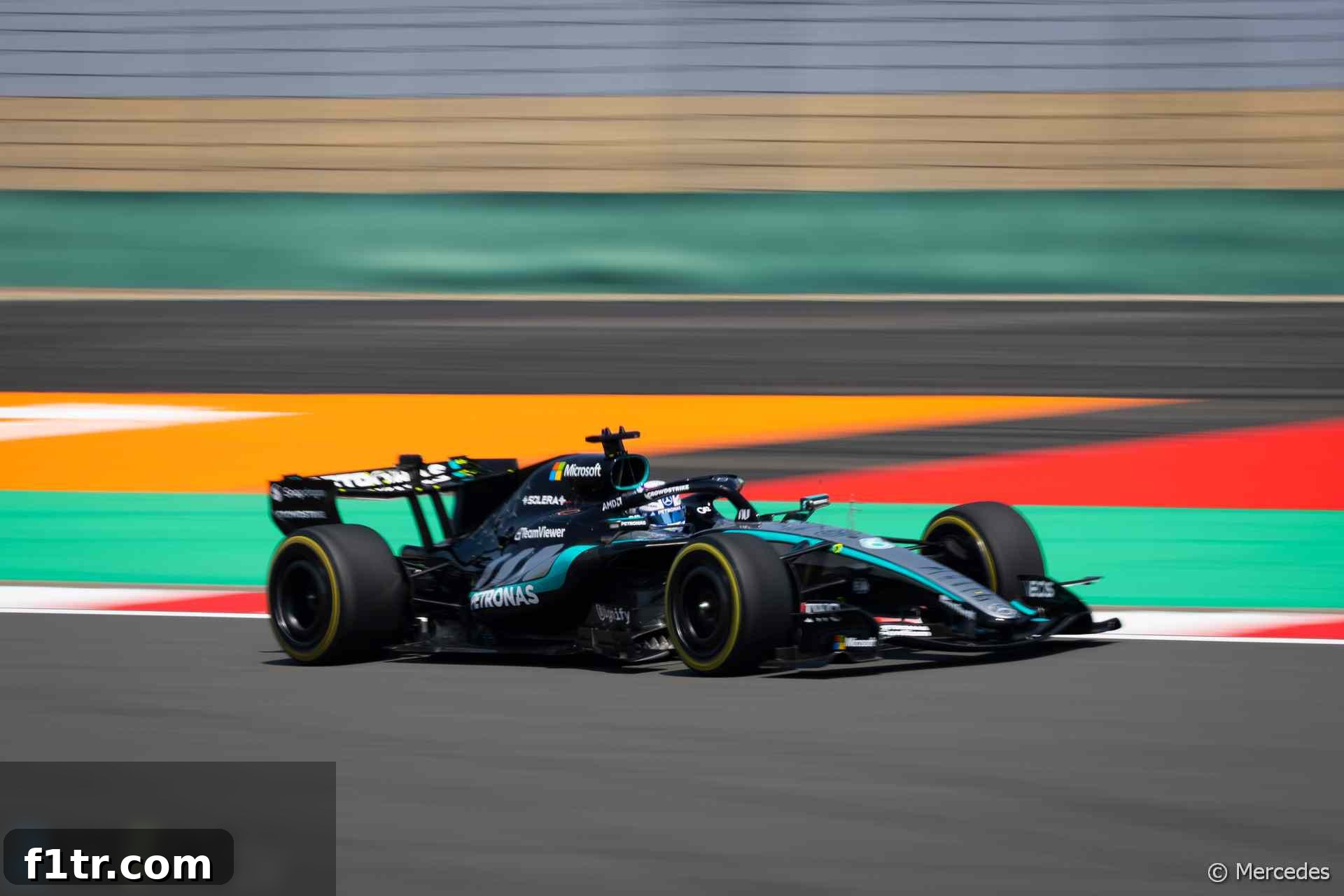
Lewis Hamilton Unpacks Mercedes’ Strategic Advantage in F1 Power Unit Development for 2026
Formula 1 icon Lewis Hamilton has offered a candid and thought-provoking assessment of the competitive landscape, suggesting that his former team, Mercedes, has once again strategically positioned itself ahead of rivals in mastering the sport’s impending power unit regulations. According to Hamilton, this strategic foresight mirrors their remarkably successful approach a decade ago, which ultimately paved the way for an unparalleled era of dominance. His insights highlight the perpetual race for technological supremacy that defines Formula 1, particularly as teams prepare for the significant technical overhaul set for the 2026 season.
Support Independent F1 Journalism
Become a Supporter & Enjoy Ad-Free Content
The period following Formula 1’s last significant shift in power unit regulations 12 years ago saw Mercedes establish an iron grip on the sport. Between 2014 and 2020, with Hamilton at the wheel, the team secured an astonishing six out of seven drivers’ championship titles, alongside eight consecutive constructors’ championships. This historical context provides a crucial backdrop to Hamilton’s current observations, as teams worldwide gear up for another seismic change in engine architecture set for the 2026 season. The seven-time world champion, who embarked on a new chapter with Ferrari at the start of the current season, believes Mercedes’ proactive approach to designing for these new regulations has granted them a significant head start over the competition. This early groundwork, he suggests, is a repeat of their past winning formula, where meticulous planning and early resource allocation proved decisive.
Ferrari’s Power Deficit: A Major Hurdle for Championship Aspirations
Hamilton didn’t mince words when describing Ferrari’s current performance limitations, particularly concerning straight-line speed, a critical factor for both lap time and racecraft. “We’re losing, I think on the straights, [and] it’s a lot of time to be losing,” he articulated, underscoring the substantial challenge facing the Scuderia. “So we have a lot of work to do.” This deficit in outright power translates directly into lost lap time, making overtaking difficult and defending positions a constant struggle on track. The pressure, as Hamilton highlighted, is immense within the legendary Maranello outfit, where the demand for continuous improvement is a core part of their identity.
“We really have to push so hard back in Maranello to improve on power. It was something that I think we were conscious of last year, we thought that Mercedes started earlier than us or the rest, which they did last time as well,” Hamilton explained. His insight suggests that Ferrari was acutely aware of Mercedes’ early commencement on the new engine designs, a strategy that has historically paid dividends for the German manufacturer and their customer teams. “So they’ve done a fantastic job and we’ve got to step up, we’ve got to push to be able to close that gap.” This candid admission from a driver of Hamilton’s caliber emphasizes the critical importance of power unit development, especially as Formula 1 moves towards a more sustainable and electrified future in 2026. The new regulations will place an even greater emphasis on electrical power and efficiency, making early R&D investments absolutely vital.
Balancing Act: Ferrari’s Cornering Prowess vs. Straight-Line Speed Dilemma
Despite the persistent power deficit, Hamilton expressed considerable confidence in the overall chassis and aerodynamic performance of his Ferrari machine. “The car feels great,” he affirmed. “I think we can compete with him through corners. But when you’re down on power, it’s just the way it is.” This statement points to a common and complex dilemma in Formula 1 car design: the delicate balance between generating maximum downforce for exceptional cornering grip and minimizing drag for superior straight-line speed. Ferrari appears to have optimized its package for high-speed corners and technical sections, where its aerodynamic efficiency shines, often allowing drivers to carry more speed through turns than rivals.
However, on circuits with long straights, during crucial overtaking maneuvers, or when trying to defend against faster cars, the car’s power unit disadvantage becomes glaringly apparent. The pursuit of the perfect balance is a relentless endeavor, requiring close collaboration between engine designers in Maranello and aerodynamicists at the factory. Hamilton’s observations confirm that while Ferrari possesses a competitive chassis capable of delivering excellent performance in specific sections of a track, the inherent power deficit acts as a significant limiter to its overall potential and championship aspirations. Closing this performance gap is not merely about incremental improvements; it demands a fundamental leap in power unit efficiency and output, a task that requires substantial investment, innovative engineering, and meticulous testing under rigorous conditions.
Stay Informed, Support Our Work
Become a RaceFans supporter andexperience our content ad-free
Shanghai Sprint Race: A Tangible Glimpse into the Competitive Dynamics
The recent sprint race in Shanghai provided a tangible demonstration of the power unit disparities Hamilton discussed. Qualifying fourth on the grid, Hamilton found himself trailing not only the two factory Mercedes cars driven by George Russell and Valtteri Bottas (or current Mercedes drivers if the article refers to a specific race year, assuming general context) but also Lando Norris’s McLaren, which is famously powered by a Mercedes engine. This outcome reinforced the notion that Mercedes-powered machinery held an undeniable advantage on the straights of the Shanghai International Circuit, a track known for its challenging mix of technical corners and long, high-speed sections.
Despite the ultimate grid position, which might have been seen as a missed opportunity for a stronger result, Hamilton remained optimistic about his team’s efforts and the car’s performance throughout the session. “I’m really pleased with the session,” he stated, reflecting on his performance. “My team did a really great job. My engineers did a fantastic job to turn the car around because P1 was a tricky session with that spin. And the car generally felt great.” This resilience and quick recovery from a difficult practice session, marked by an uncharacteristic spin, speak volumes about the operational efficiency and dedication of the Ferrari crew. It highlights their ability to optimize the car under pressure, extracting maximum performance even if the underlying power unit performance gap remains a persistent and formidable challenge to overcome.
Ferrari’s Novel Rear Wing: The Art of Component Introduction and Strategic Caution
Adding another layer of intrigue to Ferrari’s Shanghai weekend was the introduction of a novel new rear wing design. The Scuderia brought this cutting-edge aerodynamic component to China, running it in practice on both cars. Designed to potentially offer improved downforce or reduced drag, or a combination thereof, such new parts are always eagerly anticipated by fans and analysts. However, in a strategic decision reflecting careful consideration, they opted not to use it for the sprint race. Hamilton shared his perspective on this, admitting, “I don’t really know why we went back on it,” hinting at the complex internal discussions that often precede such decisions.
He elaborated on the circumstances surrounding its ambitious debut: “We rushed it to get it here and it was not supposed to be on the cars until I think it was like race four or five or something like that. So they did a great job to rush it here.” The decision to withdraw the new wing for the sprint race, despite the team’s significant effort to fast-track its development and logistics, points to the meticulous and often conservative approach taken by Formula 1 teams when introducing new components. “We only had two of them and it may be a little bit premature, so we took it off. The car was still great and we’ll work to try and bring it back when it’s ready.” This scenario perfectly illustrates the complex interplay of potential performance gains, reliability concerns, limited inventory, and the absolute need for thorough validation before committing a new part to competitive action. Rushing an unproven component could lead to unforeseen issues, potentially compromising race performance, incurring penalties, or even resulting in a catastrophic DNF. Ferrari’s cautious approach, while perhaps frustrating in the short term, ultimately underscores their long-term commitment to reliability and optimal performance, especially with limited practice time in a sprint format.
The Road Ahead: The Relentless Battle for Power and Future Performance
Lewis Hamilton’s insights offer a fascinating and invaluable glimpse into the high-stakes world of Formula 1 engine development, particularly as the sport hurtles towards the transformative 2026 regulations. His observations about Mercedes’ early preparedness serve as a stark reminder that success in F1 is often cultivated years in advance, long before the cars even hit the track under new rules. This strategic long-term planning, coupled with relentless innovation, is the bedrock of championship-winning campaigns. For Ferrari, the message is clear: the quest for raw power and efficiency must intensify dramatically. While their chassis demonstrates formidable cornering ability, unlocking true championship potential requires bridging the gap on the straights, an area where pure engine output and efficiency are paramount.
The ongoing development race will undoubtedly be a defining narrative of the coming seasons. Every team, including powerhouses like Mercedes and Ferrari, is pouring immense resources into engineering the perfect blend of power, aerodynamics, and reliability for the next generation of Formula 1 cars. The 2026 regulations, with their emphasis on sustainable fuels, increased electrical power, and revised aerodynamic rules, represent an unprecedented challenge and opportunity. Hamilton’s unique position, having witnessed Mercedes’ past dominance firsthand and now driving for Ferrari, provides an invaluable perspective on what it truly takes to win at the pinnacle of motorsport. His call for Ferrari to “step up” is not merely a challenge but a strategic imperative if they are to contend for world championships in the future, beginning with the crucial groundwork being meticulously laid now for 2026 and beyond. The battle for the future of Formula 1, both on and off the track, has truly begun.
Go ad-free for just £1 per month>> Find out more and sign up
Don’t Miss a Moment: Subscribe to Our Newsletter
Get a daily email with all our latest stories – no marketing, no ads, just pure F1 news and analysis. Sign up below:
More Formula 1 Insights:
- What led Stroll to call his Aston Martin “the worst piece of s*** I’ve ever driven”
- Stats: Antonelli is 12th Formula 1 driver to score a ‘hat trick’ with his first win
- “Leclerc just backed Lewis up”: How Russell saw the fight between the Ferraris
- Verstappen reduced his pace unnecessarily due to communications error
- ‘Just an easy pass with Overtake’: Every radio message from Antonelli’s first F1 win
Browse all Formula 1 articles related to the Chinese Grand Prix