Mercedes’ Mexican Grand Prix Gamble: A Strategic Blunder That Cost Victory
The 2022 Mexican Grand Prix proved to be a pivotal race, not just for the drivers on the podium but especially for Mercedes, whose strategic tyre choice ignited a fierce debate in the Formula 1 paddock. Rivals were quick to highlight what they perceived as a critical strategic error, one that many believe might have cost the Silver Arrows a potential victory. Mercedes’ decision to opt for a conservative medium-to-hard tyre strategy contrasted sharply with the more aggressive soft-to-medium approach taken by their closest competitors, Red Bull, ultimately dictating the race’s outcome.
The aftermath of the race saw candid criticism from top team principals. Christian Horner, Red Bull’s team principal, and Mattia Binotto, his counterpart at Ferrari, both pointed out Mercedes’ repeated strategic missteps. Binotto remarked that Mercedes had “slipped up for the second race in a row,” suggesting a pattern of suboptimal decision-making. The core of the issue revolved around Mercedes drivers, Lewis Hamilton and George Russell, starting on the medium compound tyres and then switching to the hard compound for their second stint, while Red Bull and other key rivals successfully implemented a softer compound strategy for both phases of the race.
The Strategic Divide: Mercedes’ Medium-Hard vs. Red Bull’s Soft-Medium
The Autódromo Hermanos Rodríguez in Mexico City presents unique challenges, primarily due to its high altitude. The thinner air impacts aerodynamic downforce and engine performance, but critically, it also affects tyre cooling and grip levels. This often leads to unusual tyre behaviour, making strategic choices even more critical than at sea-level tracks. Mercedes’ pre-race analysis likely led them to believe that the medium-hard combination would offer the most robust and consistent performance over a race distance, prioritizing durability and a single pit stop.
However, this conservative approach quickly backfired. While Lewis Hamilton managed to stay within striking distance of Max Verstappen during the initial stint on medium tyres, the performance gap widened significantly once Mercedes fitted the hard compound tyres. Horner’s observation perfectly encapsulated the frustration: “You could hear their drivers were not very happy about the hard tyre and that’s the second weekend in a row that they put that tyre on and it’s cost them a victory. So I was quite surprised at that.” This sentiment highlighted a growing concern within the Mercedes camp regarding their tyre strategy calls, especially after similar issues in previous races.
Red Bull, on the other hand, had drawn a distinct conclusion during their practice sessions: the hard tyre simply wasn’t suited for the race conditions. Horner explained their findings: “For us, the soft-medium this morning looked like a quicker race. The medium-hard, the hard, there’s just not as much grip with the tyre. So we were quite surprised that Mercedes went as conservative as they did with a medium-hard strategy.” This early insight allowed Red Bull to commit to a more aggressive, yet ultimately more effective, tyre strategy.
Red Bull’s Masterclass: Maximizing Soft Tyre Longevity
The success of Red Bull’s strategy hinged on two key factors: the surprising longevity of the soft compound tyres and Max Verstappen’s exceptional tyre management skills. Most front-running teams had used their new sets of soft tyres during practice and qualifying, leaving those who opted for them on Sunday with worn rubber. Mercedes had likely gambled on the soft tyre degrading rapidly, forcing a two-stop race for anyone attempting that strategy.
However, Verstappen defied these expectations, managing to cover an impressive 25 laps – more than a third of the entire race distance – on his used soft tyres. This incredible stint laid the foundation for his one-stop race, switching to a set of medium tyres to finish. Horner lauded Verstappen’s prowess: “He controlled the race from the very beginning on those soft tyres, not warming them up too quickly, making sure that there was longevity to them. Actually, when they came off the car, there was still a lot of life left in them. That gave us even more confidence that the medium tyre would be fine for a one-stop. It was again a question not abusing that tyre, which is something that he’s just been masterful at this year.” Verstappen’s ability to extract maximum performance while preserving tyre life has been a hallmark of his championship-winning seasons, and it was on full display in Mexico.
Mercedes’ team principal, Toto Wolff, later conceded that the prevalence of the one-stop soft-medium strategy caught some teams by surprise. “I think that some of the others were maybe also surprised that a one-stop suddenly was on the books with a soft and medium,” Wolff admitted, indicating a shared misjudgment among parts of the paddock regarding the tyre compounds’ true performance window at the venue.
A Race of Missed Opportunities and Brilliant Executions
George Russell’s Unfulfilled Potential
The strategic rigidness within Mercedes extended to George Russell’s race. After pitting Hamilton for hards on lap 29, Russell followed suit five laps later. At this point, several other drivers were still on their original medium tyres, and Russell himself was keen to extend his stint and switch to a soft compound for a late charge. However, Mercedes stuck to their pre-planned strategy, denying Russell the opportunity to explore an alternative path. This decision was put into stark relief when Russell eventually made a second pit stop on lap 69, bolting on soft tyres, and immediately claimed the bonus point for the fastest lap with a time over one-and-a-half seconds quicker than anyone else. This blistering pace undoubtedly left him, and many observers, wondering what could have been achieved had he been given the softer rubber earlier in the race.
Daniel Ricciardo’s Standout Performance
While the front of the grid was dominated by strategic debates, Daniel Ricciardo delivered one of the most compelling performances of the day. Starting 11th, Ricciardo successfully utilized a soft-medium strategy, eventually climbing to a commendable seventh place. His charge was further aided by McLaren’s exceptional pit crew, who recorded the fastest stationary pit stop of the race at an astonishing 1.95 seconds. Although Charles Leclerc’s total pit stop time (from entrance to exit) was marginally quicker, McLaren’s tyre change speed was crucial for Ricciardo’s track position. Ricciardo’s drive marked him as the only driver in the top eight to finish higher than his starting position, underscoring the effectiveness of his and McLaren’s execution, particularly against the backdrop of Mercedes’ struggles. The top six finishers, in contrast, maintained their starting order from the end of lap one, emphasizing the difficulty of making overtakes or significant progress in the strategic battle among the leaders.
Advert | Become a RaceFans supporter andgo ad-free
Data Insights: Unpacking the Numbers
Formula 1 races are increasingly decided not just on raw pace, but on meticulous data analysis and strategic foresight. The 2022 Mexican Grand Prix offered a rich dataset that clearly illustrated the impact of tyre choices. While dynamic interactive charts are typically used to visualize this data, a careful review of the static information, such as lap times, fastest laps, pit stop durations, and tyre strategies, reveals the underlying truth of the race.
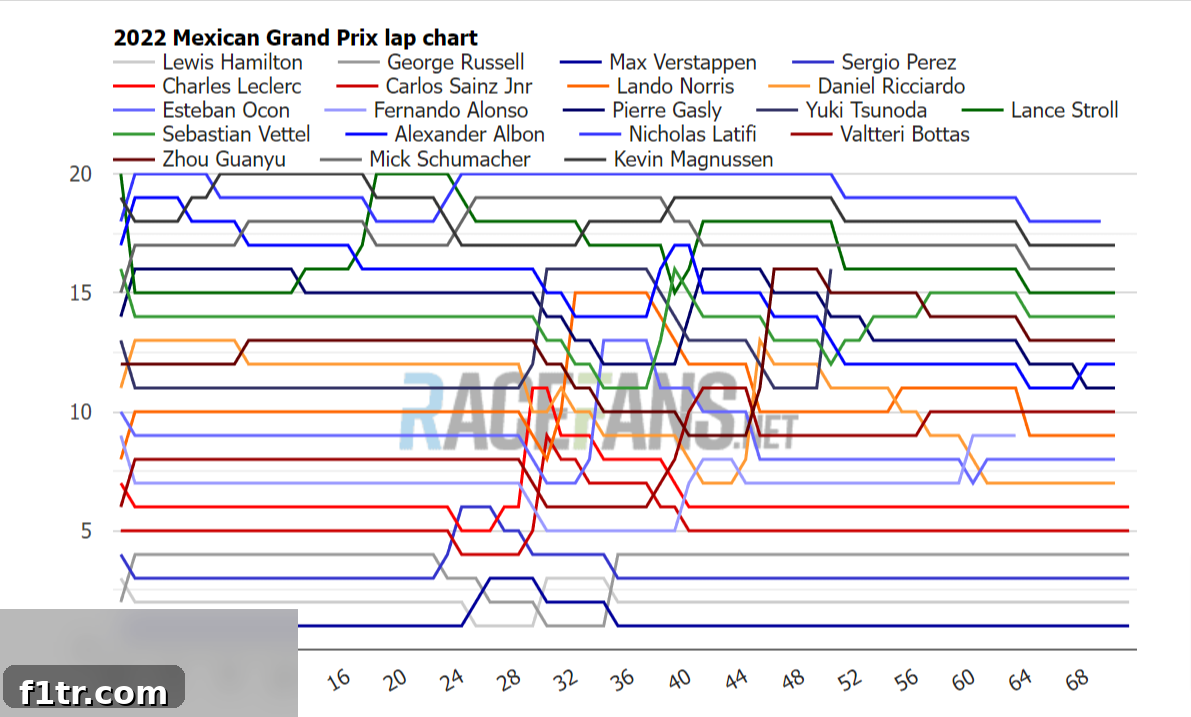
A comprehensive lap chart would show the position of each driver on every lap, clearly depicting how Max Verstappen maintained his lead from start to finish, while Lewis Hamilton’s progress stalled after his pit stop. The race chart, illustrating the gaps between drivers compared to the leader’s average lap time, would underscore Verstappen’s consistent pace and the gradual widening of the gap to Hamilton as the hard tyres struggled to find grip. Similarly, an examination of individual lap times would highlight the comparative struggles of the hard compound and the explosive speed of the soft tyres, especially in the hands of George Russell late in the race. These graphical representations, if available in an interactive format, would tell the story of the race’s strategic unfolding in vivid detail.
The Fastest Laps and Pit Stop Efficiency
The fastest lap standings are a direct indicator of raw pace and tyre performance. George Russell’s sensational 1’20.153 on the final lap, on fresh soft tyres, was a clear statement. It demonstrated not only his individual speed but also the untapped potential that Mercedes seemingly left on the table by not utilizing softer compounds for a longer race stint. Sergio Perez, on home turf, also demonstrated strong pace with the second-fastest lap, followed closely by Daniel Ricciardo. The fact that the top five fastest laps included drivers from Mercedes, Red Bull, and McLaren on various compounds and at different stages of the race speaks volumes about the evolving track conditions and the critical role of tyre choices.
Pit stop efficiency is another silent hero of Grand Prix racing. While Mercedes grappled with strategic tyre choices, McLaren demonstrated exceptional operational prowess. Daniel Ricciardo’s 1.95-second stationary pit stop was a testament to the crew’s precision and speed, a crucial element in his successful drive through the field. Ferrari’s Charles Leclerc, while not having the fastest stationary stop, recorded the quickest total time from pit entry to exit, showcasing a comprehensive pit lane strategy. These small margins can make or break a race, as evidenced by how such efficiency contributed to Ricciardo’s positive outcome.
Advert | Become a RaceFans supporter andgo ad-free
2022 Mexican Grand Prix fastest laps
Each driver’s fastest lap:
| Rank | No. | Driver | Car | Lap time | Gap | Average speed (kph) | Lap no. |
|---|---|---|---|---|---|---|---|
| 1 | 63 | George Russell | Mercedes | 1’20.153 | 193.31 | 71 | |
| 2 | 11 | Sergio Perez | Red Bull | 1’21.775 | 1.622 | 189.48 | 30 |
| 3 | 3 | Daniel Ricciardo | McLaren-Mercedes | 1’22.022 | 1.869 | 188.91 | 48 |
| 4 | 1 | Max Verstappen | Red Bull | 1’22.046 | 1.893 | 188.85 | 36 |
| 5 | 44 | Lewis Hamilton | Mercedes | 1’22.062 | 1.909 | 188.81 | 32 |
| 6 | 55 | Carlos Sainz Jnr | Ferrari | 1’22.199 | 2.046 | 188.5 | 32 |
| 7 | 24 | Zhou Guanyu | Alfa Romeo-Ferrari | 1’22.260 | 2.107 | 188.36 | 47 |
| 8 | 10 | Pierre Gasly | AlphaTauri-Red Bull | 1’22.277 | 2.124 | 188.32 | 42 |
| 9 | 18 | Lance Stroll | Aston Martin-Mercedes | 1’22.463 | 2.310 | 187.9 | 42 |
| 10 | 16 | Charles Leclerc | Ferrari | 1’22.603 | 2.450 | 187.58 | 48 |
| 11 | 14 | Fernando Alonso | Alpine-Renault | 1’22.866 | 2.713 | 186.98 | 48 |
| 12 | 23 | Alexander Albon | Williams-Mercedes | 1’22.914 | 2.761 | 186.87 | 48 |
| 13 | 5 | Sebastian Vettel | Aston Martin-Mercedes | 1’23.086 | 2.933 | 186.49 | 45 |
| 14 | 31 | Esteban Ocon | Alpine-Renault | 1’23.279 | 3.126 | 186.05 | 48 |
| 15 | 20 | Kevin Magnalled | Haas-Ferrari | 1’23.300 | 3.147 | 186.01 | 49 |
| 16 | 77 | Valtteri Bottas | Alfa Romeo-Ferrari | 1’23.363 | 3.210 | 185.87 | 43 |
| 17 | 4 | Lando Norris | McLaren-Mercedes | 1’23.402 | 3.249 | 185.78 | 48 |
| 18 | 22 | Yuki Tsunoda | AlphaTauri-Red Bull | 1’23.403 | 3.250 | 185.78 | 48 |
| 19 | 47 | Mick Schumacher | Haas-Ferrari | 1’23.641 | 3.488 | 185.25 | 30 |
| 20 | 6 | Nicholas Latifi | Williams-Mercedes | 1’23.709 | 3.556 | 185.1 | 56 |
Advert | Become a RaceFans supporter andgo ad-free
2022 Mexican Grand Prix tyre strategies
Analyzing the tyre strategies employed by each driver offers crucial insights into the race dynamics. While an interactive chart would visually map out each driver’s compound usage and pit stop laps, the overarching trend shows a clear split. Teams that successfully leveraged the soft compound early on, coupled with strong tyre management, reaped significant rewards. Max Verstappen’s soft-to-medium strategy was the epitome of success, enabling a single, efficient stop. Conversely, Mercedes’ medium-to-hard approach, though intended to be a robust one-stopper, proved too conservative, particularly given the hard tyre’s lack of performance at the circuit. Other drivers, like Daniel Ricciardo, showcased that variations of softer compounds for extended stints could also yield positive results, provided there was good tyre preservation.
Advert | Become a RaceFans supporter andgo ad-free
2022 Mexican Grand Prix pit stop times
How long each driver’s pit stops took:
| Rank | No. | Driver | Team | Complete stop time (s) | Gap to best (s) | Stop no. | Lap no. |
|---|---|---|---|---|---|---|---|
| 1 | 16 | Charles Leclerc | Ferrari | 22.193 | 1 | 28 | |
| 2 | 3 | Daniel Ricciardo | McLaren | 22.28 | 0.087 | 1 | 44 |
| 3 | 31 | Esteban Ocon | Alpine | 22.343 | 0.15 | 1 | 33 |
| 4 | 22 | Yuki Tsunoda | AlphaTauri | 22.468 | 0.275 | 1 | 29 |
| 5 | 1 | Max Verstappen | Red Bull | 22.487 | 0.294 | 1 | 25 |
| 6 | 5 | Sebastian Vettel | Aston Martin | 22.534 | 0.341 | 1 | 38 |
| 7 | 4 | Lando Norris | McLaren | 22.585 | 0.392 | 1 | 31 |
| 8 | 63 | George Russell | Mercedes | 22.795 | 0.602 | 1 | 34 |
| 9 | 63 | George Russell | Mercedes | 23.118 | 0.925 | 2 | 69 |
| 10 | 18 | Lance Stroll | Aston Martin | 23.119 | 0.926 | 2 | 40 |
| 11 | 14 | Fernando Alonso | Alpine | 23.159 | 0.966 | 1 | 40 |
| 12 | 23 | Alexander Albon | Williams | 23.182 | 0.989 | 1 | 38 |
| 13 | 44 | Lewis Hamilton | Mercedes | 23.194 | 1.001 | 1 | 29 |
| 14 | 55 | Carlos Sainz Jnr | Ferrari | 23.469 | 1.276 | 1 | 29 |
| 15 | 18 | Lance Stroll | Aston Martin | 23.509 | 1.316 | 1 | 17 |
| 16 | 47 | Mick Schumacher | Haas | 23.679 | 1.486 | 1 | 24 |
| 17 | 20 | Kevin Magnussen | Haas | 23.722 | 1.529 | 1 | 38 |
| 18 | 6 | Nicholas Latifi | Williams | 23.826 | 1.633 | 1 | 23 |
| 19 | 77 | Valtteri Bottas | Alfa Romeo | 23.863 | 1.67 | 1 | 39 |
| 20 | 6 | Nicholas Latifi | Williams | 24.039 | 1.846 | 2 | 52 |
| 21 | 24 | Zhou Guanyu | Alfa Romeo | 24.218 | 2.025 | 1 | 45 |
| 22 | 11 | Sergio Perez | Red Bull | 24.892 | 2.699 | 1 | 23 |
| 23 | 10 | Pierre Gasly | AlphaTauri | 29.168 | 6.975 | 1 | 40 |
Lessons Learned and Future Implications
The 2022 Mexican Grand Prix serves as a compelling case study in Formula 1 strategy. Mercedes’ decision to lean on the hard tyre, driven by what they likely perceived as a safer, more predictable one-stop approach, ultimately proved to be their undoing. The race highlighted the critical importance of accurate pre-race data analysis and the flexibility to adapt strategies when track conditions or tyre performance deviate from expectations.
Red Bull’s victory was not just a testament to Max Verstappen’s driving brilliance but also to their strategic team’s ability to accurately assess tyre performance and exploit opportunities. Their aggressive soft-medium strategy, combined with Verstappen’s unparalleled tyre management, demonstrated a proactive and confident approach that Mercedes lacked on this particular Sunday. For Mercedes, the race provided painful lessons about understanding tyre characteristics at specific venues and trusting their drivers’ feedback, potentially influencing their strategic calls in future high-stakes races.
The strategic battle in Mexico City underscored that in modern Formula 1, championship success is a delicate balance of car performance, driver skill, and impeccable strategic execution. While Mercedes continued their fight for race victories, this event, in particular, emphasized that even the most dominant teams can stumble if their strategic gambles don’t pay off.
2022 Mexican Grand Prix
- How many victory chances did Hamilton have in his first winless F1 season?
- Delay in producing new parts held up Alfa Romeo upgrade
- Doohan’s practice run earns praise, but Alpine undecided over reserve role
- ‘I was in the fight, which hasn’t been often this year’: Ricciardo’s Mexican GP transcript
- Verstappen “will continue to break records for the rest of his career” – rivals
Browse all 2022 Mexican Grand Prix articles