The 2000 Formula 1 season delivered an unforgettable spectacle, etching numerous dramatic moments into the annals of motorsport history. From the chaotic and rain-soaked German Grand Prix to the breathtaking fight for victory on the legendary Spa-Francorchamps circuit in Belgium, fans were treated to a season of intense competition. The climax arrived in Japan, where Michael Schumacher achieved a monumental feat, securing his third World Championship and, more importantly, bringing Ferrari their first drivers’ title in an astounding 21 years. This victory marked a pivotal moment, not just for Schumacher, but for the Scuderia and the entire sport.
Despite the drivers’ championship being decided, the season’s grand finale at the Sepang International Circuit in Malaysia still held immense significance. For only the second time in its history, the Malaysian Grand Prix hosted the final race of the championship, a unique occurrence in Formula 1 lore. While Schumacher had already sealed his destiny as the drivers’ champion, the coveted Constructors’ Championship remained fiercely contested, promising a gripping conclusion to an already thrilling season. However, the battle for the constructors’ crown would be resolved with surprising speed, even before the race reached its midpoint.
Advert | Become a Supporter & go ad-free
2000 Malaysian Grand Prix Qualifying: A Mix of Triumph and Farewell
The final race weekend of the 2000 season was a tapestry of contrasting emotions, blending moments of triumph with poignant farewells for several prominent figures. Among those preparing to depart was Jenson Button, who, despite an impressive rookie season with Williams, was making way for the highly anticipated arrival of Juan Pablo Montoya. Button’s journey in Formula 1 was far from over, as he would go on to achieve championship glory in 2009. More permanent was the departure of fellow British racer Johnny Herbert, whose illustrious 12-year career, culminating with Jaguar, was drawing to a close after 160 Grand Prix starts. It was a somber moment for a driver who had contributed so much to the sport.
Meanwhile, Alexander Wurz was also bidding adieu to a challenging three-year stint at Benetton. Seizing a final opportunity to showcase his capabilities, Wurz opted to drive the team’s sole special ‘qualifying car’ – a decision his teammate Giancarlo Fisichella had, for once, surprisingly foregone. Benefiting from the latest-specification Renault hardware, Wurz delivered a stellar performance, expertly piloting his car to fifth position on the grid. This remarkable result placed him directly behind the formidable pairs of McLarens and Ferraris, serving as a powerful reminder of his raw talent as he transitioned to a test driver role for McLaren in the upcoming season. Wurz’s exceptional showing underscored his potential and left a lasting impression as he stepped back from full-time racing.
Michael Schumacher, fresh off clinching his third world title, demonstrated his unparalleled skill in qualifying, mastering the Ferrari to devastating effect. He claimed his fourth consecutive pole position and a remarkable ninth of the season, outpacing all other drivers combined in terms of pole starts. His blistering lap secured pole by almost half a second, highlighting the German’s dominance and Ferrari’s superior package. His teammate, Rubens Barrichello, had been poised to join Schumacher on the front row, only to be narrowly pipped by both McLarens in the dying seconds of the session, falling short by less than four hundredths of a second. This incredibly tight margin underscored the fierce competition at the front of the grid.
The midfield battle was equally intense, with marginal differences separating several drivers. The fight for grid positions saw Wurz, Jacques Villeneuve’s BAR, Eddie Irvine’s Jaguar, and Ralf Schumacher’s Williams all within fractions of a second of each other, promising an exciting race day. The Jordan duo of Jarno Trulli and Heinz-Harald Frentzen completed the top 10, showcasing their consistent performance. The sixth row was notable for featuring two drivers on the cusp of significant career changes: Ricardo Zonta’s BAR seat was set to be filled by Olivier Panis, the very driver Wurz was replacing at McLaren. Meanwhile, Johnny Herbert prepared for his final F1 start from 12th position, a fitting but bittersweet place to begin his swansong race.
Jenson Button, hampered by an engine change, found himself in an uncharacteristically low 16th position on the grid. Behind him, the two Sauber drivers were sandwiched by the Prost pair, while Marc Gene delivered a commendable performance for Minardi. The same could not be said for Gaston Mazzacane, though his significant financial backing ensured this would not be his last appearance in Formula 1. The qualifying session thus set the stage for a race filled with strategic intrigue, emotional farewells, and the final chapter of a memorable Formula 1 season.
| Position | Driver | Team | Time |
|---|---|---|---|
| 1 | Michael Schumacher | Ferrari | 1’37.397 |
| 2 | Mika Hakkinen | McLaren | 1’37.860 |
| 3 | David Coulthard | McLaren | 1’37.889 |
| 4 | Rubens Barrichello | Ferrari | 1’37.896 |
| 5 | Alexander Wurz | Benetton | 1’38.644 | 6 | Jacques Villeneuve | BAR | 1’38.653 |
| 7 | Eddie Irvine | Jaguar | 1’38.696 |
| 8 | Ralf Schumacher | Williams | 1’38.739 |
| 9 | Jarno Trulli | Jordan | 1’38.909 |
| 10 | Heinz-Harald Frentzen | Jordan | 1’38.988 | 11 | Ricardo Zonta | BAR | 1’39.158 |
| 12 | Johnny Herbert | Jaguar | 1’39.331 |
| 13 | Giancarlo Fisichella | Benetton | 1’39.387 |
| 14 | Pedro de la Rosa | Arrows | 1’39.443 |
| 15 | Jos Verstappen | Arrows | 1’39.489 |
| 16 | Jenson Button | Williams | 1’39.563 |
| 17 | Mika Salo | Sauber | 1’39.591 |
| 18 | Jean Alesi | Prost | 1’40.065 |
| 19 | Nick Heidfeld | Prost | 1’40.148 |
| 20 | Pedro Diniz | Sauber | 1’40.521 |
| 21 | Marc Gene | Minardi | 1’40.662 |
| 22 | Gaston Mazzacane | Minardi | 1’42.078 |
Advert | Become a RaceFans supporter and go ad-free
2000 Malaysian Grand Prix: Drama, Strategy, and a Historic Triumph
Despite being out-classed by Ferrari in qualifying, the McLaren MP4-15s showcased formidable race pace from the very moment the red lights extinguished. However, both McLaren drivers, Mika Hakkinen and David Coulthard, would see their strong starting positions and initial pace squandered through a series of dramatic events early in the race. The constructors’ title, though seemingly within McLaren’s reach, began to slip away almost immediately after the start.
The drama began with Mika Hakkinen. In a bizarre replay of an incident involving Coulthard just four weeks prior at Indianapolis, Hakkinen’s McLaren twitched forward prematurely before the start lights went out. The Finn later claimed he thought he saw Schumacher move in his peripheral vision, but race stewards, after reviewing the footage, conclusively deemed Hakkinen to be the sole driver to have jumped the start. By this point, Hakkinen had already rocketed into the lead, with Coulthard expertly pouncing on Michael Schumacher to claim second place. But the chaos was far from over. A multi-car collision at the exit of turn two involving Pedro Diniz, Nick Heidfeld, and Pedro de la Rosa prematurely ended their seasons, scattering wheels and debris across the track and necessitating an early deployment of the Safety Car. The incident further heightened the tension of the season finale.
Following the Safety Car period and the race restart, Hakkinen, carrying a heavier fuel load, strategically allowed David Coulthard to take the lead. This appeared to be a shrewd tactical move, aligning with McLaren’s race strategy. However, much to the team’s dismay, Hakkinen subsequently lost positions to both Ferrari drivers, Michael Schumacher and Rubens Barrichello, a turn of events certainly not part of the meticulously planned strategy. To compound McLaren’s woes, the stewards soon issued Hakkinen a stop-and-go penalty for his jump start, a critical blow that relegated him to the very back of the field, effectively ending his hopes for victory and significantly impacting McLaren’s constructors’ championship aspirations.
For the initial dozen laps, David Coulthard held command, maintaining a strong lead and at times pulling over a second clear of Michael Schumacher. The Scottish driver appeared to be executing McLaren’s strategy flawlessly, benefiting from his lighter fuel load. However, McLaren’s hopes for victory were suddenly dashed after just twelve laps. Coulthard ran wide at turn three, collecting a significant amount of dirt on his tyres. Crucially, some of this debris found its way into his car’s radiators. Given the notoriously high ambient temperatures and humidity at Sepang, cooling became an immediate and major concern for the team. This forced McLaren to make an unplanned early pit stop to clear the sidepods and ensure proper engine cooling.
Though Coulthard quickly rejoined the race, his early pit stop and the unexpected issue had surrendered much of the strategic advantage his lighter fuel load was designed to provide. His race strategy was now severely compromised. In contrast, Michael Schumacher ran a significantly longer first stint, a testament to Ferrari’s superior fuel management and strategy. With the benefit of a lighter fuel load during his pit stop, Schumacher inevitably emerged ahead of Coulthard, effectively taking control of the race. The detrimental impact of Coulthard’s compromised first stint became glaringly clear throughout the remainder of the Grand Prix. While he managed to close the gap to Schumacher, often hovering within a second, he never genuinely looked poised to reclaim the lead. The two titans crossed the finish line separated by less than a second, with Schumacher holding firm to clinch his fourth victory in a row at Sepang.
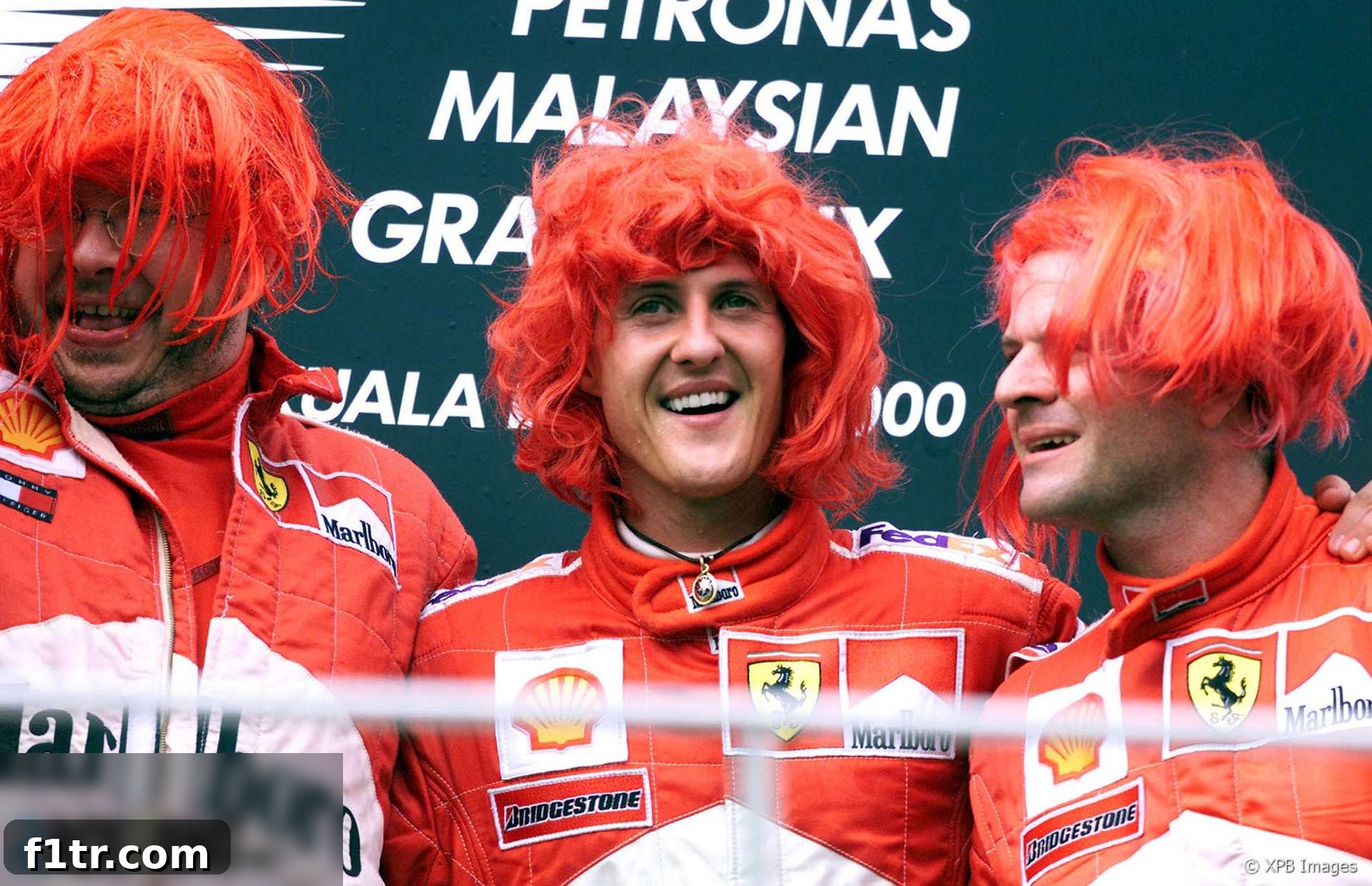
With Michael Schumacher’s win appearing increasingly likely from the early stages of the race, much of the intrigue surrounding the Constructors’ Championship outcome quickly dissipated. Ferrari, requiring only three points – equivalent to a fourth-place finish at the time – to secure the title, comfortably achieved this objective. Rubens Barrichello’s strong third-place finish more than fulfilled this requirement, sealing a historic triumph for the Scuderia. The celebrations on the podium were exuberant, with Schumacher, Barrichello, and technical director Ross Brawn donning startlingly bright red wigs, commemorating Ferrari’s first championship double (both drivers’ and constructors’ titles) since 1979. It was a moment of immense pride and joy for the entire team.
This tenth Constructors’ title held profound historical significance for Ferrari. It propelled them ahead of Williams, establishing them as the most successful team in the storied history of Formula 1 – a remarkable record they continue to hold to this day. The achievement cemented their legacy as a dominant force in the sport, laying the groundwork for an era that would redefine F1 history. Despite his early setback and penalty, Mika Hakkinen’s McLaren proved fast enough for him to stage an impressive recovery drive, ultimately securing a valuable fourth place. Jacques Villeneuve delivered a commendable performance for BAR, putting up a strong fight, but he was ultimately unable to contain Hakkinen’s superior pace, finishing over half a minute adrift. His two points for fifth place capped off an excellent second season for BAR, who finished an impressive fifth in the championship standings – a monumental improvement from their embarrassing, point-less debut season.
In stark contrast, Jaguar, having inherited the Stewart team’s fourth-place finish from the previous year, endured a profoundly disappointing season. Eddie Irvine’s sixth-place finish in Malaysia marked only their second points-scoring result of the year, a meager return that left them languishing in ninth position in the constructors’ standings. Johnny Herbert’s final race in Formula 1 ended in a painful and unfortunate manner. A suspension failure violently pitched his Jaguar into a wall, bringing a premature and disheartening conclusion to his distinguished career. Ford, who had invested heavily in re-branding Stewart as Jaguar, must have questioned the wisdom of their Formula 1 venture as their performance brand concluded its inaugural season ahead of only Minardi and Prost, neither of which scored a single point all year. Jaguar had entered the 2000 season with bold aspirations of challenging the mighty Ferrari. However, as the season drew to a close, the Scuderia had unequivocally swept all before them. As history would soon reveal, this phenomenal success was merely the prelude to an unparalleled period of dominance by Michael Schumacher and Ferrari, forever changing the landscape of Formula 1.
Advert | Become a RaceFans supporter and go ad-free
2000 Malaysian Grand Prix Result
| Position | Driver | Team | Laps | Time / laps / reason |
|---|---|---|---|---|
| 1 | Michael Schumacher | Ferrari | 56 | 1:35’54.235 |
| 2 | David Coulthard | McLaren | 56 | +0.732 |
| 3 | Rubens Barrichello | Ferrari | 56 | +18.444 |
| 4 | Mika Hakkinen | McLaren | 56 | +35.269 |
| 5 | Jacques Villeneuve | BAR | 56 | +10.692 |
| 6 | Eddie Irvine | Jaguar | 56 | +12.568 |
| 7 | Alexander Wurz | Benetton | 56 | +29.314 |
| 8 | Mika Salo | Sauber | 55 | +1 lap |
| 9 | Giancarlo Fisichella | Benetton | 55 | +1 lap |
| 10 | Jos Verstappen | Arrows | 55 | +1 lap |
| 11 | Jean Alesi | Prost | 55 | +1 lap |
| 12 | Jarno Trulli | Jordan | 55 | +1 lap |
| 13 | Gaston Mazzacane | Minardi | 50 | Engine |
| 14 | Johnny Herbert | Jaguar | 48 | Suspension |
| 15 | Ricardo Zonta | BAR | 46 | Engine |
| 16 | Ralf Schumacher | Williams | 43 | Engine |
| 17 | Marc Gene | Minardi | 36 | Wheel |
| 18 | Jenson Button | Williams | 18 | Engine |
| 19 | Heinz-Harald Frentzen | Jordan | 7 | Electrical |
| 20 | Pedro de la Rosa | Arrows | 0 | Collision |
| 21 | Nick Heidfeld | Prost | 0 | Collision |
| 22 | Pedro Diniz | Sauber | 0 | Collision |
2000 Malaysian Grand Prix Championship Standings
The 2000 Malaysian Grand Prix solidified the final championship standings, confirming Ferrari’s supremacy in both the Drivers’ and Constructors’ titles, marking a definitive end to a memorable season and signaling the dawn of a new era of dominance.
Join the RaceFans Supporters Drive!
If you’ve enjoyed RaceFans’ motor sport coverage during 2020, please take a moment to find out more about our Supporter Drive.
We’re aiming to welcome 3,000 new Supporters to help fund RaceFans so we can continue to produce quality, original, independent motorsport coverage. Here’s what we’re asking for and why – and how you can sign up:
- Join the RaceFans Supporters Drive!
F1 History Insights
Explore more captivating stories and analyses from Formula 1’s rich past:
- When did F1 last have a mid-season break longer than five weeks? 1990
- Did Norris actually win Formula 1’s closest championship fight of all time?
- Hamilton is Ferrari’s first new driver in 44 years to complete season without a podium
- Ferrari are on course to lose an F1 record they’ve held since 2004
- Red Bull in 2010 or Ferrari in 1979? Past title fights illustrate McLaren’s current dilemma
Browse all history articles