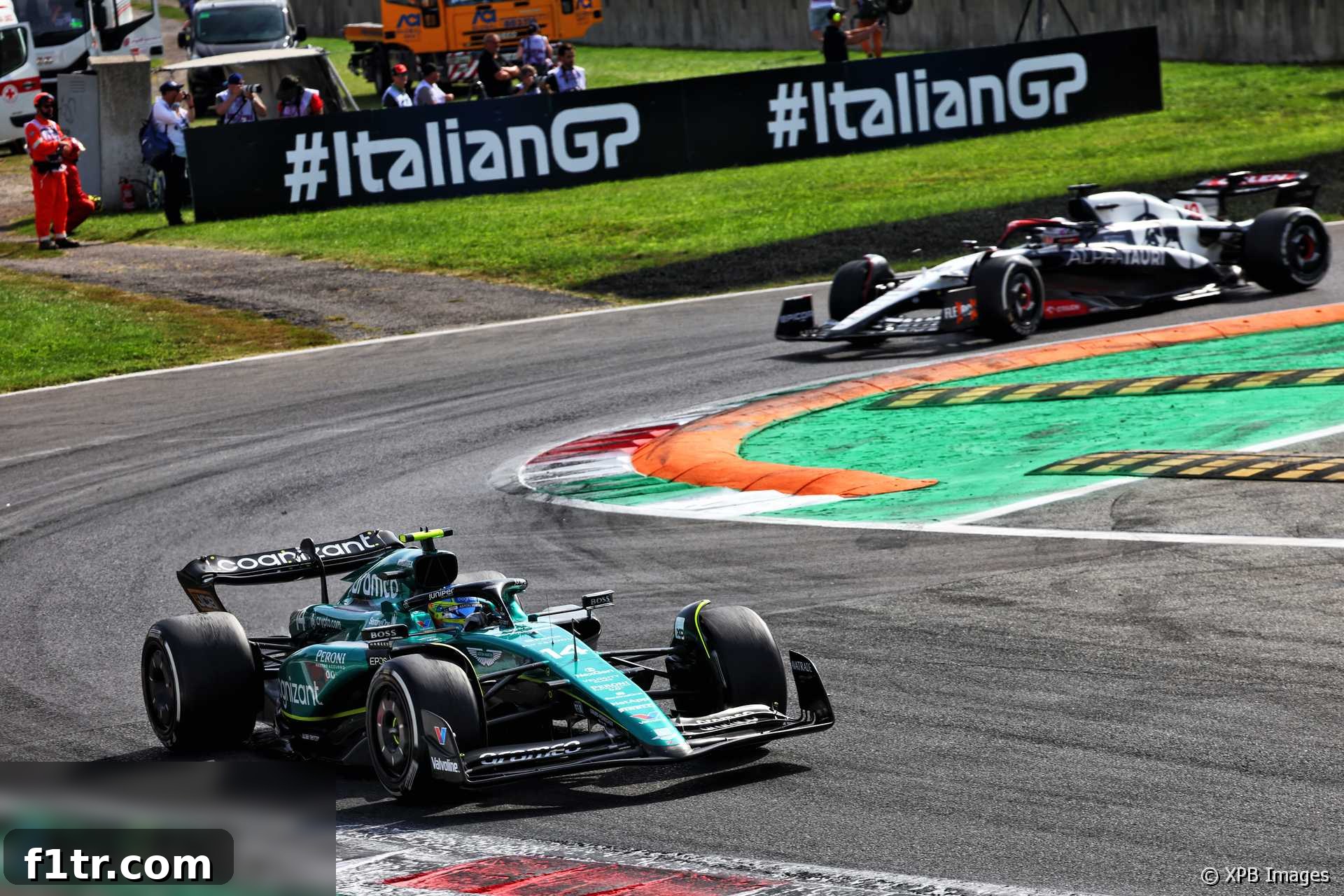
Following the exhilarating return to the podium at Zandvoort, the Aston Martin Aramco Cognizant Formula 1 Team encountered its most challenging and least competitive weekend of the 2023 F1 season so far at the iconic Autodromo Nazionale Monza. The stark contrast in performance between the high-downforce, technical circuit of Zandvoort and the low-downforce, high-speed ‘Temple of Speed’ in Italy underscored the nuanced demands of modern Formula 1 and highlighted specific areas for the Silverstone-based team to address as the season progresses.
For star driver Fernando Alonso, the Italian Grand Prix proved to be a rare dip in what has otherwise been an exceptional year. His ninth-place finish marked his joint worst race result of the 2023 campaign, a testament to the team’s overall struggle rather than any lack of effort from the two-time world champion. Compounding this, a tenth-place starting position on the grid represented his lowest qualifying slot since joining Aston Martin at the beginning of the season, a clear indicator of the AMR23’s discomfort with the Monza layout.
The performance deficit was significant, leaving little room for an optimistic spin. Alonso crossed the finish line a substantial 46 seconds behind the race winner, and perhaps more tellingly, 23 seconds adrift of fifth place. In qualifying, the gap to the pole-winning time was a staggering 1.123 seconds. To put this into perspective, Alonso would have needed to find an additional 0.439 seconds just to climb a single position on the grid. His teammate, Lance Stroll, faced even greater difficulties, qualifying last after being eliminated in Q1, with an 0.817-second gap to Alonso in that initial session. This collective struggle underscored the fact that Monza simply did not play to the AMR23’s strengths.
Reflecting on the grueling weekend, Alonso didn’t mince words, expressing the profound mental and physical toll the race had taken. “We were slow from the beginning to the end and not possible to fight better than ninth. So we take these points, but hopefully many lessons,” Alonso told media, including RaceFans. He elaborated on the demanding nature of the Italian Grand Prix: “It is frustrating because it was a very demanding race mentally, physically, to drive the car that was with very low grip, very tricky to drive. So for me, one of the most difficult races of the year.”
Despite the challenging outcome, Alonso, ever the pragmatist, acknowledged the team’s unwavering commitment. “And it’s the worst result, so it’s going to be an anonymous race. No one will remember this. But I will do, in my head because it has been a tough one. But as I said, hopefully good lessons that we take from here on the car, all the data that we have from the race and we get better next time.” His veteran insight highlights the importance of extracting every possible lesson from difficult weekends, reinforcing his belief that the team consistently extracts the maximum potential from the AMR23, even when that maximum isn’t quite enough to challenge at the very front.
Aston Martin’s performance director, Tom McCullough, offered a measured and analytical perspective on the team’s Monza performance. Despite the significant pace deficit, particularly evident in Q3, McCullough was not unduly discouraged. He pointed out that in the first two segments of qualifying, Alonso’s deficit to the leading cars was considerably smaller, suggesting that the core pace of the AMR23 wasn’t entirely off the mark in all conditions. “The margin in Q1 and Q2, it wasn’t that far from what we were thinking,” said McCullough. He acknowledged the competitive landscape: “We were pretty close most of the weekend with Mercedes. They have been marginally quicker than us, as have McLaren and Williams too. But ultimately small margins, but it wasn’t our best qualifying session.” This detailed analysis points towards a specific issue that hampered their Q3 performance rather than a fundamental flaw in the car’s design.
A key factor complicating the weekend was Formula 1’s ‘Alternative Tyre Allocation’ (ATA), implemented for only the second time in the 2023 season. This experimental format mandated the use of the hard compound tyre in Q1, followed by the medium in Q2, and the soft in Q3. It was precisely with this crucial soft compound that Aston Martin’s problems at Monza appeared to manifest most acutely. This alternative allocation significantly alters typical tyre strategy, forcing teams to adapt their car setups and driving styles to different compounds across the qualifying sessions, rather than having the freedom to choose based on optimal performance.
McCullough elaborated on the team’s struggle with the soft tyre: “I think we got a lot out of the hard and the medium tyre. The soft tyre wasn’t strong for us. We had two goes with it.” He continued, emphasizing the need for deeper understanding: “We’ve still got some analysis to do to help understand this track on a tyre that we normally get to work well. We didn’t really get too much more than we got from it in free practice three either, so we were three or four tenths quicker. But some teams found more. So we need to understand.” This indicates that while the AMR23 typically performs well on soft tyres, Monza presented a unique challenge where they couldn’t unlock the compound’s full potential, unlike some of their rivals.
The root cause, according to McCullough, lay in the specific “characteristics of our car, at this track,” which simply did not align with the demands of the soft tyres at Monza. He clarified, “There wasn’t really a balance issue, it was overall grip.” This distinction is critical: a balance issue suggests the car is unstable or difficult to control, while a lack of overall grip implies the tyres simply aren’t generating enough adhesion to the track surface, leading to slower cornering speeds and reduced acceleration. Interestingly, the Aston Martin AMR23 showed “no sort of degradation during the lap, no warm-up problems” when running the compound, which suggests the issue wasn’t related to tyre management or temperature, but rather an inherent inability to generate peak grip from the soft compound in Monza’s unique low-downforce configuration.
Monza, with its long straights, fast chicanes, and minimal cornering sections requiring ultra-low downforce setups, is an outlier on the Formula 1 calendar. Cars typically remove as much wing as possible to maximize straight-line speed. This setup can expose weaknesses in a car’s mechanical grip or its ability to generate aerodynamic grip without significant downforce elements. The AMR23, which has often thrived on more technical, high-downforce tracks where its strong front end and aero efficiency come into play, found itself struggling to adapt to Monza’s unique demands, particularly with the soft tyres.
Looking ahead, there is renewed optimism within the Aston Martin camp for the upcoming races. The next event in Singapore “is definitely a track that will suit us better,” McCullough believes. The Marina Bay Street Circuit, a demanding high-downforce urban track with numerous corners and limited straights, offers a stark contrast to Monza. This circuit’s characteristics, requiring maximum grip, precise handling, and excellent aerodynamic performance, align far more closely with the inherent strengths of the AMR23. The team is also set to introduce new parts for the AMR23 in Singapore, developments that were signed off prior to the Monza weekend. These upgrades are crucial as they aim to maximize the car’s performance in the remaining races and gather valuable data for future designs.
Beyond the immediate future of the 2023 season, Aston Martin’s strategic focus has already begun shifting towards the development of the 2024 challenger, the AMR24. McCullough outlined this transition: “Among the areas that we’ve worked on, there’s a lot of the elements actually that influence the efficiency of the car. And from now until the end of the season, most of the tracks are not the higher efficiency tracks, and our focus is really on the AMR24 to make sure that as we’re developing that car, we’re developing it as efficiently as we can be. And more efficient than this year’s car.” This emphasis on “efficiency” is paramount in modern F1, referring not just to aerodynamic efficiency (less drag for more downforce) but also to how effectively the car manages its tyres, fuel, and overall energy, translating into consistent performance across diverse circuits.
The 2023 season has been a story of remarkable highs and occasional lows for Aston Martin. From their surprise podium surge at the start of the year to the challenges faced at circuits like Monza, the journey has been a learning curve. While the Monza weekend was undeniably a setback, it offers a crucial opportunity for introspection and targeted development. The team’s ability to swiftly analyze their data, understand their limitations on specific tracks and tyre compounds, and pivot their focus towards continuous improvement, both for the current AMR23 and the future AMR24, will be key to their long-term success in Formula 1. The disappointment of Monza, therefore, serves not as a deterrent, but as a vital lesson in their ambitious quest to become a championship-contending team.
2023 Italian Grand Prix
- Despite close battles at Monza, F1 drivers want more powerful DRS
- Monza “frustrating” for Alonso but Aston Martin expect better form in coming races
- F1 changed rules to stop Mercedes in 2021 but we won’t ‘cry foul’ now – Wolff
- McLaren will bring ‘follow-up to Austria upgrade’ before focusing on 2024 car
- Magnussen explains why his driving style rarely works with the Haas VF-23
Browse all 2023 Italian Grand Prix articles