The 2023 Formula 1 season had been a relentless march of dominance for Red Bull Racing, with the formidable RB19 proving to be a class apart on virtually every circuit. However, as the highly anticipated Singapore Grand Prix weekend commenced, the reigning champions found themselves grappling with an unfamiliar and deeply perplexing challenge. Their qualifying performance on the demanding Marina Bay street circuit was nothing short of mystifying, seeing both their star drivers, Max Verstappen and Sergio Perez, relegated outside the top ten starting grid positions. This was an unprecedented setback in a season where pole positions and front-row lockouts had become a standard expectation for the Milton Keynes-based squad, immediately raising questions about the RB19’s compatibility with the unique demands of the Singapore track.
Advert | Become a Supporter & go ad-free
Yet, amidst the initial disappointment, the Singapore Grand Prix race itself began to unravel the complex enigma surrounding the RB19’s unexpected struggles. As the floodlit night enveloped the Marina Bay circuit, a subtle but significant shift in performance emerged. The Red Bull cars started to show glimpses of their customary pace, gradually improving relative to their rivals as the race progressed. This newfound understanding left Red Bull Team Principal Christian Horner pondering the tantalizing ‘what if’ – what could have been achieved had their strategic dice rolled differently, or had they unlocked the car’s potential earlier in the weekend.
Horner articulated the team’s evolving comprehension: “We understood a lot more in the race, and crucially, the pace of the car came much more back to what we expected.” He acknowledged that while they anticipated a tighter contest in Singapore, the sheer magnitude of their performance deficit during Friday practice and Saturday’s qualifying sessions caught them off guard. The core issue, as identified by the team, revolved around failing to locate the optimal “operating window” for the RB19, particularly for a single, blistering qualifying lap. This critical window dictates how the car’s aerodynamic balance, suspension, and especially the Pirelli tyres interact to deliver peak performance. When a car operates outside this narrow window, the consequences are immediate and detrimental.
“When you’re not there,” Horner elaborated, “then the tyres feel horrible, everything just doesn’t work. So, I think we got a very good steer in the race.” This sentiment highlights the delicate balance required in Formula 1 engineering; even a fraction off the ideal setup can render the tyres ineffective, leading to a profound lack of grip, poor braking performance, and reduced cornering speeds. The race, therefore, served as an invaluable live testing session, providing Red Bull with crucial data and insights into the RB19’s intricate relationship with the unique track conditions of Singapore.
Facing a challenging starting position, Red Bull opted for an audacious and high-stakes strategic gamble: both Max Verstappen and Sergio Perez began the Singapore Grand Prix on the durable hard compound tyres. This decision was predicated on the expectation of a Safety Car intervention, a common occurrence on the unforgiving street circuit, which would allow them to make their mandatory pit stop with minimal time loss. The hope was that rivals on softer, faster-degrading compounds would be forced to pit earlier, leaving Red Bull in a stronger position when a Safety Car eventually emerged, effectively granting them a ‘cheap’ pit stop.
However, the intricate dance of Formula 1 strategy often hinges on timing, and for Red Bull, the Safety Car’s appearance proved to be a cruel twist of fate. Christian Horner elaborated on the unfortunate turn of events: “Unfortunately, in the race, by starting on the hard we took, if you like, a strategic gamble, and the best way of that race paying us off is if you get an early Safety Car or a Safety Car sort of later into the race.” The strategy was sound in theory, designed to capitalize on the unique characteristics of the Marina Bay circuit and the anticipated tyre wear.
Yet, the reality unfolded differently. “Now, the lap that the safety car came out in was probably strategically the worst possible lap for the strategy that we were on because it gave the cars ahead of us a free stop,” Horner confirmed. This perfectly encapsulates the razor-thin margins in F1 strategy. The Safety Car deployed on Lap 20, following an incident, created a golden opportunity for almost the entire field. Cars that had started on medium or soft tyres and were already nearing their pit window could dive into the pits under Safety Car conditions, effectively eliminating the time penalty of a regular pit stop. For Red Bull, who still needed to stretch their hard tyres much further, this timing was catastrophic, turning their intended advantage into a significant disadvantage.
As the Safety Car period unfolded, nearly the entire grid seized the opportune moment to pit on Lap 20, swapping their worn or sub-optimal tyres for fresh rubber. However, Verstappen and Perez, committed to their long-run hard tyre strategy, remained on track. This decision propelled them up the order, with Verstappen briefly running in second place and Perez in fourth. While this offered a temporary gain in track position, it came at a significant cost. The hard tyres, having already endured over 20 laps, were incredibly difficult to bring back up to optimal operating temperature and grip levels after the Safety Car restart.
Advert | Become a RaceFans supporter andgo ad-free
Horner succinctly described the predicament: “Whilst giving us track position, it made us take the restart with tyres that are very hard to heat up again, having done well over 20 laps.” The consequence was swift and inevitable. Within just half a dozen laps of the restart, their rivals, now on fresh, hot tyres and having benefited from a “free stop,” easily bypassed the struggling Red Bulls. Both drivers rapidly fell back through the field, with Verstappen and Perez finding themselves in sixth and seventh positions respectively.
Red Bull’s diminishing hopes for another Safety Car to mitigate their strategic misstep were ultimately dashed. The pair were forced to make their essential tyre changes during green flag running, incurring the full time penalty. “We were another 23 seconds behind with that,” Horner highlighted, underscoring the severe impact of this unscheduled stop. After their eventual pit stops, both drivers plummeted down the order, with Verstappen finding himself in 15th and Perez in 17th with just 21 laps remaining.
Despite the dire situation, what followed was a testament to the RB19’s underlying pace and the drivers’ skill. Once both Verstappen and Perez switched to the medium tyre compound, their performance underwent a dramatic transformation. Horner expressed his encouragement, noting the significant progress made during this phase of the race. Verstappen, in particular, mounted an impressive charge through the field, showcasing blistering pace. He relentlessly reeled in Charles Leclerc’s struggling Ferrari in the closing stages, demonstrating incredible speed and determination. The chequered flag, however, fell just one lap too soon, denying him the opportunity to pass Leclerc by a mere 0.2 seconds at the finish line.
“All considered, the recovery that we had and the pace that we had, particularly in the latter part of the race to be 0.2s behind Charles at the finish line was a strong race,” Horner concluded. This remarkable comeback, albeit from a difficult position, provided Red Bull with crucial validation of their car’s true potential, once it was operating within its optimal window on the right tyre compound.
While Red Bull navigated their challenging race, at the very sharp end of the grid, Carlos Sainz Jnr orchestrated a masterclass in tactical race management. The Ferrari driver, keenly aware of the potent threat posed by faster rivals lurking behind, particularly George Russell in the Mercedes, meticulously controlled the pace of the race. His deliberate strategy was to keep the speeds low enough to manage his own tyre degradation effectively while simultaneously denying his competitors the opportunity to launch an aggressive undercut via an early pit stop. This masterful manipulation of the race pace was evident when, after Zhou Guanyu pitted on just the second lap, he was able to lap a remarkable seven-tenths of a second quicker than the leading pack shortly thereafter – a clear indication of how much pace Sainz was deliberately holding back.
Advert | Become a Supporter & go ad-free
Reflecting on the unique dynamics of the Singapore Grand Prix, Christian Horner couldn’t help but envision a different outcome for Max Verstappen. Given the unusually slow pace at which the race was run for a significant duration, Horner firmly believes Verstappen could have ascended much higher up the order had the crucial Safety Car periods not intervened at such an inopportune time for their strategy. This potential outcome, however, wasn’t fully captured by Red Bull’s pre-race strategy simulations, primarily because their actual race pace on the medium and hard tyres proved to be significantly stronger than initially anticipated.
“Our pre-race simulations were saying about P7,” Horner explained, highlighting the conservative initial forecast. “But that’s in a standard race.” This distinction is critical; a “standard race” implies no disruptive Safety Cars or significant pace management from the leader. In such a scenario, the RB19’s inherent speed, particularly on its preferred tyre compounds, would have shone through more readily. Horner mused, “I think ironically enough, if we’d had a standard race, the strategy that we had with Carlos holding the front up because of the deg on those hard tyres, Max would have definitely come into play with the pace that he had at the end of the race.”
He further elaborated on the potential: “When you look at the distance, the delta that he was off the leaders by the end of it, if you take away that the delta for the free stop suddenly bang, he’s right in the game.” This ‘what if’ scenario underscores the fine margins in Formula 1 and how a single, ill-timed event can completely reshuffle the strategic deck. Despite the less-than-ideal result, the underlying data from the Singapore GP provided Red Bull with valuable insights into the RB19’s performance characteristics, demonstrating that even on a challenging weekend, their car possessed formidable race pace when conditions allowed.
Advert | Become a RaceFans supporter andgo ad-free
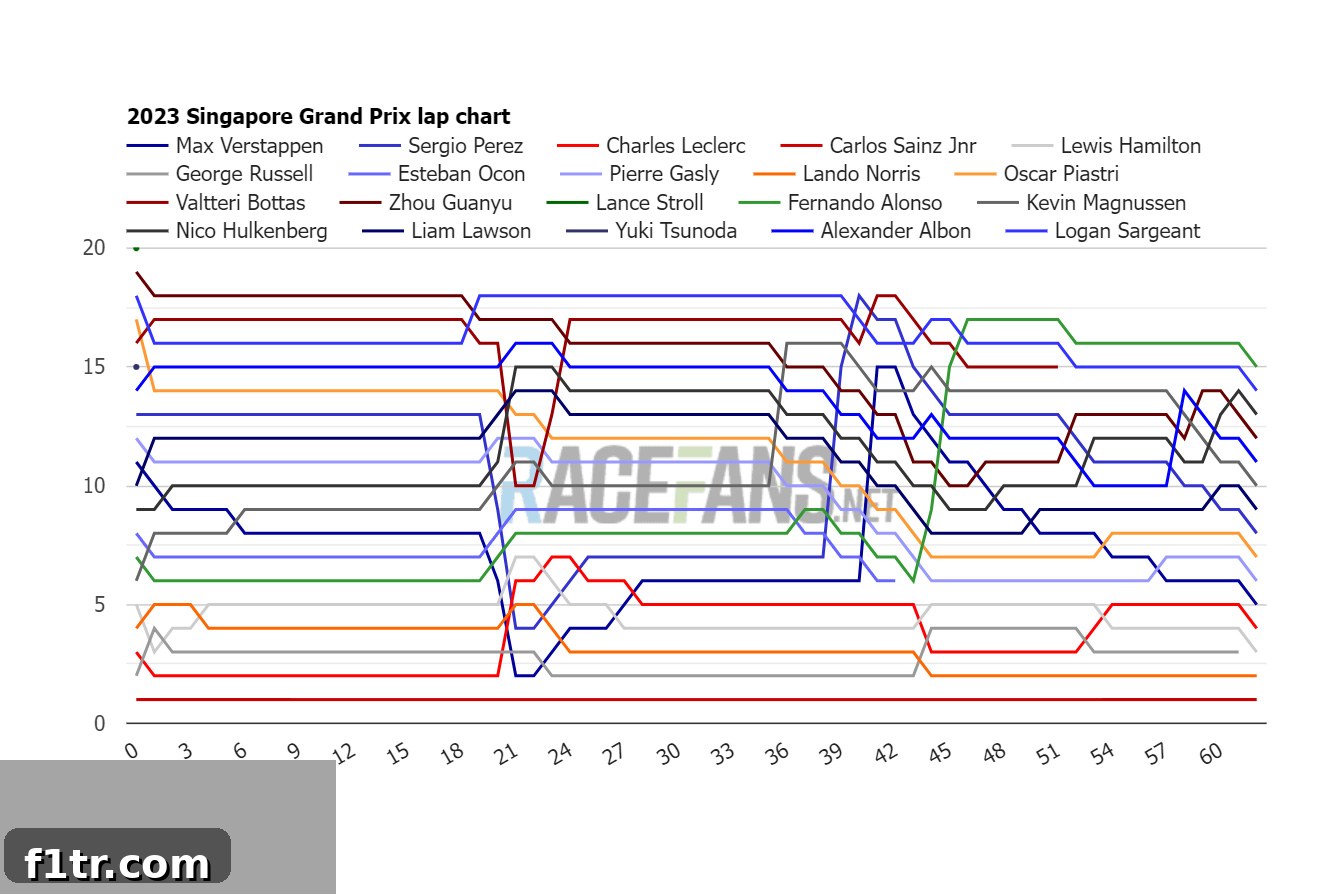
2023 Singapore Grand Prix lap chart
The Singapore Grand Prix lap chart offers a detailed visual representation of each driver’s position on every lap throughout the race. This dynamic tool is invaluable for understanding the ebb and flow of the competition, highlighting overtakes, strategic pit stops, and how drivers navigated the field. Spectators and analysts can observe key moments, such as Red Bull’s initial climb in positions during the Safety Car, followed by their subsequent drop as rivals on fresh tyres gained ground. It vividly illustrates the impact of critical events, like Safety Car periods, and reveals how different tyre strategies unfolded across the grid. By interacting with the chart, one can easily track individual driver progress, identify periods of sustained pace or struggle, and gain a deeper appreciation for the strategic complexities of a Formula 1 race.
Advert | Become a RaceFans supporter andgo ad-free
2023 Singapore Grand Prix race chart
The 2023 Singapore Grand Prix race chart provides a compelling visualization of the gaps between each driver relative to the leader’s average lap time. This sophisticated chart filters out exceptionally large gaps to maintain clarity, allowing viewers to focus on the competitive clusters and strategic advantages. It’s an essential tool for dissecting the pace differential between cars and understanding how varying tyre compounds and race strategies influenced the overall race dynamic. For Red Bull, this chart would illustrate their struggle on the initial hard tyres, the immediate loss of time post-Safety Car as rivals gained a “free stop,” and then the impressive recovery pace demonstrated by Max Verstappen and Sergio Perez in the latter half of the race on fresher medium tyres. The chart provides nuanced insights into who was pushing, who was managing, and where crucial time was gained or lost during the challenging Marina Bay event.
2023 Singapore Grand Prix lap times
Delving deeper into individual performance, the 2023 Singapore Grand Prix lap times chart meticulously records every lap time set by the drivers, excluding exceptionally slow laps such as those made under Safety Car conditions or during pit entries. This analytical chart is crucial for assessing raw pace, tyre performance over stints, and driver consistency. For Red Bull, it would visibly showcase the difference in performance between their challenging qualifying and the stronger race pace they eventually unlocked. One could identify the laps where Verstappen and Perez were most hampered by their hard tyres and, conversely, pinpoint the periods where they demonstrated their formidable speed on the medium compound, catching rivals with remarkable efficiency towards the end of the race. The ability to zoom, pan, and toggle drivers allows for a granular analysis of how each team and driver managed their pace and tyres throughout the demanding Singapore event.
Advert | Become a RaceFans supporter andgo ad-free
2023 Singapore Grand Prix fastest laps
Each driver’s fastest lap provides a snapshot of their ultimate performance capability during the race. This critical metric often highlights the car and driver combinations that found the most optimal setup and grip at various stages of the Grand Prix. While Red Bull faced an uphill battle due to qualifying and strategic misfortune, their presence high on this list, particularly with Max Verstappen and Sergio Perez setting competitive times in the later stages, underscores the underlying speed of the RB19 once it was operating effectively on the correct tyre compound. These fastest laps are not just about raw speed but also about the ability to extract maximum performance when it matters most, often demonstrating a driver’s tenacity in pursuit of every possible advantage.
| Rank | No. | Driver | Car | Lap time | Gap | Average speed (kph) | Lap no. |
|---|---|---|---|---|---|---|---|
| 1 | 44 | Lewis Hamilton | Mercedes | 1’35.867 | 185.51 | 47 | |
| 2 | 63 | George Russell | Mercedes | 1’36.273 | 0.406 | 184.72 | 46 |
| 3 | 14 | Fernando Alonso | Aston Martin-Mercedes | 1’36.456 | 0.589 | 184.37 | 47 |
| 4 | 1 | Max Verstappen | Red Bull-Honda RBPT | 1’36.575 | 0.708 | 184.15 | 61 |
| 5 | 11 | Sergio Perez | Red Bull-Honda RBPT | 1’37.108 | 1.241 | 183.14 | 61 |
| 6 | 23 | Alexander Albon | Williams-Mercedes | 1’37.342 | 1.475 | 182.7 | 46 |
| 7 | 55 | Carlos Sainz Jnr | Ferrari | 1’37.666 | 1.799 | 182.09 | 47 |
| 8 | 4 | Lando Norris | McLaren-Mercedes | 1’38.046 | 2.179 | 181.38 | 46 |
| 9 | 77 | Valtteri Bottas | Alfa Romeo-Ferrari | 1’38.075 | 2.208 | 181.33 | 51 |
| 10 | 20 | Kevin Magnussen | Haas-Ferrari | 1’38.107 | 2.240 | 181.27 | 48 |
| 11 | 16 | Charles Leclerc | Ferrari | 1’38.275 | 2.408 | 180.96 | 46 |
| 12 | 10 | Pierre Gasly | Alpine-Renault | 1’38.277 | 2.410 | 180.96 | 46 |
| 13 | 81 | Oscar Piastri | McLaren-Mercedes | 1’38.492 | 2.625 | 180.56 | 46 |
| 14 | 2 | Logan Sargeant | Williams-Mercedes | 1’38.531 | 2.664 | 180.49 | 45 |
| 15 | 40 | Liam Lawson | AlphaTauri-Honda RBPT | 1’39.028 | 3.161 | 179.59 | 47 |
| 16 | 24 | Zhou Guanyu | Alfa Romeo-Ferrari | 1’39.316 | 3.449 | 179.06 | 46 |
| 17 | 27 | Nico Hulkenberg | Haas-Ferrari | 1’39.923 | 4.056 | 177.98 | 50 |
| 18 | 31 | Esteban Ocon | Alpine-Renault | 1’39.930 | 4.063 | 177.96 | 33 |
Advert | Become a RaceFans supporter andgo ad-free
2023 Singapore Grand Prix tyre strategies
Understanding the strategic decisions of each team is paramount in Formula 1, and the 2023 Singapore Grand Prix tyre strategies chart offers a clear overview of the compound choices and pit stop timings for every driver. This visual guide reveals the diverse approaches taken on the Marina Bay street circuit, from early pitters to those attempting long stints, like Red Bull’s initial hard tyre gamble. It allows for a comparative analysis of how different strategies played out, particularly in response to the Safety Car intervention on Lap 20. The chart would highlight which drivers capitalized on the “free stop” and which, like Verstappen and Perez, had their strategies compromised. By examining this data, fans and strategists can grasp the high-stakes decisions made under pressure and their ultimate impact on race outcomes and driver positions.
Advert | Become a RaceFans supporter andgo ad-free
2023 Singapore Grand Prix pit stop times
Pit stop efficiency is a cornerstone of success in Formula 1, and the 2023 Singapore Grand Prix pit stop times table details precisely how long each driver’s stops took. This data provides crucial insights into team performance beyond just the car’s speed on track, showcasing the precision and speed of the pit crews. For Red Bull, known for their exceptional pit stop capabilities, this table allows for an assessment of their operational execution during a challenging race. Each second gained or lost in the pit lane can dramatically alter track position, especially on a circuit like Marina Bay where overtaking is difficult. Analyzing these times helps to understand the cumulative impact of strategy, timing, and crew performance on a driver’s final standing.
| Rank | No. | Driver | Team | Complete stop time (s) | Gap to best (s) | Stop no. | Lap no. |
|---|---|---|---|---|---|---|---|
| 1 | 11 | Sergio Perez | Red Bull | 28.977 | 1 | 39 | |
| 2 | 81 | Oscar Piastri | McLaren | 29.369 | 0.392 | 1 | 20 |
| 3 | 4 | Lando Norris | McLaren | 29.485 | 0.508 | 1 | 20 |
| 4 | 55 | Carlos Sainz Jnr | Ferrari | 29.499 | 0.522 | 1 | 20 |
| 5 | 1 | Max Verstappen | Red Bull | 29.698 | 0.721 | 1 | 40 |
| 6 | 31 | Esteban Ocon | Alpine | 29.755 | 0.778 | 1 | 20 |
| 7 | 23 | Alexander Albon | Williams | 29.787 | 0.81 | 2 | 43 |
| 8 | 63 | George Russell | Mercedes | 29.976 | 0.999 | 1 | 20 |
| 9 | 24 | Zhou Guanyu | Alfa Romeo | 30.032 | 1.055 | 1 | 2 |
| 10 | 63 | George Russell | Mercedes | 30.039 | 1.062 | 2 | 44 |
| 11 | 23 | Alexander Albon | Williams | 30.138 | 1.161 | 1 | 20 |
| 12 | 77 | Valtteri Bottas | Alfa Romeo | 30.487 | 1.51 | 1 | 40 |
| 13 | 24 | Zhou Guanyu | Alfa Romeo | 30.637 | 1.66 | 2 | 20 |
| 14 | 14 | Fernando Alonso | Aston Martin | 30.67 | 1.693 | 1 | 20 |
| 15 | 2 | Logan Sargeant | Williams | 31.018 | 2.041 | 2 | 43 |
| 16 | 20 | Kevin Magnussen | Haas | 31.475 | 2.498 | 1 | 20 |
| 17 | 10 | Pierre Gasly | Alpine | 31.802 | 2.825 | 1 | 20 |
| 18 | 40 | Liam Lawson | AlphaTauri | 32.348 | 3.371 | 1 | 20 |
| 19 | 44 | Lewis Hamilton | Mercedes | 32.631 | 3.654 | 1 | 20 |
| 20 | 16 | Charles Leclerc | Ferrari | 32.888 | 3.911 | 1 | 20 |
| 21 | 20 | Kevin Magnussen | Haas | 33.078 | 4.101 | 2 | 43 |
| 22 | 44 | Lewis Hamilton | Mercedes | 33.581 | 4.604 | 2 | 44 |
| 23 | 27 | Nico Hulkenberg | Haas | 35.497 | 6.52 | 1 | 20 |
| 24 | 14 | Fernando Alonso | Aston Martin | 52.708 | 23.731 | 2 | 44 |
2023 Singapore Grand Prix Related Articles
Stay informed and delve deeper into the captivating narrative of the 2023 Singapore Grand Prix with our collection of related articles. From post-race analyses to driver interviews and strategic breakdowns, these pieces offer comprehensive insights into one of the season’s most unpredictable races. Understand the ripple effects of Carlos Sainz’s tactical victory, the challenges faced by Esteban Ocon, and the ongoing discussions surrounding track limits and penalties that shaped the weekend. This curated list allows fans to revisit key moments and gain a fuller perspective on the strategies, controversies, and standout performances from the thrilling Marina Bay event.
- Sainz’s Singapore win made Leclerc focus on improving his race pace – Clear
- Singapore and Austin retirements cost me top 10 championship place – Ocon
- How Ocon’s “extreme” height for an F1 driver is helping other tall racers
- Steward’s admission Verstappen should have had penalty frustrates his rivals
- Drivers back Singapore qualifying tweak as rule changes again for Japanese GP
Browse all 2023 Singapore Grand Prix articles
The 2023 Singapore Grand Prix ultimately stood out as a stark anomaly in Red Bull’s otherwise flawless season. What began as a bewildering struggle in qualifying transformed into a race of strategic misfortune compounded by an impressive display of recovery pace. While the RB19 may not have achieved its customary dominant victory, the team’s ability to diagnose and adapt during the race, coupled with the drivers’ relentless pursuit, underscored their championship-winning pedigree. The lessons learned from the Marina Bay challenge, particularly regarding the car’s operating window and the intricate dance of tyre strategy, will undoubtedly prove invaluable as Red Bull continues its relentless pursuit of Formula 1 excellence.