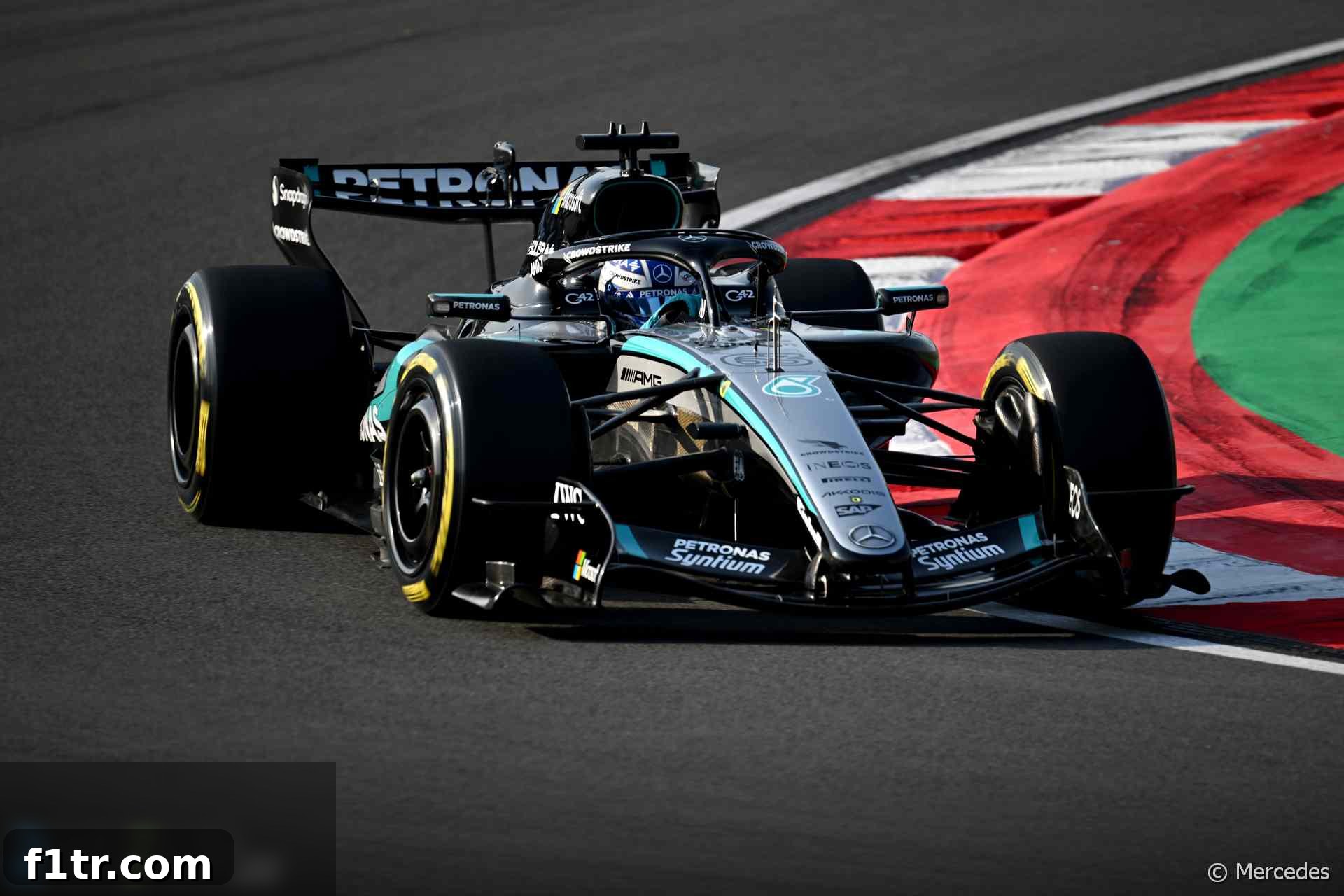
In a thrilling display of strategic acumen and raw pace, George Russell emerged victorious in the fiercely contested Shanghai sprint race. The Mercedes driver masterfully navigated the challenges posed by a formidable Ferrari onslaught, laying down a marker for the upcoming main event.
The race start was nothing short of electrifying. The Ferraris, known for their blistering getaways, once again showcased their prowess, immediately putting pressure on the front runners. From his fourth-place grid slot, Lewis Hamilton launched a lightning-fast charge, rapidly closing in on Russell. Simultaneously, Charles Leclerc, starting from sixth, demonstrated his intent by expertly weaving through the field to join the leading pack, setting the stage for an intense multi-car battle at the front of the grid.
Early Laps: A Tactical Chess Match
The opening laps were a captivating tactical chess match, particularly between the Mercedes and Ferrari drivers. Hamilton, displaying his characteristic aggression, initially swept past Russell at Turn 8 on the very first lap. However, Russell, refusing to yield, retaliated swiftly, reclaiming the position at Turn 14. This was just the beginning of a fascinating exchange of leadership as both drivers meticulously managed their energy levels and tyre degradation over the initial phase of the sprint. Hamilton briefly regained the lead at the start of lap two, only for Russell to snatch it back on lap three. The seesaw battle continued for the next two laps, each driver probing for weaknesses, conserving their resources while pushing the limits of their machinery.
As the race progressed into the mid-section, Hamilton’s tyres began to show visible signs of wear, making him vulnerable. Leclerc, sensing an opportunity, loomed large in his teammate’s mirrors. On the seventh lap, after a series of firm defensive maneuvers from the number 44 Ferrari, Leclerc finally managed to overhaul Hamilton. The intensity of their battle was palpable, even sparking a terse remark from Leclerc over team radio: “Does he know how wide these cars are, or not?” He later added, with a hint of irony, after definitively passing Hamilton through the opening complex, “He can complain about turn three, that’s okay.” These exchanges underscored the fierce competitive spirit and the fine margins at play.
Antonelli’s Uphill Battle and Controversial Penalty
While the leaders battled fiercely, Andrea Kimi Antonelli, the rising star from Mercedes, was embroiled in his own dramatic narrative. After a somewhat challenging start, Antonelli showcased impressive recovery pace. He swiftly picked off Oliver Bearman and Pierre Gasly, climbing to sixth place by lap two. His charge continued as he set his sights on the McLaren drivers, who proved to be a slightly tougher nut to crack. Nevertheless, by lap seven, Antonelli had successfully overtaken both, demonstrating the raw speed that had earmarked him as a future talent.
However, Mercedes’ hopes for a potential one-two finish were severely dented by an early race incident involving Antonelli. The stewards notified the team that Antonelli had received a significant 10-second penalty for colliding with Isack Hadjar at Turn 6 on the very first lap. This penalty cast a long shadow over his impressive recovery drive. Despite possessing the evident pace to challenge and pass the Ferraris ahead, the prospect of building a gap large enough to negate the penalty seemed an almost insurmountable task. Every overtake now came with the added pressure of not just gaining position, but creating a significant time buffer.
Antonelli pressed on regardless, driven by determination. After dispatching Hamilton on lap 11, it took him a further two laps to clear Leclerc, showcasing his consistent performance and the challenge posed by the Ferraris. Yet, the looming penalty meant his efforts were constantly under scrutiny, and the potential for a top finish remained precarious.
Safety Car Chaos and Strategic Shifts
Just as the race appeared to settle into a rhythm, drama struck again. Nico Hulkenberg’s Audi came to a halt at Turn 1, an incident that all but guaranteed a Safety Car period. Sure enough, the race was neutralised, throwing strategic plans into disarray. With many of the front-runners increasingly struggling on their medium compound tyres, the Safety Car presented a critical opportunity for a pit stop.
The vast majority of the leading pack streamed into the pits. Russell led Antonelli, Leclerc, Hamilton, Norris, and Piastri into the pit lane, all seeking fresh rubber and a strategic advantage for the final dash. However, not everyone opted for new tyres. Seventh-placed Liam Lawson, running on the more durable hard compound tyres, gambled by staying out, a bold move that would later pay dividends. Oliver Bearman, on mediums, also chose not to pit, banking on his tyre management. The pit stop phase itself was fraught with tension and decisive moments: Antonelli’s 10-second penalty was applied during this period, dropping him behind the Haas driver. Hamilton, unfortunately, lost a crucial place to Lando Norris as he was forced to wait behind Leclerc in the tightly packed Ferrari pit box, adding to Mercedes’ frustrations.
The Final Dash: Russell Consolidates, Hamilton Recovers
The restart on the end of lap 16 was another moment of high drama. Leclerc, under immense pressure, spun his wheels slightly, gifting Russell a crucial opportunity to extend his lead. The Mercedes driver seized the moment, consolidating his position at the front and opening up a comfortable gap. Although Leclerc mounted a late charge on the final lap, Russell maintained his composure and pace to cross the finish line first, securing a hard-fought victory for Mercedes.
Behind the leaders, the closing stages of the sprint saw further position changes and controversy. Hamilton, demonstrating his experience and race craft, managed to regain third place from Norris, salvaging a podium finish for Mercedes after a challenging race. Meanwhile, the incident between Antonelli and Piastri came to a head. Antonelli accused Piastri of illegally passing him before the Safety Car line, a contentious move that prompted McLaren to advise their driver to hand the position back. This sporting gesture elevated Antonelli to an impressive fifth place, mitigating some of the damage from his earlier penalty.
Liam Lawson and Oliver Bearman’s bold gamble of not pitting ultimately paid off handsomely. They expertly managed their older tyres and maintained their positions to complete the points-paying positions, a testament to their strategic courage and tyre preservation skills.
Verstappen’s Uncharacteristic Sprint
In an uncharacteristic sprint for the reigning champion, Max Verstappen failed to score points despite a late-race surge. Starting from ninth on the grid, Verstappen suffered a poor start, dropping him towards the rear of the field. He meticulously worked his way back through the pack, showcasing flashes of his usual brilliance. Notably, he avoided the potential pit lane congestion behind his teammate by shrewdly passing him on the lap before the Safety Car was deployed, as Hadjar struggled significantly on his set of soft tyres. While he managed to pass Pierre Gasly and Esteban Ocon as the final lap began, it wasn’t enough to break into the points, marking a rare non-scoring sprint for the Red Bull driver.
Shanghai Sprint: A Glimpse into the Main Race
George Russell’s victory in the Shanghai sprint race was a significant achievement, not just for the driver but also for the Mercedes team. It highlighted their strong pace and strategic execution, especially in managing the early pressure from Ferrari. The intense battles between Russell, Hamilton, and Leclerc underscored the competitive nature of the field and the importance of tyre management on the demanding Shanghai International Circuit. Antonelli’s impressive speed, despite his penalty, marked him as a driver to watch, showcasing resilience under pressure. The strategic decisions made during the Safety Car period provided valuable insights into team strategies, with some gambles paying off handsomely while others resulted in lost positions. The sprint offered a tantalizing glimpse of the potential for an even more thrilling main race, where points are higher and strategic variations could lead to vastly different outcomes, promising an unforgettable weekend of Formula 1 action in China.
Formula 1
- “Overtaking is overtaking”: Domenicali denies F1’s yo-yo racing is “artificial”
- The crashes F1 is trying to prevent may be rare – but the danger is obvious
- F1 returning to India soon after 2027 sounds like wishful thinking
- Verstappen loathes F1’s new generation of cars – but what do his rivals reckon?
- The ‘throwback weekend’ is back in fashion. But it’s a flawed concept – especially for F1
Browse all Formula 1 articles