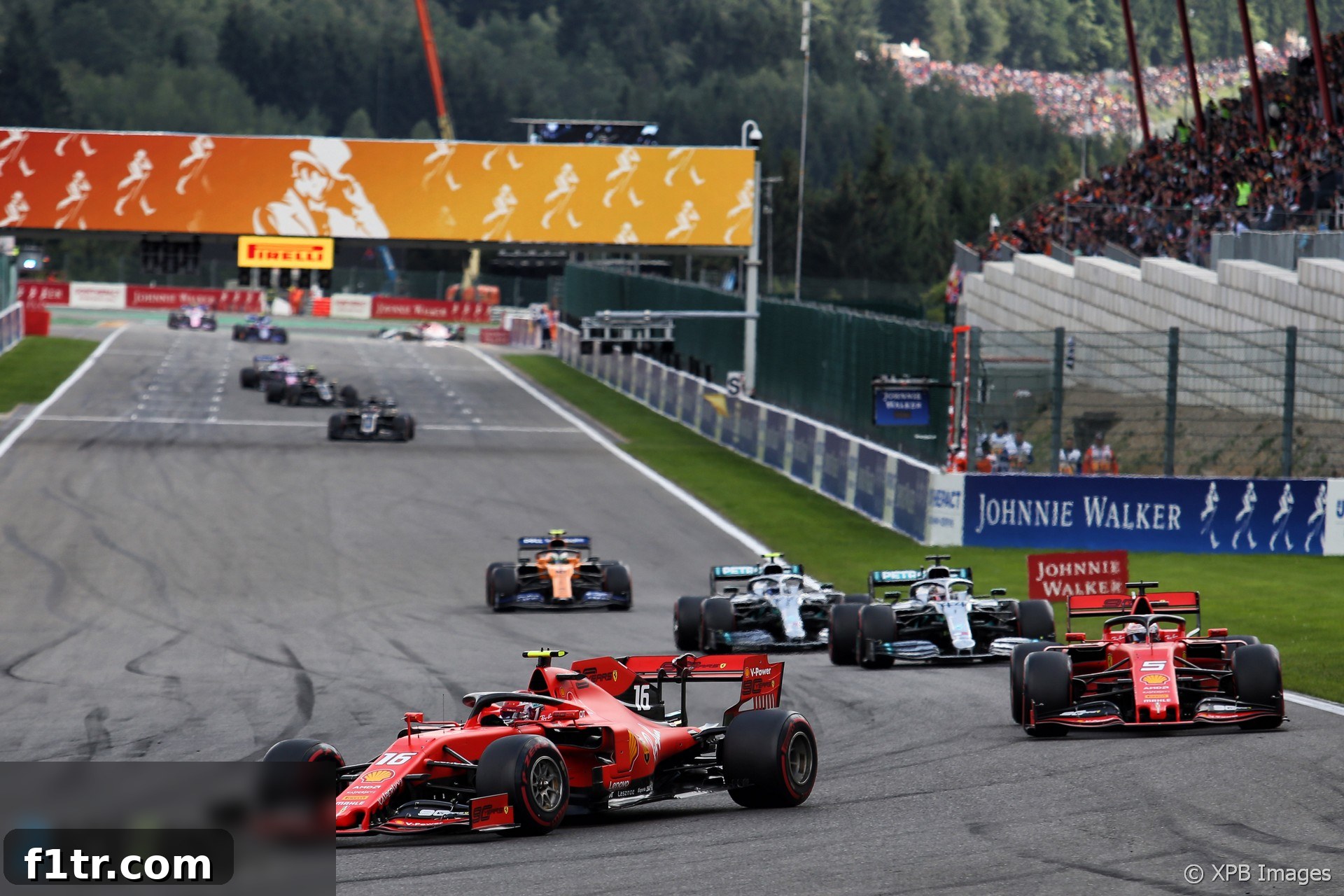
In the aftermath of the thrilling Belgian Grand Prix at the iconic Spa-Francorchamps circuit, Mercedes-AMG Petronas F1 Team Principal Toto Wolff expressed a nuanced satisfaction with his team’s performance. While securing a respectable second and third place finish with Lewis Hamilton and Valtteri Bottas respectively, Wolff conceded that outright victory was a formidable challenge given Ferrari’s formidable straight-line speed advantage. However, the Austrian motorsport executive also hinted at a lingering suspicion that, with a perfectly optimized strategy, Mercedes might have been able to exert significantly more pressure on race winner Charles Leclerc.
The 2019 Belgian Grand Prix served as a stark reminder of the intricate balance between raw power and aerodynamic efficiency. Ferrari’s SF90, particularly potent on the long straights of Spa, proved to be a formidable adversary. Wolff articulated this challenge clearly, stating, “If you would have given me a second and third in Spa [before the race] I would have taken it because we know that our package compared to the Ferraris with the straight-line speed is inferior.” This candid assessment underscored Mercedes’ understanding of their relative strengths and weaknesses on a circuit that heavily rewards top-end speed, particularly through the Eau Rouge-Raidillon complex and along the Kemmel Straight.
The superior straight-line performance of the Scuderia was evident throughout the race weekend, leaving Mercedes in a defensive posture at critical points. Wolff specifically recalled an instance that highlighted this disparity. “Look at Turn 1 and then the following straight: Sebastian [Vettel] can’t be more off the line than he was and he was still able to overtake us.” This observation encapsulates the frustration of competing against a car with such a pronounced speed advantage, even when the rival driver’s initial positioning might seem compromised. Spa’s layout, with its long power zones, amplified Ferrari’s strength, making overtakes challenging for the Mercedes drivers despite their chassis’ renowned cornering ability.
Despite the inherent challenge posed by Ferrari’s pace, Wolff couldn’t shake the feeling of missed opportunities. Post-race analysis often reveals margins for improvement, and in the high-stakes world of Formula 1, these margins can dictate the difference between victory and a podium finish. Wolff mused on the “what ifs” that could have altered the outcome. “If we would have really optimized our race, which you can only do post-race by being super-intelligent and saying what could have been, maybe we could have pitted one or two laps earlier. Maybe the pit stop could have been a little bit quicker.” These seemingly minor adjustments, when aggregated, could have theoretically positioned Hamilton directly behind Leclerc in the closing stages, potentially setting the scene for a thrilling showdown. However, Wolff remained pragmatic, acknowledging the benefit of hindsight: “But there is so many ifs that I must say I’m overall satisfied for us with the second and third place. We’ve got to take that.” This reflects the relentless pursuit of perfection inherent in Formula 1, even when excellent results are achieved.
Adding another layer of complexity to Mercedes’ weekend was an unexpected concern regarding engine reliability. The team had introduced “Phase Three” of their power unit for the Belgian Grand Prix, an upgrade designed to provide a competitive edge. However, this deployment was met with immediate setbacks, as two of the new power units suffered failures even before the main race. This occurred on the customer teams’ cars driven by Sergio Perez and Robert Kubica, casting a shadow of uncertainty over the Mercedes power plant’s durability.
Wolff openly admitted that this situation induced a degree of caution within the team, forcing them to operate slightly conservatively during the race itself. He drew a parallel to past struggles experienced by rival teams: “I know now a little bit how Red Bull felt in ’14 and ’15 when you are on the back foot on the straights. Not a good weekend.” This comparison highlighted the anxiety that comes with power unit issues, especially when the underlying causes remain unknown. The failures, described as appearing different and not yet fully analyzed or understood, meant Mercedes was not willing to take any undue risks with their engine settings. “It didn’t compromise us massively, it did a tiny bit. We were not taking any risks in the race. But it was certainly not a comfortable situation because the failures look to be different and are not analysed yet, and understood,” Wolff elaborated. This cautious approach, while prudent for preserving engine integrity, undoubtedly meant that the Mercedes cars might not have been operating at their absolute maximum potential, further contributing to the gap to Ferrari.
The 2019 Formula 1 season had, until this point, largely been a story of Mercedes’ dominance, particularly in the Constructors’ Championship. Lewis Hamilton was also in a commanding position in the Drivers’ standings. However, the performance at Spa served as a potent reminder that the competition, especially Ferrari, was capable of mounting significant challenges on circuits that played to their strengths. This ebb and flow of performance, with different teams excelling at different venues, adds a compelling dimension to the championship narrative. Mercedes’ ability to adapt, analyze, and overcome these challenges has been a hallmark of their success, and the lessons learned from Spa, both in terms of strategy and engine reliability, would be crucial for the remainder of the season.
Looking beyond the immediate result, Mercedes’ approach to such setbacks is typically one of rigorous analysis and continuous improvement. The team’s engineering prowess and strategic acumen are legendary, and any technical anomaly, especially with a new power unit phase, would undoubtedly trigger an intensive investigation. Ensuring the reliability of their power units is paramount, not just for their factory team but also for their customer teams, who rely on Mercedes for competitive and durable engines. The insights gained from the failures on Perez’s and Kubica’s cars would be critical in refining the “Phase Three” power unit and ensuring its robustness for future races, particularly as the championship battle entered its crucial concluding phase.
In conclusion, while Toto Wolff expressed a measured satisfaction with a double podium finish at the Belgian Grand Prix, his comments revealed the relentless pursuit of perfection that defines Mercedes. The superior straight-line speed of Ferrari was a significant hurdle, and while strategic “what ifs” lingered, the team delivered a strong result under challenging circumstances. More critically, the unexpected power unit failures introduced an element of concern that demanded immediate and thorough investigation. Mercedes’ ability to manage these technical challenges while maintaining a high level of competitive performance would be a decisive factor in their ongoing quest for championship glory in the 2019 season. The Belgian GP, therefore, was not just another race but a crucial learning experience, reinforcing Mercedes’ commitment to pushing boundaries and meticulously refining every aspect of their operation.
Further Reading: 2019 F1 Season Insights
- Explore key moments and analyses from the 2019 F1 season
- Dive deeper into team strategies and driver performances from 2019
- Review significant races and championship battles of 2019
- Understand the technical developments and regulations shaping the 2019 season
- Access comprehensive reports and features on the 2019 F1 calendar
Browse all 2019 F1 season articles