In the tense final moments of the qualifying session for the Abu Dhabi Grand Prix last year, a rare and somewhat unusual message echoed across the Mercedes team radio. Toto Wolff, the demanding and often reserved CEO of Mercedes-AMG Petronas F1 Team, broke with his usual convention to offer words of encouragement directly to his driver, Valtteri Bottas.
Advert | Become a Supporter & go ad-free
“All you have, Valtteri,” Wolff urged, a phrase that, while seemingly innocuous, carried significant weight given Wolff’s typical reticence in direct communication with his drivers during crucial sessions. This moment was not spontaneous; it emerged from prior discussions between Wolff and Bottas, who had explored ways to collectively inspire stronger performances from every team member. Wolff’s radio message was a direct product of that commitment, a visible sign of intensified support for a driver who had, just a week earlier, been notably outperformed by substitute driver George Russell in Bahrain.
Despite this unique display of encouragement, the desired outcome in Abu Dhabi wasn’t fully realised. Max Verstappen narrowly edged out Bottas for pole position by a mere two-hundredths of a second. Yet, the gesture underscored Mercedes’ unwavering dedication to their driver, especially during a period of intense scrutiny and pressure.
A similar, albeit more urgent, message from Wolff was heard during the recent Emilia-Romagna Grand Prix at Imola. “Come on, Valtteri,” Wolff implored on lap 16. However, far from improving, the situation for car number 77 was deteriorating rapidly, signaling a much more profound struggle for the Finnish driver.
Bottas’s weekend at Imola began with considerable promise. At the very circuit where he secured pole position the previous year, Bottas demonstrated strong pace, topping both Friday practice sessions. This performance ignited hopes within the Mercedes garage and among fans that he might replicate his past success and mount a serious challenge for pole position, especially after a challenging start to the season.
Unfortunately, Saturday’s qualifying session brought a stark change in fortunes. Throughout the crucial sessions, Bottas found himself unable to consistently keep his Pirelli tyres within their optimal operating temperature window. This elusive sweet spot, essential for extracting maximum grip and performance, seemed to constantly slip away from him. While Lewis Hamilton effortlessly placed the sister W12 on pole position, Bottas was a significant half-second adrift. In previous seasons, such a gap might still have secured him a front-row start; however, the competitive landscape of the 2021 season meant that the field was much closer, relegating him to a disappointing eighth place on the grid.
The technical intricacies of the Mercedes W12 have been a recurring theme, with both drivers offering candid insights. Strikingly, Hamilton himself described the handling of the latest Mercedes car as “knife-edge,” a descriptor echoed by Bottas when explaining his persistent struggle to match his teammate’s blistering lap times. This shared perception highlights a fundamental characteristic of the car – one that demands extreme precision and adaptation from its drivers.
Bottas elaborated on this challenge, stating, “It’s a bit [of an] overall thing with our car over the years. We quite often struggled in hot conditions and cool has been normally good because we’ve had good tyre warm-up.” He further explained the nuanced trade-offs in car development: “So we’ve been really trying to develop the car that we don’t overheat the tyres. But that’s come obviously with a negative, that if we need to get quickly temperature in the tyres, some other cars can do it better than us.” This illustrates the delicate balance Mercedes is attempting to strike with their tyre management strategy, a balance that evidently favors some conditions over others.
Advert | Become a RaceFans supporter andgo ad-free
The difficulty in mastering the W12’s tyre characteristics was particularly evident for Bottas in qualifying. “For me personally, for example compared to Lewis, it’s so in the knife-edge in qualifying. Sometimes you get it [to] work, like for me in Q1 when I did a much faster time,” Bottas explained. “But for some reason I just couldn’t get them to work in Q3 in the same way. So it’s all about one or two degrees of surface or tyre bulk temperature. It’s hard to explain. Obviously track temp was changing a bit, depending on how much there was cloud et cetera, so maybe that had a bit of a factor.” This highlights the incredibly fine margins in modern Formula 1, where minuscule environmental changes or setup variations can have a dramatic impact on performance, especially for a car already described as “knife-edge.”
Andrew Shovlin, Mercedes’ Head of Trackside Operations, further elucidated Bottas’s qualifying struggles, noting that while Bottas could achieve competitive lap times after multiple laps on fresh tyres, he couldn’t replicate this crucial performance on the initial hot lap – precisely when it was most needed in qualifying. “He did look very strong on Friday and was in a good position, very happy with the car. In qualifying he seemed to be struggling a little bit more for the tyre temperature than Lewis,” Shovlin observed.
“The lap that he did in Q1 on his first run would have put him in the top four. He just couldn’t match that lap. That was the third lap of the tyres, moving to the first lap he wasn’t really able to match that. So there’s something that we need to understand. The thing with tyre temperature though is often a very small difference has a very big impact on grip.” This assessment underscores the challenge: finding that initial peak performance window on new tyres, a skill Hamilton seems to consistently master, but Bottas often finds elusive, especially in the high-pressure environment of Q3.
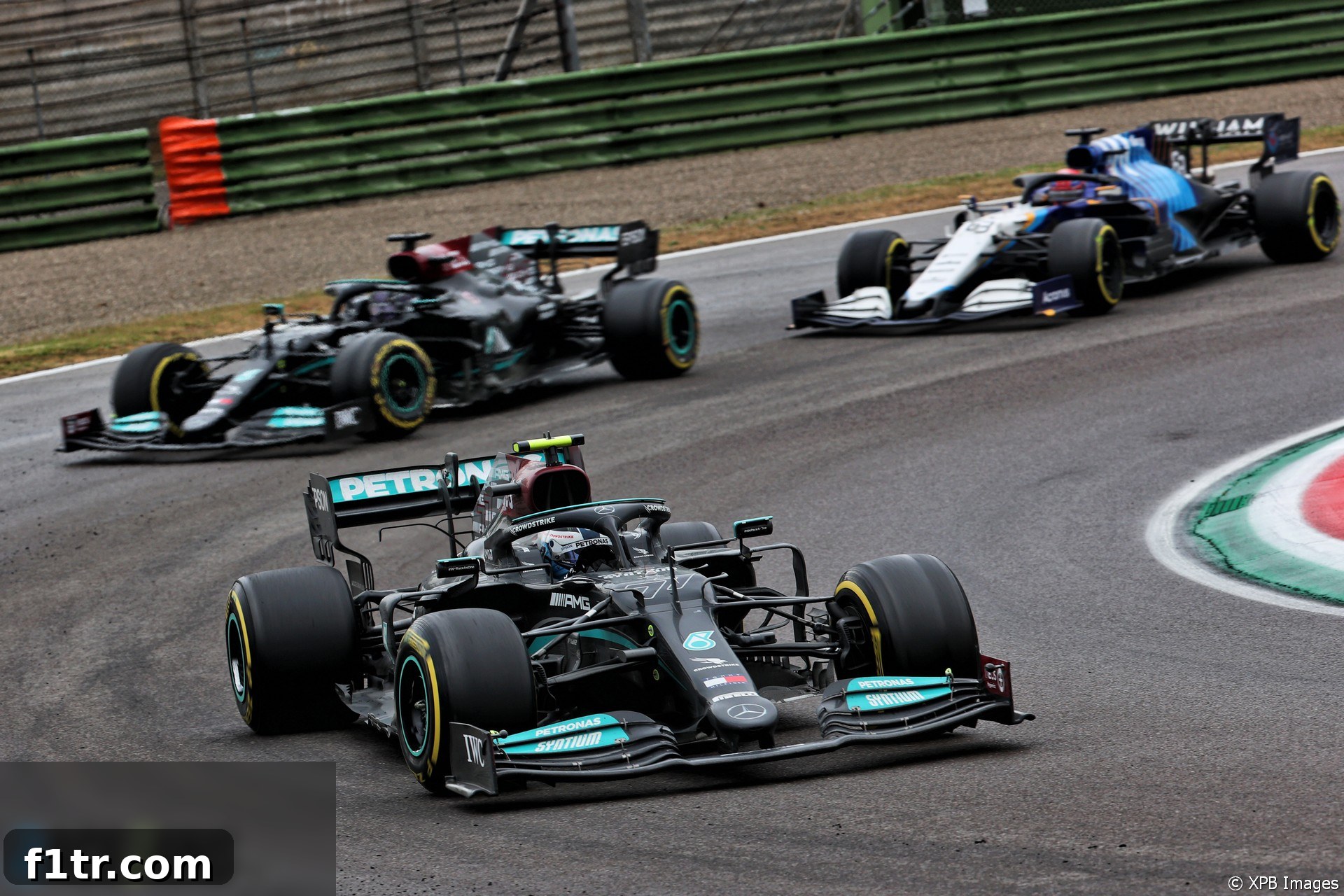
These persistent tyre and car handling problems appeared to be significantly amplified during the treacherous, wet opening laps of the Emilia-Romagna Grand Prix. Bottas, starting from eighth, immediately lost two positions at the start, dropping to tenth. He subsequently became mired behind the Aston Martin of Lance Stroll, a position from which he struggled to extract himself. The gap between Bottas and his teammate, Lewis Hamilton, who was running in second, began to open up at an alarming rate. From the moment the Safety Car peeled into the pits, signaling the resumption of racing, until Wolff’s radio message just eight laps later, Bottas conceded a staggering 49 seconds to Hamilton.
Advert | Become a RaceFans supporter andgo ad-free
This immense time loss is particularly concerning, especially considering there were initially seven cars separating Bottas and Hamilton. While each car generally loses ground to the one ahead, such a significant deficit in such a short period speaks volumes about Bottas’s struggles with the conditions and the car. His difficulties echoed painful memories of his arduous performance in last year’s Turkish Grand Prix, another wet-weather race where he struggled immensely, though on that occasion, he could at least attribute some of his problems to car damage. At Imola, there was no such external factor to blame, intensifying questions about his wet-weather driving and ability to manage difficult conditions.
The race culminated in Bottas’s spectacular retirement following a high-speed collision with George Russell, the young Williams driver widely considered to be the prime candidate for Bottas’s Mercedes seat in the future. This incident commanded extensive attention post-race. While the stewards ultimately deemed it a “racing incident,” Mercedes’ reaction made it clear they took a dim view of Russell’s role in the crash. Their public criticism of Russell, however, masked a deeper internal concern.
Behind the scenes, Mercedes management must have been asking themselves a critical question: why was one of their championship-contending cars even in a position to be under attack from a Williams, battling for minor points? Even more concerning was the fact that on the lap preceding the collision, Bottas was on the verge of being lapped by his own teammate, Lewis Hamilton, who had by then recovered from his own excursion and was flying through the field. This stark contrast in performance within the same team underscored the magnitude of Bottas’s difficulties.
Bottas’s furious criticism of Russell over the team radio, swiftly followed by a rather unambiguous greeting with a raised middle finger after the crash, were undeniably “heat of the moment” reactions. He later clarified that despite months of speculation about Russell potentially replacing him, there was no significant personal animosity between the two drivers.
“To be honest, I’ve never really worked that closely with him,” said Bottas after the incident. “Obviously, he’s been around for some time because he’s been reserve driver and done some tests for the team and some simulator work. So I know him a little bit. There’s never been any issues and no, nothing changed in Bahrain in terms of that.” He added, reflecting on the crash itself, “This one obviously I was not happy about how it ended up. But I’m a pretty easygoing guy, there’s no problems, but I can’t say that I’m friends with him, like I can’t say I’m friends with most or any of the drivers really. From my side, no issues. But [it] was not ideal because he made me lose a good chunk of points potentially, and I think it was his mistake.”
However, Bottas’s assertion that Russell deprived him of a “good chunk of points” highlights a crucial point of contention and reveals the disparity in perspective. At the time of the collision, the Mercedes was only in 10th place, heading for precisely two championship points. For a team like Mercedes, two points is hardly a “good chunk” and certainly not a result expected from their car. This fact likely caused more internal concern for the team than the momentary misjudgment by a driver in a Williams attempting to overtake one of their cars. The implication was clear: Bottas should not have been battling a Williams for such low-value positions.
Toto Wolff, after a thorough review of the incident, did not shy away from direct criticism of both drivers. “George should have never launched into this manoeuvre,” Wolff stated, placing blame on Russell’s aggressive move. But he immediately balanced this by adding a critical assessment of his own driver’s performance: “Valtteri had a bad first 30 laps and shouldn’t have been there.” This dual critique encapsulates Mercedes’ predicament: evaluating a driver who is underperforming and finding himself in situations he shouldn’t be in, while also dealing with an aspiring talent potentially overstepping boundaries.
The repeated words of encouragement from Toto Wolff, initially a sign of personal support and a strategy to boost confidence, are now starting to feel increasingly like a desperate measure. With Bottas’s struggles persisting and key incidents casting a shadow over his race performances, it is becoming apparent that mere encouragement may soon need to be replaced by a more decisive and potentially firmer approach from the Mercedes hierarchy as they navigate the complexities of their driver lineup for the future.
Quotes: Dieter Rencken
Bottas’ Emilia-Romagna Grand Prix Team Radio Transcript
This transcript captures the critical communications between Valtteri Bottas, his race engineer Ricardo Musconi, and Team Principal Toto Wolff, spanning from the first restart of the Emilia-Romagna Grand Prix until the collision that ultimately forced the Mercedes out of the race.
| Lap | Name | Message |
|---|---|---|
| 8 | Musconi | HPP12 set position three. |
| 8 | Musconi | Stroll the car ahead, less than a second ahead of him Gasly on X. |
| 9 | Musconi | Yellow, yellow. |
| 10 | Bottas | Where? |
| 10 | Musconi | Just right behind you. |
| 10 | Musconi | So pace at the front 30.1. |
| 10 | Musconi | Stroll, three seconds ahead. |
| 12 | Musconi | Set position four on the next straight. HPP three, set position four. |
| 12 | Musconi | Strat six or seven. |
| 13 | Bottas | Tyres are finally starting to work a bit. |
| 13 | Musconi | Copy, you are a couple of degrees below Lewis. |
| 13 | Musconi | Pace at the front 28.8. |
| 13 | Musconi | And Stroll two seconds ahead. |
| 16 | Musconi | Currently losing a lot of time behind Stroll. |
| 16 | Wolff | Come on, Valtteri. |
| 16 | Musconi | Give us an update on conditions, balance check. |
| 19 | Bottas | Track is still inters but it’s drying quickly. Tyres are good. Low-grip, balance okay. |
| 19 | Musconi | Copy all that. |
| 19 | Musconi | Try diff high speed five for more stability. |
| 19 | Musconi | So pace at the front 27.0. |
| 20 | Musconi | [Unclear] dry tyres, he’s on the medium, we’ll let you know how he’s getting on. |
| 21 | Musconi | And do you think it’s ready now? And do you think it’s ready now? |
| 22 | Bottas | Not yet. |
| 22 | Musconi | Vettel is losing time. Vettel is losing time. |
| 24 | Musconi | Valtteri these tyres will drop a bit and they will get the grip back. |
| 24 | Bottas | Okay. It’s so hard to follow up I’m trying everything, but can’t get closer. |
| 24 | Musconi | Keep us up to date with a track. |
| 24 | Musconi | Re-open diff high-speed two three. |
| 25 | Musconi | Still no cars going faster on dry. |
| 25 | Musconi | You completed 25 laps. |
| 25 | Musconi | Suggested diff exit six for turn seven. |
| 27 | Musconi | Stroll is in. |
| 27 | Musconi | Push hard now, it won’t be long. |
| 28 | Musconi | Gasly on exit, Gasly on exit, he will struggle with warm up. |
| 28 | Musconi | Chassis wet set position one. |
| 28 | Musconi | HPP 12 set position five. Box box box. |
| 28 | Musconi | Brake balance for the line. Pit entry is a slippery, new Tarmac. |
| 28 | Musconi | Brake balance for the box. |
| 28 | Musconi | So we’ll be close with Stroll on exit. |
| 29 | Musconi | So you have overtake, watch out for wheelspin on exit, warm-up is difficult. |
| 29 | Musconi | So car behind Stroll is Verstappen, the race, we will get blue flags. |
| 29 | Musconi | You have blue flags for Verstappen. |
| 29 | Musconi | DRS has been enabled. |
| 29 | Musconi | So Lewis behind, car behind, don’t make him lose any time. |
| 30 | Musconi | You’re racing Russell. |
| 30 | Musconi | So Lewis in the gravel trap at turn seven. |
| 30 | Musconi | Russell half a second behind. |
| 30 | Musconi | Bottas and Russell collide Yellow, yellow. |
| 31 | Bottas | What a fucking cunt. |
| 31 | Musconi | Are you OK, Valtteri? |
| 31 | Bottas | Yeah. Big one. All good. |
| 31 | Musconi | Just be careful. They’re deploying Safety Car. |
| 31 | Musconi | And go P0 before you jump out |
Go ad-free for just £1 per month>> Find out more and sign up
2021 F1 season related articles
- Masi ‘basically gifted the championship’ to Verstappen says 2021 FIA steward Sullivan
- Las Vegas race backers looking to extend F1 deal beyond 2025
- Why Mercedes put ‘a reminder of joy and pain’ on display in their factory lobby
- Verdict on error in GT race suggests Mercedes would have lost 2021 Abu Dhabi GP appeal
- Title ‘stolen’ from Mercedes made us ‘underdogs people cheer for’ – Wolff
Browse all 2021 F1 season articles