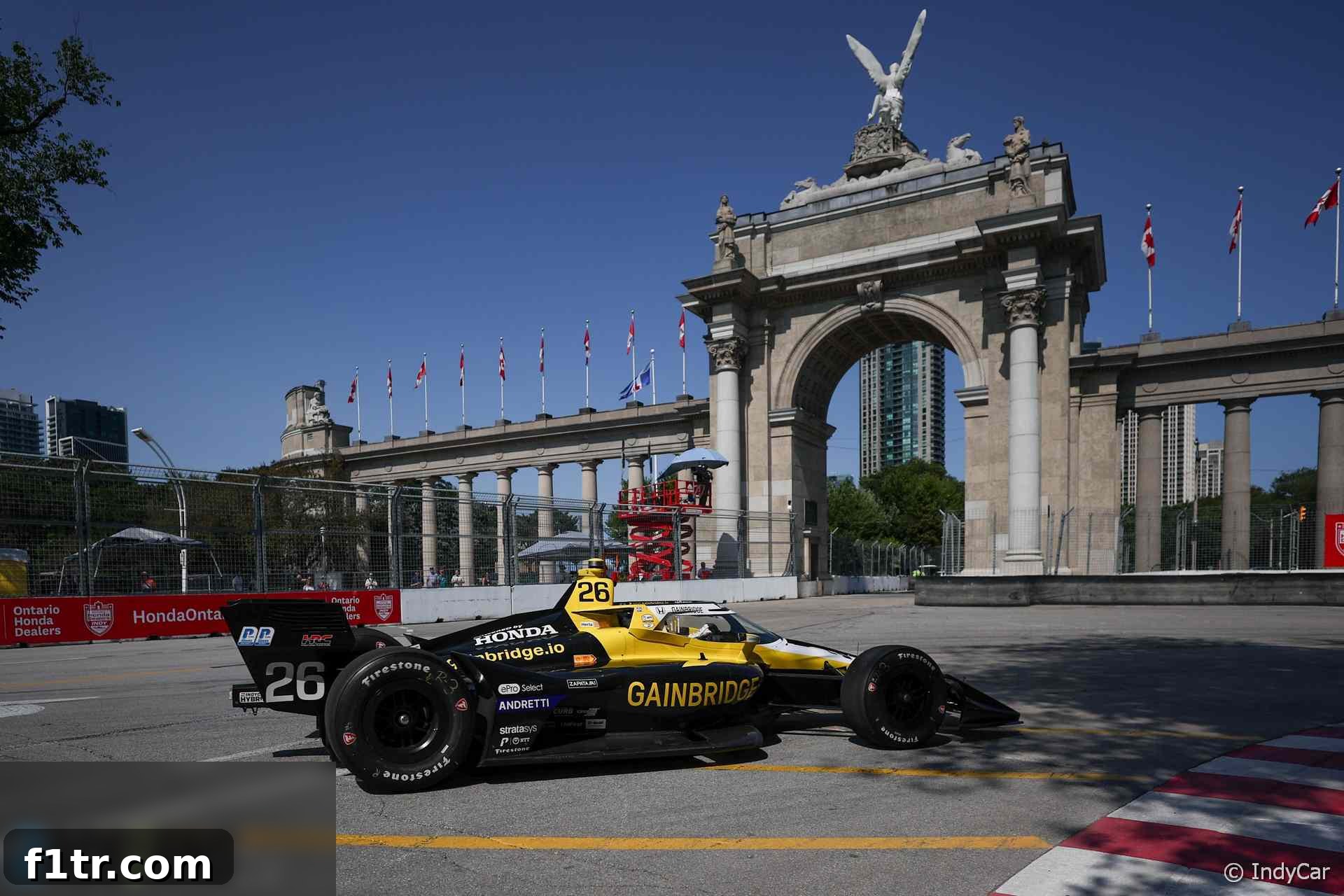
Colton Herta Clinches Pole in Thrilling Toronto IndyCar Qualifying, Andretti Secures Front Row Lockout
The streets of Toronto witnessed an exhilarating NTT IndyCar Series qualifying session, culminating in a dominant performance from Andretti Autosport. Colton Herta showcased exceptional skill and speed to secure pole position for this weekend’s highly anticipated race, fending off a fierce challenge from his teammate Kyle Kirkwood. This remarkable effort resulted in a formidable Andretti one-two, setting the stage for a captivating race on the notoriously demanding Exhibition Place street circuit.
Advert | Become a Supporter & go ad-free
A Nail-Biting Battle for Pole Position
The final moments of the Fast Six shootout were a masterclass in high-stakes competition. Both Colton Herta and Kyle Kirkwood pushed their cars to the absolute limit, with the provisional pole position exchanging hands between the two Andretti drivers twice within the dying minutes of the session. The Toronto street course, famed for its bumpy surface, tight chicanes, and unforgiving concrete walls, demands absolute precision and bravery from every driver. Herta and Kirkwood demonstrated both in abundance, each lap an exercise in balancing aggression with control, as they sought to extract every fraction of a second from their Chevrolet-powered machines.
Ultimately, it was Herta who delivered the decisive blow. His final, electrifying lap, clocked at an astonishing 59.5431 seconds, was a testament to his innate ability to perform under pressure. This blistering effort was just enough to deny Kirkwood, who had also posted an incredibly strong time, by a mere tenth of a second – a microscopic margin that speaks volumes about the intensity of their rivalry and the razor-thin performance differences at the pinnacle of IndyCar racing. This hard-fought pole position marks Herta’s third of the season, further cementing his status as a leading contender and a driver always capable of delivering when it matters most. The atmosphere in the Andretti Autosport garage was electric, celebrating a triumphant front-row lockout that promises an enthralling strategic battle for Sunday’s main event.
Navigating the Fast Six: Grid Positions Take Shape
Beyond the thrilling Andretti duel, the remainder of the Fast Six contenders also showcased their prowess. Securing a strong third position on the grid was Felix Rosenqvist of Arrow McLaren. The Swedish driver exhibited consistent speed and composure throughout the various qualifying rounds, expertly maneuvering his car around the challenging urban layout. His well-deserved starting spot on the second row positions him perfectly to challenge for a podium finish, demonstrating the strength of the McLaren effort on street circuits.
Following closely, Scott McLaughlin of Team Penske secured fourth place. As the highest-placed driver in the championship standings to reach the Fast Six, McLaughlin’s performance underscored his consistent form and ability to adapt to diverse track conditions. He was the last driver to complete his flying lap in the session, executing a perfectly timed run that allowed him to vault up the leaderboard. This crucial final effort notably displaced Romain Grosjean from what had briefly been a provisional front-row starting position. Grosjean, driving for Andretti Autosport, had displayed impressive pace and will start fifth, still a commendable achievement in such a competitive field. Rounding out the Fast Six and securing sixth on the grid was David Malukas, representing Dale Coyne Racing, whose journey to this stage included a remarkable recovery.
Malukas’s Dramatic Escape and Fortune
David Malukas’s path to the Fast Six was undoubtedly one of the most dramatic storylines of the qualifying session. During the intense Fast Twelve round, the young driver encountered a significant setback, spinning off at turn eight. On a demanding street course like Toronto, a spin can often be a definitive end to a driver’s qualifying aspirations, resulting in an immediate elimination. However, Malukas was blessed with a dose of fortune and a keen presence of mind.
While his spin necessitated a yellow flag, which in turn caused him to lose his best time up to that point – a standard penalty for impeding another driver’s hot lap – Malukas incredibly managed to recover his car and rejoin the track without major incident. Critically, he then found enough clear track space and time to unleash another rapid lap before the session’s clock expired. This heroic second attempt proved just fast enough to secure his place in the elite Fast Six, narrowly making the cut. It was a testament to his resilience, his ability to react quickly under immense pressure, and a timely slice of luck that kept his pole position dreams alive, much to the jubilation of his team.
The Fast Twelve: Margins of Milliseconds
The Fast Twelve session, designed to narrow the field from twelve contenders to the final six for pole, was characterized by incredibly tight margins and heart-stopping moments. Josef Newgarden, a multi-time IndyCar Series champion and a formidable presence for Team Penske, found himself agonizingly close to advancing. His final qualifying lap was just a hundredth of a second (0.01s) shy of Malukas’s time, forcing him to miss out on the Fast Six and highlighting the brutal competitiveness of the series, where such minuscule differences can dictate a driver’s fate.
Newgarden’s esteemed teammate, Will Power, a former series champion himself, also saw his qualifying run conclude in the Fast Twelve. Power delivered one of the most breathtaking moments of the session with a truly phenomenal save as he approached turn eight. His car experienced a sudden snap of oversteer, a terrifying loss of rear grip that, on a street circuit, almost invariably leads to a collision with the unforgiving barriers. Power’s lightning-fast reactions and vast experience allowed him to deftly catch the car, preventing what seemed like an inevitable crash. Despite this incredible display of car control, he ultimately couldn’t post a time quick enough to advance. The two Penske drivers were separated on the grid by the veteran Graham Rahal, who also failed to progress. Other notable drivers eliminated in this intense round included Agustin Canapino (who later benefited from a penalty), Marcus Ericsson, and Christian Rasmussen, all of whom had shown promising flashes of pace earlier in the day.
Drama in the Group Stages: Penalties and Unexpected Fortunes
The initial group qualifying rounds, where the full field is divided into two sections to allow for clearer track conditions, were not immune to drama, featuring significant incidents, driver frustrations, and crucial steward decisions. Drivers are tasked with finishing in the top six of their respective groups to advance to the Fast Twelve, a challenge amplified on a tight and busy street course like Toronto.
One of the most vocal frustrations came from McLaren star Pato O’Ward. The Mexican driver was visibly fuming after his hot lap in Group Two was compromised by a succession of other drivers, leading to him being impeded. On a circuit where every millisecond counts and clear air is paramount, being held up can be catastrophic for a flying lap. O’Ward’s qualifying hopes were severely dented by this incident, and despite his best efforts, he failed to make the cut, a disappointing outcome for a driver typically found battling at the front.
Further adding to the session’s intrigue, one of the drivers who initially *did* advance from O’Ward’s group was championship leader Alex Palou. However, a review by the race stewards following footage of an incident at turn five led to a penalty for Palou. He was judged to have impeded another competitor during a critical lap, resulting in the revocation of his fastest qualifying time. This crucial decision meant Palou, the championship front-runner, was also eliminated from contention, joining O’Ward on the sidelines for the later stages of qualifying – a significant setback for his championship campaign heading into the race.
The unexpected benefactor of Palou’s penalty was none other than Agustin Canapino. The Juncos Hollinger Racing driver had originally missed out on the last qualifying spot in Group Two by an astonishingly slim margin of just 0.0002 seconds to his own teammate, Romain Grosjean. Palou’s penalty effectively promoted Canapino into the Fast Twelve, offering him an unforeseen lifeline and a chance to continue competing for a better grid position. This extraordinary turn of events perfectly encapsulates the razor-thin margins and unpredictable nature that consistently make IndyCar racing one of the most thrilling motorsports in the world.
Outlook for the Honda Indy Toronto Race
With Colton Herta and Kyle Kirkwood locking out the front row for Andretti Autosport, the stage is now perfectly set for a captivating Honda Indy Toronto race. The challenging street circuit is infamous for its unpredictability, where strategic pit calls, timely caution periods, and daring overtakes often dictate the final outcome. The Andretti team will be eager to capitalize on their dominant qualifying performance, aiming for a strong start and clean execution to convert their grid advantage into victory.
However, they will face formidable pressure from Felix Rosenqvist and Scott McLaughlin, who have consistently demonstrated strong race pace and strategic acumen throughout the practice sessions. Drivers like Romain Grosjean and David Malukas, starting from respectable positions, will also be looking to make their mark and challenge for podium spots. The setbacks experienced by championship contenders such as Alex Palou and Pato O’Ward mean they face a challenging task ahead, needing to navigate through the densely packed field from deeper on the grid. Their recovery drives will be a key storyline, potentially having significant implications for the overall championship battle. The Toronto street circuit promises close-quarter racing, aggressive maneuvers, and potential for drama at every corner, ensuring fans are treated to a high-octane spectacle as the NTT IndyCar Series drivers battle for glory.
Advert | Become a RaceFans supporter andgo ad-free
More IndyCar News and Analysis
- IndyCar driver McLaughlin cleared of injury after crashing through barrier at Barber
- Schumacher says his IndyCar feels like ‘an F2 car, just with better tyres’
- IndyCar “way faster than Formula 1” in some corners, says Grosjean
- FIA to award more F1 superlicence points to IndyCar drivers from 2026
- Schumacher to race full-time in IndyCar with RLL in 2026
Browse all IndyCar articles