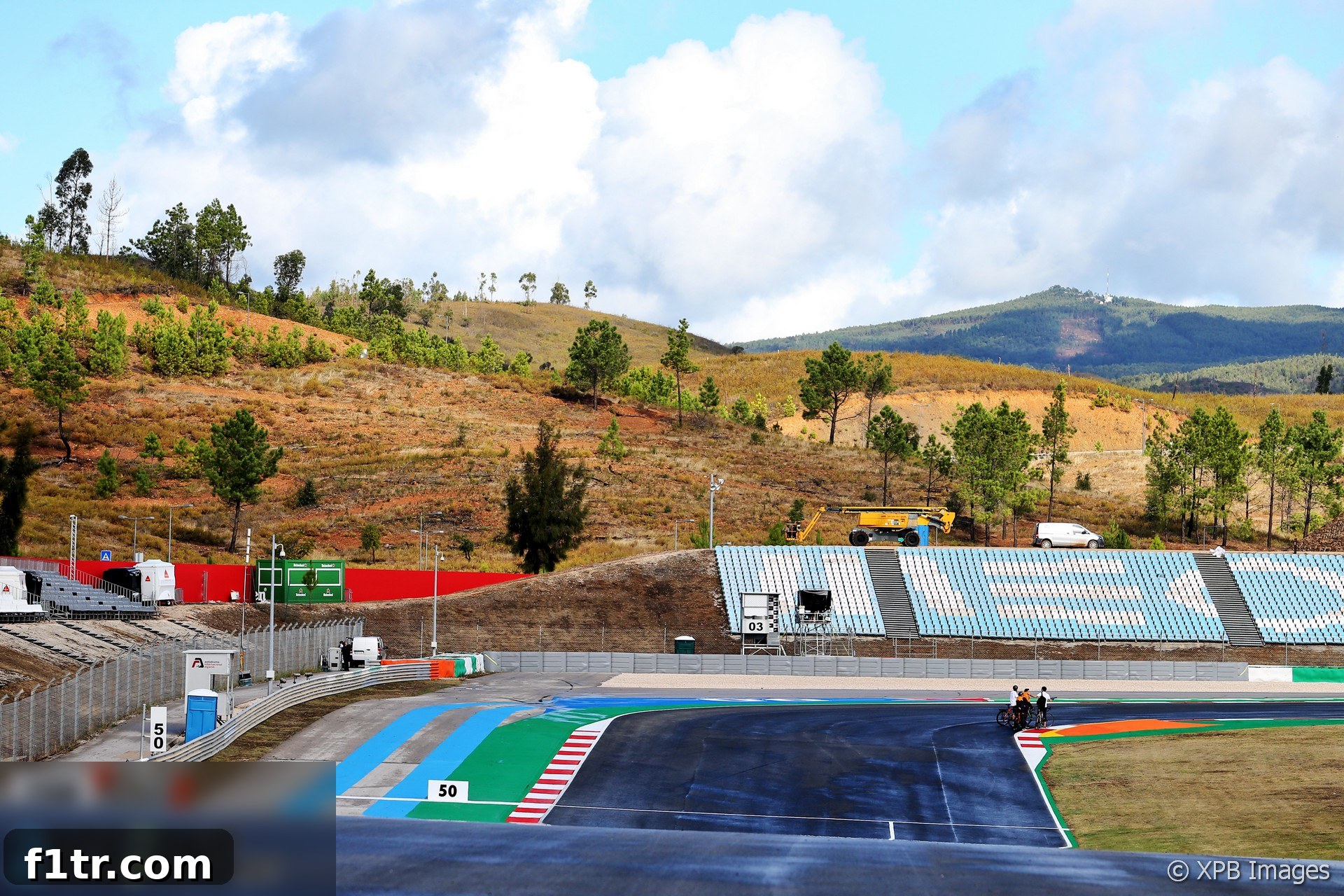
The Autodromo do Algarve, nestled near the vibrant town of Portimão, stood as a fresh and intriguing addition to Formula 1’s radically altered 2020 season calendar. This circuit, alongside Mugello, marked one of only two venues on the revised schedule that had never before hosted a round of the prestigious Formula 1 World Championship. Its inclusion was a direct response to the global disruptions caused by the COVID-19 pandemic, which necessitated F1’s focus on European tracks, presenting a unique opportunity to explore new challenges and gather invaluable data.
With much of the traditional international racing calendar beyond Europe’s borders deemed unfeasible due to public health concerns, Formula 1 seized the moment to embrace unfamiliar territories. This strategic pivot allowed the sport to visit circuits like Portimão, leveraging their distinct characteristics to glean crucial real-world insights. The core objective was to understand how diverse circuit contours and unique topographical features influence race dynamics, driver performance, and ultimately, the spectacle of Formula 1 racing. This approach moved beyond theoretical simulations, providing tangible evidence of what makes a circuit truly exceptional.
For many years, F1 has meticulously studied circuit design, primarily from a safety perspective. However, the complex variables that culminate in truly memorable and engaging races have always proven more elusive and challenging to quantify. Questions abound: Are extended DRS zones, strategically placed before tight braking points, truly the sole method for engineering overtaking opportunities? What nuanced roles do elements like track camber and gradient play in promoting thrilling on-track action? Last month, Mugello, the other new venue introduced in 2020, earned high praise specifically for its beautifully cambered corners, which offered a distinct challenge. At the Autodromo do Algarve, the defining dimension and central characteristic is its dramatic and relentless elevation change.
Formula 1’s last engagement with the Portimão track was over a decade ago, for a private testing session. Ahead of its highly anticipated return for the Portuguese Grand Prix – a race reinstated to the F1 calendar after a significant 24-year hiatus – the circuit underwent a comprehensive resurfacing. This crucial upgrade was overseen by Dromo, a renowned circuit design and engineering company that Formula 1 is increasingly entrusting with such vital projects due to their expertise in modern track evolution.
Jarno Zaffelli, the esteemed founder of Dromo, drew parallels between the Portimão circuit and another of his company’s high-profile projects that was also slated to feature on the 2020 F1 calendar: the extensively revamped Zandvoort circuit in the Netherlands. However, Zaffelli noted that the Autodromo do Algarve distinguishes itself even further with its more pronounced and dramatic crests and falls compared to its Dutch counterpart. This creates a truly distinctive challenge for both drivers and engineers.
“Portimão boasts an extraordinary amount of elevation changes,” explains Zaffelli, highlighting the circuit’s defining feature. “While there is some banking, the lateral changes are not extreme – perhaps 8-10% maximum. What truly sets it apart are the intense slopes, with downhill gradients reaching up to a staggering 16%. So, particularly between turns eight and nine, and again between eleven and twelve, drivers experience significant descents followed by steep climbs. This makes the circuit feel very much like a rollercoaster. If you describe Zandvoort as having a rollercoaster effect, Portimão offers a similar thrill, but one defined by vertical undulations rather than purely lateral movements.” This three-dimensional dynamic forces drivers to constantly adapt, recalibrating their braking points and acceleration zones as the track surface literally disappears and reappears before them.
Become a RaceFans supporter
A conventional, two-dimensional top-down track map of the Autodromo do Algarve, while useful for layout, profoundly disguises this essential characteristic. “It’s a truly magnificent track,” Zaffelli affirms. “It came as a surprise even to me because, when you view it from a flat layout perspective, its unique personality isn’t immediately apparent. But once you are physically there, experiencing the circuit firsthand, the dramatic elevation changes become incredibly clear and impactful.” This underscores how flat track diagrams can misrepresent the dynamic reality of such a dramatically undulating course.
The sheer steepness and abruptness of these gradient shifts introduce an exhilarating yet demanding dimension that is noticeably absent from many contemporary Formula 1 circuits. These modern tracks, often designed with vast run-off areas and predictable profiles, can sometimes sacrifice genuine challenge for safety and consistent performance. Portimão, in contrast, offers a refreshing return to a more organic and demanding driving experience. “Almost all of the corners here are blind,” Zaffelli reveals, emphasizing the extraordinary skill required. “This makes it incredibly interesting and immensely fun to drive.” The lack of clear sight lines demands exceptional spatial awareness, precise car placement, and a profound trust in the car’s setup, pushing drivers to the very limit of their abilities.
Remarkably, only one driver on the Formula 1 grid for that weekend, Sergio Perez, possessed prior racing experience at Portimão from when the F1 feeder series, GP2 (now known as Formula 2), visited the circuit in 2009. Perez undoubtedly noted a crucial distinction between that race and the upcoming Grand Prix, particularly concerning the configuration of Turn One. The Autodromo do Algarve offers two distinct configurations at this specific point on the track. While GP2 utilized a slower, tighter hairpin, Formula 1 was set to employ a much quicker, sweeping right-hander. Mercedes engineers anticipated that drivers would only need to drop two gears for this high-speed flick, maintaining significant momentum through the corner.
The strategic choice of the faster Turn One configuration for Formula 1 seemingly contradicted the prevailing wisdom regarding track design aimed at promoting overtaking. Conventional thought often dictates that slow corners, which compel drivers to brake heavily and for extended periods, are essential for facilitating genuine overtaking opportunities. However, Turn One at Portimão presented a significant and unique differentiating factor: it is immediately preceded by a notoriously steep downhill plunge. This particular characteristic renders it fundamentally different from outwardly similar corners found at other circuits, such as those at Bahrain, which F1 was scheduled to visit twice later that year anyway. The combination of high speed, a dramatic descent, and a blind apex makes Turn One at Portimão a truly singular challenge, capable of generating excitement in ways traditional slow corners cannot.
“A flat track offers a component that is remarkably easy to predict and straightforward to simulate,” explains Zaffelli, contrasting it with Portimão’s complexity. “However, when you begin to operate in a truly three-dimensional environment, engaging with these kinds of significant elevation changes, and particularly with blind corners and tracks that are largely unknown to the current generation of drivers, the propensity for drivers to make errors increases significantly.” This unpredictability adds an element of raw human challenge that is sometimes absent on more modern, sanitized circuits. It forces drivers to rely more on instinct, adaptability, and the fundamental feel for their car, rather than solely on pre-programmed simulations. The reduced familiarity also levels the playing field, as none of the drivers have a significant advantage in terms of track knowledge, leading to a more competitive and dynamic weekend.
Daniel Ricciardo, who had previously clinched the British F3 title at the Portimão track back in 2009, expressed confidence that overtaking would indeed be possible. “I’ve raced here in F3, but I genuinely believe F1 will be truly spectacular,” he commented, enthusiastic about the circuit’s potential. “It has a long straight and DRS, and I expect the final corner to be taken flat-out. So, hopefully, that provides a good opportunity to latch onto a strong tow, and overtaking should be manageable, even with Turn One being incredibly quick.” Ricciardo’s insights, stemming from his prior experience, offered a glimmer of hope that the circuit’s unique design would not stifle the on-track action but rather enhance it, requiring a different approach to strategic passes.
Observing the powerful Formula 1 cars dramatically pop up and over Algarve’s numerous crests and blind corners was also anticipated to significantly enhance the perception of speed. This is often a challenging aspect to convey effectively through television coverage, especially on many modern, wide tracks that feature ample run-off spaces. The visual spectacle of cars momentarily disappearing over a rise and then reappearing, coupled with the audible strain of engines battling gradients, creates an immersive experience for viewers. However, these generous run-off areas, while crucial for safety, presented a potential drawback, particularly concerning Turn One. Spectators and officials alike expected to witness numerous drivers being penalized for violating track limits on its expansive asphalt run-off, adding another layer of challenge and scrutiny to the racing.
The decision to utilize the ‘standard’ and quicker configuration of Turn One at Portimão offered Formula 1 a prime opportunity to gather invaluable lessons about track design. These are insights that would simply be unavailable at more familiar, well-established venues. “They are intentionally maintaining the usual tracks as they were, while simultaneously experimenting with the new ones as a potential avenue to explore innovative track concepts,” Zaffelli elaborates, shedding light on F1’s forward-thinking strategy. “Consequently, they are diligently collecting data. The team, expertly led by Pat Symonds, is gaining extensive experience in truly comprehending the profound degree to which a track’s inherent design and characteristics are involved in shaping the overall ‘show’ that is presented to fans.” This systematic data collection from diverse new circuits allows F1 to build a comprehensive understanding of what elements truly contribute to exciting and competitive racing.
Become a RaceFans supporter
In its earlier years, the Autodromo do Algarve played host to various racing series, including GP2 and the now-defunct A1 Grand Prix, while Formula 3 series made occasional visits. However, over time, the original track surface began to deteriorate significantly. Recognizing the need for a high-quality, modern racing surface capable of handling the demands of contemporary motorsport, Dromo was commissioned to oversee a complete resurfacing. This comprehensive project was successfully completed just the month prior to the Grand Prix, ensuring the track was in pristine condition for F1’s return.
“When the circuit was initially constructed, it achieved something of a world record, having been completed in just seven months,” Zaffelli recalls, emphasizing the speed of its original development. “They built it incredibly quickly. Perhaps, in retrospect, a little too quickly for the proper settlement of the asphalt and for achieving the exacting flatness required by modern race tracks, particularly those catering to motorbikes, rather than just cars.” This rapid initial build contributed to the later issues with the track surface, necessitating Dromo’s intervention to bring it up to current, demanding standards for both four-wheeled and two-wheeled racing disciplines.
The imperative to bring the Portimão track up to the rigorous standards demanded by motorbikes became even more pressing when MotoGP, following Formula 1’s precedent, also added Algarve to its own reorganized 2020 calendar. The track surface, which had seen various localized patching attempts over the years in trouble spots, therefore needed to be entirely revitalized to meet the exceptionally stringent requirements of motorcycle racing, which are often more demanding than those for cars due to the sensitive nature of two-wheeled grip and handling. “When Formula 1 initially accepted the opportunity to race in Portimão, they essentially requested us to rectify the existing surface issues for their event,” Zaffelli explains. “And then, subsequently, MotoGP also decided to come over. So, our initial task was solely to prepare it for Formula 1, and then we were informed, ‘Okay, MotoGP is coming too.’ This was excellent news, but it meant adapting our approach, as the tolerances for bikes are significantly more restricted and precise.”
With the extensive resurfacing work now successfully completed, the Autodromo do Algarve was finally poised and ready to host its inaugural Formula 1 race weekend. The circuit had endured a stroke of misfortune, coming into existence at the close of the 2000s, precisely as the global financial downturn, triggered by the credit crunch, began to exert its severe economic pressure. This era saw F1 teams collectively agree to stringent limits on testing, drastically cutting their annual mileage outside of official race weekends. Such restrictions dealt a significant blow to circuit owners like Portimão, who had initially hoped to generate substantial revenue by renting out their tracks for extensive testing programs.
Consequently, full-spec Formula 1 cars had not lapped the challenging Autodromo Internacional do Algarve for over a decade. The insights and data that the sport gleaned when it finally took to the track that weekend were anticipated to be profound. What the teams and the sport as a whole discovered about Portimão’s unique layout – its dramatic elevation changes, blind corners, and high-speed sections – had the potential to significantly influence the design philosophies and characteristics of future circuits, shaping the very landscape of Formula 1 for years to come. The Portuguese Grand Prix was not just a race; it was a living laboratory for the future of circuit design.
Join the RaceFans Supporters Drive!
If you’ve enjoyed RaceFans’ motor sport coverage during 2020, please take a moment to find out more about our Supporter Drive.
We’re aiming to welcome 3,000 new Supporters to help fund RaceFans so we can continue to produce quality, original, independent motorsport coverage. Here’s what we’re asking for and why – and how you can sign up:
- Join the RaceFans Supporters Drive!
2020 F1 season
- Grosjean to make F1 test return tomorrow for first time since Bahrain horror crash
- Pictures: Wrecked chassis from Grosjean’s Bahrain fireball crash to go on display
- Bottas vs Rosberg: Hamilton’s Mercedes team mates compared after 78 races each
- F1 revenues fell by $877 million in Covid-struck 2020 season
- Hamilton and Mercedes finally announce new deal for 2021 season
Browse all 2020 F1 season articles