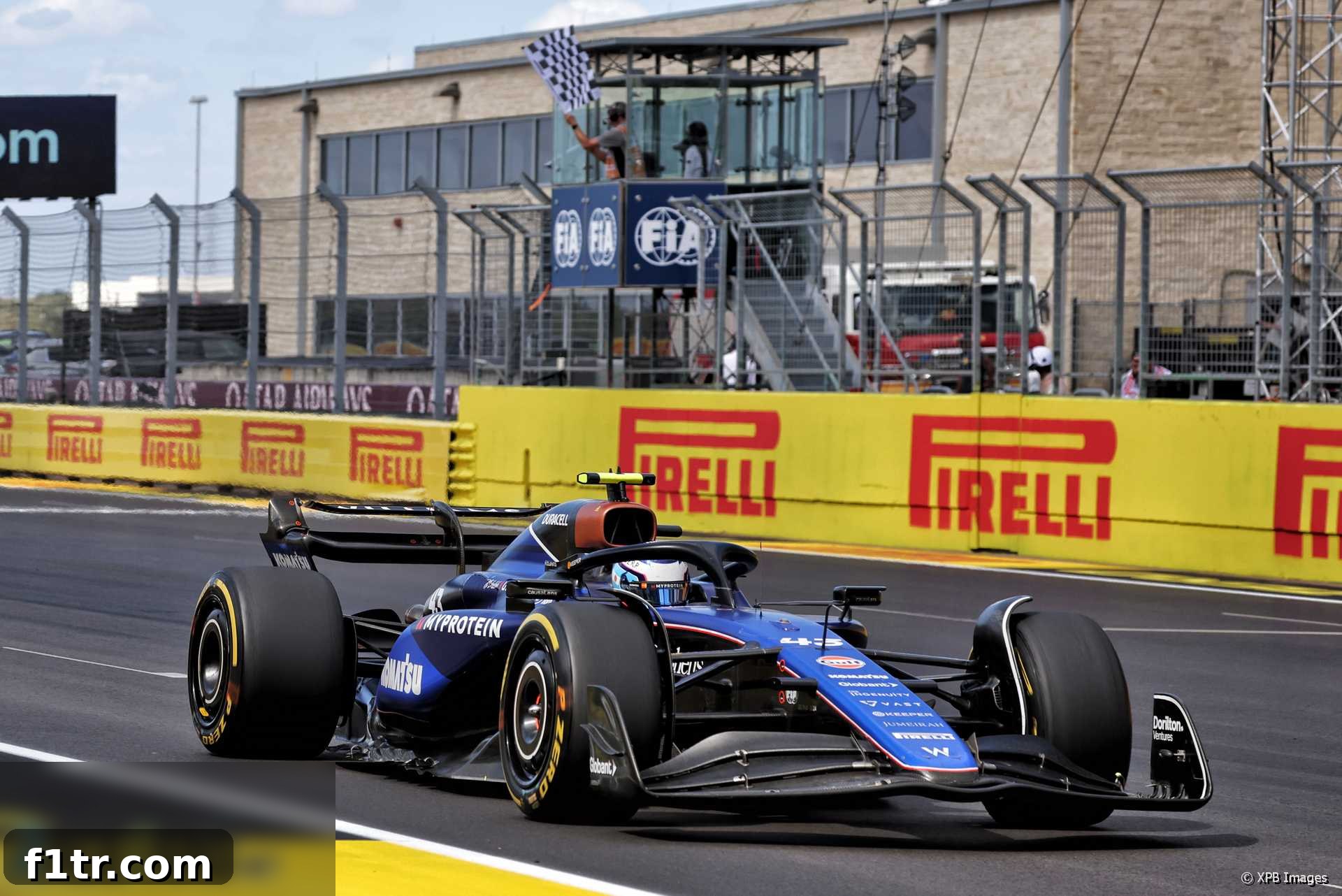
In the latest motorsport update, Williams Team Principal James Vowles recently highlighted a critical area for improvement after the United States Grand Prix: the team’s significant struggles in qualifying performance. This issue, he stated, prevented the team from maximizing its potential points haul despite respectable race pace.
Williams F1 Performance Update: Unlocking Potential Beyond Qualifying
Qualifying Challenges at COTA: When Medium Beats Soft for Williams
The Williams Racing team managed to secure a single point at the Circuit of the Americas, thanks to the commendable efforts of Franco Colapinto. However, Team Principal James Vowles firmly believes that a far greater return was possible had the team achieved a stronger qualifying position. This sentiment underscores a recurring challenge for Williams: translating promising race pace into a robust Saturday performance, a critical factor for success in modern Formula 1.
Vowles elaborated on the specific difficulties encountered, particularly with tire performance during qualifying sessions. “I think the race pace would have shown you that we’re there or thereabouts in terms of the car working,” Vowles explained in a video released by the team. “But we’re not able to get it all right for one lap in a qualifying condition. This, very specifically, was down to not extracting performance or grip from that soft tyre. Probably as extreme as, actually for us, the medium was faster than a soft in a qualifying condition. And it shouldn’t be; it should be a large grip step, which is what most other teams have experienced.”
This statement reveals a fundamental setup or operational issue unique to Williams at the US Grand Prix, where the expected performance differential between tire compounds was inverted for them. The soft tire, designed for maximum grip over a single qualifying lap, surprisingly offered less overall performance than the more durable medium compound. Such a scenario puts a team at a significant disadvantage, as optimizing for qualifying typically involves extracting every ounce of speed from the softest available rubber. When a team finds its harder compound outperforming the soft, it indicates a profound challenge in understanding and utilizing the tire window, which is crucial for competitive qualifying laps.
Vowles acknowledged that the team takes full responsibility for this performance gap, emphasizing that regardless of the circuit characteristics, it is Williams’ duty to ensure their car can be set up effectively to perform optimally everywhere. Despite the qualifying setback, the underlying package that allowed them to score a point remains competitive. “The base package, the package that allowed us to score a point is still very much there or thereabouts. If we qualified in position, I’m sure we would have the opportunity to score more again,” Vowles affirmed, highlighting the untapped potential that could be unlocked with improved qualifying form.
The quest for consistent one-lap pace remains a key focus for Williams as they continue their journey to climb the Constructors’ Championship standings. Addressing these specific tire and setup challenges will be crucial for future success, allowing their race-day competitiveness to shine through more consistently. The team’s ability to unlock this qualifying performance will be pivotal in their long-term strategy for returning to the midfield and beyond, maximizing every opportunity for points in a fiercely competitive grid.
Formula E Teams Face Penalties for Cost Cap Breaches
Advert | Become a Supporter & go ad-free
In the world of electric motorsport, two prominent Formula E teams, Nissan and Jaguar, have been sanctioned for exceeding the series’ stringent cost cap regulations for the previous season. The financial fair play rules, designed to promote sustainability and competitive balance within the championship, set the limit at €13,668,000 (£11.4 million). Nissan was found to have over-spent by €269,252, representing a 2% breach, while Jaguar’s overspend was £73,849, or 0.6%.
As a consequence of these financial infractions, both teams have faced significant penalties. Nissan received a substantial fine of €300,000, and Jaguar was fined €100,000. In addition to the monetary penalties, both teams also had their pre-season testing allocation reduced by three hours. These sanctions underscore the commitment of Formula E’s governing body, the FIA, to uphold the integrity of its financial regulations, ensuring a level playing field across the championship and deterring excessive spending.
Cost caps are a relatively modern addition to top-tier motorsport, introduced to curb escalating expenditure, prevent dominance by financially superior teams, and ensure the long-term viability and attractiveness of the sport. Breaches, even minor ones, are typically met with firm responses to deter future transgressions and maintain confidence in the system. The reduction in testing time is a particularly impactful penalty, as pre-season testing is crucial for car development, setup optimization, and driver acclimatization ahead of a new season. Less track time can directly impact a team’s preparedness and competitive edge.
This development serves as a strong reminder to all Formula E competitors about the meticulous financial discipline required to operate within the defined budgetary limits, reflecting the sport’s broader push towards efficiency and responsible spending. It also highlights the seriousness with which the FIA treats financial regulations across all its sanctioned championships, aiming to prevent scenarios that could undermine sporting fairness.
Formula 1’s Soaring Popularity: Healthy US Viewing Figures Continue
Formula 1 continues its remarkable surge in popularity across the United States, as evidenced by the robust viewing figures for the recent United States Grand Prix. ABC’s live broadcast of the event attracted an impressive average audience of 1.3 million people from the iconic Circuit of the Americas. This figure marks the joint second-largest average audience recorded since Formula 1 made its return to the ABC channel six years ago, highlighting a sustained and growing interest in the sport.
The consistent growth of F1’s audience in the US is not a new phenomenon but rather a trend that has been building momentum over several seasons. This year alone, five rounds of the championship have already broken US audience records: Miami, Monaco, Canada, Britain, and Italy. These record-breaking numbers reflect a successful strategy by F1 to engage American audiences, partly attributed to the unprecedented success of the Netflix docu-series “Drive to Survive,” increased marketing efforts, and the addition of multiple US races to the calendar, including the popular Miami Grand Prix.
The United States is a key strategic market for Formula 1, and the healthy viewing figures underscore the sport’s successful penetration into a traditionally challenging sports landscape, often dominated by American football, basketball, and baseball. The engagement of 1.3 million viewers for a single race broadcast is a testament to F1’s expanding cultural footprint and its ability to captivate a diverse demographic across the nation. This sustained interest bodes well for the future of Formula 1 in North America, signaling continued investment in events, media coverage, and potentially further expansion, solidifying its place in the American sporting consciousness.
Rising Talent: Bruno del Pino Graduates to Formula 3
The ladder of motorsport progression sees promising young talents move up through the ranks, and the latest driver to make a significant step is Bruno del Pino. The young Spaniard will graduate from Eurocup 3 to the highly competitive Formula 3 championship next year, joining the reputable MP Motorsport team. Del Pino had a strong showing in Eurocup 3 this year, finishing an impressive third overall behind Francisco Javier Sagrera and Christian Ho, showcasing his potential and consistency.
Formula 3 is a crucial stepping stone for aspiring Formula 1 drivers, providing a high-level platform to compete against some of the best emerging talents globally. The series features powerful single-seater cars and races on many of the same circuits as Formula 1, making it an ideal environment for drivers to hone their skills, understand complex race weekends, and gain exposure to team structures similar to F1. MP Motorsport, known for nurturing young talent and consistently fielding competitive cars, will provide Del Pino with an excellent opportunity to demonstrate his capabilities on a bigger stage against a formidable grid.
This move signifies a clear and progressive trajectory for del Pino’s career, placing him firmly in the spotlight of the international motorsport community. His strong performance in Eurocup 3 indicates a solid foundation of race craft and speed, and the transition to Formula 3 will be a true test of his adaptability and ability to extract performance from a new, more powerful car as he aims to make an immediate impact in the feeder series towards F1.
Advert | Become a RaceFans supporter andgo ad-free
Motorsport Headlines & Driver Insights: Beyond the Grand Prix
Stay informed with the latest developments and perspectives from across the world of single-seater motorsport, offering deeper dives into potential calendar changes, driver experiences, and career aspirations that shape the future of racing.
Return to Argentina? F1 Race Hinted for Calendar Re-entry
Lost F1 race closes in on return to calendar after 26 years as sponsor says ‘all the stars are aligning’ (The Sun)
Reports suggest that Argentina could be on the verge of making a sensational return to the Formula 1 calendar after a 26-year absence. The prospect of an F1 race in South America, beyond the existing events in Brazil and Mexico (which is geographically Central America), has been a topic of discussion among fans and officials alike. With rising Argentinian talent like Franco Colapinto making waves in feeder series and now making his F1 debut, a home Grand Prix would undoubtedly ignite local passion and provide a powerful boost for motorsport in the region. A sponsor involved in the potential return enthusiastically stated, “‘It is great for [Argentina] and hopefully it will give your country, once again (…) hopefully sooner rather than later the possibility for South America to host not only Mexico – in Central America – Sao Paulo in Brazil… why not?’ This sentiment highlights the growing desire for F1 to diversify its global footprint and engage with its passionate South American fanbase, potentially adding another historic venue back to the prestigious calendar and tapping into a rich motorsport heritage.
Christian Lundgaard’s Positive McLaren IndyCar Test Experience
IMS test was open house for Lundgaard with McLaren (IndyCar)
IndyCar driver Christian Lundgaard recently had the opportunity to test with McLaren, an experience that provided valuable insights into the team’s operations and car characteristics. Lundgaard expressed positive feedback on the stability of the McLaren vehicle during the test at Indianapolis Motor Speedway (IMS), noting a distinct difference compared to his previous experiences. “‘It’s a very different feeling. The difference is how the car not necessarily handles but stable on the ground, which was nice,'” he remarked. Such test opportunities are crucial for drivers to broaden their experience and for teams to evaluate talent, potentially leading to future collaborations or offering benchmarks for current setups. Lundgaard’s positive impression of the car’s stability speaks to the engineering prowess within McLaren’s IndyCar program, providing him with a unique perspective on top-tier open-wheel machinery and contributing to his overall development as a driver in the competitive IndyCar Series.
Jamie Chadwick Prioritizes IndyCar Move for 2025 Season
Chadwick prioritising IndyCar move over Indy Nxt return in 2025 (Racer)
Jamie Chadwick, a trailblazing female driver who has made a name for herself in various single-seater categories, is reportedly prioritizing a move to the NTT IndyCar Series over a return to Indy NXT for the 2025 season. Having gained significant experience and learning in Indy NXT, Chadwick feels she has reached the limits of what that series can teach her and is now eager to make the crucial step up to the premier open-wheel category in North America. “‘Really, what the test has shown me is yes, there are things to work on, yes, I wasn’t winning a championship necessarily in Indy Nxt, but I feel like the learning that I had in Indy Nxt is now kind of reached its limit, and really I want to make that step up now,'” Chadwick conveyed. This ambition highlights her determination to compete at the highest level and continue breaking barriers for women in motorsport. A move to IndyCar would be a significant milestone in her career, offering new challenges and opportunities to showcase her talent on a global stage, competing against some of the world’s best open-wheel drivers.
We always endeavour to credit original sources. Got a tip for a link relating to single-seater motorsport? Please send it to us via the contact form.
Advert | Become a RaceFans supporter andgo ad-free
Social Media Pulse: Instant Insights from the Motorsport World
Social media platforms continue to be a vibrant hub for real-time reactions, discussions, and updates from the motorsport community. Here’s a notable post capturing recent commentary, reflecting the immediate dissemination of news and opinion:
Actual story: https://t.co/Rt0q59zwpR
— Keith Collantine (@keithcollantine) October 23, 2024
This post from Keith Collantine, a respected voice in motorsport journalism, directs followers to a relevant story, showcasing how journalists and influencers use social media to disseminate news and engage with their audience instantly. Social media is an indispensable tool for fans to stay connected, follow live updates, and interact directly with drivers, teams, and pundits, fostering a more dynamic and engaging fan experience.
Advert | Become a RaceFans supporter andgo ad-free
- Find more official F1 accounts to follow in the F1 Twitter Directory
Fan Perspectives: Addressing Track Limits at Circuit of the Americas
The issue of track limits at various Formula 1 circuits has been a persistent talking point among drivers, teams, and fans, often leading to controversial penalties and inconsistent rulings. The Circuit of the Americas (COTA) in Austin, Texas, has often found itself at the center of this debate, prompting constructive suggestions for improvement from the motorsport community.
Today’s featured comment from @Jerejj offers a practical and insightful comparison to other circuits that have successfully addressed similar issues, demonstrating a common-sense approach to regulating track boundaries:
I’m surprised COTA didn’t go for the same compromise solution for this year’s edition as Red Bull Ring & Hungaroring, i.e., have a small gravel portion beside curbing at every problem corner exit (T1, 9, 11, 12, 15, 19, & 20) to make going wide beyond the white line automatically slower compared to staying within track limits.
@Jerejj
This insightful comment highlights a practical approach adopted by circuits like the Red Bull Ring in Austria and the Hungaroring in Hungary, where strategic placement of gravel traps immediately beyond the curbing at critical corner exits serves as a natural deterrent to exceeding track limits. Unlike purely asphalt run-off areas, which can sometimes encourage drivers to push wider without significant penalty, gravel provides an immediate and undeniable speed disadvantage, often kicking up debris and disrupting the car’s balance, thus forcing drivers to respect the white lines and encouraging tighter, fairer racing.
The suggestion pinpoints specific problem corners at COTA (Turns 1, 9, 11, 12, 15, 19, & 20) where such a solution could be particularly effective. Implementing these minor changes, rather than relying solely on stewards’ decisions or electronic detection which can be inconsistent or time-consuming, could significantly enhance the fairness and clarity of racing. It ensures that only drivers who stay within the designated track boundaries gain an advantage, making the racing cleaner and easier for both fans and officials to understand. This ongoing discussion underscores the importance of circuit design in promoting clean, fair, and exciting motorsport for all stakeholders.
Happy Birthday!
We extend our warmest wishes to Adam Tate on his birthday! We hope he has a fantastic day filled with celebration.
On This Day in Motorsport History: Montoya’s Final Williams Triumph
Twenty years ago today, on October 23, 2004, a significant moment in Formula 1 history unfolded: Juan Pablo Montoya secured his final victory for the Williams team. This memorable win took place at the challenging Interlagos circuit in Brazil, where he skillfully outmaneuvered his future McLaren team mate, Kimi Räikkönen, in a thrilling display of speed and aggression.
Montoya’s departure from Williams marked the end of an era for both the charismatic Colombian driver and the historic British team. Known for his aggressive driving style, electrifying overtakes, and uncompromising approach, Montoya was a fan favorite and a formidable competitor who brought a unique flair to Formula 1. His victory at Interlagos was a testament to his raw talent and the competitive spirit of the Williams team during that period, representing a high point in their collaboration before his move to McLaren. Tragically for the historic British outfit, this win also signaled the beginning of a prolonged dry spell; Williams has only managed to clinch one Grand Prix victory since that day in 2004, highlighting the dramatic shifts in the sport’s competitive landscape and the team’s struggles over the past two decades.
Furthermore, this day also marked the final Formula 1 race for the Jaguar Racing team. Jaguar, which had entered F1 in 2000 following Ford’s acquisition of Stewart Grand Prix, struggled to achieve consistent success despite significant investment and a distinctive green livery. The team was ultimately sold to Red Bull at the end of the 2004 season, laying the foundation for what would become one of F1’s most dominant and innovative forces in the years that followed. The events of this day underscore the ever-evolving nature of Formula 1, with teams rising and falling, and driver careers taking pivotal turns that redefine their legacies. Montoya’s final Williams win and Jaguar’s F1 swansong serve as poignant reminders of motorsport’s rich and dynamic history, where every race can be a turning point.