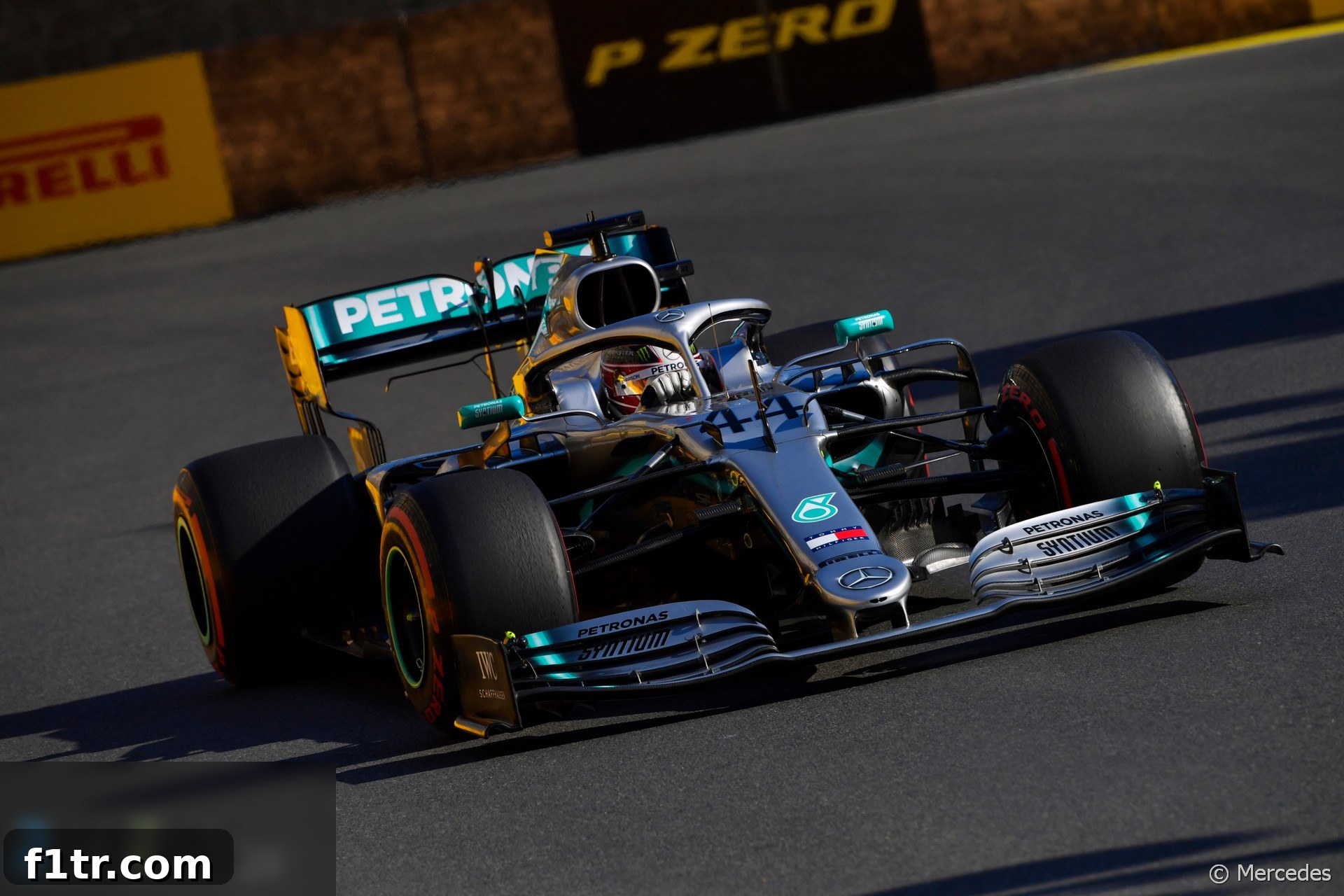
Lewis Hamilton, a titan of Formula 1, openly acknowledged the pivotal time loss to his Mercedes teammate, Valtteri Bottas, during a critical Virtual Safety Car (VSC) period at the 2019 Azerbaijan Grand Prix. The championship contender, known for his meticulous approach and relentless pursuit of perfection, described the incident as his own fault, highlighting the razor-thin margins that define success and failure at the pinnacle of motorsport. This moment, though seemingly minor in the grand scheme of a full season, underscored the intricate blend of driver skill, technological setup, and instantaneous decision-making required to excel in Formula 1.
Advert | Become a Supporter & go ad-free
The Critical VSC Incident: A Tale of Two Dashboards
The incident unfolded during the latter stages of the race, specifically on lap 40, when a Virtual Safety Car was deployed. Before the VSC, Hamilton was hot on Bottas’s heels, maintaining a gap of approximately two and a half seconds. However, as the VSC period concluded on lap 41, Hamilton found himself trailing by an extended margin of three and a half seconds. This seemingly small differential of a single second during a VSC period can be a lifetime in F1, especially when battling for victory against a direct rival.
Hamilton didn’t shy away from taking responsibility for the lost time, stating, “I lost two-and-a-half seconds, or whatever it is, under the VSC, so had to regain that and, with only nine laps to go, that was not so easy. So, that was my fault and something I’ll work on. There’s some things I can fix on the dash to make sure that doesn’t happen again.” His immediate focus on identifying the root cause and implementing a solution reflects the mindset of a multi-world champion constantly striving for improvement. The admission also highlighted the personal element in dashboard configuration and driver interaction with complex in-car systems.
Understanding the Virtual Safety Car Protocol
During a Virtual Safety Car period, drivers are mandated to adhere to a specified minimum ‘delta’ time across each sector of the track. This system ensures that all competitors maintain a controlled pace, neutralizing any advantage gained by faster sectors under caution. The critical juncture, however, is the moment the VSC period ends. Drivers must react instantaneously to the “VSC ENDING” message, quickly returning to racing speed without exceeding track limits or gaining an unfair advantage. Time can be crucially won or lost based on a driver’s reaction speed, their understanding of their car’s telemetry, and the pre-programmed settings of their dashboard display.
The precision required during these transitions is immense. A fraction of a second’s delay in reacting to the VSC ending, or an inefficient acceleration back to full pace, can translate into measurable time loss. Conversely, a perfectly timed reaction allows a driver to maintain their position relative to their rivals, or even gain a marginal psychological edge. This high-stakes precision demonstrates why every detail, including the customization of cockpit displays, is paramount in Formula 1.
Valtteri Bottas’s Masterclass in VSC Management
While Hamilton was grappling with his dash settings, Valtteri Bottas executed the VSC restart flawlessly. Bottas, who ultimately went on to win the 2019 Azerbaijan Grand Prix, confirmed that he and Hamilton utilize different dashboard configurations, a common practice in F1 where drivers personalize their environments for optimal performance. “It’s pretty similar but between us there are some differences,” Bottas explained. “We work with a personal electronics engineer, we work [on] starts and the dash, these kind of things.”
Bottas’s satisfaction with his setup and his ability to remain “close enough to the delta time under the VSC” proved critical for his race outcome. His seamless transition from VSC pace to full racing speed denied Hamilton any opportunity to close the gap, effectively solidifying his lead. This subtle but significant advantage underscored the effectiveness of Bottas’s preparation and his personal electronics engineer’s meticulous work. It was a testament to how crucial seemingly minor technical details and driver-engineer collaboration are in achieving peak performance, especially in high-pressure scenarios like a race restart after a safety car.
The Importance of Dash Customization and Driver-Engineer Synergy
The F1 cockpit is a marvel of engineering, packed with buttons, switches, and a highly customizable digital dashboard display. This display provides drivers with a wealth of real-time information, from lap times and sector deltas to tire temperatures, fuel levels, and VSC delta times. Each driver, in collaboration with their dedicated electronics engineer, fine-tunes these displays to present information in a way that is most intuitive and useful to them under various race conditions.
This personalization is not merely a matter of preference; it’s a performance differentiator. For Hamilton, his immediate response to the VSC incident was to adjust his dash display, indicating that a particular piece of information, or its presentation, wasn’t optimally configured for that specific VSC scenario. The ability to make such swift, technical adjustments mid-season, or even between sessions, speaks volumes about the dynamic and adaptive nature of Formula 1 teams and drivers. It highlights that the pursuit of speed extends beyond aerodynamics and engine power to the very interface between driver and machine.
The Psychological Edge in F1
Beyond the technical aspects, the VSC incident in Baku also touches upon the psychological battle within Formula 1. While Hamilton is renowned for his mental strength, any perceived lapse, however small, can be a source of frustration. His willingness to admit fault and immediately seek a solution demonstrates his winner’s mentality and resilience. For Bottas, managing the VSC perfectly likely boosted his confidence, especially given his strong start to the 2019 season and his “Bottas 2.0” narrative, where he aimed to challenge Hamilton more consistently.
These small victories, like a perfectly executed VSC period, contribute to a driver’s overall confidence and rhythm, which can be invaluable over the course of a demanding race and a lengthy championship battle. The ability to perform flawlessly under pressure, when every millisecond counts, often separates the good from the truly great in Formula 1. It’s not just about raw pace, but also about execution in every conceivable scenario, including the unpredictable nature of safety car deployments.
Advert | Become a RaceFans supporter andgo ad-free
Reflecting on the 2019 F1 Season and Beyond
The 2019 Azerbaijan Grand Prix was a significant race for Mercedes, with Bottas taking the win and Hamilton finishing second, securing a dominant 1-2 finish for the team. While Hamilton’s VSC time loss didn’t alter the Mercedes 1-2, it certainly impacted the individual battle for supremacy between the two teammates. This incident serves as a microcosm of the intense competition within Formula 1, where every detail, every decision, and every second truly matters.
Hamilton’s commitment to refining his dashboard settings is a testament to the continuous learning and adaptation required to stay at the forefront of Formula 1. It’s a reminder that even the most accomplished drivers are perpetually seeking marginal gains, analyzing every data point, and fine-tuning every aspect of their craft. This relentless pursuit of perfection, extending to something as seemingly minor as a dash display, is what makes F1 drivers and their teams truly extraordinary, consistently pushing the boundaries of human and technological performance.
2019 F1 season: Related Articles
- Crying in the Melbourne car park at 2019 grand prix was my career low – Ocon
- McLaren Racing reports reduced £71 million loss in 2019
- Kvyat: Hockenheim podium last year was “my biggest achievement” so far
- How the FIA’s new encrypted fuel flow meter targets Ferrari’s suspected ‘aliasing’ trick
- “He smashed my office door”: 23 must-see moments from ‘Drive to Survive’ season two
Browse all 2019 F1 season articles