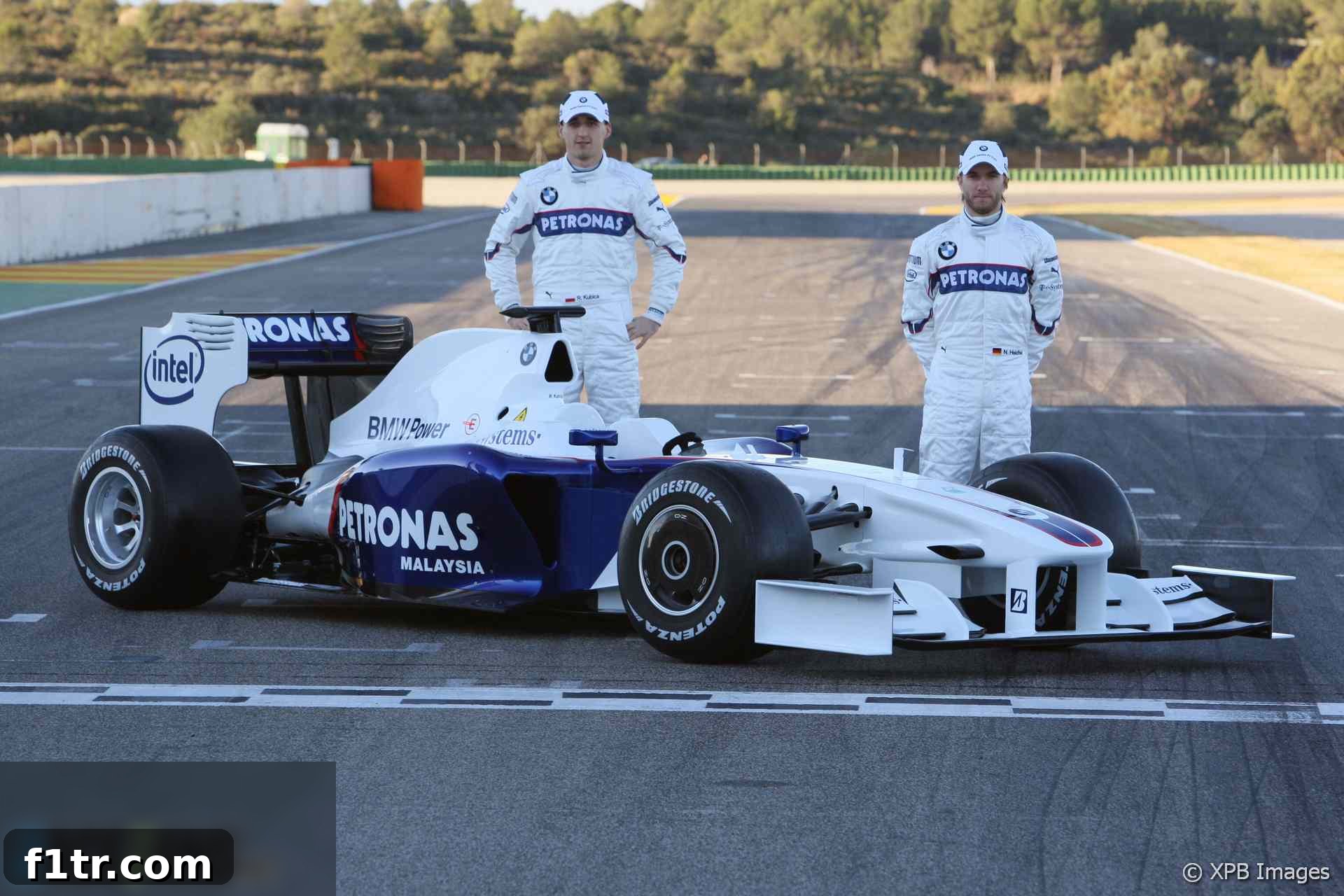
The highly anticipated 2009 Formula 1 season officially kicked off for BMW Sauber with the grand unveiling of their new challenger, the F1.09, at Spain’s renowned Valencia Ricardo Tormo circuit. This pivotal moment marked a new chapter for the team, as they presented a car meticulously engineered to conform to the sport’s drastically altered technical regulations. The launch event was a statement of intent, signaling BMW Sauber’s ambitions to build upon their impressive 2008 campaign and contend at the pinnacle of motorsport.
Esteemed drivers Robert Kubica and Nick Heidfeld had the distinct honor of pulling back the covers, revealing the striking design of the F1.09. This car represents the fourth iteration of a Formula 1 machine developed by the team since BMW’s acquisition of the Sauber operation. Following its debut, Kubica wasted no time in putting the new chassis through its paces, completing the inaugural laps and providing crucial early feedback. The atmosphere was charged with a mixture of excitement and cautious optimism, as the team embarked on what promised to be one of the most transformative seasons in recent F1 history.
BMW Sauber F1.09: A New Era Dawns for Formula 1
The unveiling of the BMW Sauber F1.09 was more than just a car launch; it was a testament to the team’s unwavering commitment to innovation and competitive excellence. Designed from the ground up to meet the rigorous demands of the 2009 technical regulations, the F1.09 embodies a philosophy of adapting to change while pushing the boundaries of performance. With a clear focus on simplifying aerodynamics and introducing groundbreaking technologies like KERS, the 2009 season mandated a revolutionary approach to car design, and BMW Sauber aimed to be at the forefront of this evolution.
A Legacy Forged in Competition: BMW Sauber’s Journey to 2009
BMW’s entry into Formula 1 as a works team through the acquisition of Sauber in 2006 marked a significant step for the German automotive giant. From its inception, the team rapidly ascended the ranks, demonstrating a steady and impressive trajectory of improvement. Each subsequent season saw BMW Sauber grow in stature, consolidating their position as a formidable force in the constructors’ battle. By 2008, the team had firmly established itself among the elite, consistently challenging the long-standing titans of the sport. Their measured progress and strategic investments in personnel and infrastructure laid a solid foundation, fueling aspirations for even greater success in the challenging landscape of Formula 1.
The Pivotal 2008 Season: Triumphs and Missed Opportunities
The 2008 Formula 1 season was unequivocally BMW Sauber’s most successful to date, a year that etched their name into the sport’s history books with a memorable victory. Robert Kubica delivered a stunning performance at the Canadian Grand Prix held at the iconic Circuit Gilles Villeneuve, securing the team’s maiden win. This triumph was made even more special by Nick Heidfeld’s strong second-place finish, resulting in an unforgettable one-two for BMW Sauber. This achievement not only showcased the car’s potential but also validated the team’s relentless efforts and strategic direction.
Throughout 2008, both Kubica and Heidfeld consistently scored points, demonstrating remarkable reliability and competitive pace. This impressive consistency propelled BMW Sauber to a commendable third place in the Constructors’ Championship standings, finishing a mere 17 points behind the eventual champions, Ferrari. While this marked a strong finish, it was, ironically, one position lower than their revised standing in 2007, where McLaren’s disqualification had elevated BMW Sauber to second place. The 2008 season, however, was about genuine on-track performance and a clear demonstration of their growing prowess.
Despite these significant successes, the latter half of the 2008 season saw a noticeable tapering off in BMW Sauber’s development rate. This deceleration proved particularly detrimental to Robert Kubica’s bid for the coveted drivers’ title. At one point, with just four races remaining in the championship, Kubica was a mere 14 points adrift of Lewis Hamilton, who would ultimately clinch the title. However, the slowing pace of car development meant Kubica only managed to score points in two of the final four rounds, costing him valuable ground. This unfortunate dip in performance saw him finish the season in fourth place overall, a solid result but one that left a lingering sense of what might have been for a driver who had genuinely been in championship contention.
Navigating the Regulatory Revolution: The F1.09’s Technical Innovations
The 2009 Formula 1 season introduced a seismic shift in technical regulations, representing one of the most comprehensive overhauls in the sport’s modern era. These changes were deliberately implemented to improve the racing spectacle, primarily by reducing the reliance on complex aerodynamics and promoting closer competition. BMW Sauber’s F1.09 was meticulously designed to embrace these new rules, with the team making a conscious decision to prioritize its development over the latter stages of the 2008 season. The hope was that this foresight would give them a crucial head start in mastering the new technical landscape, ultimately paying dividends on track.
Kinetic Energy Recovery System (KERS): The Power Boost
One of the most significant and talked-about innovations for 2009 was the introduction of the Kinetic Energy Recovery System, or KERS. This revolutionary technology allowed teams to recover energy generated during braking and store it, typically in batteries or flywheels, for later deployment as a temporary boost of additional electrical power. Drivers could activate this boost at strategic moments, such as for overtaking or defending positions. The implementation of KERS brought a new layer of strategy to races, demanding precise timing and tactical decision-making from both drivers and engineers. BMW Sauber dedicated substantial resources to developing their proprietary KERS unit, aiming to maximize its effectiveness and integrate it seamlessly into the F1.09’s overall performance package.
Aerodynamic Overhaul: Redefining Downforce
Beyond KERS, the 2009 regulations ushered in a dramatically different approach to aerodynamics. The rules were simplified to reduce the “dirty air” phenomenon that made overtaking difficult. Key changes included a significantly larger and wider front wing, allowing drivers to make greater use of the clean air ahead of the car. Conversely, the rear wings were made smaller and higher, reducing the amount of downforce generated at the back of the car. Furthermore, many of the complex aerodynamic appendages, such as bargeboards and winglets, which had proliferated in previous seasons, were banned. This redefinition of aerodynamic principles forced designers to rethink their entire approach to downforce generation, aiming for cleaner, less turbulent airflow, and consequently, closer racing.
Dynamic Adjustments: The Driver’s New Control
Another crucial revision to the 2009 rules empowered drivers with more in-race control. For the first time, drivers were permitted to make limited adjustments to their front wing settings during a race from the cockpit. This capability allowed them to alter the car’s balance in response to changing track conditions, tire wear, or fuel load. This dynamic adjustment added an extra dimension to a driver’s skill set, demanding a deeper understanding of vehicle dynamics and strategic foresight. It also provided a means to fine-tune the car’s handling throughout a grand prix, potentially offsetting degradation or adapting to different racing scenarios. BMW Sauber engineers worked diligently to integrate this new control system ergonomically and effectively into the F1.09’s steering wheel and cockpit design.
Driver Expectations: Kubica and Heidfeld Eyeing Success
With the F1.09, expectations were high for BMW Sauber’s established driver lineup. Robert Kubica, fresh from a championship challenge in 2008, was seen as a genuine contender if the new car delivered on its promise. His aggressive driving style, combined with his technical feedback, made him an invaluable asset in the development of the F1.09. Nick Heidfeld, known for his consistency, technical prowess, and smooth driving, provided a strong complementary force. Both drivers were eager to exploit the new regulations, especially KERS and the adjustable front wing, to gain a competitive edge. Their combined experience and dedication were crucial for extracting maximum performance from the new machine and navigating the complexities of a revamped Formula 1 landscape.
The F1.09 Launch: A Glimpse into the Future
The BMW Sauber F1.09 was the sixth new car to be presented for the highly anticipated 2009 Formula 1 season, underscoring the intense development race underway among all teams. Each launch provided tantalizing glimpses into how different manufacturers interpreted the new regulations, showcasing diverse aerodynamic solutions and KERS implementations. For BMW Sauber, the Valencia launch was not just a formality; it was a declaration of intent, a display of engineering prowess, and a public demonstration of their readiness to compete at the highest level. The team’s decision to unveil their car early and conduct immediate shakedown runs signified their aggressive approach to preparation, aiming to gain valuable track time and data ahead of the crucial pre-season testing phase. This proactive strategy was designed to ensure that the F1.09 would hit the ground running, embodying the team’s aspirations for a truly memorable season.
Pictures: BMW Sauber F1.09 Launch & Shakedown
Nick Heidfeld (GER), BMW Sauber F1 Team and Robert Kubica (POL), BMW Sauber F1 Team “unpacking” the new car – BMW Sauber F1.09 – www.xpb.cc, EMail: [email protected] – copy of publication required for printed pictures. Every used picture is fee-liable © Copyright: xpb.cc
Robert Kubica (POL), BMW Sauber F1 Team and Nick Heidfeld (GER), BMW Sauber F1 Team – BMW Sauber F1.09 – www.xpb.cc, EMail: [email protected] – copy of publication required for printed pictures. Every used picture is fee-liable © Copyright: xpb.cc
BMW Sauber F1.09 – www.xpb.cc, EMail: [email protected] – copy of publication required for printed pictures. Every used picture is fee-liable © Copyright: xpb.cc
BMW Sauber F1.09 – www.xpb.cc, EMail: [email protected] – copy of publication required for printed pictures. Every used picture is fee-liable © Copyright: xpb.cc
Walter Riedl (Managing Director), Robert Kubica (POL), BMW Sauber F1 Team, Dr. Mario Theissen (GER), BMW Sauber F1 Team, BMW Motorsport Director, Nick Heidfeld (GER), BMW Sauber F1 Team, Christian Klien (AUT), Test Driver, BMW Sauber F1 Team, Markus Duismann (Head of Powertrain) – BMW Sauber F1.09 – www.xpb.cc, EMail: [email protected] – copy of publication required for printed pictures. Every used picture is fee-liable © Copyright: xpb.cc
Robert Kubica (POL), BMW Sauber F1 Team first installation lap – BMW Sauber F1.09 – Shakedown – www.xpb.cc, EMail: [email protected] – copy of publication required for printed pictures. Every used picture is fee-liable © Copyright: xpb.cc
Robert Kubica (POL), BMW Sauber F1 Team – BMW Sauber F1.09 – Shakedown – www.xpb.cc, EMail: [email protected] – copy of publication required for printed pictures. Every used picture is fee-liable © Copyright: xpb.cc
Robert Kubica (POL), BMW Sauber F1 Team after his first installation lap – BMW Sauber F1.09 – Shakedown – www.xpb.cc, EMail: [email protected] – copy of publication required for printed pictures. Every used picture is fee-liable © Copyright: xpb.cc
Robert Kubica (POL), BMW Sauber F1 Team – BMW Sauber F1.09 – Shakedown – www.xpb.cc, EMail: [email protected] – copy of publication required for printed pictures. Every used picture is fee-liable © Copyright: xpb.cc
Robert Kubica (POL), BMW Sauber F1 Team – BMW Sauber F1.09 – Shakedown – www.xpb.cc, EMail: [email protected] – copy of publication required for printed pictures. Every used picture is fee-liable © Copyright: xpb.cc
Robert Kubica (POL), BMW Sauber F1 Team – BMW Sauber F1.09 – Shakedown – www.xpb.cc, EMail: [email protected] – copy of publication required for printed pictures. Every used picture is fee-liable © Copyright: xpb.cc
Nick Heidfeld (GER), BMW Sauber F1 Team and the steering wheel with KERS BOOST Button and Wings adjustment button – BMW Sauber F1.09 – www.xpb.cc, EMail: [email protected] – copy of publication required for printed pictures. Every used picture is fee-liable © Copyright: xpb.cc
Related Formula 1 Insights
- “Overtaking is overtaking”: Domenicali denies F1’s yo-yo racing is “artificial”
- The crashes F1 is trying to prevent may be rare – but the danger is obvious
- F1 returning to India soon after 2027 sounds like wishful thinking
- Verstappen loathes F1’s new generation of cars – but what do his rivals reckon?
- The ‘throwback weekend’ is back in fashion. But it’s a flawed concept – especially for F1
Browse all Formula 1 articles