Nestled deep within the ancient, undulating Eifel mountains lies a legendary ribbon of asphalt, universally revered as the ultimate crucible for racing talent: the Nürburgring. While its treacherous 20-kilometer northern loop, famously dubbed the “Green Hell,” has long been deemed too perilous for modern Grand Prix racing, the circuit’s mystique remains undiminished. It’s a place where history breathes, and where the very best drivers are often pushed to their absolute limits, conjuring performances that transcend the ordinary. It was against this iconic backdrop that the Eifel Grand Prix of 2020 unfolded, destined to become the stage for a truly monumental achievement in motorsport – one that would witness an exceptional talent finally ascend to a winning record almost too mythical to comprehend.
The weekend itself was shrouded in an atmosphere of stark challenge. The world’s elite club of 20 Formula 1 drivers found themselves battling not only each other but also the unforgiving elements. A stingingly cold Sunday set the scene for some truly exquisite displays of skill, where every ounce of raw talent and mental fortitude was demanded. The conditions were so severe that all Friday running was completely washed out, a rare occurrence that deprived teams of crucial practice and setup time. This lack of preparation only amplified the pressure for Saturday’s qualifying session and, subsequently, for race day. Despite the abbreviated schedule, Saturday afternoon’s qualifying session delivered a familiar sight at the front of the grid: another Mercedes lock-out of the top two places, with Max Verstappen’s Red Bull slotting in a strong third.
Valtteri Bottas had truly excelled, delivering what many considered his finest qualifying lap of the year to snatch pole position. He edged out his formidable teammate, Lewis Hamilton, leaving the championship leader somewhat bewildered as to how he had been outpaced. As the race lights went out, the initial 11 seconds — the frantic dash from the starting grid to the apex of the tight first corner — once again proved pivotal. Conventional wisdom suggested the left-hand side of the grid, which straddled the racing line, offered a distinct advantage. However, starting from second, Hamilton unleashed a blistering start, roaring up alongside Bottas as the field thundered down the hill towards Turn 1. Hamilton robustly squeezed Bottas on the exit of the first corner, and for a fleeting moment, as the sister Mercedes disappeared into his blind spot, he might have believed he had secured the lead. Yet, Bottas, displaying uncharacteristic defiance and grit, refused to surrender. He bravely held his line, keeping his car’s nose on the inside of Hamilton through Turn 2, forcing the champion to yield and relinquish the lead back to him. It was a bold, assertive move from the Finn, one that undoubtedly caught his teammate by surprise.
“He did an amazing job,” a candid Hamilton later conceded, reflecting on the early skirmish. “I remember coming out of the corner thinking, ‘good on you, man, I’m impressed’.” Behind the battling Mercedes pair, Max Verstappen comfortably held onto third place. Charles Leclerc’s Ferrari initially slotted into a promising fourth position, though it would prove to be short-lived. Further back, Alexander Albon endured an almost disastrous start when he snatched a brake at Turn 3, narrowly avoiding a collision with Daniel Ricciardo’s Renault. While contact was averted, the incident resulted in a heavily flat-spotted tyre, forcing the Red Bull team to call Albon into the pits much earlier than originally planned, effectively derailing his race strategy from the outset. The blistering pace of the leading trio – Bottas, Hamilton, and Verstappen – was truly remarkable. By the end of Lap 7, they had established a commanding lead over Leclerc’s Ferrari, an advantage that stretched the entire length of the pit straight, underlining their dominance.
Predictably, Leclerc soon found himself under intense pressure from Ricciardo for his fourth position. Earlier in the season, the Nürburgring’s demanding high-downforce characteristics would not have suited the Renault, which previously favored lower downforce tracks. However, the team had made significant advancements with their car, and Ricciardo, who was set to depart for McLaren in six races’ time, was brimming with confidence in its capabilities. After a couple of exciting skirmishes, Ricciardo masterfully utilized DRS on the approach to Turn 1, pulling level with the Ferrari. He then out-dragged his rival and executed a perfectly judged move, sweeping around the outside of Leclerc into Turn 2 to claim fourth place. The challenge for the drivers wasn’t limited to their rivals; the single-digit temperatures were already pushing them, and soon, radio waves crackled with reports of imminent light rain around the circuit, adding another layer of uncertainty to the unfolding drama.
Further down the field, Sebastian Vettel, struggling in 10th after yet another failure to reach Q3, was looking for a way past Antonio Giovinazzi’s Alfa Romeo. His Ferrari only seemed to gain significant ground at the very end of the straight, making overtakes particularly challenging. As Vettel attempted to pressurize Giovinazzi at the start of Lap 11, he suddenly lost control under braking, skidding wildly across the asphalt runoff area. This flat-spotted his medium compound tyres, completely destroying his race strategy, as he had been one of the few drivers to start on that compound. The unscheduled early pit stop that followed effectively compromised the remainder of his afternoon. Vettel later attributed the spin to his car being disturbed by the turbulent aero wake of the Alfa Romeo as he tried to maneuver past his rival. Out front, Bottas appeared to be in a comfortable rhythm, with Hamilton seemingly content, or perhaps unable, to mount a serious challenge for the lead. Hamilton instead chose to shadow his teammate, staying within two seconds, focusing on meticulously managing his soft tyres while patiently hoping for an error from Bottas.
“I could see he was graining his front tyres,” Hamilton later explained, revealing his strategic patience. “So I knew those next few laps was the time for me to push.” True to his prediction, on Lap 13, Bottas tragically squandered his hard-won lead. Braking heavily for Turn 1, he locked up his right-front wheel and ran wide, creating the opening Hamilton had been waiting for. The reigning champion immediately pounced, utilizing his superior momentum to sweep past Bottas around the outside of Turn 2 and seize the lead. Bottas would later cite a “drizzle” of rain as a contributing factor to his costly error. With his tyres severely flat-spotted from the lockup, Bottas was forced to pit immediately for a fresh set of medium tyres, dropping him to fourth place, behind Ricciardo. The question hung in the air: would this be yet another promising weekend for Bottas undone by a single, critical mistake? As events unfolded, we would never truly find out the full extent of the impact on his race.
Following his spin and subsequent pit stop, Vettel found himself under attack from George Russell’s Williams. The pair fiercely battled for 18th place at the chicane, a struggle that allowed Kimi Raikkonen to close in rapidly behind them. As the three cars rounded Turn 1, Raikkonen’s Alfa Romeo suffered a sudden snap of oversteer at the apex. The resulting contact sent Russell’s Williams briefly airborne, and upon returning to the track, his rear suspension was severely broken. Raikkonen was later handed a 10-second penalty for his reckless manoeuvre. Russell valiantly attempted to recover, but it quickly became evident that his race was irrevocably over. As he pulled off the circuit into retirement, the Virtual Safety Car (VSC) was deployed. If Bottas’s unforced error had cost him the lead, the intervention of the VSC now threatened to extinguish any remaining flicker of hope for victory. Hamilton and Verstappen swiftly capitalized on the opportunity, diving into the pits for new tyres while minimizing their time loss due to the reduced VSC speeds. Once the track went green again, Bottas found himself almost 15 seconds adrift of his teammate and Verstappen, who now held the front two positions.
While Verstappen relentlessly pursued Hamilton at the front, the sister Red Bull of Albon, running in 11th after his earlier pit stop, was chasing Daniil Kvyat’s AlphaTauri. Albon enjoyed a powerful slipstream along the back straight on Lap 17, pulling alongside Kvyat as they approached the chicane. Kvyat misjudged his braking point for the chicane, running straight over the grass. This presented Albon with a clear opportunity to breeze past, which he did. However, in a moment of carelessness, Albon swept across the front of Kvyat’s car as he tried to take the racing line for the final corner, completely removing his rival’s front wing. This forced Kvyat to complete an entire lap without a front wing, a situation that caused further damage to his car’s floor, effectively ending his chances of a respectable result. Albon received a five-second time penalty for his error. Not long after, however, Albon was called into retirement by Red Bull, who detected rising power unit temperatures, later traced back to a holed radiator.
Suddenly, Bottas began plummeting through the field. His Mercedes power unit had started to malfunction during the VSC period, with a suspected MGU-H problem leaving him with vastly reduced power. The Mercedes pit wall desperately tried to offer their driver on-track remedies, but these efforts proved futile. Bottas was ultimately called into retirement at the end of Lap 18, a devastating blow for the Mercedes driver in a season already marked by frustration and missed opportunities where Saturday’s promise had, once again, failed to translate into Sunday’s celebration. With Ricciardo having pitted under the VSC, third place was now occupied by Lando Norris in the McLaren. The team had made a strategic decision to revert Norris’s McLaren to a Tuscan Grand Prix specification, and the young Brit felt significantly more comfortable and confident in the car than he had in the previous race in Sochi.
However, Norris soon became the latest driver to report serious issues with his car. “I’m losing power!” he exclaimed over the radio, his voice tinged with alarm. “Something’s happening. I’ve lost power.” His team responded with urgent instructions: “Driver default 03. Default 03.” Norris’s reply was grim: “It’s getting worse. A big loss of power now.” After pitting Norris and with no immediate solution apparent, McLaren informed their driver that he would have to contend with the affliction for the remainder of the race. “This is not great, but we need default 03 on every straight,” he was instructed. “So default 03 whenever you can. Default 03 on every straight, after every corner.” While Norris battled valiantly, troubleshooting his power unit problem at speeds exceeding 300 km/h, he was inevitably passed by Sergio Perez and his teammate Carlos Sainz Jr. A points finish still remained a possibility, but only if he could somehow nurse the ailing car through the remaining laps. Meanwhile, leader Hamilton’s margin over Verstappen was steadily growing by just under a second per lap as the pair skillfully navigated lapped traffic. One of these lapped cars, now remarkably positioned inside the top ten for the first time that afternoon, belonged to an unexpected name: Nico Hulkenberg.
The seasoned Formula 1 veteran had awakened on Saturday morning expecting a leisurely weekend of punditry for German television channel RTL. However, his plans were dramatically altered when Racing Point team principal Otmar Szafnauer made an urgent call, summoning him to the Nürburgring to replace an unwell Lance Stroll. Without a single lap of practice under his belt, Hulkenberg was thrust directly into qualifying. He faced the immense challenge of competing at a circuit he hadn’t raced since 2013, in a car he had last driven briefly in early August, and which had since undergone extensive upgrades – some, ironically, based on his own earlier recommendations. Unsurprisingly, given the circumstances, he qualified at the very rear of the field. Yet, despite being arguably the least prepared driver to take a race start in a long time, Hulkenberg displayed incredible composure and skill. He steadily climbed through the order, finding himself running in ninth position after switching to medium tyres at the halfway point of the race, a truly astounding performance given his lack of preparation.
Meanwhile, Norris’s chronic power problem had regrettably evolved into a terminal issue. The McLaren dramatically fell into anti-stall in Turn 5 on Lap 44, leaving Norris with no option but to pull off the circuit and retire. Whereas race control had previously deemed a Virtual Safety Car sufficient to recover Russell’s stricken Williams, it was now decided that a full Safety Car would be required to safely remove Norris’s McLaren. This decision immediately sparked speculation that Formula 1 had indulged in a NASCAR-style ‘competition caution,’ designed to bunch up the field and generate late-race excitement. However, these claims were swiftly dismissed by race director Michael Masi. With the race now neutralized, almost every driver in the field seized the opportunity to pit for fresh soft tyres. Hamilton maintained his lead over Verstappen, but his comfortable 11-second advantage had now completely vanished. Of the top ten, only Leclerc, Giovinazzi, and Romain Grosjean opted to preserve track position rather than sacrifice it for new rubber. Ricciardo remained in third, with Perez in fourth. The Racing Point had been slowly but surely catching the Renault, thanks to its fresher tyres, but that advantage was now entirely nullified as both drivers switched to softs under the Safety Car.
After what must have felt like an eternity for Verstappen and Hamilton, held under caution while a plethora of lapped cars painstakingly looped back around, the race was finally restarted, setting the stage for an intense 11-lap sprint to the chequered flag. Hamilton expertly utilized both Mercedes’ unique Dual Axis Steering (DAS) system and his privilege as the pace setter, pulling well clear of Verstappen at the restart. Instead, it was Ricciardo who made a speculative attempt at his former Red Bull teammate, Max Verstappen, around the outside into Turn 1, but Verstappen effortlessly resisted the challenge. With most of the field now on fresh soft tyres, significant speed differentials between cars on track were minimal. Among the top ten, only Pierre Gasly in the AlphaTauri managed to make a decisive move, brilliantly overtaking Leclerc’s Ferrari to claim sixth place – a crucial gain for the Monza winner in their ongoing battle for sixth place in the constructors’ championship. Hamilton, with his impeccable pace and control, was simply too quick for Verstappen to realistically overcome him. He methodically ticked off the remaining laps, heading inexorably towards the chequered flag and a record-equalling 91st career Grand Prix victory. The Mercedes driver crossed the line not only to extend his championship lead to an almost unassailable 69 points but, more significantly, to officially draw level with Michael Schumacher’s all-time record for wins in the sport.
While Verstappen couldn’t quite mount a sustained challenge to Hamilton and Mercedes for the win, he managed to extract some personal satisfaction from the race. A superb last-lap effort saw him deny Hamilton the bonus point for fastest lap by a mere six-thousandths of a second, showcasing his relentless pursuit of every available advantage. Ricciardo was undoubtedly the happiest driver to cross the line, having masterfully kept Perez at bay through the thrilling final 11 laps to secure a well-deserved third place. This momentous podium appearance was Renault’s first since their return as a factory team in 2016, a testament to their progress and Ricciardo’s exceptional talent. “It’s been a while,” said a jubilant Ricciardo, who hadn’t tasted champagne in Formula 1 since his victory in Monaco back in 2018. “To be honest, it feels like the first podium all over again.” Perez expressed satisfaction with his fourth-place finish but openly lamented the late Safety Car, believing it had robbed him of a genuine chance to chase down Ricciardo for third. An exasperated Sainz took fifth after what he described as “60 laps of struggle” in the McLaren, while Gasly capped off a strong performance with sixth in the AlphaTauri following his successful pass on Leclerc’s Ferrari.
But perhaps the most truly remarkable performance of the day came from the driver who finished in eighth place: Nico Hulkenberg. Drawing upon all 178 starts’ worth of experience, he somehow managed to be competitive despite having zero track time over the weekend. Hulkenberg navigated the entire race distance without making a single significant mistake, gaining an astonishing 12 positions by the finish. “I feel quite happy and relieved that I managed this kind of performance,” Hulkenberg stated, clearly elated by his unexpected achievement. “It was difficult to expect very much from this race, you know, with so little preparation. Obviously the other guys – they’re in the season, they’re in their cars and then here I am being thrown into the ice bath and trying to swim and survive somehow.” Crucially, for Racing Point, Hulkenberg’s outstanding performance propelled them up to third position in the constructors’ championship, surpassing both McLaren and Renault. As at Silverstone, Hulkenberg’s stand-in performance served only to strengthen his compelling claim for one of the coveted 20 seats on the Formula 1 grid.
The final points positions were claimed by Grosjean and Giovinazzi, securing valuable, albeit minor, points finishes for Haas and Alfa Romeo. Beyond the sheer importance of these results for their respective teams, it was a welcome positive outcome for two drivers who had endured plenty of frustrating race weekends over the preceding years. Yet, despite the wealth of feel-good stories blossoming through the field, and the sheer volume of driving excellence displayed around the Nürburgring that afternoon, it all paled in comparison to Lewis Hamilton’s truly historic achievement. Many who had watched in awe of Michael Schumacher’s unrelenting dominance over Formula 1 would have harbored significant doubts that the seven-time champion’s record of 91 victories would ever be approached, let alone matched – certainly not within a single generation. The profound gravity of his accomplishment only truly began to dawn on Hamilton as he entered the pit lane after the race had concluded, still processing the magnitude of what he had just achieved.
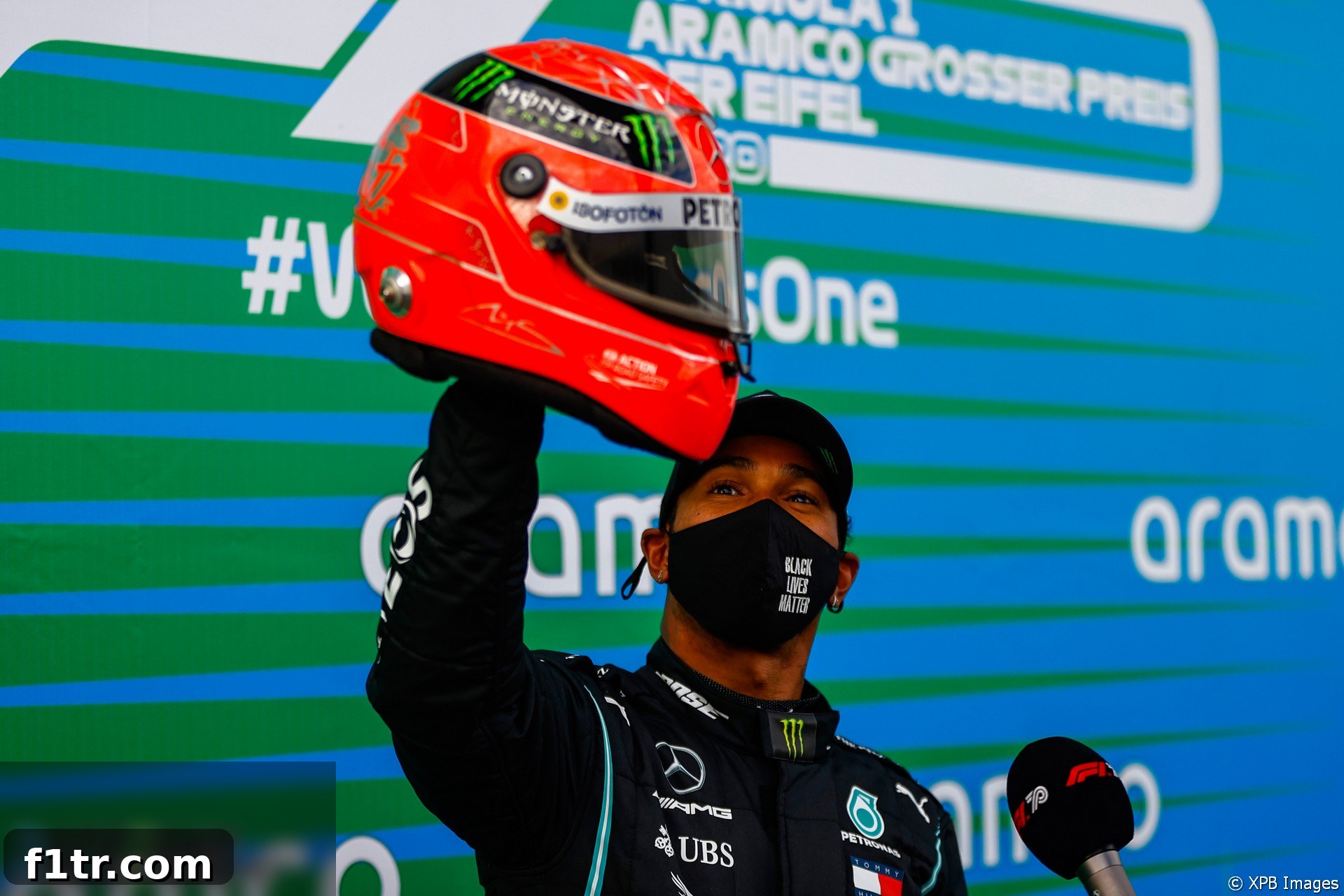
“I hadn’t even computed it when I crossed the line,” he admitted later, a sentiment of genuine surprise in his voice. “You grow up watching someone and you generally idolize them in terms of the quality of the driver they are, what they are continuously able to do year on year, race on race, week on week with their team. Just seeing his dominance for so long, I don’t think anyone – especially me – imagined that I would be anywhere near Michael in terms of records, so it’s an incredible honor.” Fittingly, a further, deeply symbolic honor was bestowed upon the Mercedes driver on behalf of the Schumacher family by current Formula 2 leader and Michael’s son, Mick Schumacher. Presenting Hamilton with one of his father’s iconic race helmets, the second-generation Schumacher offered his heartfelt congratulations, acknowledging Hamilton’s ascent to the unfathomable heights that only the elder Schumacher had scaled before him. At a circuit so deeply steeped in the rich and glorious history of motorsport, the Eifel Grand Prix of 2020 saw Formula 1’s past, present, and future converge in a poignant celebration of the very essence of racing – the eternal glory of victory, etched forever into the annals of the sport.
2020 Eifel Grand Prix
- Renault “not scared of anywhere” in remaining races
- Bottas “needs a miracle” to overturn Hamilton’s 69-point lead
- 2020 Eifel Grand Prix Star Performers
- Leclerc sees ‘quite a few positives’ in Ferrari’s Nurburgring weekend
- Mercedes relied on DAS “more than ever” at cold Nurburgring
Browse all 2020 Eifel Grand Prix articles
F1 race reviews
- Antonelli lucks in for second win and becomes youngest F1 championship leader
- Emotional Antonelli grabs first Formula 1 victory in Chinese Grand Prix
- Russell sees off Ferrari threat to lead Mercedes one-two in Melbourne
- Norris clinches F1 title by two points as Verstappen wins finale at Yas Marina
- McLaren strategy blunder in Losail hands Verstappen crucial win and shot at title
Read all F1 race reviews