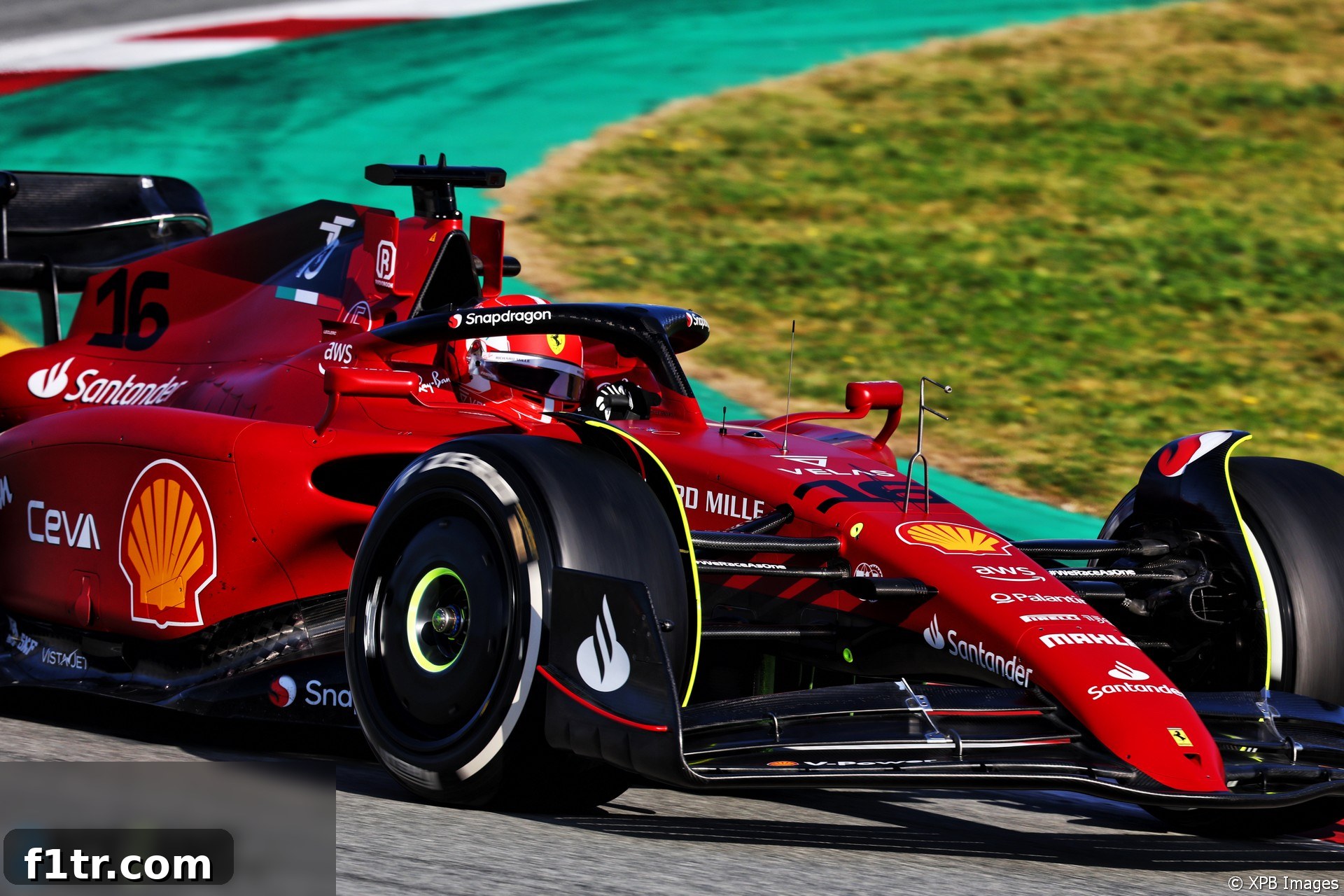
The second day of Formula 1 pre-season testing in Barcelona concluded with Charles Leclerc and Ferrari asserting their early dominance, setting the fastest time and once again leading the field in total laps completed. This promising display from the Scuderia signals a strong start to their 2022 campaign as teams continue to adapt to the sport’s radical new technical regulations. The atmosphere at the Circuit de Barcelona-Catalunya was buzzing with anticipation, as fans and pundits alike observed the first true glimpses of competitive performance from the highly anticipated new-generation cars.
Ferrari’s commitment to gathering extensive data was evident, with their drivers, Carlos Sainz Jnr and Charles Leclerc, collectively putting in an impressive 150 laps throughout the day. Sainz handled the morning duties, methodically racking up mileage and assessing the F1-75’s behaviour, while Leclerc took over in the afternoon. It was Leclerc who ultimately lit up the timing screens, posting a best lap of 1’19.689. This blistering time was not only the fastest of the day but also demonstrated Ferrari’s raw pace, placing them just over a tenth of a second shy of Lando Norris’s benchmark from the opening day. Such consistency in both speed and reliability underlines Ferrari’s meticulous preparation and could hint at a truly competitive package for the upcoming season. The team’s focused approach on track suggests they are leaving no stone unturned in understanding the intricacies of their new challenger.
Chasing Ferrari’s lead, Pierre Gasly showcased an outstanding performance for AlphaTauri. In his first outing with the AT03, Gasly secured the second-fastest time of the day, a remarkable achievement that underscores both his talent and the potential of AlphaTauri’s new car. More impressively, Gasly was the most prolific driver on track, completing a staggering 147 laps across both sessions. This immense lap count is invaluable for AlphaTauri, allowing them to gather a wealth of data on the car’s aerodynamics, tyre degradation, and overall reliability. A productive testing day like this is crucial for a midfield team aiming to make significant strides up the grid in a new regulatory era. His pace and diligence certainly turned heads in the paddock, indicating AlphaTauri could be a dark horse in 2022.
McLaren also enjoyed another highly productive day, echoing the strong showing from Lando Norris on Wednesday. Daniel Ricciardo took the helm of the MCL36 and completed an admirable 126 laps around the demanding Barcelona circuit. His efforts culminated in the third-fastest time of the day, approximately six tenths behind Leclerc’s leading pace. McLaren’s consistent performance and high lap counts across both testing days suggest they have a robust and well-balanced package in the MCL36, a vital foundation upon which to build their season. The Woking-based squad appears to be focusing heavily on reliability and understanding their car’s characteristics over outright single-lap glory, a shrewd strategy for pre-season.
Mercedes, the reigning constructors’ champions, presented a more enigmatic picture on Day 2. New recruit George Russell took over the Mercedes W13 in the afternoon session, demonstrating excellent form by setting the fourth-fastest time. Crucially, Russell also completed a full race distance, a testament to the W13’s endurance and Mercedes’ robust testing program aimed at validating the car’s long-run performance. In contrast, his illustrious teammate Lewis Hamilton concluded the morning session with a modest 40 laps and registered the slowest overall best time among all 16 drivers who participated. While testing times are notoriously misleading due to varying fuel loads, engine modes, and test programs, Hamilton’s relative lack of mileage and pace raised a few eyebrows, sparking early speculation about Mercedes’ immediate competitive standing or perhaps a very conservative initial approach.
The day was not without its minor disruptions, underscoring the challenges of developing entirely new machinery under fresh regulations. Sergio Perez experienced an early stoppage in his Red Bull RB18, which led to the first red flag of the session. The incident occurred on the exit of Turn 13 and was reportedly caused by a gearbox problem. However, Red Bull’s pit crew and engineers demonstrated their efficiency, swiftly addressing the issue and sending Perez back out onto the track. He managed to complete 78 laps by the end of the day, securing the seventh-fastest time, which indicates Red Bull’s strong recovery capabilities and desire to maximize track time despite setbacks. The RB18’s raw speed was still evident when it was running smoothly, suggesting the team has a competitive base.
Haas also faced technical hurdles when Nikita Mazepin took control of the VF-22 in the afternoon. His session was temporarily halted due to a fuel pump issue, forcing him to stop on track. The team managed to retrieve the car, rectify the fault, and return Mazepin to the circuit, allowing him to add valuable mileage to their testing program. Despite the interruption, Mazepin finished the day eighth on the timing screens with 42 laps, a decent effort considering the limited resources of the Haas team and the impact of their technical glitch. For teams like Haas, every lap counts immensely in understanding their new car and extracting performance.
Among the rookies, Guanyu Zhou made his highly anticipated debut for Alfa Romeo, taking his first serious runs in the C42 during the afternoon. The Chinese driver quickly adapted, logging an impressive 71 laps – a significant achievement that marked the most laps completed by an Alfa Romeo driver in a single session so far in the test. Finishing tenth on the timing screens, Zhou’s performance was a positive indicator for both the driver and the team, suggesting a smooth integration and promising potential. Meanwhile, Esteban Ocon had his initial taste of the Alpine A522, completing a robust 125 laps over the course of the two sessions. Alpine’s consistent running further reinforces the notion that many teams are prioritizing reliability and data acquisition during this crucial initial phase of testing.
The broader implications of these testing days revolve around the dramatic shift in technical regulations for 2022. The new ground effect cars are designed to promote closer racing and provide a cleaner aerodynamic wake, fundamentally altering how teams approach car design and setup. Understanding these new aerodynamic characteristics and managing the revised 18-inch Pirelli tyres are paramount. Teams are rigorously evaluating various components, conducting extensive aerodynamic mapping, and fine-tuning their setups to ensure compliance and extract maximum performance. The high lap counts seen from Ferrari, AlphaTauri, McLaren, and Alpine are particularly encouraging, as consistent running allows engineers to gather critical data to feed back into their development cycles.
Looking ahead, there is one final day of running scheduled for Friday before the circus moves to Bahrain for the second and ultimate pre-season test in two weeks’ time. The Friday afternoon session in Barcelona is particularly intriguing, as the track will be artificially soaked to simulate wet conditions. This unique opportunity will allow teams to test their brand-new 2022 cars in rain-like environments for the very first time, providing crucial data on wet-weather performance, tyre behaviour, and driver feedback in challenging circumstances. This will be invaluable for understanding how the new regulations impact racing in adverse weather and prepare teams for any conditions they might face during the demanding 2022 season. The final day promises more insights and perhaps a few surprises before the focus shifts entirely to the season opener.
2022 F1 Pre-Season Testing Day Two Times – Barcelona:
| Pos. | Car number | Driver | Team | Model | Best time | Gap | Laps |
|---|---|---|---|---|---|---|---|
| 1 | 16 | Charles Leclerc | Ferrari | F1-75 | 1’19.689 | 79 | |
| 2 | 10 | Pierre Gasly | AlphaTauri | AT03 | 1’19.918 | 0.229 | 147 |
| 3 | 3 | Daniel Ricciardo | McLaren | MCL36 | 1’20.288 | 0.599 | 126 |
| 4 | 63 | George Russell | Mercedes | W13 | 1’20.537 | 0.848 | 66 |
| 5 | 55 | Carlos Sainz Jnr | Ferrari | F1-75 | 1’20.546 | 0.857 | 71 |
| 6 | 5 | Sebastian Vettel | Aston Martin | AMR22 | 1’20.784 | 1.095 | 74 |
| 7 | 11 | Sergio Perez | Red Bull | RB18 | 1’21.430 | 1.741 | 78 |
| 8 | 9 | Nikita Mazepin | Haas | VF-22 | 1’21.512 | 1.823 | 42 |
| 9 | 23 | Alexander Albon | Williams | FW44 | 1’21.531 | 1.842 | 47 |
| 10 | 24 | Guanyu Zhou | Alfa Romeo | C42 | 1’21.885 | 2.196 | 71 |
| 11 | 6 | Nicholas Latifi | Williams | FW44 | 1’21.894 | 2.205 | 61 |
| 12 | 18 | Lance Stroll | Aston Martin | AMR22 | 1’21.920 | 2.231 | 55 |
| 13 | 47 | Mick Schumacher | Haas | VF-22 | 1’21.949 | 2.260 | 66 |
| 14 | 31 | Esteban Ocon | Alpine | A522 | 1’22.164 | 2.475 | 125 |
| 15 | 77 | Valtteri Bottas | Alfa Romeo | C42 | 1’22.288 | 2.599 | 21 |
| 16 | 44 | Lewis Hamilton | Mercedes | W13 | 1’22.562 | 2.873 | 40 |
Additional insights into the 2022 F1 season and testing:
- Mercedes told me “you’re wrong” about 2022 car’s problems – Hamilton
- FIA confirms all 10 F1 teams complied with 2022 cost cap
- Steiner “not ashamed” of panning “slow” Schumacher in Drive to Survive
- Albon believes year out of F1 improved him as a driver
- Hamilton sees diversity gains in F1 years on from his ‘traumatising’ experience of racism
Browse all 2022 F1 season articles