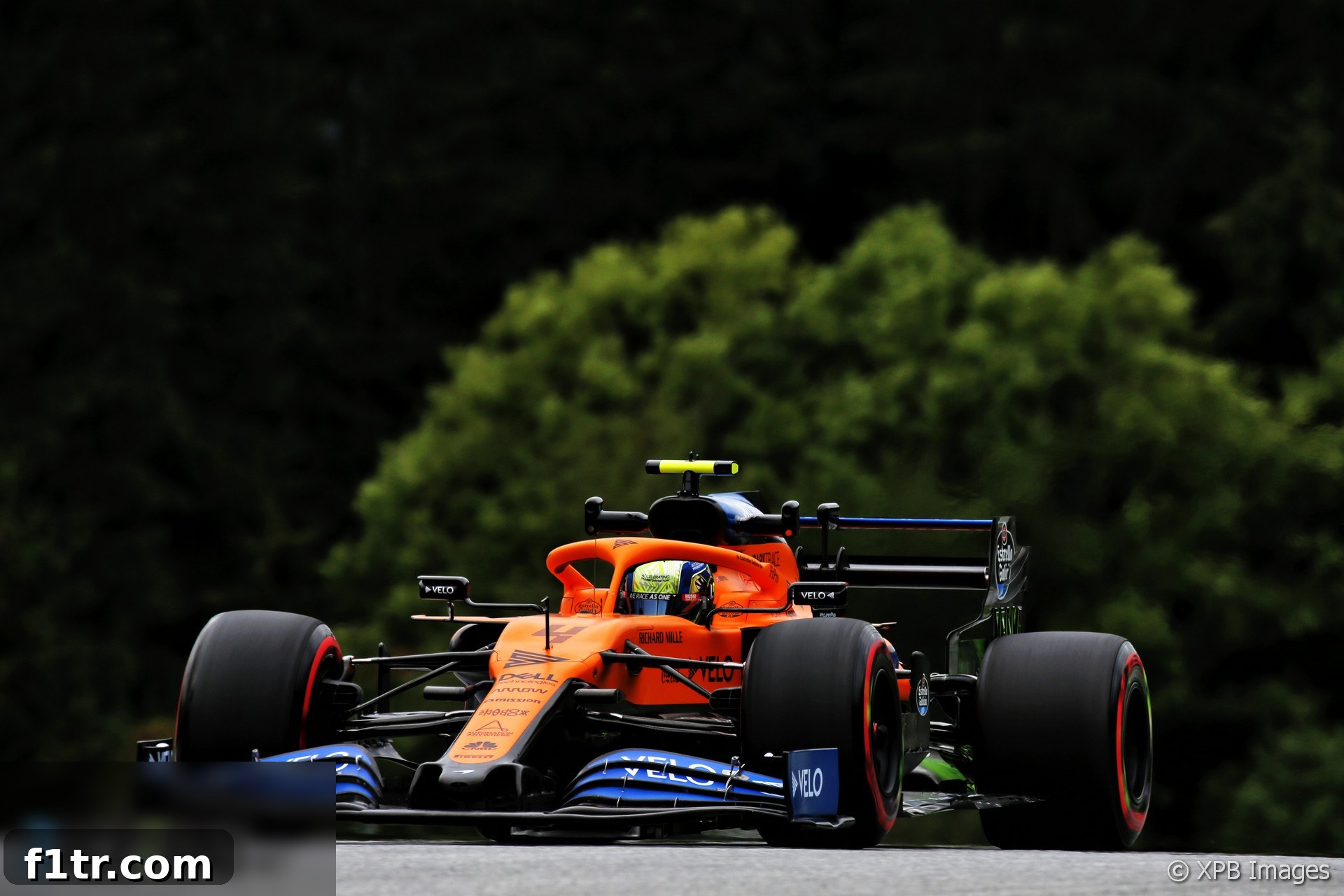
Lando Norris Battles Unforeseen Challenges: Chest Pain and Grid Penalty at Styrian Grand Prix
The Styrian Grand Prix weekend began with an unexpected wave of challenges for McLaren’s star driver, Lando Norris. As the Formula 1 circus descended upon the picturesque Red Bull Ring in Spielberg, Austria, Norris found himself grappling with both a perplexing physical ailment and a frustrating grid penalty. These dual setbacks threatened to derail what promised to be a crucial weekend for the young Briton and his team.
A Mysterious Physical Ordeal: Chest Pain Hampers Practice Performance
During the crucial practice sessions leading up to qualifying, Norris revealed he was enduring “a lot of pain,” primarily centered in his chest area. This discomfort was severe enough to significantly impact his driving and necessitated a reduction in his planned track time. “I’ve been struggling a bit physically with something,” the McLaren driver confessed, explaining that his team had to “cut down quite a few of the laps that we were planning to do just to make sure I’m in good condition for tomorrow.”
The nature of the pain was particularly concerning for an F1 driver, whose body is subjected to extreme G-forces and precise physical demands. Norris elaborated, “It’s just something in my chest or something. I hit the brakes and then the compression, it spikes up massively so I’m just afraid to brake anywhere, which is not ideal around here.” The Red Bull Ring is renowned for its heavy braking zones and high-speed corners, making precise and aggressive braking absolutely critical for lap time. For a driver to feel apprehensive about this fundamental aspect of racing speaks volumes about the intensity of his discomfort.
Speaking candidly after the session, Norris acknowledged that the issue had severely hindered his progress on the opening day. “I feel fine now and walking around, it’s something that when I’m driving just causes me a lot of pain, particularly in the high-speed corners and when I’m braking.” Despite consulting with specialists, the underlying cause remained elusive, adding to the frustration. “I’ve spoken to my specialist and he tried to figure it out, but it’s not as obvious as just pointing it out and so on.”
The uncertainty surrounding his physical condition meant Norris had to resort to painkillers, a far from ideal solution for the demands of a Formula 1 race weekend. The impact on his performance was immediate and palpable. “I’ve been on painkillers and whatever, but it’s been setting me back a lot today, so it’s been pretty frustrating. I’ve not felt confident in the car in terms of pushing it and so on.” For an F1 driver, confidence in the car is paramount, directly translating to lap time and the ability to extract maximum performance. This physical setback undoubtedly put Norris at a significant disadvantage, requiring immense mental fortitude to push through the discomfort while simultaneously seeking a solution for the race.
The Yellow Flag Incident: A Three-Place Grid Penalty
Adding to Norris’s woes was a three-place grid penalty for Sunday’s race, handed down by the stewards for an infringement during the first practice session (FP1). The incident involved Norris overtaking Pierre Gasly’s AlphaTauri under yellow flags, which were being waved following Nicholas Latifi’s Williams coming to a stop on track. Safety regulations in Formula 1 are among the strictest in motorsport, and yellow flags signal a hazard, mandating drivers to slow down, be prepared to stop, and avoid overtaking.
Norris himself was upfront about the incident, labelling it a “silly move.” He recounted his perspective: “I saw the yellow flag. I was on a ‘push lap’ at the two other guys were on a slow lap or an out-lap. And they pulled over to let me past knowing that I was on my push lap.” This scenario highlights a common dilemma in F1 practice: drivers on hot laps often encounter slower cars, and courtesy dictates the slower car moves aside. However, the presence of yellow flags overrides all other considerations.
Norris continued, explaining his actions: “I let off when I saw the yellow flags and I braked but I just haven’t braked and completely gone to the same speed as them. So I’ve slowed down, I’ve gone away from everyone, I did what I had to do in terms of driving cautiously and being prepared to stop and whatever. But I just rolled a bit more speed than what the other guys did, I ended up passing them.” His explanation reveals a nuanced situation where he attempted to comply with the rules by slowing down but ultimately failed to do so sufficiently to avoid an overtake. The rules are unequivocal on this front: no overtaking under yellow flags, and drivers must demonstrate a significant reduction in speed.
Acknowledging the strictness of the regulations, Norris accepted the penalty. “So the rules are the rules, a bit unfortunate because I left off, but I just didn’t do everything that I should have done. A bit of a silly move by me.” This candid admission underscores the razor-thin margins and instantaneous decision-making required in Formula 1, where a fraction of a second or a slight misjudgment of speed can lead to severe consequences. The three-place grid drop is a substantial penalty that could significantly compromise his starting position for Sunday’s race, making his climb through the field all the more challenging.
Implications for McLaren and the Styrian Grand Prix Weekend
These combined challenges placed Lando Norris and McLaren in a precarious position heading into the Styrian Grand Prix. Norris has been a consistent performer for McLaren, often leading their charge and contributing vital points to their constructors’ championship campaign. His ability to deliver strong qualifying results has been a hallmark of his recent performances, setting the stage for competitive races.
The chest pain, with its direct impact on braking and confidence, threatened to undermine his fundamental driving ability. If not resolved or adequately managed, it could lead to compromised performance in qualifying, where every tenth of a second counts, and a grueling race on Sunday. Furthermore, the grid penalty, irrespective of his qualifying position, means he will start at least three places lower than he earns. This automatically puts him at a disadvantage, forcing him to fight harder through the pack, which consumes more tire life and increases the risk of incidents.
For McLaren, who are locked in a tight battle for supremacy in the midfield, every point is crucial. Their hopes rest on both drivers maximizing their potential. With Norris facing such significant hurdles, the team’s strategy and support become even more vital. They will need to work tirelessly to assist him in managing his physical condition, boost his confidence, and plan a race strategy that accounts for his compromised starting position.
Looking Ahead: Overcoming Adversity on Track
The Formula 1 calendar is relentless, and drivers rarely have the luxury of time to fully recover or regroup. Lando Norris’s resilience and mental strength will be severely tested as he aims to overcome these dual challenges. His immediate focus will be on finding a way to alleviate his chest pain for qualifying and the race, whether through further medical intervention or simply managing it with painkillers.
Beyond the physical aspect, he must regroup mentally from the penalty, focusing on delivering a strong performance despite the setback. The Red Bull Ring, with its short lap and limited overtaking opportunities, makes any grid penalty particularly impactful. However, Norris has demonstrated his racecraft and ability to make up positions in the past. His task will be to channel his frustration into a determined effort, driving intelligently and aggressively to climb back up the order and salvage as many points as possible for McLaren.
The Styrian Grand Prix weekend, therefore, transformed into a personal battle against pain and a strategic challenge against the clock and the grid for Lando Norris. His ability to navigate these complex circumstances will not only be a testament to his character but also a critical factor in McLaren’s aspirations for championship success.
2020 F1 season
- Grosjean to make F1 test return tomorrow for first time since Bahrain horror crash
- Pictures: Wrecked chassis from Grosjean’s Bahrain fireball crash to go on display
- Bottas vs Rosberg: Hamilton’s Mercedes team mates compared after 78 races each
- F1 revenues fell by $877 million in Covid-struck 2020 season
- Hamilton and Mercedes finally announce new deal for 2021 season
Browse all 2020 F1 season articles