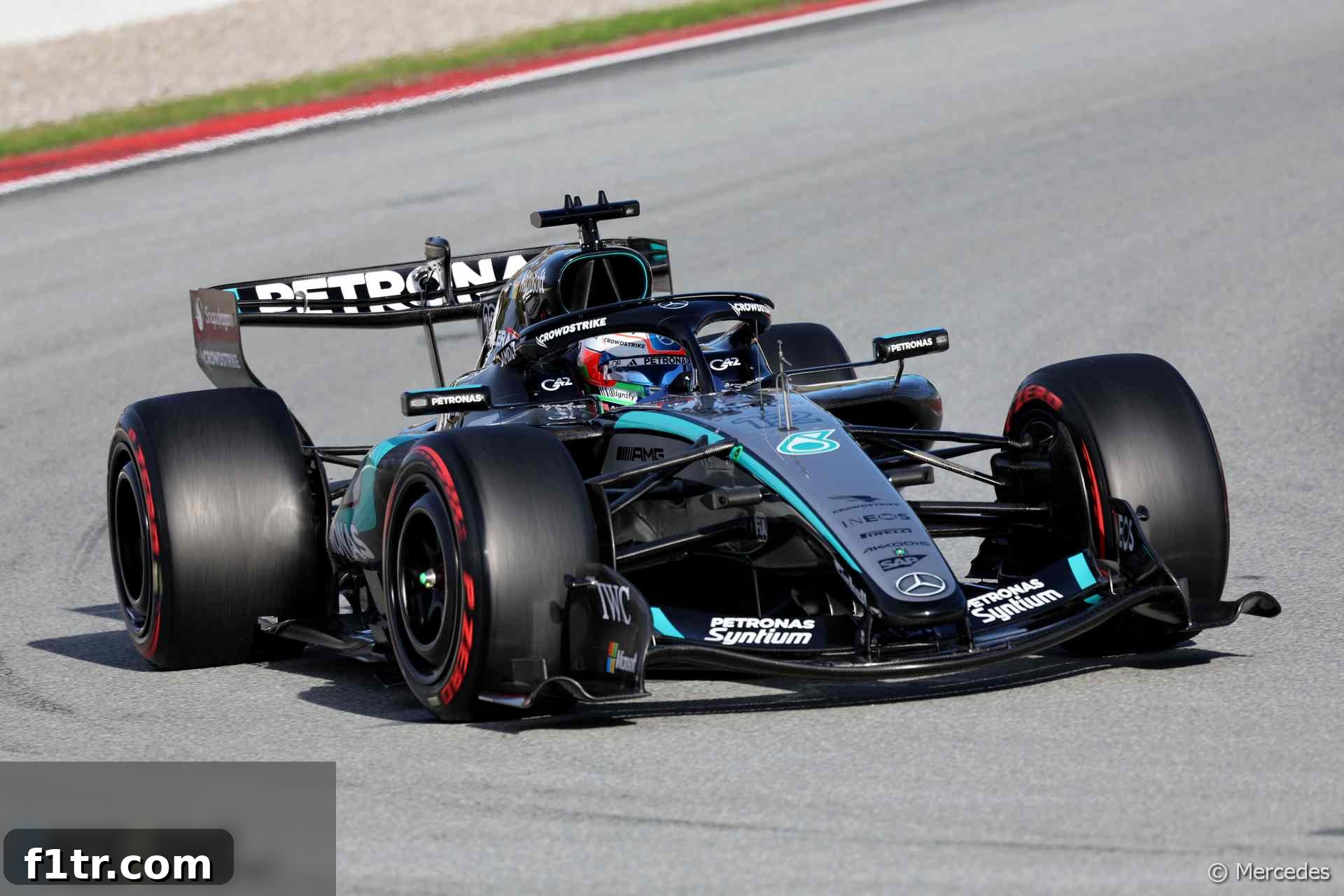
The dawn of the 2026 Formula 1 season has arrived with a palpable sense of anticipation and radical change, as drivers report their brand-new cars feel dramatically different following the inaugural day of testing at the iconic Circuit de Catalunya. This early assessment sets the stage for what promises to be one of the most transformative eras in the sport’s rich history, with a complete overhaul of technical regulations designed to redefine performance, excitement, and sustainability.
Seven teams took to the track as the extensive five-day testing session commenced on a bustling Monday. While F1 officially refers to these initial runs as a “shakedown,” many teams had already conducted private filming days prior to this week, offering a preliminary glimpse of their new machines. However, it’s during these intensive testing periods that the true character and potential of the cars begin to emerge, pushing the boundaries of engineering and driver adaptation.
This year’s pre-season testing regimen has been notably extended, starting earlier and lasting longer than previous seasons. This strategic decision by Formula 1 and the FIA acknowledges the monumental challenge teams face in grappling with the first generation of cars meticulously engineered under the new, far-reaching regulations. These include profoundly overhauled power units, a simplification of under-body aerodynamics aiming for cleaner air, and the introduction of groundbreaking moveable front and rear wings – a significant evolution in active aerodynamic principles.
Drivers React to the Revolutionary 2026 F1 Cars
Initial feedback from the cockpit has been overwhelmingly consistent: these cars are a different breed. Drivers, seasoned veterans and promising newcomers alike, are discovering new demands and capabilities from their machinery, marking a decisive departure from the preceding era of ground-effect dominance.
Valtteri Bottas Highlights a “Big Difference”
Valtteri Bottas, making a much-anticipated return to F1 with the new Cadillac team this year, was among the first to articulate the profound changes. “There is definitely a big difference to before,” he stated to the official F1 channel, underscoring the immediate shift in driving dynamics. Bottas elaborated on the nuanced handling characteristics: “The cars handle different, you have a bit less load especially in the high-speed corners.” This reduction in high-speed downforce suggests a return to a driving style that places greater emphasis on mechanical grip and driver skill rather than pure aerodynamic prowess. Furthermore, the updated power unit regulations present their own set of challenges and opportunities. “With the PU [power unit], you have so much more torque out of the corners, but then you have the battery to manage.” This highlights a critical new dimension of race strategy and driver input, as energy management becomes an even more intricate dance.
The previous generation of F1 cars, particularly those from 2022-2025, relied heavily on sophisticated shaped floors to generate massive ‘ground effect’ and produce substantial downforce. While effective in theory, drivers frequently voiced concerns that this design philosophy led to unpredictable handling, especially when closely following another car, making overtaking a complex and often frustrating endeavour. The simplified under-body aerodynamics for 2026 are specifically designed to mitigate this issue, promoting closer racing and more intuitive car behaviour.
Isack Hadjar Praises Enhanced Predictability
New Red Bull driver Isack Hadjar offered a positive outlook on the revised handling characteristics, particularly noting an improvement in the cars’ predictability. “There’s definitely a lot less load in general,” he confirmed, echoing Bottas’s observations on reduced downforce. However, Hadjar saw this as an advantage: “and it’s a bit more predictable compared to the previous generation of cars. They are more simple, it’s easier to play around with them.” This newfound simplicity and predictability could empower drivers to push the limits with greater confidence, leading to more aggressive and entertaining racing. Hadjar also touched upon the increased complexity and options available to drivers regarding the power unit. “Also on the PU side there’s a lot more options for the driver to play with. I already started to work on it today so that was very interesting.” This suggests a greater degree of control and fine-tuning at the driver’s fingertips, requiring sophisticated understanding and strategic deployment of the hybrid power.
George Russell Impressed by Power and Compact Design
Mercedes opted for a split program on their opening day of testing, with seasoned driver George Russell sharing duties with promising talent Andrea Kimi Antonelli. Russell emerged from his session highly impressed, particularly by the straight-line performance delivered by the new regulations. “The amount of power they give is pretty impressive,” he enthused. His observations extended to the entire field: “For all the cars I was watching today with all the different power units, it’s probably the quickest I’ve ever seen an F1 car pass here in Barcelona, so that was pretty exciting to see.” This suggests that despite the reduction in aerodynamic load in corners, the enhanced power units, possibly combined with the active aero allowing for ultra-low drag on straights, are yielding astonishing top speeds.
Beyond raw power, the new rules have also significantly reduced the overall dimensions of the cars and specified a lower minimum weight limit. Russell unequivocally welcomed these changes. “The cars do generally feel like you feel it being smaller,” he remarked, emphasizing a tangible difference in the vehicle’s footprint and agility. He added, “You can feel that weight reduction compared to previous years. So I think from that aspect as well, it’s gone in a good direction.” A smaller, lighter car is inherently more nimble and responsive, potentially leading to more dynamic driving and closer wheel-to-wheel battles. These changes collectively aim to create a more agile and demanding machine for drivers, rewarding precision and adaptability.
The Technical Evolution: What the New Rules Mean
The 2026 regulations represent a monumental paradigm shift for Formula 1, moving beyond incremental updates to instigate a truly revolutionary design philosophy. The goal is clear: to enhance racing spectacle, improve sustainability, and make the sport more attractive to new manufacturers. The “overhauled power units” are central to this. While retaining the V6 turbo hybrid architecture, the emphasis shifts dramatically towards electrical power. The MGU-H (Motor Generator Unit-Heat) has been removed, simplifying the complex hybrid system, while the MGU-K (Motor Generator Unit-Kinetic) output has been significantly increased. Furthermore, the engines will run on 100% sustainable fuels, marking a crucial step towards F1’s net-zero carbon target by 2030.
The “simplified under-body aerodynamics” directly addresses the “dirty air” problem that plagued previous generations. By reducing the reliance on highly complex ground-effect tunnels and wings that generated massive wake, the aim is for cars to be able to follow each other more closely without losing significant downforce. This should facilitate more overtaking opportunities and intense on-track action. The “moveable front and rear wings” – a form of active aerodynamics – is another critical innovation. While exact implementations are still being refined, the concept allows drivers to adjust the wing angles on demand. This could enable “overtaking modes” or “energy harvest modes” on straights, reducing drag for higher top speeds, and then adjusting for maximum downforce in corners. This level of dynamic control offers unprecedented strategic depth and performance flexibility.
The Significance of Early and Extended Testing
The extended testing period, commencing earlier than usual, is not merely a formality; it’s a vital necessity for teams grappling with such a comprehensive rule change. These initial shakedowns and testing days provide invaluable data, allowing engineers to correlate simulator models with real-world performance, identify unforeseen issues, and begin the arduous process of optimization. Every lap, every sector time, and every driver comment contributes to a massive data pool that will shape the development trajectory for the entire season. The early start also offers a buffer for reliability concerns, particularly with the new power unit architecture, which will be pushed to its limits during these sessions. The five-day run at Circuit de Catalunya, a track known for its diverse range of corners and demanding characteristics, serves as an ideal proving ground for the nascent 2026 challengers.
Visuals from the Track: Day One Gallery
- Every new F1 car of 2026 so far pictured: Official images, liveries and more
Exploring Formula 1’s Future
- “Overtaking is overtaking”: Domenicali denies F1’s yo-yo racing is “artificial”
- The crashes F1 is trying to prevent may be rare – but the danger is obvious
- F1 returning to India soon after 2027 sounds like wishful thinking
- Verstappen loathes F1’s new generation of cars – but what do his rivals reckon?
- The ‘throwback weekend’ is back in fashion. But it’s a flawed concept – especially for F1
Browse all Formula 1 articles
As the extensive testing continues at Circuit de Catalunya, the initial feedback from drivers like Bottas, Hadjar, and Russell paints a vivid picture of a Formula 1 entering an exhilarating new chapter. The 2026 regulations promise not only to challenge teams and drivers to adapt to profoundly different machinery but also to deliver a more sustainable, unpredictable, and ultimately more thrilling spectacle for fans worldwide. The journey of understanding and mastering these revolutionary cars has only just begun, but the early signs are undeniably exciting, hinting at a future where driver skill, strategic ingenuity, and cutting-edge technology converge to define the pinnacle of motorsport once again.