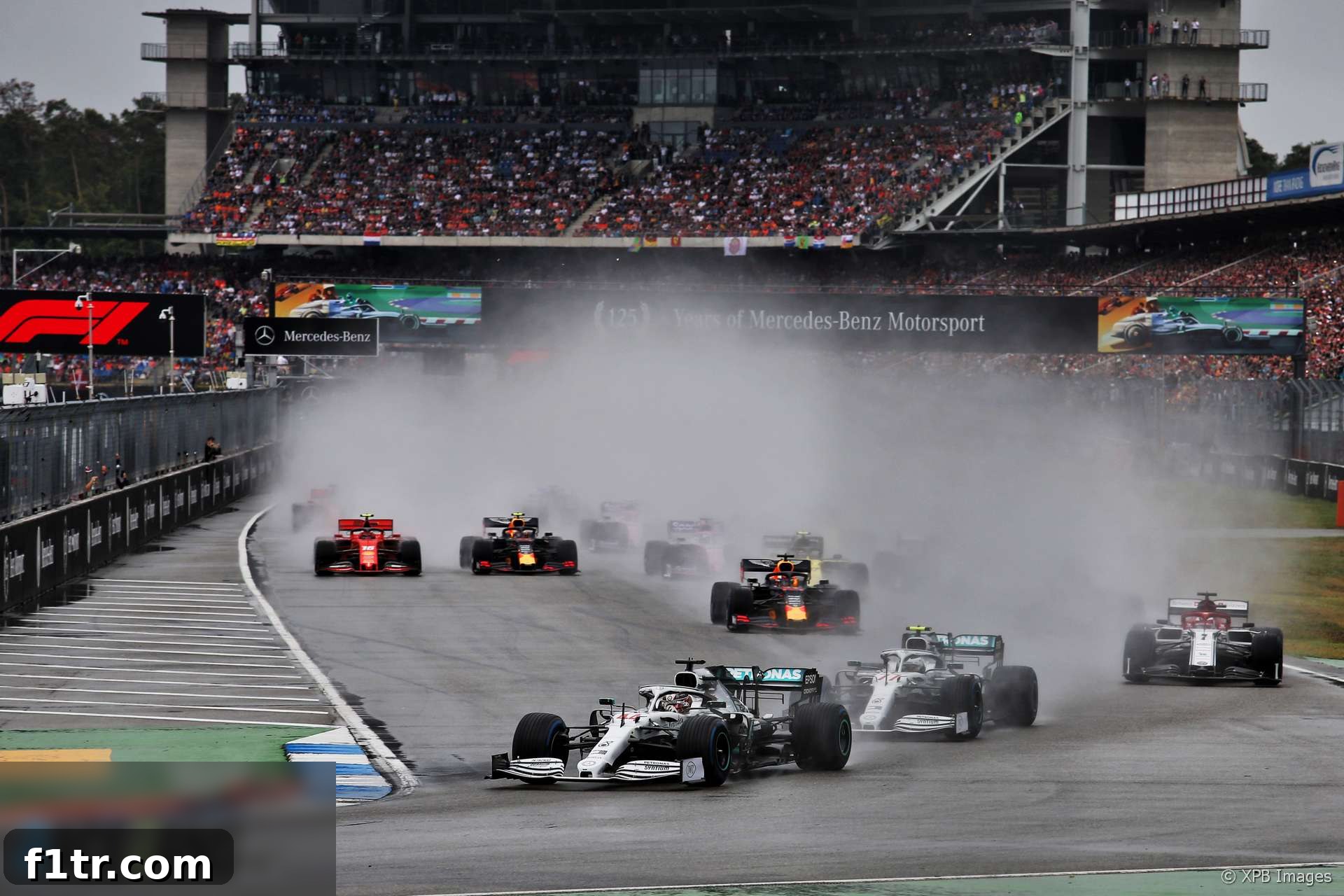
The iconic Hockenheimring, a circuit steeped in motorsport history and a traditional host of the German Grand Prix, has officially confirmed it will not feature on the revised Formula 1 calendar for the 2020 season. This decision, while anticipated by many in the F1 paddock, underscores the unprecedented challenges faced by event organizers and sports leagues worldwide in the wake of the global COVID-19 pandemic.
The news comes amidst widespread speculation and, as previously revealed, the expectation that Formula 1 is poised to announce another historic German venue, the Nürburgring, as a replacement. This potential shift highlights F1’s proactive efforts to reconstruct a viable championship schedule, seeking out circuits capable of hosting races under stringent new health and safety protocols, and often, without the crucial revenue stream of spectators.
Hockenheim last hosted the German Grand Prix in 2019, delivering a memorable and dramatic race. Despite its recent presence on the calendar and its consideration by F1 management as a potential venue for 2020 after the pandemic forced a complete overhaul of the original schedule, terms could not be mutually agreed upon. This inability to strike a deal stems from a complex web of financial viability concerns and the varied, state-specific governmental restrictions in Germany.
Hockenheimring’s Stance: Financial Realities and State Regulations
The decision by the Hockenheimring management not to host a Formula 1 event this year was communicated clearly by General Manager Jorn Teske. Speaking to RaceFans, Teske stated, “We can confirm that in 2020 no Formula 1 race will take place at the Hockenheimring and we are also aware that Liberty Media has been in contact with the Nürburgring.” He further clarified the uncertainty surrounding the Nürburgring’s negotiations, noting, “However we are unable to state what level the negotiations [with the Nürburgring] are at.” This transparency from Hockenheim offers a rare glimpse into the complex and often confidential discussions that shape the F1 calendar.
Teske elaborated on the specific factors that rendered hosting an F1 race unfeasible for the Baden-Württemberg facility. At the core of their decision was a resolute stance against incurring further financial losses. “Since the beginning we have played totally open cards,” Teske explained. “In other words, we have regularly stated that we are unable to stage a race if there are any financial disadvantages. In the present crisis during which we have lost millions due to Corona it would be irresponsible towards the company and our employees to do anything else.” This pragmatic approach prioritizes the long-term stability of the circuit and the livelihoods of its staff over the prestige of hosting a Grand Prix under economically crippling conditions.
The financial impact of the COVID-19 pandemic on sporting venues, particularly those reliant on large crowds, has been devastating. F1 races, with their vast infrastructure requirements, significant organizational costs, and the expectation of substantial appearance fees, become particularly challenging to host without the primary revenue streams from ticket sales, hospitality packages, and trackside merchandising. For the Hockenheimring, which had already faced financial pressures in previous years, absorbing additional losses was simply not a viable option.
The Complexities of German Federalism and COVID-19 Restrictions
A crucial element in Hockenheim’s decision was the varying COVID-19 regulations across Germany’s federal states. Teske highlighted this key distinction: “We have made clear that we also need to adhere to the Corona regulations of the state of Baden-Württemberg and therefore we cannot stage an event with spectators. This is not a federal-wide ruling and this could be a major reason for any decision taken by Formula 1.” This statement points to the fundamental challenge posed by Germany’s decentralized governance structure, where public health policies are often determined at the state level rather than uniformly across the country.
Baden-Württemberg’s strict stance on prohibiting spectators at major events meant that any race held at the Hockenheimring would inevitably be a ‘behind closed doors’ affair. While Formula 1 has adapted to this new reality for many events, the financial implications for the host circuit are profound. The absence of fans translates directly into a massive loss of income, making the event economically unviable for circuits that are not independently wealthy or heavily subsidized.
This contrasts with the situation in other German states, such as Rhineland-Palatinate, where the Nürburgring is located. While specific details about Nürburgring’s potential agreement remain under wraps, the implication is that different regional regulations or a more favorable financial package might make it a more attractive proposition for Formula 1. The Hockenheimring team remained flexible and engaged in discussions with F1, but ultimately, the disparity in state-level requirements proved insurmountable. “During the last weeks we have remained flexible and have engaged [with Formula 1] but in the end it was clear that it was not viable as the requirements for a race within Germany are different [from state to state],” Teske confirmed.
The Nürburgring Emerges as a Timely Alternative
As the Hockenheimring steps aside, the Nürburgring stands poised to potentially reclaim its place on the Formula 1 calendar, at least for a one-off event in 2020. This historic circuit, renowned for its challenging layout and storied past, last hosted a Grand Prix in 2013. Its return would be a welcome sight for many fans, offering a nostalgic trip back to one of motorsport’s most revered venues. The Nürburgring’s potential inclusion underscores F1’s creative problem-solving and its determination to deliver a robust championship season amidst extraordinary circumstances. The choice of the Nürburgring would not only add another classic circuit to the revised calendar but also ensure that Germany, a nation with a deep connection to Formula 1 and home to Mercedes-AMG Petronas F1 Team, continues to be represented during this challenging year.
The specific conditions that make the Nürburgring a more viable option than Hockenheim in this scenario are likely multi-faceted. They could include less restrictive local government guidelines regarding event hosting, potentially a different financial structure for hosting fees that better accommodates the spectator-less format, or a stronger financial backing that allows for greater risk absorption. Regardless of the exact reasons, the impending announcement for the Nürburgring signifies F1’s continued adaptability and its commitment to piece together a compelling season for fans worldwide.
The Broader Challenge for Formula 1 in 2020
The Hockenheimring’s decision is a microcosm of the larger logistical and financial hurdles Formula 1 has faced throughout 2020. The initial calendar, brimming with races across five continents, was effectively shredded by the global health crisis. Liberty Media, F1’s commercial rights holder, along with the FIA, embarked on an unprecedented mission to construct a new schedule almost entirely from scratch. This involved constant negotiations with circuits, governments, and health authorities, often under rapidly changing circumstances.
The revised calendar has seen the inclusion of circuits not typically on the F1 schedule, such as Mugello in Italy and Portimão in Portugal, alongside traditional venues. The emphasis has been on European circuits to minimize travel and create a safer “bio-bubble” environment for teams and personnel. Hosting races without spectators, while financially painful for circuits, became a necessary compromise for F1 to ensure the championship could proceed, safeguarding broadcasting revenues and sporting integrity. The challenges extended beyond venue selection; intricate health and safety protocols, including regular testing, limited team personnel, and strict social distancing, have become the new normal in the F1 paddock.
The Formula 1 organization has shown remarkable resilience in navigating these complex waters, striving to put on a show for millions of fans globally who crave the thrill of motorsport. Every confirmed race, every new venue, and every agreement reached represents a significant victory in this battle against an unpredictable global crisis. The Hockenheimring’s decision, while disappointing for its fans, is a pragmatic response to an untenable situation, highlighting the delicate balance between sporting aspirations and economic realities during a global pandemic.
Looking Ahead: The Future of the German Grand Prix
The absence of the Hockenheimring from the 2020 calendar, even if temporarily filled by the Nürburgring, reignites perennial questions about the long-term future of the German Grand Prix. Germany, a country with a rich motorsport heritage that has produced legendary drivers like Michael Schumacher and Sebastian Vettel, and is home to the dominant Mercedes-AMG F1 team, has struggled in recent years to secure a regular slot on the F1 calendar. Financial difficulties and a perceived decline in spectator interest have often left the German Grand Prix’s fate hanging in the balance.
The current situation, exacerbated by the pandemic, only adds to these concerns. While F1 seeks a temporary solution for 2020, the underlying issues regarding host fees and the financial model for circuits remain. For the Hockenheimring, Teske’s closing remarks underscore their priority: “For the Hockenheimring the most important thing is to ensure that we can emerge from the crisis in a stable condition.” This focus on survival and financial stability will likely dictate their future engagement with Formula 1. The challenge for Liberty Media will be to craft a calendar that balances tradition, geographic diversity, and financial sustainability for all parties involved, ensuring that historic venues like Hockenheimring and Nürburgring can remain part of Formula 1’s future, perhaps under new, more equitable commercial terms.
2020 F1 season
- Grosjean to make F1 test return tomorrow for first time since Bahrain horror crash
- Pictures: Wrecked chassis from Grosjean’s Bahrain fireball crash to go on display
- Bottas vs Rosberg: Hamilton’s Mercedes team mates compared after 78 races each
- F1 revenues fell by $877 million in Covid-struck 2020 season
- Hamilton and Mercedes finally announce new deal for 2021 season
Browse all 2020 F1 season articles