2018 Singapore Grand Prix: A Deep Dive into the Marina Bay Action
The 2018 Formula 1 Singapore Grand Prix at the iconic Marina Bay Street Circuit was a race packed with strategic nuances, challenging overtakes, and unexpected records. While Lewis Hamilton secured a dominant victory, the event delivered its share of talking points, from a historic fastest lap by Kevin Magnussen to the persistent struggles of midfield teams and the ever-present challenge of overtaking on this demanding street circuit.
Haas’s Historic Fastest Lap and the Art of Tyre Strategy
Kevin Magnussen, starting from 16th position, ultimately finished even lower in the race. However, his performance was far from unremarkable. The Danish driver etched his name into the history books by setting Haas F1 Team’s first-ever fastest lap in a Formula 1 Grand Prix. This remarkable achievement saw him clock a lap time over a second faster than the race winner, Lewis Hamilton, who commanded the proceedings at the front.
Magnussen’s blistering pace was a masterclass in strategic tyre deployment. Towards the end of the race, with his main competitive battles settled, Haas made the tactical decision to pit him for a fresh set of super-soft tyres. This fresh rubber on a low-fuel car allowed Magnussen to unleash the full potential of his machine, demonstrating the sheer speed advantage that soft compound tyres offered, even if it didn’t translate into a higher finishing position. This highlighted how a well-timed, aggressive tyre strategy could yield significant records, irrespective of the final race result.
The Unyielding Challenge of Marina Bay: Overtaking Difficulties
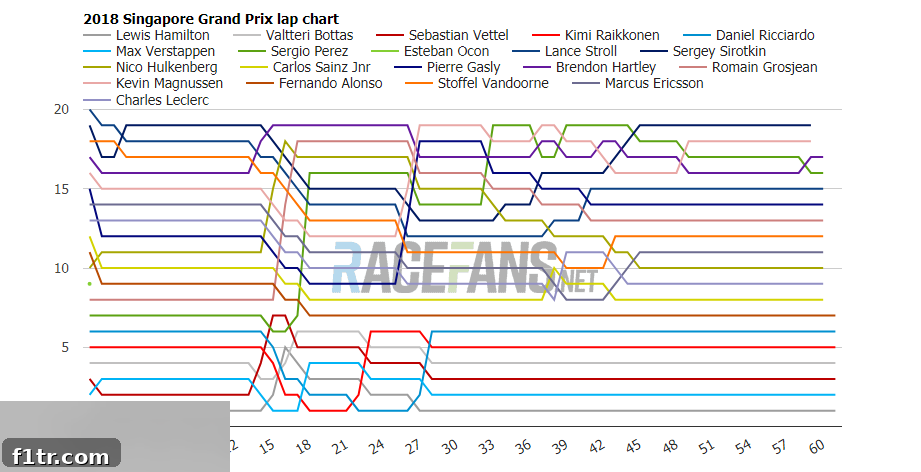
One of the enduring narratives of the 2018 Singapore Grand Prix was the stark reality of how difficult overtaking proved to be on the Marina Bay Street Circuit, particularly with the generation of cars at the time. The top six drivers in the grand prix finished in precisely the same order they started, a testament to the track’s tight, twisty nature and the broad dimensions of modern F1 cars, which make close-quarters racing and daring overtakes a rare spectacle.
The circuit’s layout, characterized by numerous slow corners and minimal straights, heavily penalizes even minor errors, placing immense pressure on drivers and strategies. Furthermore, the high-downforce requirements of Singapore meant that cars running in close proximity suffered significantly from turbulent air, making it exceedingly challenging to follow another car closely enough to attempt a pass. This inherent difficulty cemented Singapore’s reputation as a track where qualifying position and strategic pit stops often dictated the outcome more than on-track battles, leading some to describe parts of the race as a “procession.”
Midfield Mayhem: Strategic Setbacks and Team Collisions
While the front of the grid remained largely static, the midfield witnessed its share of drama and frustration. Drivers who qualified in the top 10 but were not part of the ‘big three’ teams (Mercedes, Ferrari, Red Bull) faced a significant strategic disadvantage. Starting on used hyper-soft tyres from Q2, these drivers, including Sergio Perez and Romain Grosjean, were always going to struggle once they dropped back into traffic early in the race after their mandatory pit stops. The degraded hyper-softs, combined with the difficulty of overtaking, trapped them in slower convoys, severely compromising their race pace and ability to make progress.
Adding to the midfield woes, Force India’s Esteban Ocon was unceremoniously eliminated at the very start of the race following a collision with his own teammate, Sergio Perez. This incident not only dashed Ocon’s hopes but also highlighted the intense pressure and tight margins under which midfield teams operate, where every point is crucial and team orders or internal rivalry can lead to costly errors.
The Q3 Tyre Rule Controversy
Among the drivers caught in the strategic crossfire was Nico Hulkenberg, who managed to score points despite the challenges. However, his race clearly demonstrated a contentious rule: drivers who qualify in Q3 must start the race on the tyres they set their fastest Q2 lap with. Conversely, those outside the top 10 have the freedom to start on fresh tyres of their choice. Hulkenberg, starting 10th on used hyper-softs, found himself vulnerable to drivers who didn’t reach Q3 but were able to start on new, often more durable or strategically advantageous, compounds. This rule, designed to add strategic complexity, often led to frustrating scenarios for midfield drivers, where their qualifying success inadvertently became a race-day hindrance. It sparked widespread debate about the fairness and sporting integrity of penalizing strong qualifying performances in this manner.
Notable Ascenders in the Field
Despite the general difficulty in making up places, a few drivers managed to buck the trend. Stoffel Vandoorne and Lance Stroll were the biggest risers, each making up an impressive six positions during the race. Stroll, starting from the very back of the grid in 20th, showcased strong race craft and tyre management to climb through the field. While neither driver ultimately finished in the points, their ability to gain such significant ground in a race known for its static nature underscored their individual efforts and perhaps astute team strategies that allowed them to navigate the traffic effectively.
2018 Singapore Grand Prix Lap Chart
The positions of each driver on every lap. Click name to highlight, right-click to reset. Toggle drivers using controls below:
Position Changes: A Snapshot of Race Progress
Understanding how drivers gained or lost positions is crucial for analyzing a Grand Prix. The following table provides a clear overview of each driver’s starting position, their change after the first lap, and their overall position change from start to finish. This data highlights the impact of opening lap incidents, strategic decisions, and on-track performance throughout the challenging Singapore race.
| Driver | Start position | Lap one position change | Race position change |
|---|---|---|---|
| Lewis Hamilton | 1 | 0 | 0 |
| Valtteri Bottas | 4 | 0 | 0 |
| Sebastian Vettel | 3 | 1 | 0 |
| Kimi Raikkonen | 5 | 0 | 0 |
| Daniel Ricciardo | 6 | 0 | 0 |
| Max Verstappen | 2 | -1 | 0 |
| Sergio Perez | 7 | 0 | -9 |
| Esteban Ocon | 9 | ||
| Lance Stroll | 20 | 1 | 6 |
| Sergey Sirotkin | 19 | 2 | 0 |
| Nico Hulkenberg | 10 | -1 | 0 |
| Carlos Sainz Jnr | 12 | 2 | 4 |
| Pierre Gasly | 15 | 3 | 2 |
| Brendon Hartley | 17 | 1 | 0 |
| Romain Grosjean | 8 | 0 | -7 |
| Kevin Magnussen | 16 | 1 | -2 |
| Fernando Alonso | 11 | 2 | 4 |
| Stoffel Vandoorne | 18 | 0 | 6 |
| Marcus Ericsson | 14 | 0 | 3 |
| Charles Leclerc | 13 | 0 | 4 |
Go ad-free for just £1 per month>> Find out more and sign up
2018 Singapore Grand Prix Race Chart
The gaps between each driver on every lap compared to the leader’s average lap time. Very large gaps omitted. Scroll to zoom, drag to pan and right-click to reset. Toggle drivers using controls below:
2018 Singapore Grand Prix Lap Times
All the lap times by the drivers (in seconds, very slow laps excluded). Scroll to zoom, drag to pan and toggle drivers using the control below:
Fastest Laps: Beyond the Race Winner
While the focus often remains on the race winner, the fastest lap of a Grand Prix can offer fascinating insights into a car’s potential and a team’s strategic thinking. As highlighted, Kevin Magnussen’s fastest lap was exceptional, but examining the top performers reveals who else pushed the limits and at what stage of the race, often after late pit stops for fresh tyres. This section details each driver’s best effort, showcasing the raw pace achievable on the demanding Marina Bay circuit.
| Rank | Driver | Car | Fastest lap | Gap | On lap |
|---|---|---|---|---|---|
| 1 | Kevin Magnussen | Haas-Ferrari | 1’41.905 | 50 | |
| 2 | Lewis Hamilton | Mercedes | 1’42.913 | 1.008 | 56 |
| 3 | Daniel Ricciardo | Red Bull-TAG Heuer | 1’43.120 | 1.215 | 59 |
| 4 | Fernando Alonso | McLaren-Renault | 1’43.164 | 1.259 | 57 |
| 5 | Max Verstappen | Red Bull-TAG Heuer | 1’43.345 | 1.440 | 54 |
| 6 | Sebastian Vettel | Ferrari | 1’44.669 | 2.764 | 48 |
| 7 | Kimi Raikkonen | Ferrari | 1’44.715 | 2.810 | 46 |
| 8 | Valtteri Bottas | Mercedes | 1’44.720 | 2.815 | 42 |
| 9 | Brendon Hartley | Toro Rosso-Honda | 1’44.889 | 2.984 | 38 |
| 10 | Marcus Ericsson | Sauber-Ferrari | 1’45.169 | 3.264 | 50 |
| 11 | Charles Leclerc | Sauber-Ferrari | 1’45.203 | 3.298 | 57 |
| 12 | Carlos Sainz Jnr | Renault | 1’45.211 | 3.306 | 50 |
| 13 | Sergio Perez | Force India-Mercedes | 1’45.389 | 3.484 | 48 |
| 14 | Stoffel Vandoorne | McLaren-Renault | 1’45.555 | 3.650 | 50 |
| 15 | Sergey Sirotkin | Williams-Mercedes | 1’45.902 | 3.997 | 48 |
| 16 | Romain Grosjean | Haas-Ferrari | 1’45.904 | 3.999 | 57 |
| 17 | Lance Stroll | Williams-Mercedes | 1’46.033 | 4.128 | 53 |
| 18 | Pierre Gasly | Toro Rosso-Honda | 1’46.063 | 4.158 | 56 |
| 19 | Nico Hulkenberg | Renault | 1’46.093 | 4.188 | 53 |
| 20 | Esteban Ocon | Force India-Mercedes |
Tyre Strategies: The Backbone of Singapore’s Race
Tyre management and strategy are paramount at the Singapore Grand Prix due to the high temperatures, demanding track surface, and the circuit’s impact on tyre wear. The diverse strategies employed by teams reveal their pre-race planning and adaptability. From aggressive hyper-soft starts to more conservative ultra-soft or soft compounds, each choice had profound implications for a driver’s stint length, pit stop windows, and overall race pace. This table illustrates the various tyre compounds used by each driver across their stints, offering a glimpse into the strategic chess match that unfolded on track.
| Stint 1 | Stint 2 | Stint 3 | Stint 4 | |
|---|---|---|---|---|
| Lewis Hamilton | Hyper soft (15) | Soft (46) | ||
| Max Verstappen | Hyper soft (17) | Soft (44) | ||
| Sebastian Vettel | Hyper soft (14) | Ultra soft (47) | ||
| Valtteri Bottas | Hyper soft (16) | Soft (45) | ||
| Kimi Raikkonen | Hyper soft (22) | Soft (39) | ||
| Daniel Ricciardo | Hyper soft (27) | Ultra soft (34) | ||
| Fernando Alonso | Ultra soft (38) | Soft (23) | ||
| Carlos Sainz Jnr | Ultra soft (37) | Soft (23) | ||
| Charles Leclerc | Ultra soft (38) | Hyper soft (22) | ||
| Nico Hulkenberg | Hyper soft (15) | Ultra soft (45) | ||
| Marcus Ericsson | Ultra soft (44) | Hyper soft (16) | ||
| Stoffel Vandoorne | Ultra soft (43) | Soft (17) | ||
| Pierre Gasly | Hyper soft (26) | Ultra soft (34) | ||
| Lance Stroll | Soft (40) | Ultra soft (20) | ||
| Romain Grosjean | Hyper soft (16) | Soft (44) | ||
| Sergio Perez | Hyper soft (17) | Ultra soft (16) | Soft (6) | |
| Brendon Hartley | Hyper soft (14) | Ultra soft (22) | Hyper soft (24) | |
| Kevin Magnussen | Ultra soft (26) | Soft (10) | Hyper soft (12) | Hyper soft (11) |
| Sergey Sirotkin | Ultra soft (3) | Soft (42) | Hyper soft (14) | |
| Esteban Ocon |
Pit Stop Times: The Race for Milliseconds
In the high-stakes world of Formula 1, pit stops are critical moments where races can be won or lost in milliseconds. The demanding nature of the Singapore circuit often necessitates precise and efficient pit work. This table provides a detailed breakdown of each driver’s pit stop times, including the total duration and the lap on which the stop occurred. These figures highlight the consistency of the pit crews and any instances where a quick stop aided a driver’s strategy or a slower one hampered their progress, offering another layer of insight into the overall race performance.
| Driver | Team | Pit stop time | Gap | On lap | |
| 1 | Sergio Perez | Force India | 24.340 | 39 | |
| 2 | Valtteri Bottas | Mercedes | 28.542 | 4.202 | 16 |
| 3 | Sebastian Vettel | Ferrari | 28.722 | 4.382 | 14 |
| 4 | Lance Stroll | Williams | 28.767 | 4.427 | 40 |
| 5 | Daniel Ricciardo | Red Bull | 28.779 | 4.439 | 27 |
| 6 | Marcus Ericsson | Sauber | 28.860 | 4.520 | 44 |
| 7 | Pierre Gasly | Toro Rosso | 28.931 | 4.591 | 26 |
| 8 | Lewis Hamilton | Mercedes | 28.946 | 4.606 | 15 |
| 9 | Charles Leclerc | Sauber | 29.310 | 4.970 | 38 |
| 10 | Kevin Magnussen | Haas | 29.324 | 4.984 | 48 |
| 11 | Kevin Magnussen | Haas | 29.408 | 5.068 | 26 |
| 12 | Brendon Hartley | Toro Rosso | 29.464 | 5.124 | 36 |
| 13 | Kimi Raikkonen | Ferrari | 29.513 | 5.173 | 22 |
| 14 | Romain Grosjean | Haas | 29.517 | 5.177 | 16 |
| 15 | Max Verstappen | Red Bull | 29.681 | 5.341 | 17 |
| 16 | Brendon Hartley | Toro Rosso | 29.912 | 5.572 | 14 |
| 17 | Fernando Alonso | McLaren | 29.922 | 5.582 | 38 |
| 18 | Sergio Perez | Force India | 29.978 | 5.638 | 17 |
| 19 | Stoffel Vandoorne | McLaren | 30.234 | 5.894 | 43 |
| 20 | Carlos Sainz Jnr | Renault | 30.242 | 5.902 | 37 |
| 21 | Sergey Sirotkin | Williams | 30.477 | 6.137 | 3 |
| 22 | Sergio Perez | Force India | 30.561 | 6.221 | 33 |
| 23 | Kevin Magnussen | Haas | 30.711 | 6.371 | 36 |
| 24 | Nico Hulkenberg | Renault | 31.183 | 6.843 | 15 |
| 25 | Sergey Sirotkin | Williams | 34.022 | 9.682 | 45 |
More on the 2018 Singapore Grand Prix
- How Singapore showed F1’s problem with processions again
- 2018 Singapore Grand Prix Star Performers
- Top ten pictures from the 2018 Singapore Grand Prix
- Hamilton closes on title as Mercedes deny Ferrari in Singapore
- Vote for your 2018 Singapore Grand Prix Driver of the Weekend
Browse all 2018 Singapore Grand Prix articles