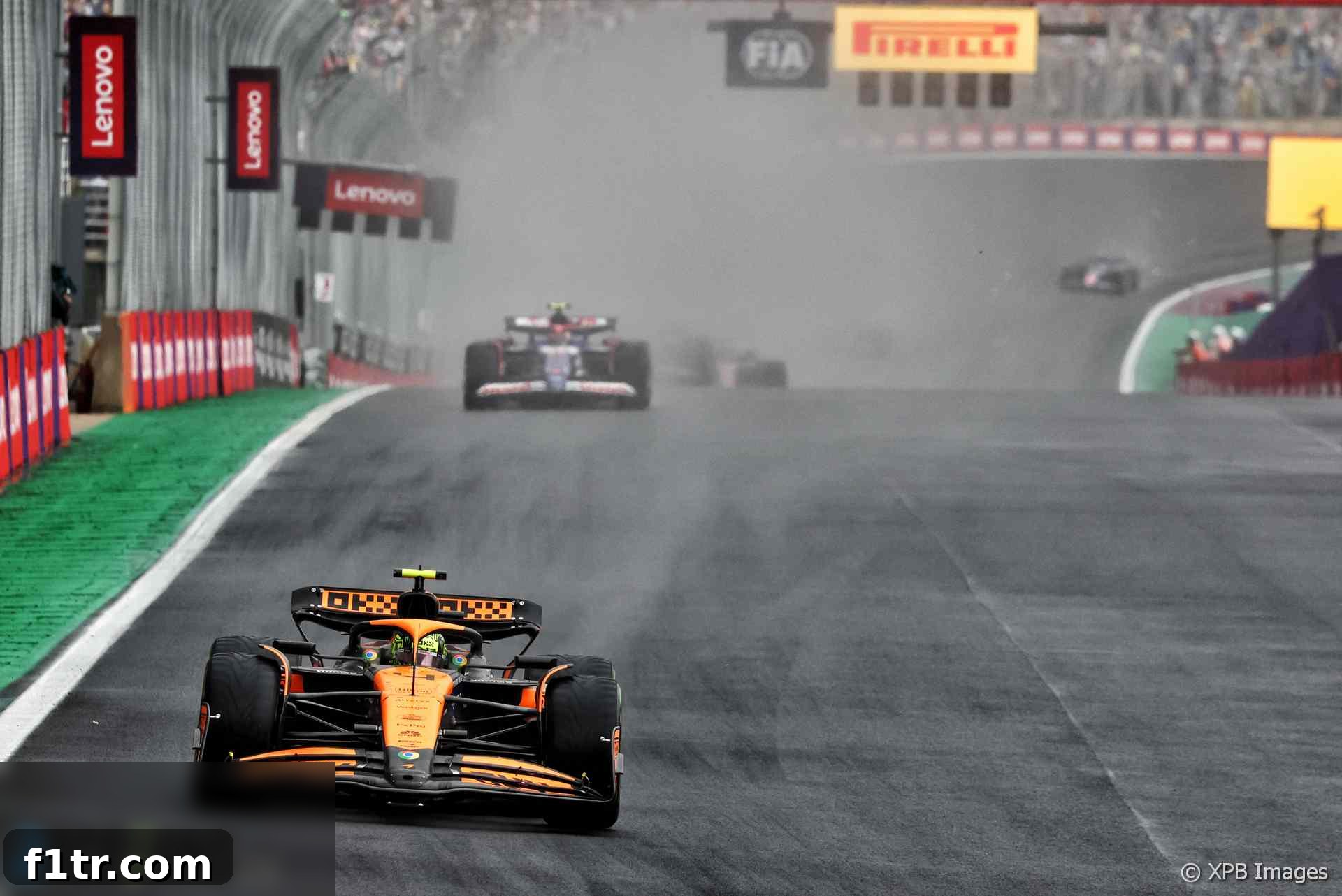
A contentious moment during the pre-race procedure at a recent Formula 1 Grand Prix saw two prominent drivers, Lando Norris and George Russell, incur penalties from the official race stewards. Both Norris and Russell were each fined a sum of €5,000 (approximately £4,200) and issued a formal reprimand for their actions during an aborted start sequence, specifically for leaving their grid positions prematurely. This decision by the stewards not only highlights the strict adherence required to Formula 1 regulations but also underscores the critical importance of clear communication and immediate obedience to race control signals, especially when the safety of all participants is at stake.
The sequence of events unfolded just as the cars were lining up for what was intended to be the start of the race. The atmosphere was charged with the usual pre-race tension, a familiar feeling for any F1 fan. However, this anticipation quickly shifted to confusion and concern due to an incident involving Aston Martin driver Lance Stroll. Stroll’s car spun at the notorious Subida do Lago section of the circuit, a demanding corner known for catching drivers out. In an unfortunate turn of events, as he attempted to regain control and recover, his vehicle slid off the track and became beached in the gravel trap. This rendered his car immobile and unable to proceed, posing a significant hazard on or near the circuit. Recognizing the immediate danger this presented to a safe start, the Race Director promptly initiated an aborted start procedure, a standard safety protocol designed to prevent a race from beginning under unsafe conditions.
Following the distinct signal to abort the start, a moment of misinterpretation or perhaps an instinctive reaction led to the penalized actions. Lando Norris, who held the coveted pole position, began to move his car off the grid. This initial movement, whether a result of confusion about the signal or an assumption of an extra formation lap, proved to be a catalyst. George Russell, positioned directly behind Norris on the front row, immediately followed suit. As these two leading cars pulled away, a chain reaction ensued. Several other drivers further down the grid, observing the movement of the front-runners, also began to move their vehicles, departing their designated grid slots. What should have been a moment of static waiting for further instructions evolved into a staggered movement across the grid. Eventually, realizing the widespread motion across the entire grid, the remaining drivers also pulled away, leading to a situation where almost the entire field was in motion despite the clear aborted start signal.
The stewards launched a thorough investigation into the incident, meticulously reviewing all available evidence, including telemetry data, onboard camera footage, and communication logs. Their findings confirmed that the signal to abort the start was “appropriately given.” This confirmation included verification that the designated light panels displayed the necessary signals as prescribed by the sporting regulations, and critically, all competing teams received notifications via the official messaging system. These findings eliminated any ambiguity regarding the clarity and delivery of the official abort signal. The investigation therefore shifted focus to the drivers’ interpretation and reaction to these unequivocal instructions. In the case of Lando Norris, the stewards’ report explicitly stated that “the driver left the grid and proceeded on a lap that he assumed to be an extra formation lap.” This assumption, while potentially stemming from the intense pressure and split-second decision-making inherent in Formula 1, directly conflicted with the proper protocol for an aborted start, which dictates that cars must remain stationary until explicitly instructed otherwise.
A key element in the stewards’ decision to penalize Norris and Russell was their strategic position at the very front of the grid. Their actions, as the lead cars, carried significant influence and effectively set a precedent for those behind them. The stewards concluded that “as the driver was on the front row of the grid this triggered following drivers to take similar action.” This ‘domino effect’ meant that their premature departure “precipitated the action of the drivers on the grid directly behind” them. The Race Director, observing the escalating situation where a substantial portion of the grid had begun to move, then issued an additional instruction to all teams. This instruction clarified that, for practical reasons and to re-establish the correct procedure for a restart, all cars should “proceed and return to the grid to follow the correct aborted start procedure,” effectively confirming an additional formation lap and bringing order back to the chaos.
The investigation also carefully considered the roles of other drivers who moved prematurely. Specifically, the RB pair of Yuki Tsunoda and Liam Lawson, who were starting from third and fourth positions respectively, underwent scrutiny. However, their cases concluded differently than those of Norris and Russell; Tsunoda and Lawson were ultimately cleared of significant culpability. The stewards noted that “although the driver breached the regulation this was influenced by the driver ahead of him and as such he was not predominately responsible for the breach.” This distinction is pivotal, showcasing the nuanced approach of the FIA in assessing driver responsibility. While all drivers are expected to be fully aware of and adhere to the regulations, the stewards acknowledge the powerful immediate influence exerted by cars directly ahead, especially in moments of rapidly unfolding events and potential confusion on the grid. This differentiation highlights a recognition of the pressures and dynamics at play during an F1 start, drawing a line between initiating a breach and reacting to one.
The penalties meted out to Norris and Russell serve as a stern reminder of the rigorous and unwavering nature of the rules governing Formula 1 race starts. An aborted start procedure is not a trivial matter; it is a fundamental safety mechanism designed to avert potentially catastrophic multi-car collisions or other hazards that could endanger drivers and track personnel during an unsafe grid departure. The established procedure is unambiguous: if a start is aborted, all cars must remain absolutely stationary until definitive further instructions are communicated. Any deviation from this protocol, regardless of whether it stems from confusion, a genuine mistake, or a momentary lapse in judgment, carries significant repercussions for both safety and the integrity of the competition. The fines, while not financially crippling for high-earning F1 drivers, signify an official acknowledgment of the infraction. Moreover, the formal reprimands are particularly notable as they accumulate throughout a season; a certain number of reprimands can lead to more severe sanctions, such as grid place penalties, making even a single reprimand a significant entry on a driver’s record.
Beyond the immediate disciplinary actions, this incident also prompts broader discussions regarding driver awareness, communication protocols, and the psychology of decision-making in the high-octane environment of Formula 1. Drivers operate under an extreme level of pressure and sensory overload as they prepare for a race start, with countless variables to monitor and process. While official signals, such as illuminated light panels and clear radio messages from their teams (relaying instructions from race control), are engineered to be unequivocal, the necessity for split-second reactions can sometimes lead to errors in judgment or misinterpretations. The fact that several drivers, including Tsunoda and Lawson, followed the lead of Norris and Russell suggests a prevailing collective reactive behavior, where the visual cue of a leading car moving might, in the heat of the moment, momentarily override the immediate processing of official signals. This underscores the perpetual challenges faced by drivers in interpreting dynamic, rapidly evolving situations, as well as by race control in ensuring universal, immediate, and unambiguous compliance across the entire grid.
Furthermore, these events contribute to the ongoing evolution of race procedures and the application of Formula 1’s comprehensive sporting regulations. The FIA consistently reviews incidents of this nature, using them as opportunities to refine existing rules, clarify protocols, and enhance their effectiveness. While the penalties in this specific instance were relatively moderate, the incident could potentially trigger further discussions within the FIA and among teams. These discussions might focus on reinforcing driver briefings on aborted start protocols, exploring technological advancements to further prevent mass movements after an abort signal, or even re-evaluating the visual and auditory cues used to signal such events. Ensuring seamless and immediate compliance across the entire grid is not merely a matter of rule enforcement; it is paramount for maintaining the fundamental integrity and uncompromising safety standards that define the pinnacle of motorsport.
The ramifications of such an incident extend beyond the immediate financial penalties and reprimands. For the teams involved, it necessitates a thorough review of their pre-race communication strategies and protocols with their drivers, ensuring that clear instructions are understood and adhered to in all scenarios. For the drivers themselves, it serves as a valuable, albeit financially costly, lesson in heightened vigilance, unwavering adherence to regulations, and the importance of independent judgment, irrespective of the perceived actions of competitors around them. In the fiercely competitive realm of Formula 1, where every minute detail can influence outcomes and split-second decisions often differentiate triumph from defeat, a profound understanding and strict observance of every regulation is not merely a means to avoid penalties, but a foundational pillar for upholding the paramount safety standards and the esteemed sporting integrity that underpin the entire sport.
In conclusion, the penalties imposed upon Lando Norris and George Russell for their premature departure during an aborted start procedure powerfully underscore the uncompromising and meticulous nature of Formula 1’s regulatory framework. While the initial cause of the aborted start was an unfortunate incident involving Lance Stroll’s stranded car, the subsequent actions of the front-row drivers created a distinct secondary issue of procedural non-compliance. The stewards’ detailed investigation, culminating in a differentiated judgment between those who initiated the movement and those who reacted to it, provides invaluable insight into the intricate application of F1’s complex rulebook. This event serves as a crucial reminder for all participants in the pinnacle of motorsport: strict adherence to every signal, every instruction, and every rule is not merely a matter of avoiding sanctions, but is fundamental to safeguarding the integrity, fairness, and, most importantly, the safety of the competition, ensuring that the thrilling spectacle of racing is always conducted within the strictest boundaries of sporting conduct.
Related Articles from the 2024 Brazilian Grand Prix:
- “I didn’t really want to come back” – Hamilton explains cryptic Brazil radio message
- Ocon’s role in Gasly’s Q2 exit was almost another ‘flare-up’ at Alpine – Oakes
- Interlagos must improve “very bad” new track surface for 2025, say F1 drivers
- “That’s how we silence them”: Verstappen’s stunning Brazil win from start to finish
- Verstappen now has as many wins as F1’s first six world champions combined
Browse all 2024 Brazilian Grand Prix articles