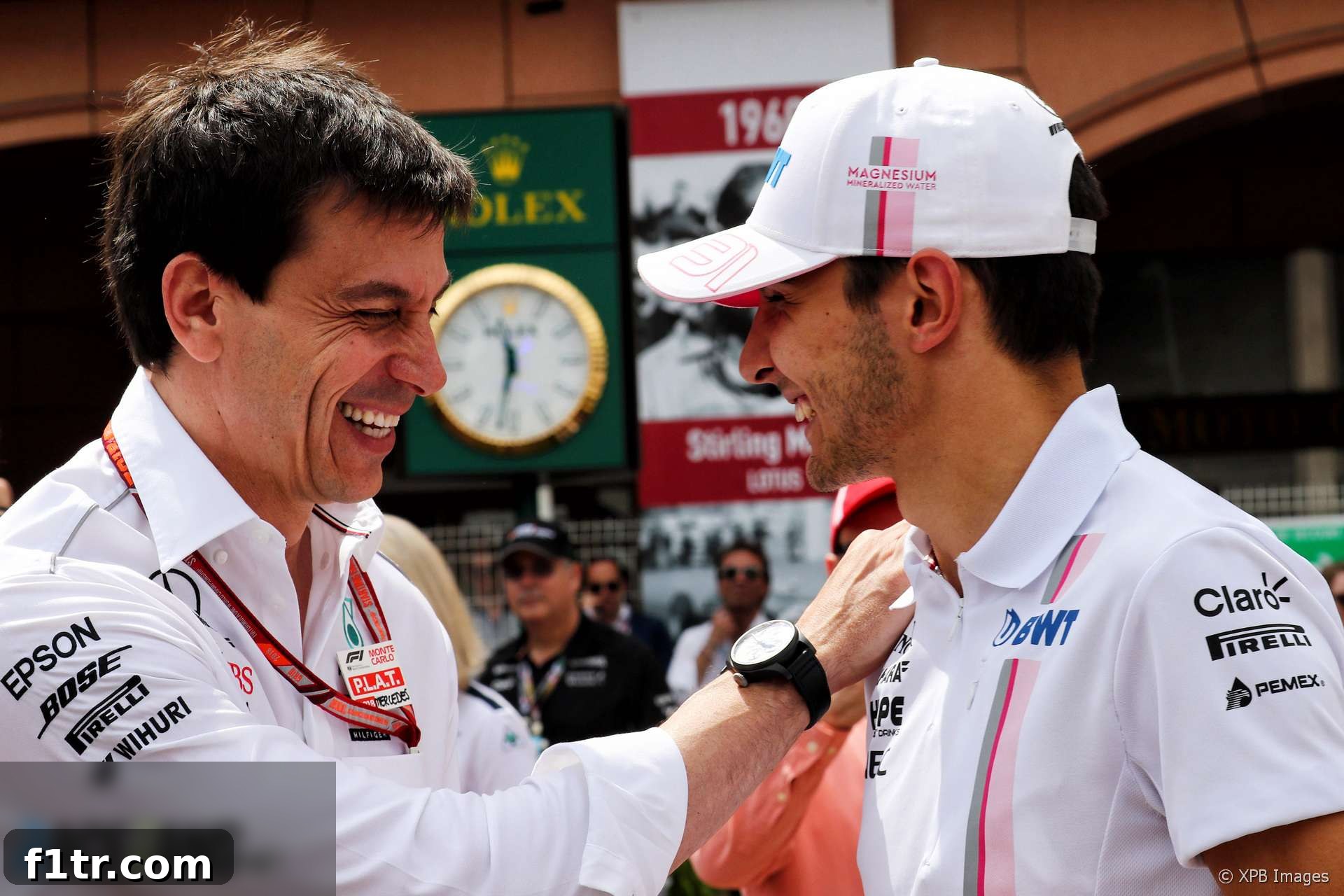
The Monaco Grand Prix, a jewel in the Formula 1 crown, is renowned for its unforgiving street circuit, where overtaking is notoriously difficult and strategic decisions often dictate the outcome. It’s a race where every millisecond counts, and the slightest misjudgment can prove costly. It was amidst this high-stakes environment during a pivotal moment in the 2018 Monaco Grand Prix that an incident unfolded, sparking debate and accusations within the paddock. Force India driver Esteban Ocon’s decision to allow Mercedes’ Lewis Hamilton to pass him became a flashpoint, drawing both criticism and commendation.
Mercedes executive director Toto Wolff was quick to defend and praise Esteban Ocon’s seemingly astute move, labeling it a “clever” decision. This incident, however, was not without its controversy. Following a pit stop by Lewis Hamilton’s Mercedes, Ocon, then driving for Force India, eased off to allow the championship leader through. This strategic concession was crucial in preventing Hamilton from losing valuable time, which could have potentially allowed Ferrari’s Kimi Raikkonen to emerge from his own pit stop ahead of the British driver, thereby disrupting Mercedes’ race strategy and championship aspirations.
Unraveling the Controversial Overtake: Accusations and Clarifications
The swiftness and apparent ease with which Ocon yielded to Hamilton immediately raised eyebrows. Whispers circulated through the paddock, evolving into outright accusations from unnamed rival teams. These competitors suggested that Mercedes, as a power unit supplier to Force India, had exerted influence, instructing their customer team to facilitate Hamilton’s progress. Such claims, if proven, would carry significant implications for the integrity of the sport and the perceived fairness of competition between factory teams and their customer counterparts. However, Toto Wolff firmly refuted these allegations, insisting that Ocon had acted purely on his own initiative, guided by his own race strategy and intelligent decision-making.
“We were operating in a completely different race scenario to Force India,” Wolff explained, distancing Mercedes from any direct instruction. “I genuinely believed that Esteban executed the right maneuver, a highly intelligent one for the context of his own race. Instead of enduring several laps with Lewis, on fresh tyres, constantly looming in his mirrors before his own scheduled pit stop, Ocon wisely chose to concentrate on his own competitive battle. At that particular juncture, his primary rivals were a McLaren and another car. From his perspective, it was a truly clever and self-serving strategic choice.” Wolff’s remarks underscored the independent nature of Ocon’s decision, framing it not as a favor to Mercedes, but as a calculated move to optimize his own performance and race position.
Force India’s Independent Strategy: A History of Prudent Decisions
The narrative of Esteban Ocon’s independent judgment was strongly supported by Force India’s technical director, Andrew Green. Green highlighted a pattern of behavior from Ocon, noting that the young driver had a precedent for allowing quicker cars to pass without explicit team instruction. This proactive approach, Green argued, demonstrated Ocon’s understanding of race dynamics and his ability to make real-time decisions that ultimately benefited his own race outcome, rather than hindering it through a futile defense.
Green cited an example from the very first race of that season, the Australian Grand Prix in Melbourne, to bolster his defense. “In race one, Melbourne, if you consult the records, you’ll discover there was a Mercedes that successfully navigated through the field during that race,” Green recounted. “Crucially, there was absolutely no communication or contact from our team to Ocon regarding that specific incident. He instinctively understood that he did not need to waste precious time engaging in a defensive battle against a faster Mercedes car. He handled the situation with finesse, ensuring he didn’t make it difficult for the passing car, thereby minimizing his own time loss. I vividly recall the maneuver; no words were exchanged on the radio from our end.” This historical context painted a picture of Ocon as a discerning driver capable of making split-second strategic calls, a trait particularly valuable in the unpredictable environment of Formula 1.
The core of Force India’s defense, however, centered on their own fierce battle for track position, entirely separate from the championship fight at the front. Otmar Szafnauer, Force India’s chief operating officer, emphatically stated that Ocon’s primary concern was not Lewis Hamilton, but rather their direct competitor, Fernando Alonso, who was attempting to execute an undercut strategy against them.

The Monaco Strategy: Countering the Undercut Threat
Szafnauer elaborated on Force India’s specific race objectives. “At that moment, we were intensely focused on our own race, which was certainly not against Lewis Hamilton,” he clarified. “Our absolute priority was to avoid losing any time whatsoever on track. Our main threat was Fernando Alonso, who, if I recall correctly, had pitted just prior to this sequence and was actively attempting to execute an undercut against us. Our primary objective was to ensure we didn’t lose any time whatsoever battling with Lewis, which would provide Alonso with a critical window of opportunity to gain track position on us. This is precisely why we communicated to Esteban not to lose any unnecessary time with Lewis.”
This statement provided crucial insight into Force India’s strategic thinking. While initial reports might have suggested Alonso pitted before Ocon let Hamilton pass, the interactive data from the 2018 Monaco Grand Prix later confirmed that Fernando Alonso made his pit stop five laps after Ocon allowed Hamilton through. However, this nuance does not invalidate Force India’s strategy. Alonso, despite pitting later, was the closest significant competitor behind Ocon who had not yet made his own pit stop. This made him the most immediate and tangible threat to Force India’s race position, as he possessed the potential to gain significant time through his own upcoming pit stop and fresh tyres.
“Our primary risk was unequivocally losing out to Alonso, and that was the central focus of our race strategy,” Szafnauer reiterated, underscoring the team’s unwavering concentration on their direct competitor. “That’s why our instruction to Esteban was clear: ‘don’t lose any time with Lewis.’ The rationale behind this is straightforward: if you choose to hold back a faster car, like Lewis, for five, six, or even seven laps, he will inevitably overtake you eventually. But in doing so, you would not only have lost significant time to Lewis, but more critically, you would have sacrificed invaluable time to the very competitor you are truly racing against – Alonso, who is likely making up time elsewhere on the track, having already pitted or preparing to do so.”
This perspective fundamentally reframed the incident. It wasn’t about aiding Mercedes, but about safeguarding Force India’s position. Engaging in a protracted, ultimately futile battle with Hamilton would have been detrimental to Ocon’s own race. By letting Hamilton pass efficiently, Ocon minimized his time loss, allowing him to concentrate on managing his gap to Alonso and protecting his own strategic window. This was a classic example of prioritizing the most immediate and relevant competitive threat in a complex strategic race.
Fair Play and F1 Dynamics: A Wider Perspective
The controversy surrounding Ocon’s move also shone a light on the broader dynamics of Formula 1, particularly the relationship between manufacturer teams and their customer teams. Accusations of “team orders” or undue influence are not new to the sport, and any incident that appears to benefit a manufacturer’s leading team through a customer team’s action is scrutinized. Force India’s robust defense, backed by Toto Wolff’s acknowledgement, aimed to dismantle these suspicions by emphasizing independent strategic thinking and driver initiative.
Szafnauer concluded his defense with a pointed remark aimed at the anonymous critics: “And that’s the fundamental reason we acted as we did. So, whoever felt compelled to complain about this incident might do well to start examining how they approach and execute their own racing strategies.” This statement effectively dismissed the accusations as uninformed, suggesting that a deeper understanding of race strategy would reveal the logic behind Ocon’s seemingly cooperative, yet entirely self-serving, decision.
In hindsight, Esteban Ocon’s decision at the 2018 Monaco Grand Prix was a nuanced one, born out of strategic necessity rather than obligation. It highlighted the intricate ballet of Formula 1 racing, where drivers and teams constantly weigh multiple variables – track position, tyre wear, competitor strategies, and the unique demands of each circuit – to make split-second decisions that can ultimately define their race. Ocon’s move, praised as “clever” by Wolff and justified by Force India, served as a testament to intelligent driving and strategic acumen in the high-pressure world of F1.
2018 F1 Season Insights
Delve deeper into the events and storylines of the 2018 Formula 1 season with these related articles:
- F1 feared “death knell” for Drive to Survive after Ferrari and Mercedes snub
- McLaren staff told us we were “totally crazy” to take Honda engines in 2018 – Tost
- ‘It doesn’t matter if we start last’: How Red Bull’s junior team aided Honda’s leap forward
- Honda’s jet division helped F1 engineers solve power unit problem
- McLaren Racing losses rise after Honda split
Browse all 2018 F1 season articles