Kevin Magnussen Defends Driving After Spanish GP Clash with Romain Grosjean
In the aftermath of a contentious 2019 Spanish Grand Prix, Kevin Magnussen has firmly refuted claims that his on-track contact with Haas teammate Romain Grosjean was responsible for Grosjean losing positions. The incident, which unfolded during a crucial Safety Car restart at the Circuit de Barcelona-Catalunya, sparked immediate concern within the Haas garage and led to a stern intervention from team principal Guenther Steiner.
The 2019 season proved to be a challenging one for the Haas F1 Team, often marked by flashes of pace followed by perplexing inconsistencies and, at times, internal friction. This particular event in Spain encapsulated many of the team’s struggles, with two highly competitive drivers pushing the limits, sometimes to the detriment of team cohesion and overall points accumulation. Magnussen’s post-race comments aimed to clarify his perspective, emphasizing that while contact occurred, the ultimate outcome for Grosjean was due to a chain of events beyond his direct influence.
The Tense Barcelona Showdown: Incident at the Safety Car Restart
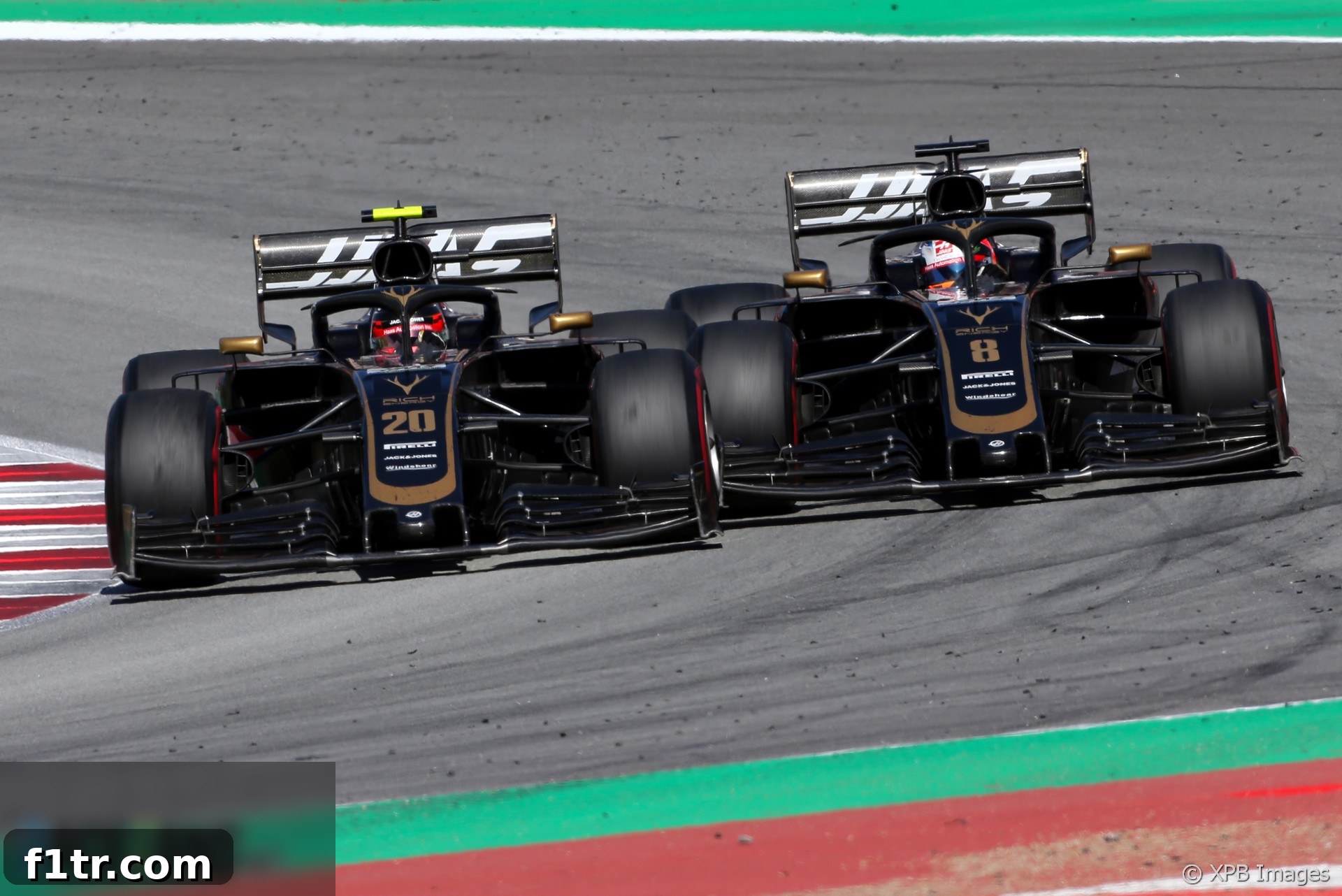
The pivotal moment occurred during the Safety Car restart in Sunday’s race. As the field bunched up and then accelerated away, Magnussen initiated an overtake on Grosjean. In the heat of the moment, the two Haas drivers made contact. The jostle forced Grosjean to use the escape road to maintain control and rejoin the track, though he inevitably lost ground to his teammate. This type of incident, while unfortunate, is not uncommon in the high-stakes environment of a Formula 1 restart, where drivers are vying for every inch of track and positions are fiercely contested.
The tension didn’t dissipate there. Just a few laps later, Grosjean attempted to reclaim the position from Magnussen, leading to another instance of wheel-to-wheel racing and further contact. Once again, Grosjean found himself having to take evasive action, signaling a level of aggression and determination from both drivers that, while individually admirable, began to raise questions about team strategy and driver management. The replays of these encounters highlighted the fine line between hard racing and compromising a teammate’s race.
Observing the unfolding drama, the Haas pit wall quickly intervened. Both drivers were immediately instructed via team radio to “calm down,” a clear indication of the team’s concern over the escalating rivalry and the potential for a complete self-sabotage. The urgency in the team’s tone underscored the high-pressure environment of Grand Prix racing, where every point is vital, especially for a midfield contender like Haas. Despite the instruction, the damage, both in terms of track position and potential morale, had already been done.
Magnussen’s Unwavering Defense: “Nothing Happened Between Us”
Speaking after the race, Kevin Magnussen was resolute in his defense, stating there were “no problems” between the drivers and that his actions had not cost Grosjean points. “At the end of the day, nothing happened between us,” Magnussen asserted. He pointed to his own seventh-place finish, securing six valuable points, while Grosjean managed only a single point for tenth. Magnussen argued that Grosjean “could have scored more” due to having the pace, but “didn’t for different reasons” that were unrelated to their skirmishes.
Magnussen elaborated on his perspective, meticulously dissecting the sequence of events. He clarified that the initial contact led to Grosjean going off-track, but crucially, Grosjean rejoined the circuit directly behind him. Any subsequent loss of positions, such as to Carlos Sainz Jnr on the next lap or to Daniil Kvyat later in the race, occurred after this point. Magnussen stressed, “It wasn’t what happened between me and him that meant we didn’t score more points. He went off-track, came back behind me and then dropped back behind other people so it’s not that I pushed him off the track and then he lost a lot of positions, that didn’t happen.” This distinction was central to his argument, suggesting Grosjean’s ultimate misfortune was a consequence of subsequent race events rather than their initial contact.
Further defending his driving, Magnussen characterized the initial contact at the Safety Car restart as a “misjudgement” rather than an intentional act. He acknowledged that it “looked harder than it was” due to the visual drama of Grosjean being forced off track, but maintained that such incidents can and do happen in the close quarters of a Safety Car restart or on lap one of a race. He emphasized his line, stating, “I was on the white line on the inside when we touched,” indicating he had taken a legitimate racing line and was not overtly aggressive in squeezing his teammate. For Magnussen, the subsequent off-track excursion and use of the bollard escape route were part of the race’s natural flow, with Grosjean ultimately rejoining right behind him, only to lose further places later on.
Internal Strife and the Haas F1 Team’s 2019 Struggles
The Spanish Grand Prix incident wasn’t just another racing squabble; it highlighted deeper issues within the Haas F1 Team during the 2019 season. Immediately after the race, team principal Guenther Steiner summoned both Magnussen and Grosjean for “clear the air” talks. Steiner, known for his direct and often fiery approach, was visibly frustrated by the repeated clashes between his drivers, especially given the team’s ongoing struggles with car performance and tire management throughout the year. Such internal conflicts not only cost valuable points but also added unnecessary pressure and negativity to an already challenging campaign.
The 2019 season was particularly vexing for Haas. Despite showing promising pace at times, the team often found itself unable to translate that into consistent results, largely due to difficulties in making their car work effectively with the Pirelli tires. In such a competitive environment, maximizing every scoring opportunity becomes paramount. Driver clashes, therefore, were seen as egregious missed opportunities, directly impacting the team’s position in the constructors’ championship and its overall morale. Steiner’s intervention reflected a desperate attempt to restore order and focus amidst a period of underperformance.
The dynamic between Magnussen and Grosjean had long been a point of interest, characterized by both strong performances and occasional flashes of intra-team rivalry. Both are fiercely competitive drivers, and while this can sometimes push a team forward, it can also lead to incidents like those witnessed in Barcelona. The challenge for Haas, like any F1 team, was to harness this competitive spirit without letting it compromise the collective goal. The Spanish GP incident became a prominent example of this delicate balance going awry, overshadowing any potential positive takeaways from the race weekend.
The Intricacies of F1 Racing: Aggression vs. Teamwork
Formula 1 is a sport that demands an intense blend of individual brilliance and team cooperation. Drivers are expected to race hard, extract every ounce of performance from their machinery, and fight for every position. However, when two drivers compete for the same team, an unwritten code of conduct often comes into play, emphasizing the importance of not jeopardizing a teammate’s race or the team’s overall championship aspirations. The Magnussen-Grosjean incident in Spain served as a stark reminder of the fine line between aggressive, legitimate racing and actions that could be detrimental to the team.
Safety Car restarts, in particular, are notorious breeding grounds for such incidents. The sudden compression of the field, followed by an immediate surge of acceleration, creates a chaotic environment where drivers are making split-second decisions at incredibly high speeds. This high-pressure situation often pushes drivers to their limits, increasing the likelihood of contact and misjudgments. While Magnussen defended his actions as an unavoidable racing incident, it nonetheless underscored the constant tension between a driver’s instinct to win and the team’s overarching objective to score points efficiently and safely.
For midfield teams like Haas, where points are hard-won and championship positions are decided by fine margins, incidents between teammates carry even greater weight. Every single point lost due to intra-team squabbles can have significant financial and competitive repercussions. The management of driver rivalries, therefore, becomes a crucial aspect of team strategy, requiring a balance between allowing drivers to race freely and imposing clear boundaries when team interests are at stake. The 2019 Spanish Grand Prix was a moment where Haas had to confront this dilemma head-on, underscoring the complexities inherent in modern Formula 1.
Aftermath and Lingering Questions
In the immediate aftermath of the Spanish Grand Prix, Kevin Magnussen’s P7 finish brought six valuable points to the Haas F1 Team, a decent result given the competitive midfield. However, Romain Grosjean’s solitary point for P10 felt like a missed opportunity, especially considering his initial track position and pace. The incident undeniably cast a shadow over the team’s performance, highlighting the difficulty of maintaining internal harmony when drivers are fiercely battling for position, even against each other.
Magnussen remained steadfast in his conviction that the contact was not the primary cause of Grosjean’s wider race struggles. His explanation focused on the sequence of events, emphasizing that Grosjean’s subsequent losses to other competitors occurred independently after rejoining behind him. While the team principal’s call for “clear the air” talks suggested a degree of concern, Magnussen’s public stance aimed to downplay any lasting animosity, portraying it as an intense but ultimately resolved racing matter.
The events in Barcelona provided a telling glimpse into the demanding world of Formula 1, where split-second decisions can have significant consequences, and the line between fierce competition and team collaboration is constantly tested. For the Haas F1 Team, this incident became another chapter in a challenging 2019 season, underscoring the perennial difficulty of managing two hungry, competitive drivers under the immense pressure of top-tier motorsport.
Advert | Become a RaceFans supporter andgo ad-free