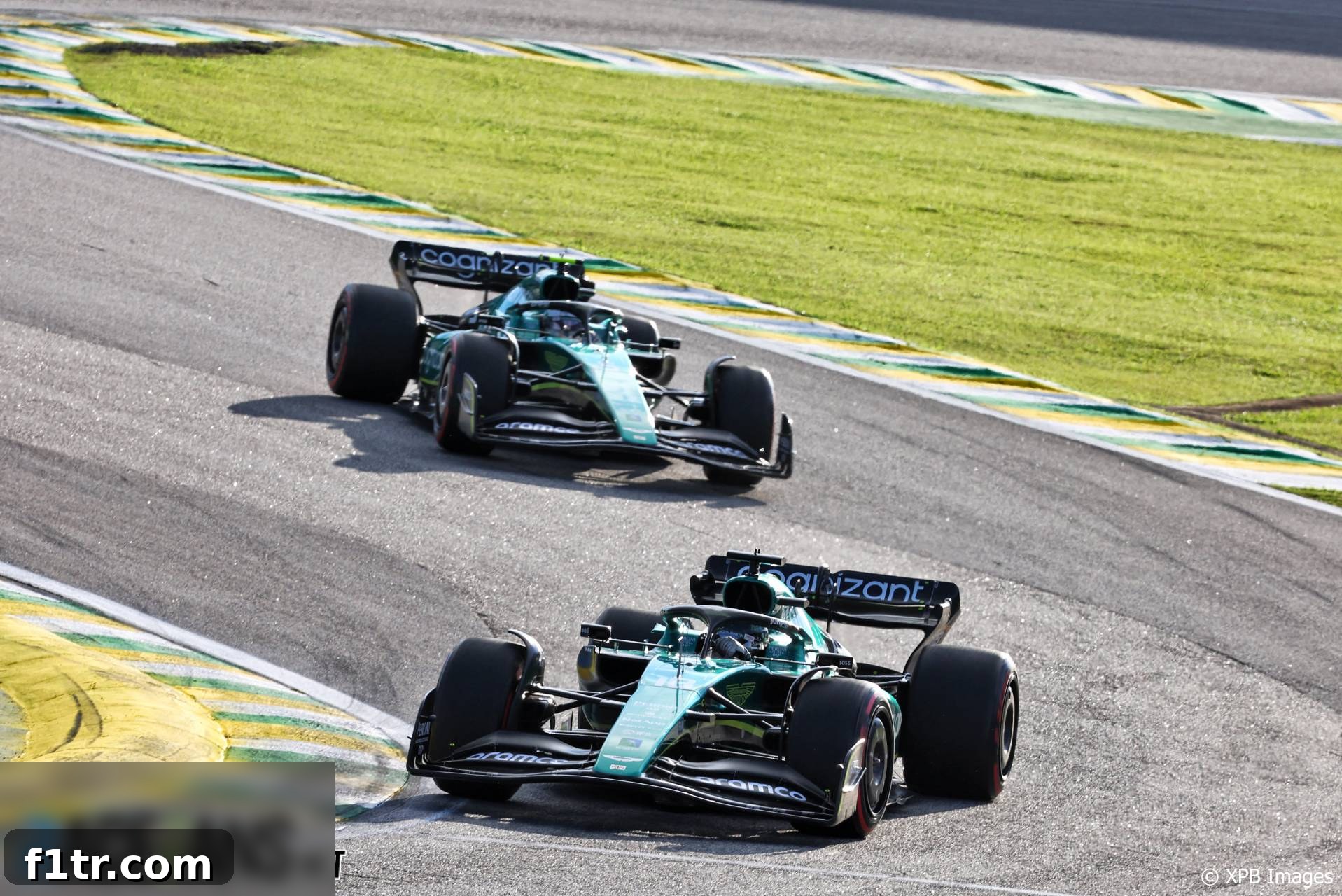
Lance Stroll Penalized: Dangerous Driving Incident with Teammate Sebastian Vettel Rocks Aston Martin
A contentious on-track manoeuvre involving Aston Martin teammates Lance Stroll and Sebastian Vettel at the recent Brazilian Grand Prix has resulted in significant penalties for Stroll. Stewards deemed the move “dangerous,” handing the Canadian driver a 10-second time penalty during the race and adding three crucial penalty points to his super license. This incident not only altered the race’s final standings but also reignited discussions around driver conduct, team dynamics, and the strict enforcement of Formula 1’s sporting regulations.
Advert | Become a Supporter & go ad-free
The Heated Battle: Vettel vs. Stroll at Interlagos
The incident unfolded during a fiercely competitive phase of the Brazilian Grand Prix, as drivers fought tooth and nail for every position on the challenging Interlagos circuit. Veteran Sebastian Vettel, in his final Formula 1 season, was locked in a close quarters battle with his younger Aston Martin teammate, Lance Stroll. The pair found themselves in a direct fight for track position, a scenario that often brings an extra layer of tension, even among teammates. As they approached the exit of Turn 3, a critical corner for gaining momentum onto the long back straight, Vettel attempted to make an assertive overtake on Stroll.
Vettel, utilizing his experience and superior traction, positioned his car alongside Stroll’s, aiming to complete the pass. However, as the cars accelerated out of the corner, Stroll veered significantly from the established racing line. This aggressive defensive move forced Vettel, who had committed to his overtaking manoeuvre, to take evasive action. With nowhere else to go, Vettel’s car was pushed wide, resulting in two of his wheels running onto the treacherous grass runoff area at high speed. The manoeuvre was not just a minor inconvenience; it was a heart-stopping moment that could have easily led to a high-speed collision or a significant accident, potentially compromising the safety of both drivers and their multi-million dollar machinery.
Such incidents between teammates are always scrutinized intensely, raising questions about internal team protocols and the fine line between aggressive racing and unacceptable risk. While Formula 1 is a high-stakes sport where drivers are expected to fight hard, there are unwritten rules, especially when battling a fellow driver from the same garage. The immediate aftermath saw Vettel expressing clear frustration, a sentiment likely shared by the Aston Martin pit wall, who would have been monitoring the potentially disastrous interaction between their two drivers.
Stewards’ Swift Judgment and Regulatory Breaches
Race stewards swiftly initiated an investigation into the incident, utilizing comprehensive video replays, telemetry data, and onboard camera footage from both cars. Their thorough review unequivocally concluded that Lance Stroll’s manoeuvre was not within the bounds of acceptable racing conduct. During the race, they issued a 10-second time penalty to Stroll, a decision that had an immediate impact on his classification. This penalty effectively dropped him from a respectable 12th place finish to a significantly lower 17th in the final standings, robbing him of any potential championship points and demonstrating the immediate consequences of dangerous driving.
Beyond the in-race time penalty, the stewards also imposed three penalty points on Stroll’s super license. This is a critical accumulation, as Formula 1 drivers face an automatic one-race ban if they amass 12 penalty points within a 12-month period. With these three additional points, Stroll’s tally now stands at eight, placing him uncomfortably close to the threshold for a suspension. This significantly raises the stakes for his driving behaviour in upcoming races, as any further infringements could lead to him missing a Grand Prix – a severe blow for any driver and team.
The specific regulations Stroll was found to have violated are articles 2b and 2e of Appendix L, Chapter IV of the International Sporting Code. These articles are foundational to ensuring fair play and safety in motorsport. Article 2b explicitly states: “Manoeuvres liable to hinder other drivers, such as deliberate crowding of a car beyond the edge of the track or any other abnormal change of direction, are strictly prohibited.” Stroll’s action of moving across the track and forcing Vettel onto the grass clearly fell under the definition of “deliberate crowding” and an “abnormal change of direction.”
Furthermore, Article 2e reinforces the general principle of safe driving: “it is not permitted to drive any car unnecessarily slowly, erratically or in a manner deemed potentially dangerous to other drivers at any time.” While Stroll’s move wasn’t slow or erratic in the traditional sense, the stewards concluded that forcing another car onto the grass at high speed undeniably constituted driving “in a manner deemed potentially dangerous to other drivers.” These regulations serve as the bedrock for maintaining order and preventing reckless driving that could lead to serious incidents, underscoring the FIA’s commitment to driver safety and the integrity of the competition.
Implications for Stroll, Aston Martin, and Driver Conduct
The incident and subsequent penalties carry significant implications for Lance Stroll personally, for the Aston Martin F1 Team, and for the broader narrative of driver conduct in Formula 1. For Stroll, accumulating eight penalty points is a serious concern. Drivers must exercise extreme caution to avoid further infringements, as reaching 12 points would mean sitting out a race. This pressure can subtly affect a driver’s approach, potentially leading to more conservative moves when battling closely, which might not always be to the team’s strategic advantage.
From Aston Martin’s perspective, a collision or dangerous incident between their own drivers is always an unwelcome scenario. While internal team orders are common, direct battles for position can sometimes boil over. Such incidents reflect poorly on team cohesion and can strain relationships within the garage, particularly between drivers. Given that Sebastian Vettel was in his swansong season, ending his illustrious career with such a contentious moment with a teammate might have added an unfortunate footnote to his final appearances, even if he did not voice extensive public criticism.
The stewards’ firm stance also sends a clear message across the paddock: aggressive defensive driving that compromises another driver’s safety or forces them off the track will not be tolerated. Formula 1 has, over its history, swung between periods of extremely lenient and increasingly strict interpretations of on-track conduct. The current era emphasizes driver safety and fair play, aiming to prevent the kind of potentially disastrous accidents that have marred the sport in the past. This ruling reaffirms the commitment to these principles, reminding all drivers that while racing hard is encouraged, crossing the line into dangerous territory will be met with penalties.
Consistency in stewarding decisions is often a point of contention among fans and teams, but in this instance, the clear violation of well-defined rules left little room for ambiguity. The incident serves as a stark reminder of the responsibilities that come with driving at the pinnacle of motorsport – not just to perform at the highest level, but to do so safely and within the spirit of the regulations.
Don’t miss anything new from RaceFans
Follow RaceFans on social media:
- Join RaceFans on Facebook
- Follow RaceFans on Twitter
- Get daily email updates from RaceFans
Advert | Become a RaceFans supporter andgo ad-free
Beyond the Brazilian Grand Prix: Looking Ahead
The conclusion of the Brazilian Grand Prix brought this particular incident to a close, but its ripple effects will undoubtedly be felt. For Lance Stroll, the focus will now shift to driving meticulously in the remaining races of the season and into the next, ensuring he avoids any further infringements that could trigger a race ban. Such a ban would be highly detrimental to his championship aspirations and the team’s constructors’ championship efforts. The pressure to drive clean, while still being competitive, will be a significant challenge.
The episode also serves as a poignant reminder of the inherent risks and intense rivalries within Formula 1, even between teammates. While every driver is striving for personal glory and to outperform their peer, the shared objective of bringing home points for the team often takes precedence. Incidents like these, however, highlight the delicate balance between individual ambition and team harmony.
Ultimately, the stewards’ decision reinforced the FIA’s unwavering commitment to maintaining the highest standards of safety and sportsmanship in Formula 1. Dangerous driving, regardless of intent or the identities of the drivers involved, will continue to be penalized. This incident involving Stroll and Vettel will be remembered not just as a moment of on-track drama, but as a significant case study in the interpretation and enforcement of F1’s critical sporting regulations.
2022 Brazilian Grand Prix: Further Insights
- Ferrari’s season of missed chances led to “difficult” criticism for Binotto
- How many victory chances did Hamilton have in his first winless F1 season?
- Red Bull “never envisaged” Brazil team orders situation – Horner
- Red Bull “accept Max’s reasoning” over radio row and condemn online abuse
- Russell’s first grand prix victory means F1 has a dozen winners – for one race only
Browse all 2022 Brazilian Grand Prix articles