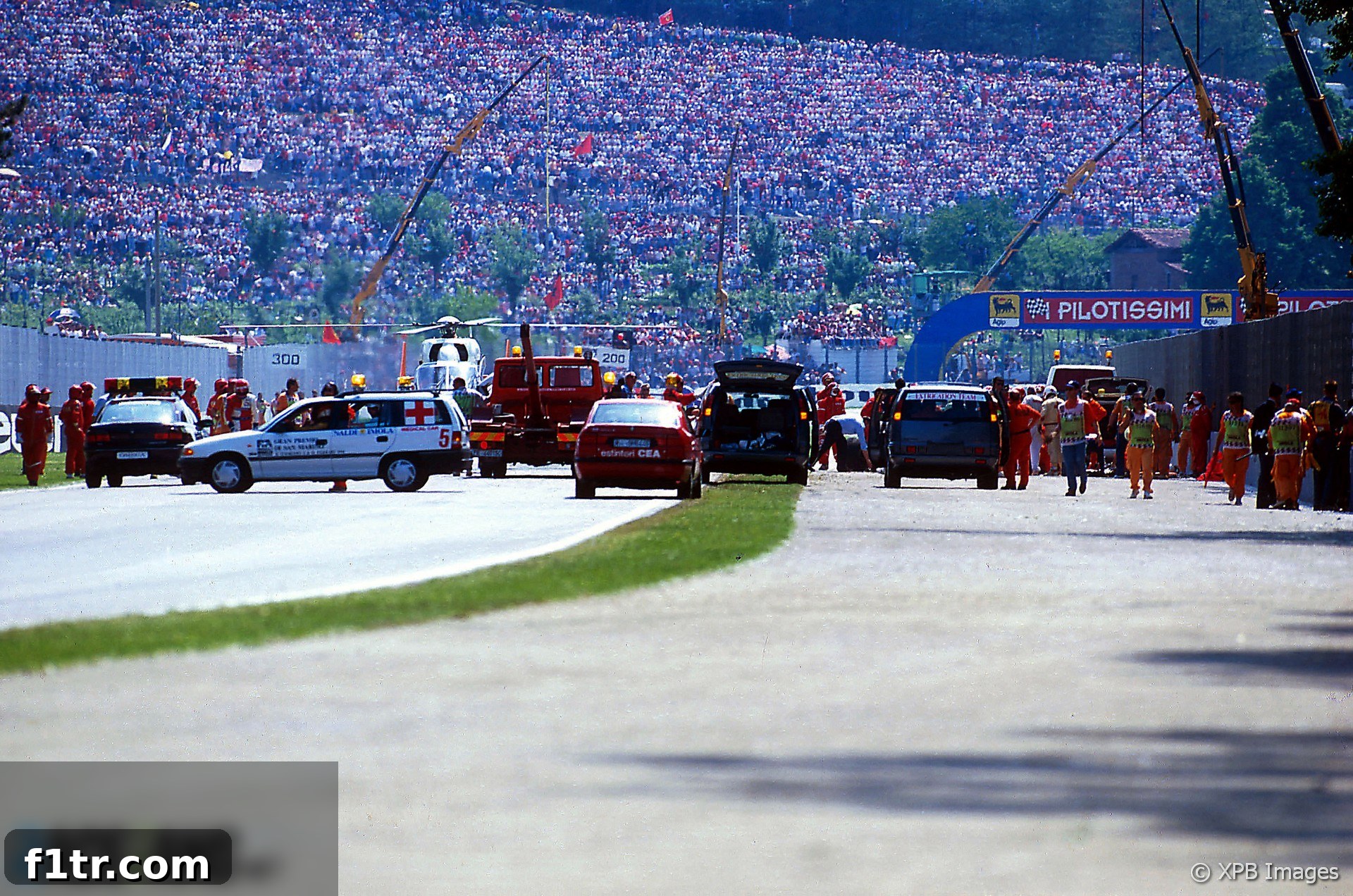
“Honestly, even now, the thought still gives me goosebumps.”
Everyone who has ever had the privilege of experiencing a Formula 1 car in person, whether hearing its roar or witnessing its blur, remembers that indelible first encounter. Yet, few can claim their inaugural exposure to the sport was the visceral, screaming symphony of a Ferrari V12 engine, its magnificent sound reverberating through the picturesque hills and valleys of its native Italian countryside. This was the dramatic and unforgettable introduction for Claire Campbell.
A Childhood Dream in the Heart of Motorsport
In April of 1994, Claire Campbell embarked on a long-anticipated journey through Italy with her boyfriend, fulfilling a childhood dream to explore the enchanting country. Central to their meticulously planned itinerary was a pivotal event: attending the third round of the 1994 Formula 1 World Championship, the San Marino Grand Prix, held at the historic Imola circuit. For Claire, an admitted Italophile, the destination held particular allure.
“We’d specifically gone for the Grand Prix,” Claire fondly recalls. “Being in Imola, I’d read all about the passionate Tifosi on the hill at the Rivazza, eagerly watching the race. So, experiencing it in the very hometown of Ferrari, if you like, made the whole adventure even more special.” While her boyfriend was undoubtedly the more fervent Formula 1 enthusiast at the time, Claire herself possessed a deep-seated appreciation for the gladiatorial spectacle of the sport, nurtured since her formative years.
“I was born in the sixties, so I grew up watching Formula 1,” she explains, her voice alight with memories. “Legends like James Hunt graced the tracks, followed by icons such as Nigel Mansell and Damon Hill during my younger years. These motorsport drivers, they were just otherworldly, weren’t they? I always had a kind of fascination with them. And I still believe that to be the case today; their bravery and skill remain unparalleled.”
Arrival in Imola: The Calm Before the Storm
Claire and her partner arrived in Imola on Thursday, a day ahead of the scheduled track action. Given the intense demand for accommodation during a Grand Prix weekend, finding a place to stay proved to be a creative challenge. They secured a hotel room in Imola for that initial Thursday night, but full weekend accommodation in the immediate vicinity was simply unavailable.
“We were staying in a hotel in Imola for that first Thursday night,” Claire recounts. “However, as we planned to stay for the entire Grand Prix weekend, we couldn’t secure accommodation in Imola for the duration.” It was during their stay that an intriguing detail emerged. “When we arrived on the Thursday, we learned from some of the other guests that one of the F1 drivers was actually staying there for the weekend. A driver by the name of ‘Ratzenberger’ was sharing the hotel with us that night. I always remembered that name.” This seemingly minor detail would later take on a profound and tragic significance.
Friday: The Unmistakable Roar and Unseen Danger
On Friday, the pair made their way to the five-kilometre circuit just before 10 am, by which time the opening practice session of the weekend was already well underway. The air was thick with the high-pitched shriek of Formula 1 engines, but above all, the distinctive and unforgettable roar of the Ferrari V12s cut through the sonic tapestry, immediately recognizable among a field largely populated by V10s and V8s.
“I remember there was this long kind of avenue leading to the track,” Claire vividly describes. “As we walked up the avenue, you could actually hear the Ferraris – their sound was absolutely unmistakable. Honestly, even now, the thought of that sound still gives me goosebumps.” The anticipation grew with every step. “By the time we’d reached the end of this avenue, I was almost running down, propelled by the sheer excitement, because all I could think was ‘I’ve got to see these cars, I have to witness this spectacle with my own eyes’.”
And when they did, the sight was breathtaking. “It was amazing. I remember watching them practice and just being utterly mesmerized. I kept thinking, ‘I cannot get my head around how incredibly fast they’re going around these bends’. It was staggering, truly mind-boggling.” Unbeknownst to Claire and her partner, who, like most spectators in the pre-mobile internet era, relied solely on the circuit’s public address system for information, the day had already witnessed a grave development. Jordan driver Rubens Barrichello had suffered frightening injuries in a horrific crash at the Variante Bassa chicane, a stark and early warning of the perils to come.
Saturday: Confronting the Inherent Peril
After travelling to their hotel in Bologna, where they would stay until Monday, the couple returned to the circuit on Saturday for qualifying. It was on this day that Claire was directly confronted with the inherent and raw danger of the spectacle they had come to witness. The circuit, 28 years ago, was different. Today, the Tamburello and Villeneuve corners have been reconfigured into chicanes, designed to slow the cars. But back then, they were terrifyingly fast, flat-out kinks. Standing on the inside of the left-hand Villeneuve, Claire and her partner saw cars approach at terrifyingly close to top speed, pushing the limits of physics and human courage.
“Watching them then, it looked like it was just crazy,” she says, her voice still reflecting the shock. “Crazy dangerous. Beyond crazy, truly.” Then, without warning, the unthinkable happened. Ratzenberger – the driver with whom they had unknowingly shared a hotel roof just one night previously – speared off the circuit on the outside of Villeneuve, directly into a concrete barrier. Having struck the unforgiving wall at an estimated 314.9 kph (195 mph), his shattered car didn’t come to a rest until the next corner, Tosa. The silence that followed was deafening, the reality crushing.
An hour later, at Maggiore Hospital in Bologna, the 33-year-old Roland Ratzenberger was tragically pronounced dead. This was Formula 1’s first fatal accident in almost eight years and the first at a Grand Prix for almost twelve. “It was horrific,” Claire remembers, the weight of the moment still palpable. “It’s just ridiculous that it got to that point. But I’m not an expert, so I don’t know what safety measures were in place, or what the prevailing attitude towards safety was at the time.”
Sunday: A Day of Chaos and Confusion
Arriving back in Bologna that evening, the couple decided to try and distract themselves from the sad and shocking events of the day by heading out to a local bar. “While we were out, we met these two Austrian guys who were also attending the race and got talking. Naturally, given the day’s events, we had a lot to discuss.” A unique opportunity then presented itself. “We had tickets for Rivazza, where the Tifosi were, on the hill. These two Austrian lads said they had grandstand seats for the start-finish straight and asked if we wanted to swap, as they weren’t interested in the start. We could swap over midway through the race, meaning we could watch the crucial start of the race from a prime position.”
“So obviously we jumped at that chance,” Claire explains. “We arranged that we’d meet in a public area at a certain time, swap tickets again, and we’d go back to the Tifosi while they’d return to the grandstand for the race finish.” Now in possession of coveted tickets for the pit straight, the pair walked to the grandstand, ready to witness the electrifying start of their first ever Grand Prix, overlooking the pit straight at the exit of the final chicane.
But as the start lights illuminated and then faded, and a cacophony of 24 engines roared off the line, chaos erupted. JJ Lehto’s Benetton, starting fifth on the grid, failed to get away. Pedro Lamy, who had started 17 places further back, moved from the right of the track to the left to seize a perceived gap, tragically unaware that the stationary Benetton was directly in his path. Lamy’s car struck Lehto’s with immense force. “A pair of what I think must’ve been wheels shot up over the track,” Claire recalls, her voice still laced with disbelief. “We were literally directly across from where that happened.”
“There were bits of debris flying over the track towards the spectators and landing right in the crowd. I remember thinking ‘this is just unreal,’ because having witnessed what had happened on Saturday leading up to this race, it was almost impossible to comprehend what else could possibly go wrong.” Elsewhere in the crowd, nine spectators had been injured, one seriously, adding another layer of horror to the already unfolding tragedy.
Senna’s Crash: The Unspoken Tragedy
After a handful of laps behind the Safety Car, the race eventually resumed. Leader Ayrton Senna, the three-time world champion, swiftly pulled away from the pack with a determined Michael Schumacher in close pursuit. Then, after the leaders passed Claire for a second time under green flag conditions, she noticed the marshals begin to wave the yellow flags once more. A chilling sense of déjà vu, but this time, it felt different.
“First the Safety Car went out, then it became clear that they’d stopped the race,” Claire explains, recalling the profound confusion. “We had no clue what was truly happening. The PA system was entirely in Italian, there were no screens to watch the race progress, and this was all before the advent of mobile phones. So, we were completely in the dark about the unfolding events.” The pair watched Schumacher eventually return to the pits, while Senna’s iconic Williams, however, did not. A sickening realization dawned: something terrible had happened to the legendary three-time world champion.
“We saw a helicopter arrive on the circuit and then, eventually, take off,” Claire says, her voice solemn. “We didn’t know what to do or where to get information, so we went and found those two chaps, swapped tickets back as arranged, and they went to watch the restart. Meanwhile, we headed to where the Tifosi were on the hill, still completely bewildered. Again, all we knew was that the race had been stopped for a serious incident.”
Eventually, the race restarted and the San Marino Grand Prix ran its full, albeit truncated, course. Yet another dangerous accident occurred in the pit lane during a chaotic stop, leaving a Ferrari mechanic needing medical treatment after being hit by an errant wheel. The result of the race mattered little; after three consecutive days of serious, life-threatening crashes, no one was in the mood for celebration. A dark cloud hung over Imola.
The Chilling Revelation: “È Morto”
“After the race it was really eerie,” Claire recalls, remembering the unsettling atmosphere. “Once it was over, we left the circuit. As we walked away, I remember it being just profoundly quiet. People were talking in hushed tones, desperately trying to get information, and we gradually got a sense that something truly terrible had happened to Senna. But we weren’t entirely sure of the extent. So, we left the track feeling incredibly worried and anxious, knowing he’d either been severely injured or, quite possibly, worse.”
“When we finally got to the hotel in Bologna very late that night and checked in, we mentioned to the guy on reception that we’d been at the Grand Prix. ‘What a terrible day,’ we said, hoping for some shared understanding or news. And he just paused for a second – and I’ll never forget this moment – he crossed himself, looked at us with solemn eyes, and simply said ‘è morto’.”
“‘He’s dead?’ we shouted, completely stunned – we had absolutely no idea until that very moment. We ran straight upstairs to our room and immediately put Eurosport on, and obviously watched all the devastating coverage on TV. It’s truly amazing, looking back, that in those pre-internet days, you could be present at such a momentous event and have absolutely no real-time understanding of what had happened. We were just in a state of profound shock. We sat upstairs watching the TV, repeating to each other, ‘I can’t believe we were there, that he’d died, and we didn’t even know until now’.”
With the sudden, shocking death of an international sporting icon, it was little surprise to see Senna’s accident dominate the front pages of every newspaper displayed around the Bologna newsagent forecourts the following morning. What Claire did not expect, however, was to be confronted with such graphic and horrific images of the Williams driver’s accident.
“Back then, the Italian press weren’t averse to being able to print really horrific pictures. There was just picture after picture of Senna’s bloodied helmet just sitting there, stark and unforgiving, on every front cover of every newspaper. It was vile, a truly awful sight that burned into your memory.”
A Legacy of Change and Enduring Passion
Despite admitting that her first Grand Prix experience was “a really awful thing to be a part of, a horrifying tragedy,” it did not extinguish Claire’s interest in motorsport. In the years that followed that somber weekend, the couple checked off other iconic races, attending the Spanish Grand Prix in Barcelona and the glamorous Monaco Grand Prix, proving the enduring allure of Formula 1 even after such a traumatic introduction.
The tragic events of Imola 1994 served as an undeniable catalyst for revolutionary advancements in safety standards across Formula 1. Tremendous strides have been made in the design and construction of circuits, the inherent safety of the cars themselves, the protective equipment worn by drivers, and the protocols for incident management. These changes have significantly reduced the number of serious crashes and injuries during Grand Prix weekends. However, the fatal accidents suffered by Jules Bianchi in 2014 and Formula 2 driver Anthoine Hubert in 2019, both within the last decade, serve as somber reminders of the inherent and ever-present dangers that remain within motorsport, a testament to the fact that absolute safety can never be guaranteed.
Nonetheless, Claire unequivocally states that anyone who has ever contemplated attending a Grand Prix should seize the opportunity. “Oh my god, definitely,” she asserts with conviction. “It’s a real spectacle, an unparalleled experience.”
“It’s still got that incredible cachet – there’s truly nothing quite like it in the world of sports. I would say there’s something utterly captivating about a racing car, seeing all that power, precision, and technology in action. It’s not just the speed, it’s the sheer wealth of talent and engineering, the immense pressure on the drivers and teams, the profound sense of adventure – it’s absolutely everything combined into one thrilling package.”
While her regular race-watching days may be long behind her, Claire says she will never forget her intense and formative experience of witnessing Formula 1’s darkest weekend play out around her. The memories of Imola 1994, both exhilarating and devastating, are etched forever in her mind.
“I think, generally speaking, it was a fantastic experience to go, even though it culminated in a horrible tragedy,” she reflects. “It was a profound moment in history, and I’m glad I was there to witness it, even with its heartbreaking outcome.”
Become a RaceFans Supporter and Go Ad-Free
RaceFans thrives thanks in part to the generous support of its dedicated readers. By contributing just £1 per month or £12 per year (or the equivalent in your local currency), you can play a crucial role in helping to cover the ongoing costs of creating, hosting, and continuously developing RaceFans, both today and into the future.
Become an official RaceFans Supporter today and enjoy an entirely ad-free browsing experience across the site. Sign up or find out more about the benefits via the links below:
- Become a RaceFans Supporter
- RaceFans Supporter FAQ
More from F1 History
- When did F1 last have a mid-season break longer than five weeks? 1990
- Did Norris actually win Formula 1’s closest championship fight of all time?
- Hamilton is Ferrari’s first new driver in 44 years to complete season without a podium
- Ferrari are on course to lose an F1 record they’ve held since 2004
- Red Bull in 2010 or Ferrari in 1979? Past title fights illustrate McLaren’s current dilemma
Browse all history articles