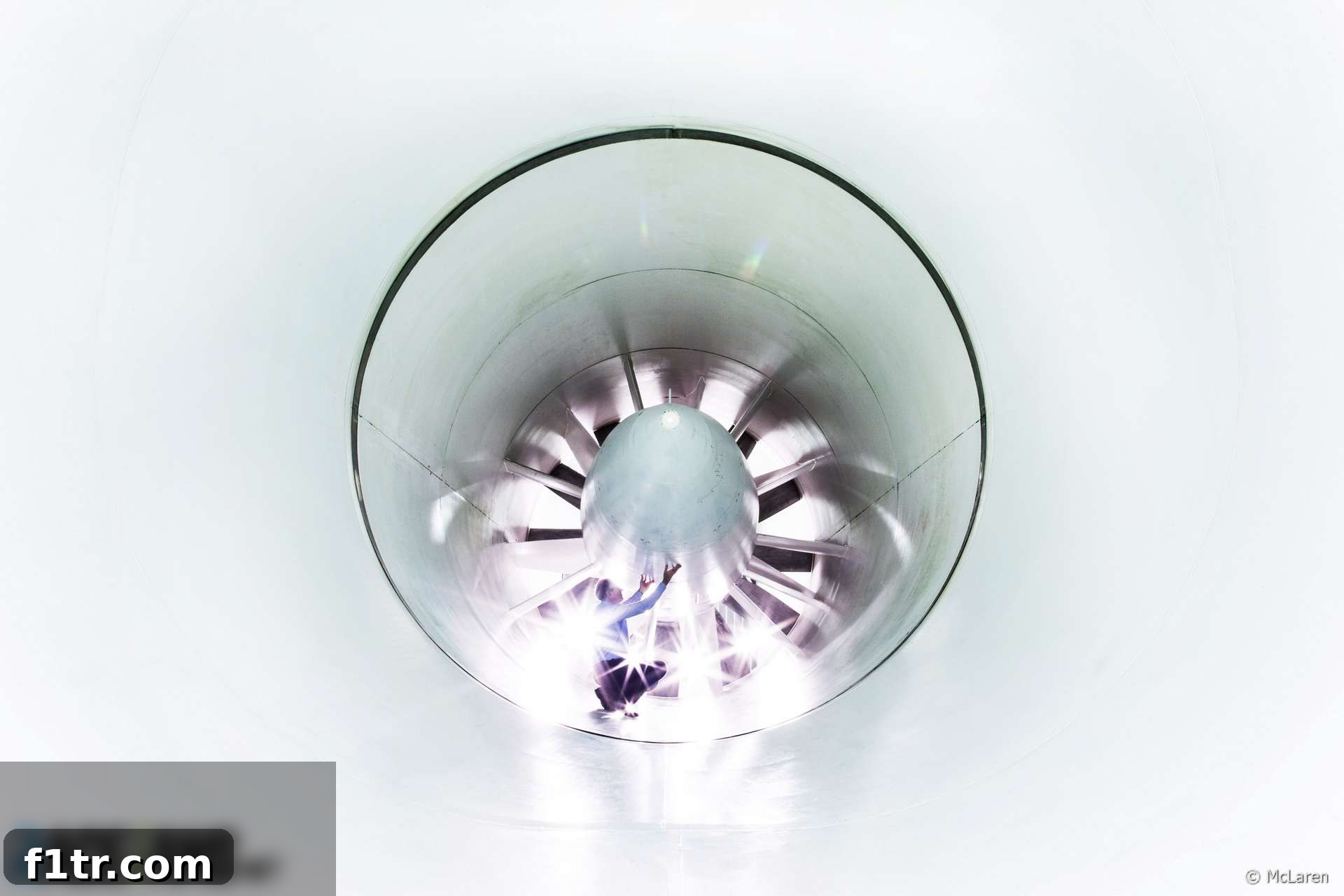
The world of Formula 1 is a relentless arena of innovation, speed, and strategic investment. Amidst the intense competition, teams are constantly evaluating and upgrading their infrastructure to gain a vital edge. A recent conversation with Lando Norris, McLaren’s promising young driver, shed light on the strategic thinking behind his long-term commitment to the team, reportedly extending until the end of 2024. During an interview in Monaco, Norris highlighted several factors influencing his decision, prominently featuring McLaren’s ambitious plans to construct a state-of-the-art wind tunnel. This investment, he explained, is a cornerstone of the team’s forward-looking strategy, combining past successes with significant future developments.
“Having our own wind tunnel is undeniably one of the most crucial elements,” Norris stated, emphasizing the immediate benefits for the team’s dedicated workforce. He elaborated on the arduous process currently faced by McLaren’s aerodynamicists and engineers, who are required to travel extensively to external facilities, such as Toyota’s advanced wind tunnel in Germany. These frequent and prolonged trips, often involving weeks of isolation away from home, result in significant logistical challenges and considerable time loss. For a sport where every millisecond counts, minimizing such inefficiencies is paramount. In contrast, teams with in-house facilities enjoy a substantial advantage, enabling faster iteration, more direct supervision, and seamless integration with their design processes.
Wind tunnels are not merely large pieces of equipment; they are monumental investments, representing a colossal financial commitment for any Formula 1 team. The cost of installing a new, cutting-edge wind tunnel is staggering, with a turnkey project easily exceeding $60 million (£42.4 million). Even upgrading existing facilities to meet contemporary standards can demand at least half that amount. Beyond the initial capital outlay, the ongoing operational costs are equally substantial. Aston Martin’s former team principal, Otmar Szafnauer, estimated the annual running costs for a wind tunnel to be around $10 million, which includes powering the facility and consistently supplying it with intricate scale models for testing. Another competitor source suggested that these annual costs could potentially double, contingent on the intensity of a team’s aerodynamic development program and the specific methodologies employed.
Norris’s enthusiasm for McLaren’s new wind tunnel is well-founded. He informed RaceFans that the facility is an indispensable component of his team’s broader plans for a completely new factory, which is currently in advanced planning stages. This strategic alignment underscores the critical role that a dedicated wind tunnel plays in a modern F1 team’s development cycle. The ability to conduct rigorous, immediate, and proprietary aerodynamic testing is considered non-negotiable for pushing the boundaries of car performance.
However, this substantial investment by McLaren and others is set against a backdrop of a looming paradigm shift in Formula 1. Discussions are actively underway to completely ban the use of wind tunnels in F1 by 2030. Pat Symonds, F1’s chief technical officer, has been a vocal proponent of this change, claiming that eight of the ten current teams favor such a ban once computational fluid dynamics (CFD) technology matures to a point where it can consistently deliver highly accurate and reliable results. Symonds highlighted the environmental and economic benefits, noting that wind tunnels typically consume up to 3000kW to propel air at full speed, leading to annual electricity expenditures that can easily exceed $1 million. The move towards a CFD-only future aligns with F1’s broader sustainability goals and its commitment to technological advancement.
During a pre-race press conference organized by the FIA, six team bosses were asked for their perspectives on the proposed ban. While most expressed a degree of support, several also voiced significant caveats, underscoring the complexities of transitioning away from a long-established testing methodology. Laurent Rossi, CEO of Alpine, acknowledged the potential for cost reduction, stating, “If it helps curb the costs, obviously it’s a good measure.” However, he immediately raised concerns about the current reliability of CFD simulations compared to real-world track performance. “I think we’re not there yet, to the point that we can just get rid of the wind tunnel altogether,” Rossi cautioned, a sentiment echoed by Mercedes F1 team boss Toto Wolff.
Ferrari’s Mattia Binotto offered a more nuanced perspective, highlighting the extended timeline before 2030. “It’s a long time from now to [2030],” Binotto remarked, suggesting that teams are generally open to discussing and potentially accepting such a ban in the future. However, he firmly asserted the current indispensability of wind tunnels. “Are we today ready to ban the wind tunnel? Not at all.” Binotto underscored that the engineering process in Formula 1 has always been a combination of design, simulation, and rigorous physical testing. He stressed the importance of testing across various domains, including aerodynamics and power units, viewing it as an integral part of normal engineering practice. “For today, it’s important to have the wind tunnel, and let’s see how much simulation will develop in the future,” he concluded, indicating a cautious optimism about CFD’s evolution.
The most intriguing and perhaps prescient response came from Red Bull’s Christian Horner. He revealed that he had initiated discussions on this topic months prior, advocating for a longer-term perspective. Horner candidly described wind tunnels as being “not particularly efficient” and “not very environmentally-friendly.” He emphasized the rapid evolution of simulation tools and CFD, suggesting that Formula 1, as a pinnacle of technology, should embrace these advancements. Horner believes F1 should adopt a “10-year view” on the matter, ensuring that these “dinosaurs of machinery,” with their heavy consumption of electricity and power, become relics of the past. For Horner, Formula 1 should always be at the cutting edge of technology, and that future lies in advanced simulation.
To support his argument, Horner cited the Aston Martin Valkyrie supercar, a project developed by Red Bull Advanced Technologies, as a compelling example of what can be achieved without traditional wind tunnel testing. “It never went in a wind tunnel once during its whole development phase,” he proudly stated. Given that Red Bull’s chief technical officer, Adrian Newey, is widely regarded as Formula 1’s pre-eminent aerodynamicist, this statement carries significant weight. Red Bull’s confidence in CFD and other simulation methods suggests they have thoroughly considered the full implications of an outright ban and are preparing for a future where physical wind tunnels are obsolete.
Tellingly, Andreas Seidl, the team principal of McLaren—a team actively investing in building a new wind tunnel—expressed full agreement with Christian Horner’s long-term vision. Seidl confirmed McLaren’s support for the ban, provided there is “a good medium- to long-term plan in place with a glide path of introducing this.” He further clarified, “At the moment, we are discussing, at the earliest, the introduction of banning the wind tunnels from 2030 onwards, which is something we support as well.” This demonstrates a nuanced position: McLaren recognizes the long-term direction of the sport while also acknowledging the present-day necessity of a wind tunnel for competitive development.
The historical context of relying solely on CFD provides a cautious reminder. In 2010, Manor Grand Prix Racing, later known as Virgin Racing, unveiled its inaugural Formula 1 car, the VR01. Its aerodynamic surfaces were purportedly designed exclusively via CFD. Despite various contributing factors to its overall performance, the VR01 famously failed to score a single point in 26 starts, achieving a best result of only 14th. While CFD technology has undoubtedly advanced significantly over the past decade, this early attempt serves as a stark illustration of the challenges in translating purely digital simulations into real-world track success.
Fast forward more than 10 years, and the paradox becomes clearer: two prominent teams, Aston Martin and McLaren, are making substantial investments, planning to spend tens of millions of dollars on constructing new wind tunnels in the short term. This commitment comes despite the very real possibility of a comprehensive ban being imposed in less than a decade. Their collective investment, conservatively estimated at $150 million for construction and operation of these new facilities, strongly implies a lingering lack of full confidence in CFD as a truly viable and reliable standalone alternative for current-generation F1 car development. While CFD offers immense potential for efficiency and cost savings, the perceived gap in accuracy and predictive capability compared to physical testing remains a critical concern for these teams.
As Binotto rightly pointed out, 2030 might seem a considerable distance away, but in the fast-paced world of Formula 1, eight years can pass in a flash. The introduction of the current hybrid power units, for instance, occurred eight years prior to these discussions, a time when Lewis Hamilton was still a one-time world champion. This rapid evolution underscores that 2030 may indeed be too soon for a complete and confident transition to CFD-only development for all teams. However, any delays in making a definitive decision on the ban could inadvertently entice teams to continue investing heavily in costly upgrades for their existing wind tunnels or even construct new ones. Such continued investment would, in turn, make a future ban far more complicated and expensive to implement, potentially creating a significant financial burden on teams that have recently committed to these facilities.
Therefore, as is often the case in Formula 1, there is no time to lose. Procrastination or indecision on this critical issue could result in tens of millions of dollars being misspent on infrastructure that will soon be deemed obsolete. Such a scenario would utterly undermine the sport’s stated ideals of cost-saving and sustainability. F1 must strike a delicate balance between fostering technological innovation, ensuring competitive fairness, and implementing responsible financial and environmental policies. The path forward requires clear vision and decisive action to steer the sport towards a truly sustainable and cutting-edge future.
2021 F1 season
- Masi ‘basically gifted the championship’ to Verstappen says 2021 FIA steward Sullivan
- Las Vegas race backers looking to extend F1 deal beyond 2025
- Why Mercedes put ‘a reminder of joy and pain’ on display in their factory lobby
- Verdict on error in GT race suggests Mercedes would have lost 2021 Abu Dhabi GP appeal
- Title ‘stolen’ from Mercedes made us ‘underdogs people cheer for’ – Wolff
Browse all 2021 F1 season articles