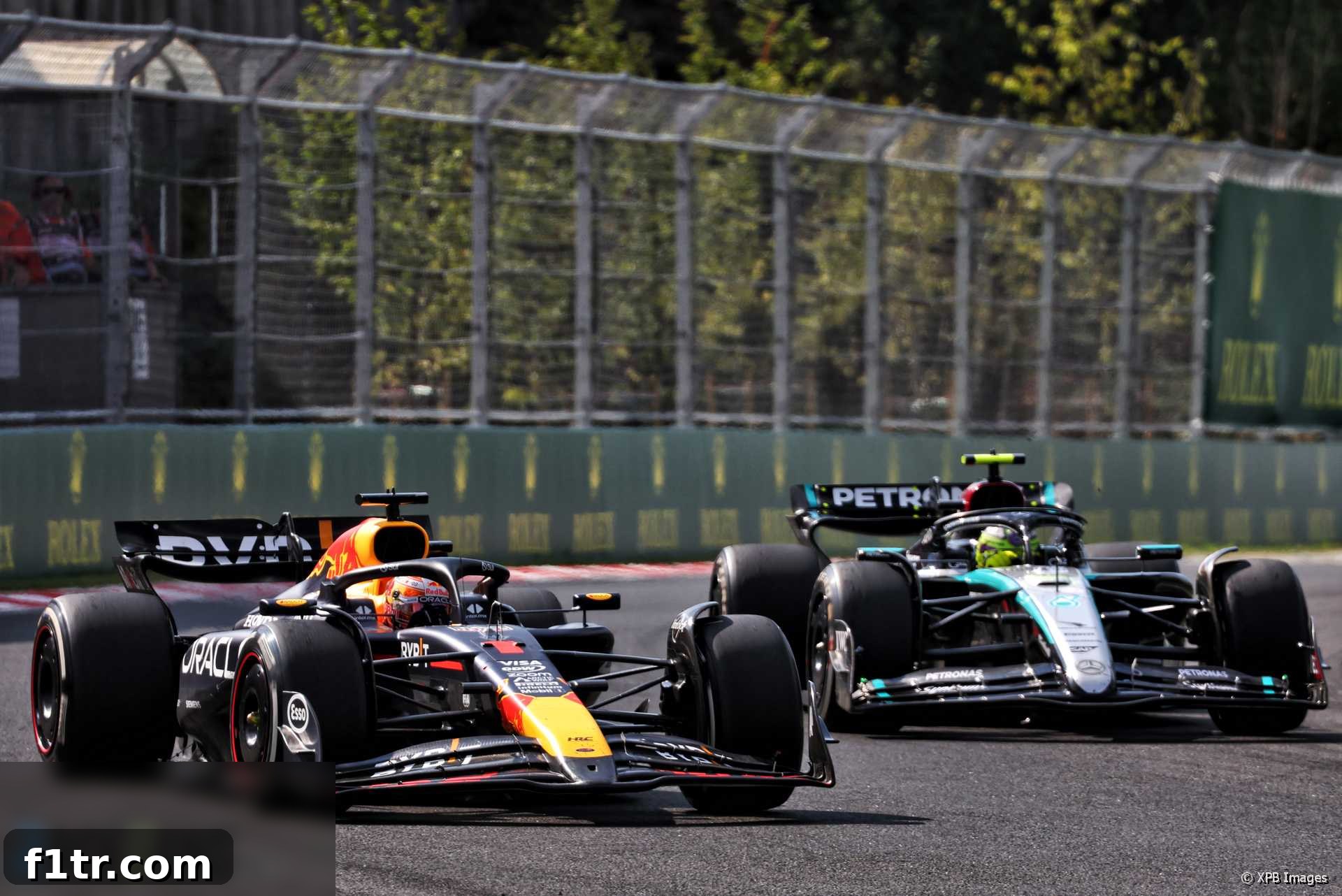
In the high-stakes world of Formula 1, every decision, every maneuver, and every strategic call can dictate the outcome of a race. For Max Verstappen, the recent Hungarian Grand Prix served as a stark reminder of this unforgiving reality. While public attention largely fixated on his dramatic lap 62 collision with Lewis Hamilton and his subsequent fiery radio comments, Red Bull team principal Christian Horner pointed to an earlier, more subtle misstep that he believes ultimately cost Verstappen a significantly better result. As Verstappen prepares for a challenging recovery drive from 11th on the grid at the iconic Belgian Grand Prix, this critical analysis from his team principal undoubtedly weighs heavily.
The incident that seized headlines—the late-race tangle with Hamilton’s Mercedes—was, in Horner’s view, merely the culmination of a narrative that had already been shaped. Long before the spectacular contact that sent both cars momentarily off track, Verstappen had made repeated, often aggressive, attempts to pass his rival. One particular moment, on lap 35, appeared to be the decisive move. Verstappen launched an attack, seemed to have the upper hand, only for an understeer moment at turn two to send his Red Bull wide, allowing Hamilton to deftly reclaim the position. This, for Horner, was the pivotal turning point of the Hungarian Grand Prix, a seemingly minor error with profound strategic ramifications.
Verstappen’s frustration later boiled over with his pit wall, particularly regarding the timing of his final pit stop. He felt that the delay in bringing him in before Hamilton condemned him to emerge behind the Mercedes, setting the stage for their eventual collision. However, Horner’s perspective suggests a different chain of events. He argued that had Verstappen successfully completed that mid-race overtake on Hamilton, Red Bull’s strategy would have unfolded entirely differently. With clean air ahead, Verstappen could have utilized a fresh set of medium tires available for the final stint, unleashing his potent pace to chase down the McLaren drivers who had been a dominant force at the front. The potential to apply immense pressure on his rivals, and perhaps even challenge for a victory, was lost in that critical lap 35 error. “That race hinged on the middle point where, if Max had managed to get the pass – I think we underestimated the overtaking delta, if we could run that again, that’s what we do differently – if he’d have made that pass around the outside of Lewis, circa half-distance, it was a different race,” Horner explained to Sky. He added, “The second half would have come alive. The overlap we’d have had, we still had a set of mediums available to us [for the final stint], and if you look at his pace on the hard tyre, he would have closed in on the McLarens and we would have been putting them under pressure. Sometimes the margins are very fine and then we’d be talking about what a fantastic strategy it was.” This statement underscores the intricate dance of strategy and driver execution in Formula 1, where a single miscalculation can unravel an entire race plan.
Moving from the hills of Hungary to the Ardennes forest, the Belgian Grand Prix presents an entirely new set of challenges for Max Verstappen. Red Bull’s pre-planned engine change resulted in a grid penalty, relegating him to 11th place. Despite starting deep in the midfield, the formidable pace demonstrated by the Red Bull RB20 throughout the weekend at Spa-Francorchamps means Verstappen cannot be entirely ruled out of contention for victory. While the team publicly manages expectations, cautiously aiming for a podium finish, the underlying potential for a dominant performance remains. The recovery drive through the field will test both Verstappen’s skill and Red Bull’s strategic prowess.
Navigating the field at Spa, particularly against the in-form McLarens, will be a significant hurdle. Lando Norris and Oscar Piastri have emerged as Red Bull’s most consistent threat this season, demonstrating exceptional speed and race craft. In any wheel-to-wheel battle with Norris, Verstappen is acutely aware that his championship rival is in desperate need of points, perhaps even more so than he is. This dynamic often compels Norris to exercise a degree of restraint, a calculation Verstappen famously exploited to his advantage during an earlier encounter in Austria. However, the same cannot be said for Lewis Hamilton. Not being in championship contention, Hamilton has no strategic incentive to yield to Verstappen, as he unequivocally demonstrated in Hungary. Their rivalry, forged in the crucible of the bruising and controversial 2021 championship fight, continues to simmer, leading to intense and often uncompromising on-track battles.
Following their collision in Hungary, a strained exchange between the two rivals underscored the enduring tension. Hamilton, while stating, “I don’t feel there should be any hostility,” also prophetically noted, “but of course, from his side, there always will be.” More significantly, Hamilton vocally disagreed with the stewards’ remarks on their incident. Although both drivers ultimately escaped penalties, the stewards’ claim that Hamilton “could have done more” to prevent contact left him genuinely surprised and perplexed. “I was really, really surprised by it,” Hamilton commented later. “I was very relaxed about the situation and saying look, it’s just a racing incident, let’s just move on. But considering one car was in control and one car was not in control at the time, because obviously when all the wheels are locked you’re not in control… If you look at the replay, I’m very, very far – at the end of the whole move – I’m very far from the apex. So I’ve left a lot of room on the right-hand side. So I was very, very surprised by the stewards, I don’t know who typed it up, that will be a question when I speak to them at some stage.” This strong reaction from Hamilton highlights not only the intensity of their personal rivalry but also the subjective nature of race officiating, particularly when two of the sport’s greatest competitors are involved.
It is abundantly clear that Hamilton will not be doing Verstappen any favors on track. Indeed, Hamilton has already predicted that his rival will “make his way through pretty quick” from his sixth-row start, a statement that could be interpreted as a subtle challenge rather than a compliment. However, not everyone shares Hamilton’s confidence in Verstappen’s ease of progression through the field. Carlos Sainz Jnr, who starts four places ahead of the Red Bull, offered a more cautious outlook: “I think it will be tricky. It’s not as easy to overtake as it used to be. At the same time, when you have his pace, everything is easier. But the McLarens were extremely strong [on Friday], so it will not be easy.” Sainz’s point is particularly pertinent given the modifications to the Spa-Francorchamps circuit, including the shortened DRS zone on the Kemmel straight, which historically has been a prime overtaking spot. This change could make Verstappen’s charge through the pack more intricate and less straightforward than in previous years, forcing him to rely more on raw pace and daring moves rather than simple DRS passes.
Nonetheless, the immutable reality of a 44-lap Grand Prix means that Verstappen and Hamilton’s paths are almost certainly destined to cross at some point during the race. When this inevitable confrontation occurs, Verstappen will need to display a level of precision and clinical execution that perhaps eluded him in Hungary. Facing the driver who consistently puts up the hardest fight against him, any repeat of the understeer moment on lap 35 could prove disastrous for his recovery efforts and aspirations of a strong finish, or even victory. Horner’s timely observation about the true turning point of the Hungarian Grand Prix serves as a powerful reminder. Verstappen, a driver known for vociferously demanding perfection from his team, must apply that same exacting standard to his own performance, particularly in these critical, wheel-to-wheel scenarios.
The key difference for Verstappen heading into the Belgian Grand Prix compared to Hungary is a shift in expectation. In Budapest, he didn’t necessarily anticipate a prolonged, direct battle with his bitterest rival. At Spa, starting from the midfield with Hamilton ahead, he knows precisely what is coming. This foreknowledge, combined with the lessons learned from Hungary, should arm him with the mental fortitude and strategic awareness required to tackle the race with heightened focus and a renewed commitment to flawless execution. The Ardennes forest awaits a thrilling chapter in this ongoing rivalry, and Verstappen’s ability to convert potential into performance, especially when confronted by Hamilton, will define his Sunday.
Miss nothing from RaceFans
Get a daily email with all our latest stories – and nothing else. No marketing, no ads. Sign up here:
2024 Belgian Grand Prix
- Lost Spa win last year was ‘the best race I’ve ever done in Formula 1’ – Russell
- Belgian GP was “still a win” for Russell despite disqualification
- High plank wear also a factor in Russell’s disqualification, say Mercedes
- Russell is sixth F1 driver to be disqualified after winning a grand prix
- Unheard radio shows why Hamilton missed Russell’s (almost) race-winning strategy
Browse all 2024 Belgian Grand Prix articles