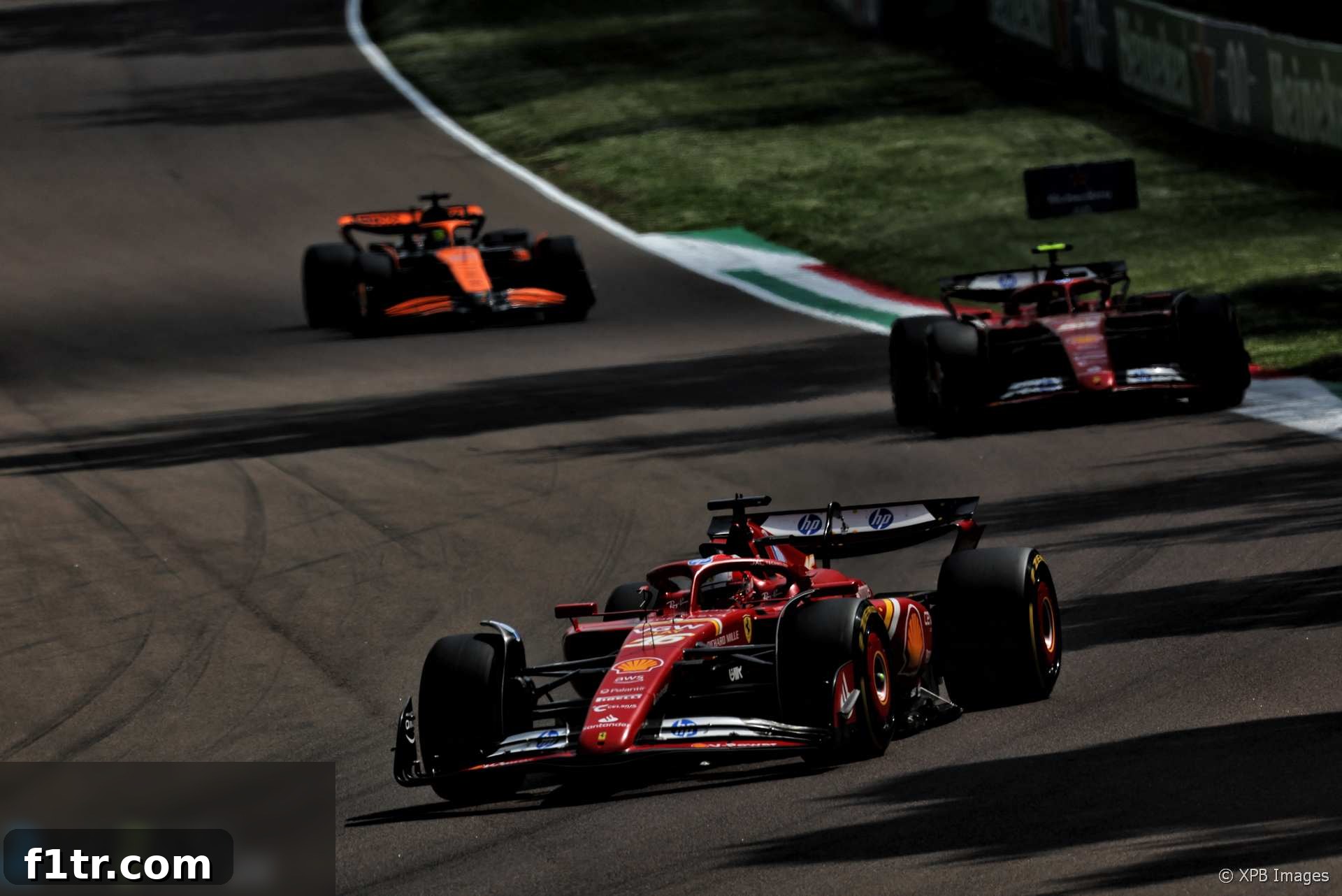
Charles Leclerc, the charismatic driver for Scuderia Ferrari, expressed a nuanced optimism following the Emilia-Romagna Grand Prix. While a podium finish at Imola, Ferrari’s home circuit, brought a measure of satisfaction, it was the underlying performance of the team’s extensively upgraded car that truly fueled his positive outlook for the upcoming races. The significant package of new parts, meticulously tested and integrated into the SF-24, demonstrated promising strides in competitiveness, particularly in race trim. However, Leclerc also highlighted a puzzling anomaly: the seemingly “weird” technique employed by rival teams, specifically McLaren and Red Bull, to boost their speed on the straights – an area Ferrari must now diligently investigate and counteract.
Ferrari’s Home Race: High Hopes and Crucial Upgrades at Imola
The Emilia-Romagna Grand Prix at Imola is always a momentous occasion for Ferrari. It’s not just another race on the calendar; it’s a pilgrimage for the Tifosi, a stage where the Prancing Horse is expected to gallop with pride and power. The build-up to this year’s event was particularly charged with anticipation, as Ferrari chose their home track to debut a substantial upgrade package. This wasn’t merely a minor tweak but a comprehensive overhaul aimed at unlocking greater potential from the SF-24, enhancing its overall balance, downforce, and speed.
The new components, which included modifications to the floor, bodywork, and wings, were put through their paces in pre-race testing, generating cautious optimism within the Maranello camp. The goal was clear: to close the gap to the dominant Red Bull and solidify their position ahead of McLaren in the Constructors’ Championship battle. The team knew that delivering a strong performance at Imola would not only appease the passionate home crowd but also serve as a crucial validation of their development direction for the remainder of the season.
Qualifying Insights and Race Day Performance
The initial signs from qualifying at Imola suggested an improved, albeit not yet perfect, step forward. Charles Leclerc initially qualified in fourth position, with his teammate Carlos Sainz Jnr securing fifth. A subsequent grid penalty for Oscar Piastri of McLaren elevated both Ferrari drivers one spot, placing Leclerc third and Sainz fourth on the starting grid. While not on the front row, this represented a tangible improvement over recent qualifying performances in China and Miami, where the team had struggled to extract maximum single-lap pace.
Race day, however, offered a more encouraging narrative, particularly regarding the car’s long-run performance. Leclerc’s second stint on hard tyres was a testament to the upgrades’ efficacy. He displayed remarkable pace, steadily closing the distance to Lando Norris, who was running ahead in second place. The momentum was building, and the prospect of challenging for a higher position seemed increasingly plausible. “We were very fast at the beginning of the stint with the hards,” Leclerc recalled, emphasizing the newfound strength of the SF-24 in race conditions. “I started to push to try and put some pressure on Lando.”
The intensity of the chase, unfortunately, culminated in a critical error for Leclerc. A momentary lapse of concentration at the challenging Variante Alta chicane caused him to make a mistake, costing him valuable time and disrupting his rhythm. This incident allowed Norris to pull away once more, extinguishing Leclerc’s immediate hopes of directly battling for the second position. Despite this setback, Leclerc managed to maintain his composure and cross the finish line in third, securing a valuable podium spot for Ferrari at their home race. “At least it’s a podium,” Leclerc acknowledged, his competitive spirit evident. “Of course, I’m only very happy when I win, and today, we didn’t quite make it.”
The Enigma of Straight-Line Speed: A “Weird” Advantage
While the overall race pace provided significant encouragement, Charles Leclerc’s post-race analysis pinpointed a specific, perplexing area where Ferrari remained at a disadvantage. This was not related to cornering speed or tyre degradation, which often dictates performance, but rather to a curious disparity observed on the straights. Leclerc’s deep dive into the telemetry and data from qualifying and the race revealed a consistent pattern: Ferrari was losing time to its key rivals, primarily McLaren and Red Bull, exclusively during the straight-line sections of the track.
This observation was particularly striking because it didn’t align with conventional explanations like tyre wear or general car balance issues. Had the deficit been in the corners, it might have suggested problems with aerodynamics or mechanical grip related to the new upgrades. Instead, the loss of time solely on the straights pointed towards a more specific and potentially technical advantage held by their competitors. “What makes me optimistic is that if I look back at the data, I thought we were losing in Turn 2, 3, 4, which would have been tyre related again. But it wasn’t the case,” Leclerc elaborated. “We lost everything in the straights.”
Leclerc, known for his meticulous approach to data analysis, didn’t shy away from speculating on the nature of this advantage. He described McLaren and Red Bull’s technique as “doing something weird with the energy, engine-wise.” This statement opens up a realm of possibilities related to sophisticated power unit management and deployment strategies. Modern Formula 1 engines feature complex Energy Recovery Systems (ERS) that harvest energy from both the turbocharger (MGU-H) and braking (MGU-K), deploying it strategically to boost acceleration and top speed. A “weird” technique could imply an optimized ERS deployment strategy, perhaps utilizing specific engine modes at precise moments or managing battery discharge rates in a way that maximizes straight-line thrust for longer durations than Ferrari currently achieves.
Another potential aspect could involve advanced aerodynamic solutions, such as ultra-efficient drag reduction systems (DRS) or subtle flow manipulation techniques that provide a disproportionate boost on the straights. Whatever the precise mechanism, this distinct advantage allows McLaren and Red Bull to pull away or defend more effectively on the faster sections of the track, even if Ferrari matches or surpasses them in the corners. Identifying and understanding this specific technical nuance will be paramount for Ferrari’s ongoing development.
Ferrari’s Path Forward: Analysis, Adaption, and Ambition
Despite the puzzle of their rivals’ straight-line speed, Charles Leclerc exuded confidence that Ferrari possesses the capability and resolve to find an answer. His belief stems from the fact that this identified weakness is a specific, technical challenge rather than a fundamental flaw in the car’s overall concept or the effectiveness of the recent upgrades. “We’ve got to look into it, but it’s nothing that is not possible to change,” Leclerc asserted, reflecting the team’s pragmatic approach to problem-solving. This sentiment underscores a crucial aspect of Formula 1 development: identifying precise areas of improvement allows for targeted engineering efforts, often yielding significant gains.
The immediate task for Ferrari’s engineers back at Maranello will be an intensive deep-dive into the vast amounts of data collected during the Imola weekend. This will involve comparing their power unit and aerodynamic data with that of Red Bull and McLaren, looking for subtle differences in energy deployment curves, engine mapping, and aerodynamic efficiency at various speeds. The goal is to demystify the “weird” technique and reverse-engineer a solution that can be integrated into the SF-24 in upcoming races.
Leclerc’s optimism is further buoyed by the overall positive impact of the upgrade package. The car felt more balanced, performed consistently over long stints, and allowed him to extract strong pace in the corners. These foundational improvements are critical. If Ferrari can maintain its enhanced cornering prowess and tyre management while simultaneously unlocking greater straight-line efficiency, they will truly be in a position to challenge for race victories consistently. “So, we’ll look into that, and once we fix that, I think we’ve got a real shot of going back on the top step for the podium,” Leclerc concluded, his words echoing the ambition that defines Scuderia Ferrari.
Implications for the Championship Battle
The insights gained from the Emilia-Romagna Grand Prix have significant implications for the unfolding 2024 Formula 1 season. Ferrari’s upgrades have clearly elevated their performance, solidifying their position as a formidable challenger. The fight for second place in the Constructors’ Championship with McLaren promises to be fierce, and the gap to Red Bull, while still present, appears to be shrinking. Leclerc’s ability to consistently challenge the front-runners, coupled with Sainz’s strong performances, positions Ferrari as a credible threat for both individual race wins and potentially a sustained championship challenge as the season progresses.
The ongoing technical battle at the pinnacle of motorsport is not just about raw speed but also about continuous innovation and adaptation. Ferrari’s proactive approach to development, demonstrated by the Imola package, shows their commitment to this arms race. The next few races will be crucial in demonstrating whether they can indeed unravel the mystery of their rivals’ straight-line advantage and translate their newfound overall pace into more victories.
The future of the 2024 F1 season promises an enthralling contest, with Charles Leclerc and Ferrari firmly in the thick of it, armed with a better car and a clear understanding of the challenges that lie ahead. Their determination to climb to the top step of the podium remains unwavering.
2024 Emilia-Romagna Grand Prix Analysis and Related Articles
- Ferrari expect qualifying gain after spotting rivals’ power strategy tactics
- How Alonso and Stroll copied Verstappen’s tactic plus more unheard Imola radio
- Verstappen beats Hamilton’s winning rate with Emilia-Romagna GP victory
- How Russell resisted losing position to Hamilton “for no reason” with extra stop
- “Lando’s found some pace”: Unheard radio from Verstappen-Norris Imola duel
Browse all 2024 Emilia-Romagna Grand Prix articles