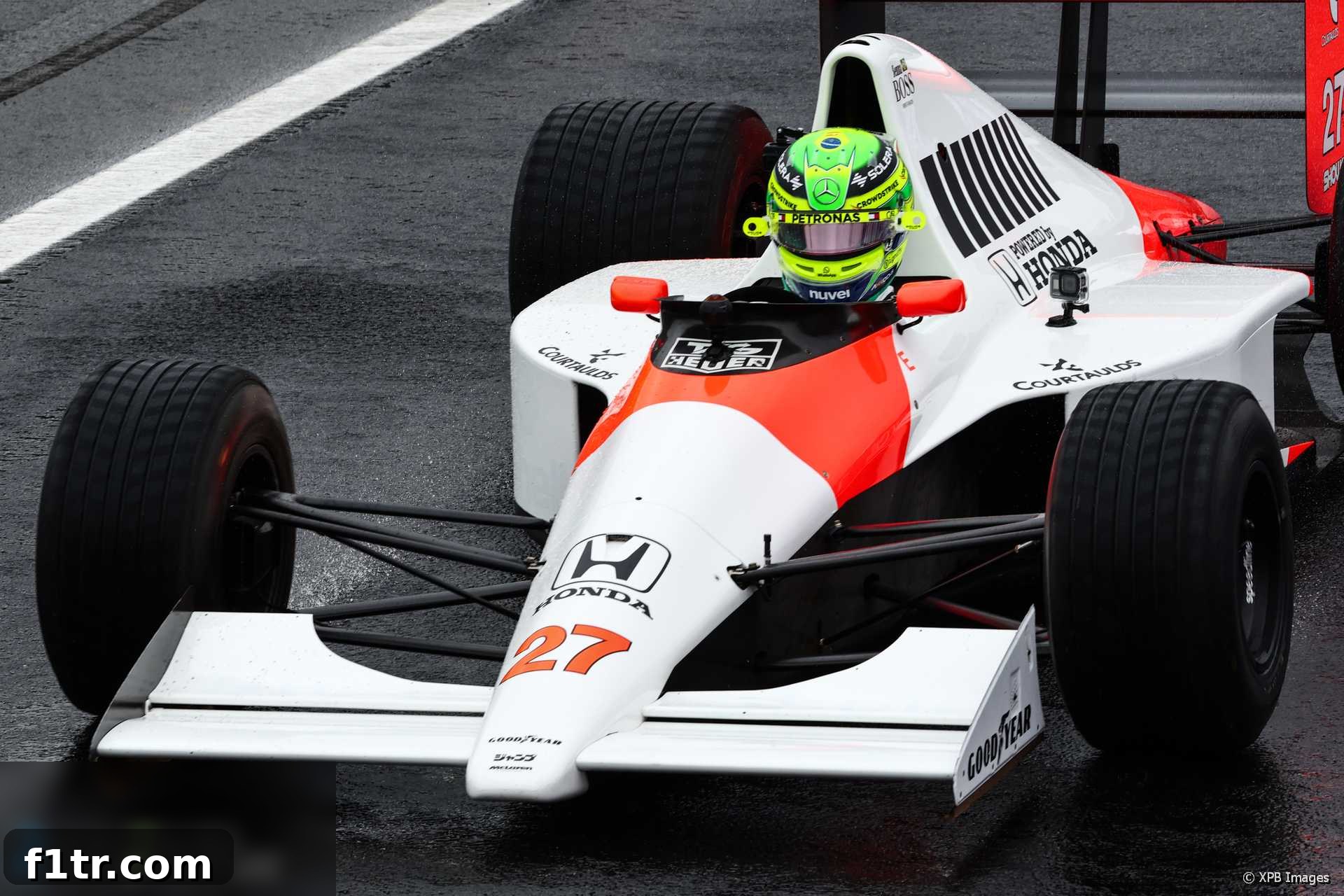
In a truly monumental moment that bridged eras and celebrated motorsport heritage, seven-time Formula 1 World Champion Lewis Hamilton took to the legendary Interlagos circuit in Brazil, demonstrating the iconic McLaren MP4/5B. This was the very machine driven by his childhood hero, the late, great Ayrton Senna, to his second Formula 1 World Championship title in 1990. The highly anticipated demonstration run occurred after today’s qualifying session for the Brazilian Grand Prix, captivating fans and rekindling the spirit of one of F1’s most revered figures.
For Hamilton, this wasn’t just another laps in a classic car; it was an deeply personal journey back to his formative years. “I couldn’t believe I just had the chance to do that,” Hamilton exclaimed after stepping out of the McLaren cockpit, his voice laced with emotion. “It was truly the greatest honour of my career.” His admiration for Senna, who tragically passed away 30 years ago at the San Marino Grand Prix, has always been profound, serving as a significant inspiration throughout Hamilton’s own illustrious career. Senna, a national hero in Brazil, clinched three world titles in 1988, 1990, and 1991, etching his name into the annals of Formula 1 history.
Advert | Become a Supporter & go ad-free
“It’s very, very emotional,” Hamilton continued, reflecting on the experience. “I was just revisiting my childhood as I was watching Ayrton race here as a kid.” The sentiment perfectly encapsulated the profound connection between the two sporting legends, transcending generations and highlighting the enduring impact of Senna’s legacy on current Formula 1 stars. This wasn’t the first time a contemporary champion has honored Senna in this way; earlier this year, Sebastian Vettel drove Senna’s final McLaren at Imola, the poignant scene of his last race. However, for Hamilton, driving Senna’s MP4/5B at Interlagos – a circuit intrinsically linked with Senna’s legend – carried an unparalleled significance.
The opportunity to drive such a revered piece of motorsport history was a dream come true for Hamilton. “I never in a million years thought I’d ever get to drive Senna’s car here,” he admitted on Thursday, just days before the demo run. “Someone contacted me, my manager told me about it, and I jumped at the opportunity.” This marked the second time Hamilton has had the privilege of driving one of his childhood hero’s iconic machines. “When I was at McLaren, I did get the chance to drive the MP4/4 around Silverstone, which was incredible,” he recalled, referring to the dominant 1988 car that Senna drove to his first championship.
While the MP4/4 is often lauded for its near-perfect season, the MP4/5B holds a special place in the hearts of many F1 aficionados. It represents a different chapter of Senna’s career, one characterized by intense rivalry and a fiercely competitive championship battle. The thought of bringing that car to Interlagos, a track where Senna created some of his most memorable moments, was overwhelming for Hamilton. “But the thought of driving that car around here… I remember the races where he was, when he finally won here and held the flag, and yeah, it will definitely be quite an emotional experience and I hope people are here to see it.” This statement underscored not just Hamilton’s personal connection, but also his understanding of what this moment meant to the legions of fans gathered at Senna’s home circuit.
Advert | Become a RaceFans supporter andgo ad-free
The McLaren MP4/5B: A Championship Pedigree
The McLaren MP4/5B was a masterpiece of engineering from a golden era of Formula 1. It was the evolution of the championship-winning MP4/5, and it continued McLaren and Honda’s incredible run of dominance. In the hands of Ayrton Senna, the MP4/5B secured six victories during the 1990 season, each a testament to his unparalleled skill and the car’s formidable performance. This machine was powered by the normally-aspirated 690bhp RA100E V10 engine, a marvel of Japanese engineering from Honda. This powerful engine delivered the fifth of six consecutive constructors’ titles powered by the Japanese manufacturer, cementing Honda’s status as a powerhouse in the sport.
The 1990 season was particularly memorable for its intense championship duel between Senna and his arch-rival, Alain Prost, who had moved to Ferrari. The rivalry culminated in a now-infamous incident at the penultimate race, the Japanese Grand Prix at Suzuka. Senna, starting from pole, deliberately drove into Prost’s Ferrari at the first corner, a move that secured him the drivers’ championship. This controversial moment remains one of the most talked-about events in F1 history, highlighting Senna’s fierce competitive spirit and his relentless pursuit of victory. The MP4/5B was not just a fast car; it was a character in one of Formula 1’s greatest narratives.
Interlagos: Senna’s Sacred Ground
The Interlagos circuit holds a special, almost sacred place in the heart of Brazilian motorsport and for Ayrton Senna himself. The 1990 Brazilian Grand Prix marked a significant return for the race to Senna’s home city of São Paulo, after relocating from Jacarepagua in Rio de Janeiro. While Senna had achieved global success, he was still yearning for his first victory on home soil. That 1990 race proved to be a frustrating affair; Senna led for a significant portion, only to throw away the lead just after half-distance when he collided with Satoru Nakajima while lapping the Tyrrell driver. It was a heart-breaking moment for the Brazilian crowd, but it only amplified their yearning for their hero’s eventual triumph.
Senna finally achieved his long-awaited first home victory at Interlagos in 1991, an emotional win where he famously battled an ailing gearbox in the final laps, demonstrating immense physical and mental fortitude. The iconic image of him, exhausted but triumphant, waving the Brazilian flag from the cockpit, is forever etched into motorsport memory. It is this profound connection to Interlagos, the circuit that witnessed both his struggles and his glorious triumphs, that made Hamilton’s demonstration run even more poignant. To drive the MP4/5B on these very asphalt veins, imbued with such rich history, was to truly walk in the footsteps of a legend.
A Driver’s Perspective: The H-Pattern Challenge
One of the most striking differences between the MP4/5B and modern F1 cars lies in its gearbox. While Ferrari had introduced semi-automatic gearboxes to F1 the year before, McLaren still employed an H-pattern manual shift in 1990. For Lewis Hamilton, who has only ever raced with sophisticated, wheel-mounted paddle-shift gearboxes in Formula 1, this presented a unique and exciting challenge. However, he expressed confidence in handling the MP4/5B’s transverse, six-speed gearbox, drawing on his early experiences.
“I’m always heel-and-toeing,” he said, referring to the technique of using the heel and toe of one foot to operate both the brake and accelerator pedals simultaneously while downshifting. “It used to be really good when I was younger, and when I did the MP4/4, I was able to do it back then.” This skill, crucial for maintaining balance and speed in older racing cars, is largely obsolete in modern F1. Hamilton’s enthusiasm for the manual process was palpable: “It’s something I miss. I wish we had that in Formula 1. I mean, the two-pedal thing is just not exciting, and they need to bring back the H-Box.” His comments spark a familiar debate among fans and drivers alike: the balance between technological advancement and raw, engaging driver skill in motorsport.
Advert | Become a RaceFans supporter andgo ad-free
Despite the wet conditions that prevailed at the Interlagos track during the demonstration, Hamilton’s run was reported to have gone smoothly, much to the delight of the passionate Brazilian crowd. His sheer joy and respect for the machine and the man it once carried were evident throughout. “I did one or two more laps than I was supposed to,” he admitted with a smile afterwards, a testament to how truly immersed he was in the moment, savoring every second behind the wheel of Senna’s championship-winning car. This demonstration was more than just a spectacle; it was a heartfelt tribute, a living connection to Formula 1’s glorious past, and a powerful reminder of the legends who continue to inspire.
Pictures: Hamilton in Senna’s 1990 McLaren MP4/5B
03.11.2024. Formula 1 World Championship, Rd 21, Brazilian Grand Prix, Sao Paulo, Brazil, Race Day.
– www.xpbimages.com, EMail: [email protected] © Copyright: Staley / XPB Images
03.11.2024. Formula 1 World Championship, Rd 21, Brazilian Grand Prix, Sao Paulo, Brazil, Race Day.
– www.xpbimages.com, EMail: [email protected] © Copyright: Charniaux / XPB Images
03.11.2024. Formula 1 World Championship, Rd 21, Brazilian Grand Prix, Sao Paulo, Brazil, Race Day.
– www.xpbimages.com, EMail: [email protected] © Copyright: Charniaux / XPB Images
03.11.2024. Formula 1 World Championship, Rd 21, Brazilian Grand Prix, Sao Paulo, Brazil, Race Day.
– www.xpbimages.com, EMail: [email protected] © Copyright: Charniaux / XPB Images
03.11.2024. Formula 1 World Championship, Rd 21, Brazilian Grand Prix, Sao Paulo, Brazil, Race Day.
– www.xpbimages.com, EMail: [email protected] © Copyright: Charniaux / XPB Images
Advert | Become a RaceFans supporter andgo ad-free
Miss nothing from RaceFans
Get a daily email with all our latest stories – and nothing else. No marketing, no ads. Sign up here:
2024 Brazilian Grand Prix Highlights
- “I didn’t really want to come back” – Hamilton explains cryptic Brazil radio message
- Ocon’s role in Gasly’s Q2 exit was almost another ‘flare-up’ at Alpine – Oakes
- Interlagos must improve “very bad” new track surface for 2025, say F1 drivers
- “That’s how we silence them”: Verstappen’s stunning Brazil win from start to finish
- Verstappen now has as many wins as F1’s first six world champions combined
Browse all 2024 Brazilian Grand Prix articles