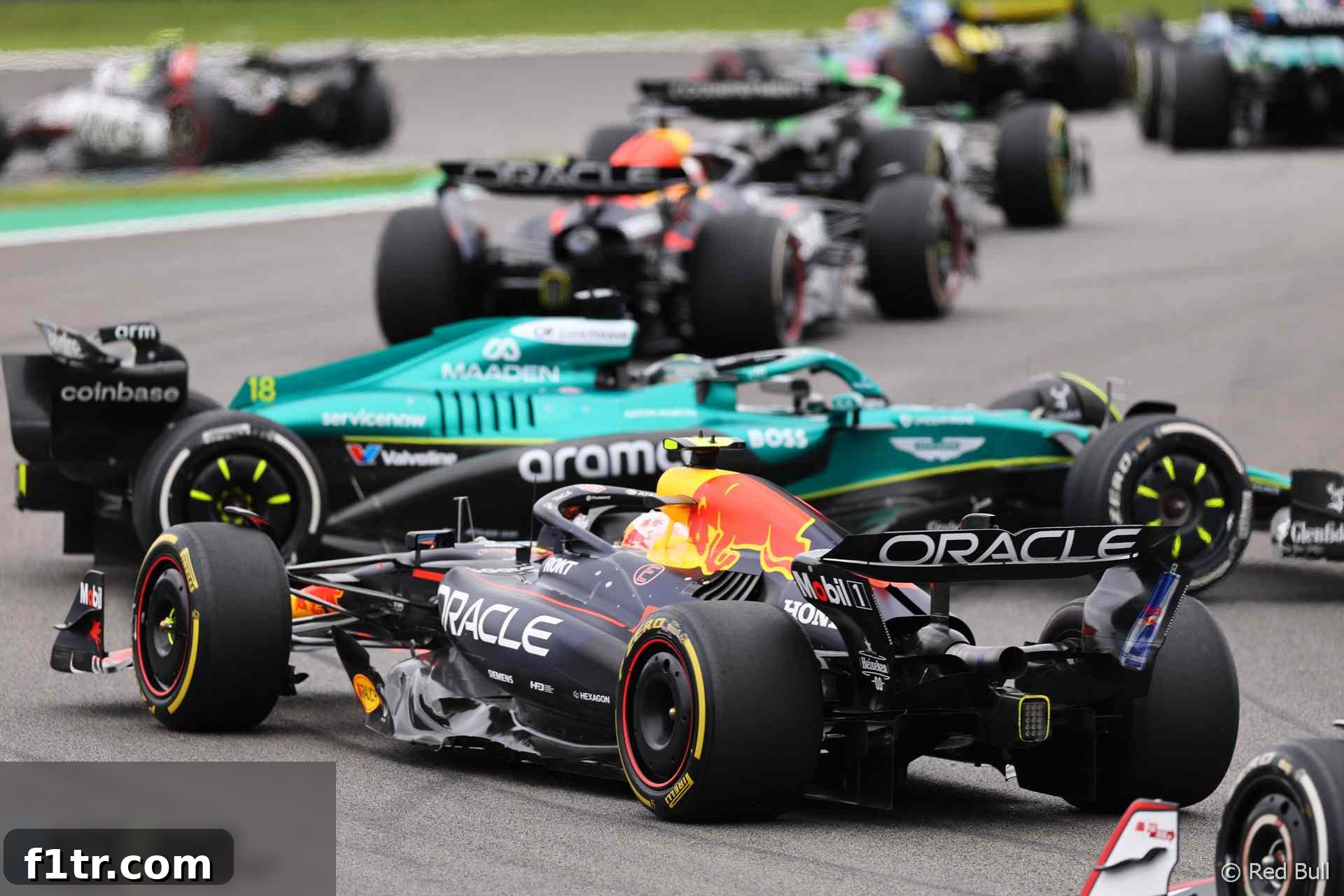
Yuki Tsunoda has found himself under increased scrutiny after a turbulent race saw him amass further penalty points, bringing his total to seven. The young driver was penalised twice during the event, initially for a collision with Lance Stroll and subsequently for an infraction during his pit stop, highlighting the FIA’s strict enforcement of Formula 1’s intricate regulations.
The incident that initiated Tsunoda’s woes occurred early in the race at the challenging Bico de Pato corner. The Red Bull driver, known for his aggressive style, attempted an ambitious move to overtake Franco Colapinto on the inside. However, his entry speed into the corner was judged to be excessive, leading him to run too deep. This misjudgment resulted in an unavoidable collision with Lance Stroll’s Aston Martin, sending the Canadian driver into a disruptive spin. The impact not only compromised Stroll’s race but also brought Tsunoda squarely into the crosshairs of the race stewards.
Advert | Become a Supporter & go ad-free
The stewards’ detailed investigation revealed that Tsunoda carried significantly more speed into the corner compared to the cars immediately around him. Their official report clearly outlined the sequence of events: “On lap six, car 22 [Tsunoda] approached turn eight carrying much more speed than the cars ahead, closed up on the inside behind car 18 [Stroll], and made contact with the rear of that car, causing a collision and forcing car 18 into a spin.” This comprehensive assessment left little room for doubt regarding culpability.
Following their review, the stewards concluded that “car 22 was wholly responsible for the incident, and the standard penalty for causing a collision was applied.” This standard penalty typically involves a time penalty during the race and the addition of penalty points to the driver’s Super Licence. In this instance, Tsunoda was handed a 10-second time penalty and two penalty points, increasing his career total to seven. This accumulation of penalty points is a significant concern for any Formula 1 driver, as it brings them closer to the threshold for a potential race ban, a deterrent designed to encourage consistent safe driving practices.
The FIA’s penalty point system is a critical component of maintaining discipline and safety in Formula 1. Each driver holds a Super Licence, and accumulating 12 penalty points within a 12-month period automatically triggers a one-race ban. Points remain on a driver’s licence for precisely 12 months from the date they were incurred, after which they are removed. Reaching seven penalty points, as Tsunoda now has, places a driver in a precarious position for the remainder of their active 12-month period, requiring exceptional caution in subsequent races to avoid further sanctions. This system acts as a constant reminder for drivers to race aggressively but within the boundaries of fair play and safety, ensuring that repeated infringements are met with escalating consequences.
However, Tsunoda’s day of tribulations was far from over. In an unfortunate turn of events, his team subsequently failed to correctly serve the initial 10-second time penalty during his routine pit stop. The specifics of the violation were meticulously detailed by the stewards: “While the car was stationary for the purpose of serving the penalty, a mechanic immediately began working on the car by loosening the left rear wheel nut with a wheel gun before the 10 seconds had elapsed.” This seemingly minor action, a fraction of a second too early, constitutes a serious breach of the FIA Formula One Sporting Regulations.
Article 54.4 c) of the FIA Formula One Sporting Regulations explicitly states that “no work may be carried out on a car while a time penalty is being served.” To eliminate any ambiguity, the regulations further clarify that “any physical contact with the car, whether by hand, tool or equipment, constitutes ‘working’ on the car.” This rule is rigorously enforced to prevent teams from gaining an unfair advantage by performing maintenance or adjustments during a period meant solely for serving a penalty. The underlying principle is to ensure that a time penalty is a genuine hindrance to a driver’s race, not an opportunity for covert mechanical work. For instance, if a team could change tires or make minor adjustments during a 10-second stop, it would effectively negate part of the penalty’s punitive effect, creating an uneven playing field.
As the mechanic initiated work before the prescribed penalty period had fully elapsed, the stewards deemed that the initial penalty had “not been served correctly.” This procedural error led to the imposition of an additional 10-second time penalty for Tsunoda. While he ultimately served this second penalty successfully during a subsequent pit stop, the compounded penalties severely hampered his race performance and any hopes of scoring points. The double setback underscored the immense pressure on both drivers and their pit crews to meticulously adhere to every facet of the complex F1 rulebook, where even a momentary lapse can lead to significant repercussions.
For Yuki Tsunoda, this series of events adds another layer of challenge to his Formula 1 career. Known for his raw speed and aggressive racing, these incidents highlight areas where greater discipline and precision are required. Accumulating seven penalty points places him on a watch list, making every subsequent race crucial in avoiding a potential ban. Such situations can exert considerable psychological pressure on a driver, influencing their on-track decisions and potentially tempering their natural racing instincts. Teams also face scrutiny when procedural errors occur, reinforcing the importance of rigorous training and flawless execution in the high-stakes environment of Formula 1.
Penalty Box: Weighing the Stewards’ Decisions
The dual penalties levied against Yuki Tsunoda sparked considerable debate among fans and pundits alike. Were the stewards justified in their assessments of both the on-track collision and the pit lane infringement? The strict application of Article 54.4 c) often divides opinion, with some arguing for absolute adherence to the rules, regardless of the perceived minor nature of the infringement, while others might advocate for a degree of common sense or leniency in the heat of a Grand Prix. The incident with Lance Stroll also ignites discussions about aggressive driving versus reckless driving, and where the line should be drawn in competitive motorsport. We invite you to cast your vote on whether the penalties were appropriate and share your perspectives in the comments section below. Your insights contribute to the vibrant discourse surrounding Formula 1’s officiating decisions.
A RaceFans account is required in order to vote. If you do not have one, register an account here or read more about registering here. When this poll is closed the result will be displayed instead of the voting form.
Advert | Become a RaceFans supporter andgo ad-free
Miss nothing from RaceFans
Get a daily email with all our latest stories – and nothing else. No marketing, no ads. Sign up here:
2025 Brazilian Grand Prix
- 2026 rules will stop F1 teams making “strategic” engine changes for performance
- Tsunoda admits he could have “easily” scored points in Brazil
- Top 10: Most controversial penalty calls during a Formula 1 title fight
- Verstappen is eighth F1 driver to race from pits to podium: Brazilian GP stats
- Verstappen’s latest setback makes this season look even more like a 2007 repeat
Browse all 2025 Brazilian Grand Prix articles