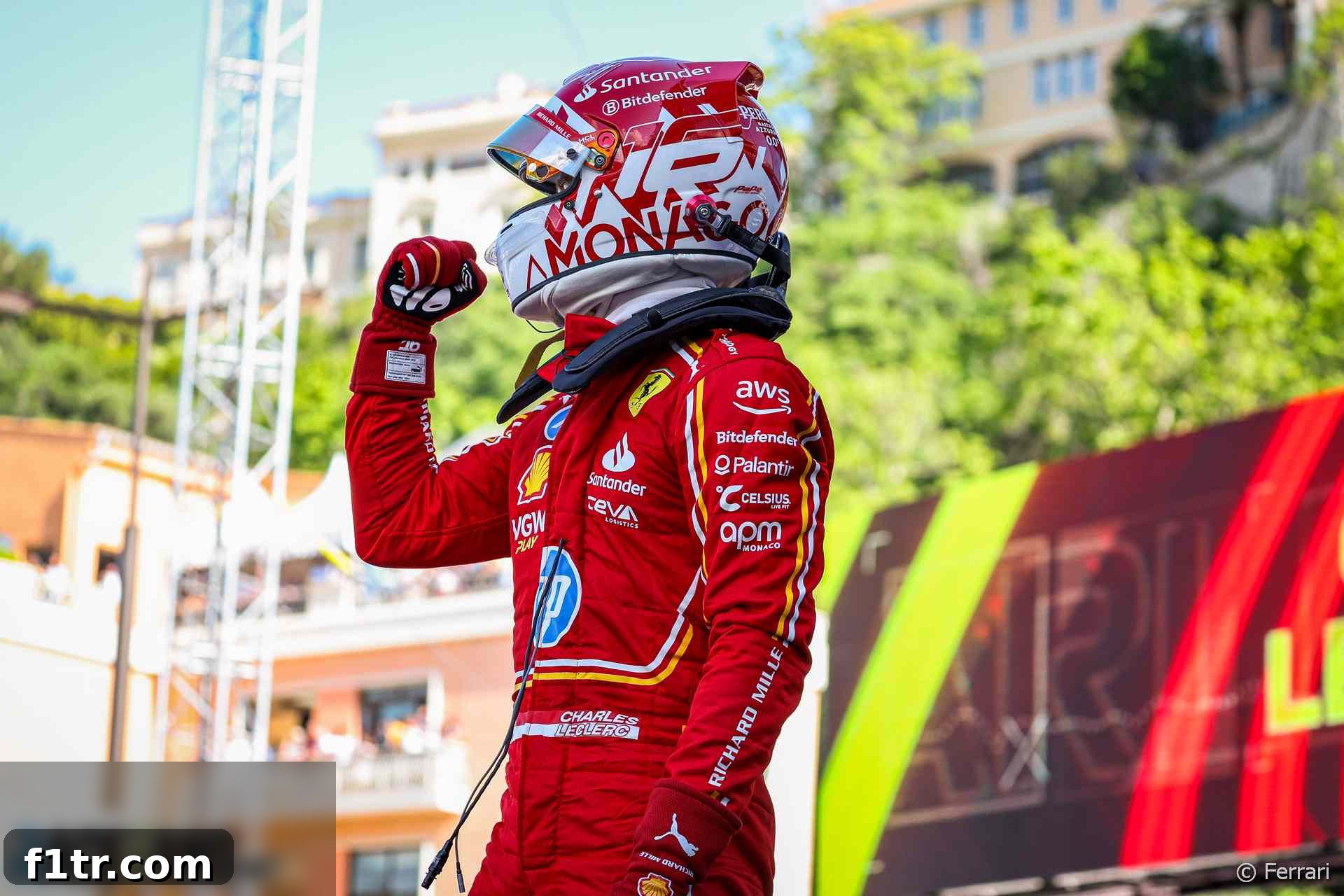
Charles Leclerc, the Monegasque sensation driving for Ferrari, anticipates a distinct shift in atmosphere for the Monaco Grand Prix race day, expecting it to be “more relaxed” following the intense, high-stakes qualifying session. This sentiment comes after a pivotal Saturday where he masterfully secured pole position for his home race, a feat he has now accomplished three times in the last four events held on the principality’s iconic streets.
Advertisement
Your support helps us deliver quality motorsport content.
Despite his undeniable pace and consistent pole positions at Monaco, a victory at his home circuit has famously eluded Leclerc. This unique and somewhat frustrating track record has led to speculation about additional pressure, yet the Ferrari ace remains resolute, dismissing any notion of feeling extra burden this time around. His focus, he asserts, is purely on execution and delivering a strong performance.
The Unparalleled Intensity of Monaco Qualifying
“I think the peak of the tension, not just for this weekend but potentially for the entire season, is undoubtedly experienced during qualifying in Monaco,” Leclerc articulated. He elaborated on the psychological distinction between Saturday’s single-lap pursuit of perfection and Sunday’s strategic endurance test. “While it’s not accurate to say you’re completely relaxed for the race, there’s certainly a different kind of calm. On race day, the primary focus shifts to critical moments like the start and the pivotal laps surrounding the pit stops, which are incredibly important for track position.”
The streets of Monaco offer virtually no room for error, and overtaking opportunities are notoriously scarce, making pole position a significant advantage, often considered half the battle won. This stark reality amplifies the pressure on drivers during qualifying, as even a minor mistake can prove catastrophic. Leclerc acknowledges this, stating, “Qualifying in Monaco represents a massive part of the job here. It’s true that in previous years, we haven’t achieved the success we desired, but I’ve made a conscious decision not to dwell on that past any longer. I’m genuinely confident that this weekend will be a successful one for us.” His declaration reflects a mature mindset, keen to break the ‘Monaco curse’ that has plagued his previous attempts.
Converting Practice Pace into Pole Position
Leclerc also shed light on the immense weight of expectation that built up after his impressive performances in the practice sessions. Having consistently topped the timings in two of the three free practice sessions leading into qualifying, the pressure to convert that raw speed into pole position was palpable. Fans, media, and the team all looked to him to deliver what seemed inevitable.
“When you’ve had such a strong showing in FP1, FP2, and FP3, you enter qualifying knowing that you have everything to lose,” Leclerc explained candidly. “There’s a distinct feeling that if you fail to secure pole position after demonstrating that level of pace, you risk looking completely foolish. That psychological burden was certainly substantial, but we managed to execute when it mattered, which was incredibly satisfying.” This illustrates the razor-thin margin between triumph and perceived failure in Formula 1, especially for a driver of Leclerc’s calibre, competing at his home circuit with a competitive car.
Advertisement
Support independent motorsport journalism.
Navigating Pre-Qualifying Challenges: An Unexpected Engine Change
Adding another layer of stress to an already high-pressure scenario, Leclerc’s preparation for qualifying was unexpectedly disrupted. The Ferrari team discovered an issue with his engine shortly before the session was due to begin, necessitating a last-minute change. This unforeseen hurdle could easily have unsettled a driver, but Leclerc demonstrated remarkable composure.
“The eleventh-hour engine change certainly didn’t contribute to a sense of calm,” he admitted. “It introduced an additional element of tension and uncertainty as we headed into qualifying.” Such an event, even if managed flawlessly by the team, can sow seeds of doubt about reliability and potentially impact a driver’s mental rhythm. However, Leclerc’s ability to compartmentalize and focus despite this significant distraction speaks volumes about his mental fortitude and the trust he places in his team.
The Zone: Finding Focus Behind the Wheel

Despite the external pressures and pre-session anxieties, Leclerc described a profound transformation once he was strapped into the cockpit. “Once you’re actually in the car, you genuinely feel incredibly good,” he elaborated. “Or at least, I personally felt an immediate sense of calm and everything external just faded away.” This phenomenon is often described by elite athletes as entering a “flow state,” where complete immersion in the task at hand overrides all other thoughts and sensations.
He further distinguished the periods of tension: “The more challenging period is actually the two hours between the end of FP3 and the start of qualifying. That’s when the tension really starts to build, as you know you need to meticulously prepare everything, anticipate potential changes in track conditions, and process all the data. But the moment I put on my helmet and settle into the car, I’m completely fine; I genuinely don’t feel any of that pressure anymore.” This insight highlights the dual challenge faced by F1 drivers: mastering the intricate mental preparation outside the car, and then achieving a state of pure, unadulterated focus once inside it.
Mastering Monaco’s Evolving Conditions: A Technical Challenge
Leclerc’s pole-winning lap was nothing short of spectacular, clocking in at just a tenth of a second slower than the quickest-ever lap recorded on this particular configuration of the Monaco circuit. While the car felt progressively better throughout the session, adapting to the ever-changing track conditions proved to be a significant challenge for the Ferrari team and driver.
“What we found most difficult to counter as we approached qualifying, and something that is typically challenging to anticipate under new conditions, is how the track evolves,” Leclerc explained. “Specifically, one thing you can’t fully predict is the consequence of carrying greater speed through a corner. In Monaco, with its inherent bumps, this increased speed leads to more significant wheel lift. The amount of time the wheels spend in the air, not touching the ground, increases considerably compared to FP3 due to the higher cornering speeds.”
This technical nuance is crucial at a circuit like Monaco, where precision and consistent grip are paramount. When the wheels lift, the car temporarily loses aerodynamic and mechanical grip, making it incredibly difficult to maintain a consistent balance and extract maximum performance. “That made it considerably trickier to accurately feel the car’s balance and consistently drive on the absolute limit,” Leclerc admitted, acknowledging a slight dip in his own consistency during certain parts of qualifying.
Advertisement
Support quality motorsport content.
Fine-Tuning and Aggression: Finding the Edge
To counteract these challenging conditions and regain optimal balance, Leclerc and his team made strategic adjustments. “I subsequently opted to be a bit more aggressive with the front wing settings, aiming to generate more front-end load and assist with turn-in and grip. This adjustment proved beneficial and improved the car’s behaviour,” he noted. Such fine-tuning during critical qualifying moments underscores the intricate relationship between driver feedback, engineering expertise, and real-time decision-making that defines Formula 1.
Despite the hurdles, Leclerc remained confident in his machinery. “As I mentioned, the car felt at its absolute best during FP2 and FP3. However, even in qualifying, it was still exceptionally strong and ultimately proved to be the fastest package out there. We undoubtedly possess a fantastic car, but it was certainly a trickier session to stitch everything together perfectly. Nevertheless, I am extremely pleased that we managed to deliver when it counted in Q3, securing that crucial pole position.” This ability to overcome adversity and extract maximum performance under pressure is a hallmark of champions, and Leclerc’s performance in Monaco qualifying certainly demonstrated that trait.
Support Independent Motorsport Journalism
Providing in-depth analysis and timely updates requires significant resources. Your contributions help cover the costs of creating, hosting, and continually developing high-quality motorsport content for fans worldwide.
By becoming a supporter, you can help ensure the continued delivery of comprehensive and ad-free reporting. Find out more about how you can contribute via the links below:
- Learn More About Becoming a Supporter
- Supporter FAQ
Looking Ahead: The 2024 Monaco Grand Prix
As Charles Leclerc prepares for the race, the anticipation builds for whether he can finally convert his pole position into a maiden victory at his home Grand Prix. The history of Monaco, combined with Leclerc’s past misfortunes, sets the stage for a dramatic and potentially career-defining race. All eyes will be on the Ferrari driver as he navigates the tight streets, aiming to break the curse and deliver a long-awaited triumph.
- Formula 1 will fix red flag rule loophole which ruined Monaco GP – Domenicali
- Magnussen ‘could have backed off but didn’t’ in Monaco crash, says team boss
- Ocon defends his driving after ‘hurtful abuse’ over Monaco GP crash with Gasly
- How the midfield’s hottest team mate rivalry boiled over
- “He’s really dangerous”: Unheard driver radio from F1’s slow show in Monaco
Browse all 2024 Monaco Grand Prix articles