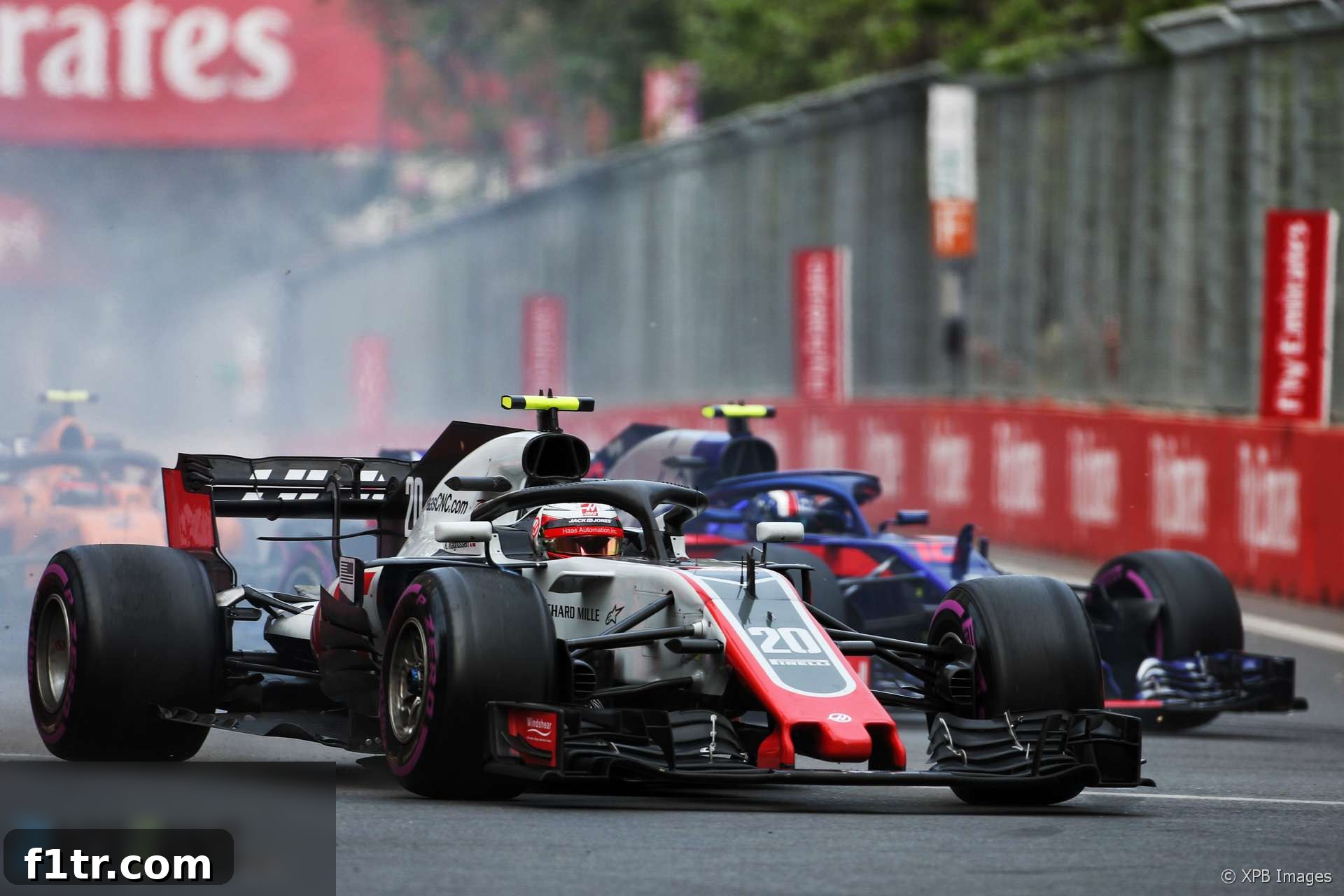
Pierre Gasly, then driving for Toro Rosso, did not mince words when describing Haas F1’s Kevin Magnussen, branding him “the most dangerous driver” he had ever competed against following a dramatic high-speed collision at the Azerbaijan Grand Prix. The incident, which occurred during a crucial restart phase of the race, left Gasly’s car significantly damaged and fueled a broader debate about aggressive driving standards in Formula 1.
The fiery exchange unfolded on the challenging streets of Baku, a circuit renowned for its unique blend of blistering straights and tight, technical sections. It was precisely on one of these high-speed sections, where cars routinely exceed 300 kilometers per hour, that the two drivers made contact. The impact was significant, ripping off part of Gasly’s floor and severely compromising the handling of his car, effectively ending any hopes he had of scoring points in a race that had already seen its fair share of drama and unpredictability.
The High-Speed Collision: A Moment of Controversy
“Kevin is the most dangerous guy I have ever raced with,” a visibly frustrated Gasly stated to the media after the checkered flag. His condemnation was unequivocal: “He literally put me in the wall at 300kph at the restart and completely ruined my race.” The restart in question was one of several during the chaotic Azerbaijan Grand Prix, a race punctuated by multiple Safety Car deployments, which often lead to intense wheel-to-wheel battles as drivers vie for position. This particular restart saw Gasly aggressively challenging Magnussen for what was then the final points-scoring position, P10, adding significant stakes to their on-track duel.
Gasly detailed the sequence of events leading up to the collision, emphasizing his intent to complete the overtake before the Safety Car line. “We were P11 so I knew points was on the table. I was going to pass him just before the Safety Car line one, I went on the side and he just put me in the wall right in the middle and took half of my floor out. Both my front wheels went in the air and I broke my right mirror and bent my steering as well.” The extensive damage described by Gasly underscored the severity of the contact, which transformed his race from a potential points finish into a desperate struggle for survival. “After that, I was just trying to survive until the end of the race. There was no point to race after that,” he conceded, painting a grim picture of the remainder of his grand prix.
Magnussen’s Reputation and Gasly’s Skepticism
Kevin Magnussen has, throughout his Formula 1 career, earned a reputation as a fiercely aggressive driver, often pushing the limits of what is considered fair racing. This incident was not an isolated event, with other drivers frequently voicing concerns about his uncompromising style. Following the collision in Baku, Magnussen offered a defense, claiming that he was suffering from severe vibrations in his car and therefore might not have seen Gasly alongside him. However, Gasly was quick to dismiss this explanation, expressing deep skepticism regarding its veracity.
“He did all the race like this so he knew exactly what he was doing and he literally put me in the wall,” Gasly countered, implying that Magnussen’s actions were deliberate rather than an accidental consequence of technical issues. This sentiment echoes a broader perception among some drivers that Magnussen’s aggression sometimes crosses the line from hard racing into dangerous maneuvers. “He’s been always like this, he’s been always racing hard. I don’t mind racing drivers which are hard but like this is just way over the limit. You don’t put someone in the wall at 300kph.” Gasly’s comments highlighted the crucial distinction between robust, competitive racing and actions that pose a significant safety risk, especially at such extreme speeds.
Adding to the tension, this wasn’t the first skirmish between Gasly and Magnussen during the Azerbaijan Grand Prix weekend. The pair had another run-in during the first practice session at the very same point on the Baku circuit, suggesting a simmering rivalry or a recurring pattern in their on-track interactions. This history further fueled Gasly’s frustration and belief that Magnussen’s driving was intentionally reckless.
FIA’s Stance and the Stewards’ Decision
Despite the chorus of criticism leveled against Kevin Magnussen by Gasly and others, then-FIA Race Director Charlie Whiting maintained a pragmatic approach, preferring to evaluate each incident on its own merits rather than singling out a particular driver for pre-emptive special attention. “I tend to try to look at things in isolation,” Whiting stated, emphasizing the FIA’s commitment to objective adjudication based on the specifics of each racing incident. He affirmed the stewards’ decision regarding the Baku collision: “I think what Kevin did today was incorrect and he was duly penalised.”
Whiting also acknowledged Gasly’s additional complaints, particularly concerning Magnussen’s conduct immediately after the initial contact. “I think Pierre was complaining about was he appeared to have done it again after the first contact. I haven’t yet looked at the video but I will do when I go back.” This indicated a thorough review process by race control, aiming to ensure all aspects of the incident were considered before any final judgment or further action. The stewards, after reviewing the evidence, found Magnussen primarily at fault for the collision.
For his role in the incident, Kevin Magnussen received a 10-second time penalty, which was added to his race time. More significantly, he was also handed two penalty points on his super licence. This system is designed to penalize drivers for repeated infringements over a 12-month period. Gasly, still feeling the sting of the incident and potentially seeking a harsher review, indicated his intention to follow up with race control: “I will go to see Charlie and see my onboard [camera] and then after we’ll see if it’s only two.”
Implications of Penalty Points and Driving Standards
The accumulation of penalty points carries significant consequences for Formula 1 drivers. As it stood after the Azerbaijan Grand Prix, Kevin Magnussen had amassed eight penalty points on his licence within the preceding 12 months. This placed him perilously close to the threshold for a race ban. Under FIA regulations, any driver who reaches 12 penalty points within a 12-month period automatically receives a one-race suspension. This system underscores the FIA’s commitment to maintaining driving standards and ensuring driver safety, acting as a deterrent against consistently reckless or dangerous behavior on track.
The incident between Gasly and Magnussen in Baku highlighted the delicate balance between aggressive, hard racing—a hallmark of Formula 1 that fans often laud—and driving that crosses the line into being genuinely dangerous. F1 circuits, particularly street tracks like Baku with its concrete barriers and limited run-off areas, leave little margin for error, making driver conduct even more critical. The debate surrounding Magnussen’s style often pits his uncompromising approach against the safety concerns raised by his peers. While some commend his tenacity and refusal to yield, others argue that a more disciplined approach is necessary to prevent serious accidents.
Ultimately, the stewards’ decisions, backed by the FIA’s regulatory framework, serve as the arbiter in these disputes, attempting to enforce a standard of driving that promotes competitive racing while safeguarding the participants. The 2018 Azerbaijan Grand Prix incident remains a vivid example of the high-stakes, high-speed drama that defines Formula 1, and the perennial discussion surrounding where to draw the line between aggressive driving and outright dangerous conduct.
Related Articles from the 2018 F1 Season
- F1 feared “death knell” for Drive to Survive after Ferrari and Mercedes snub
- McLaren staff told us we were “totally crazy” to take Honda engines in 2018 – Tost
- ‘It doesn’t matter if we start last’: How Red Bull’s junior team aided Honda’s leap forward
- Honda’s jet division helped F1 engineers solve power unit problem
- McLaren Racing losses rise after Honda split
Browse all 2018 F1 season articles