2018 Japanese Grand Prix: Hamilton’s Dominance and Vettel’s Resilient Fastest Lap
The 2018 Japanese Grand Prix at the legendary Suzuka Circuit delivered a captivating spectacle of speed, strategy, and high-stakes drama that significantly shaped the Formula 1 World Championship narrative. Mercedes’ Lewis Hamilton showcased a masterclass in controlled aggression, dominating the race from pole position and leading every single lap. He was on the brink of achieving a coveted ‘grand slam’ – pole position, led every lap, win, and fastest lap – a rare feat in Formula 1. However, in a surprising turn of events in the closing stages, his championship rival, Sebastian Vettel, denied him the perfect weekend by snatching the fastest lap on the penultimate tour.
This race was more than just a battle for victory; it was a microcosm of the intense championship fight between Hamilton and Vettel. While Hamilton further solidified his lead, Vettel’s spirited comeback drive after an early incident, culminating in the fastest lap, offered a glimpse of his unwavering determination despite the mounting pressure.
Race Highlights and Key Incidents
Hamilton’s Untouchable Performance
From the moment the lights went out, Lewis Hamilton was in a league of his own. Starting from pole position, he converted it into a commanding lead, meticulously managing his tyres and pace throughout the 53-lap race. His Mercedes W09 performed flawlessly around the demanding Suzuka circuit, known for its high-speed corners and technical challenges. Hamilton’s ability to maintain a comfortable gap to his teammate Valtteri Bottas, who secured a strong second place, underscored Mercedes’ formidable package and Hamilton’s exceptional driving. His relentless consistency and precision were key to his unchallenged victory, which pushed him ever closer to securing his fifth World Championship title.
Vettel’s Collision and Recovery Drive
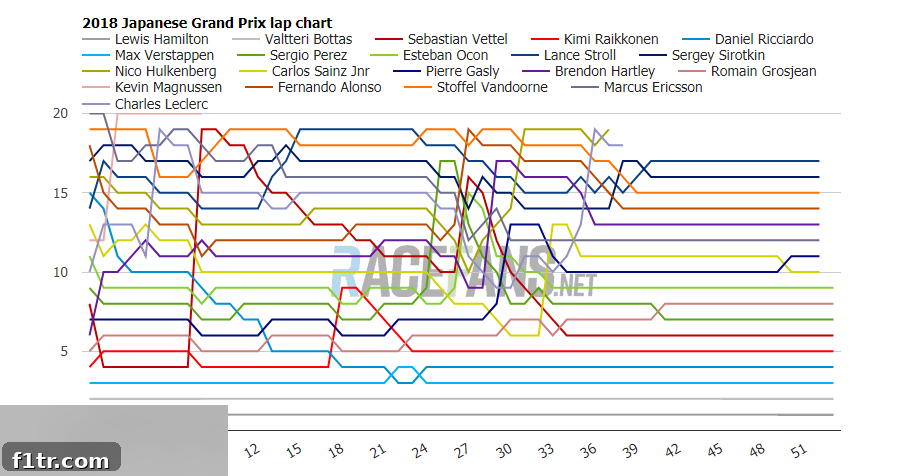
For Sebastian Vettel, the race took a dramatic turn early on. After a strong qualifying session, he started eighth due to a grid penalty for his Ferrari teammate Kimi Räikkönen. An ambitious move on Red Bull’s Max Verstappen on Lap 8 resulted in contact at the Spoon Curve. The collision sent Vettel spinning, dropping him to a disheartening 19th and last position. This incident, coming after a series of challenging races, seemed to dealt a severe blow to his already dwindling championship aspirations.
Despite the setback, Vettel demonstrated remarkable resilience. He embarked on an impressive recovery drive, skillfully navigating through the midfield. With the superior pace of his Ferrari, he steadily climbed up the order, executing several clean overtakes. By the checkered flag, he had recovered to a commendable sixth place, salvaging valuable points from what could have been a disastrous outing. His tenacity was further highlighted by his capture of the fastest lap of the race on the final lap, a strategic move that, while not affecting his own championship standing significantly, did deny his rival Hamilton a clean sweep.
Impact of the Virtual Safety Car
The Virtual Safety Car (VSC) period, triggered by Charles Leclerc’s retirement, played a crucial role in shaping the midfield battles and tyre strategies. While some drivers capitalized on the opportunity for a ‘cheap’ pit stop, others struggled with the restart and loss of tyre temperature. Pierre Gasly, for instance, was among those who found themselves on the back foot after the VSC, losing his position in the top 10 to Carlos Sainz Jnr. This period often serves as a critical juncture in Formula 1 races, testing a driver’s ability to adapt quickly and a team’s strategic acumen.
Comprehensive Race Data Analysis
The 2018 Japanese Grand Prix offered a wealth of data for enthusiasts to pore over, revealing the intricate details of driver performance, strategic decisions, and team efficiency. Below, we delve into various aspects of the race using detailed statistics.
Understanding Driver Progression: Lap and Race Charts
While dynamic interactive charts are not possible in this static HTML format, the underlying data provides profound insights. A comprehensive lap chart would visually depict the position of each driver on every single lap, offering a clear timeline of overtakes, falls, and steady climbs. Similarly, a race chart illustrating the gaps between drivers relative to the leader’s average lap time helps visualize how the field spread out or closed up over the course of the race, highlighting periods of intense competition or dominant control. These charts are invaluable tools for race analysis, showcasing the ebb and flow of a Grand Prix.
Position Change Across the Race
The following table summarizes how each driver’s position evolved from the start of the race to its conclusion, including any changes on the very first lap. This data highlights standout performances, particularly those drivers who made significant progress through the field.
| Driver | Start position | Lap one position change | Race position change |
|---|---|---|---|
| Lewis Hamilton | 1 | 0 | 0 |
| Valtteri Bottas | 2 | 0 | 0 |
| Sebastian Vettel | 8 | 4 | 2 |
| Kimi Raikkonen | 4 | -1 | -1 |
| Daniel Ricciardo | 15 | 1 | 11 |
| Max Verstappen | 3 | 0 | 0 |
| Sergio Perez | 9 | 1 | 2 |
| Esteban Ocon | 11 | 2 | 2 |
| Lance Stroll | 14 | -3 | -3 |
| Sergey Sirotkin | 17 | -1 | 1 |
| Nico Hulkenberg | 16 | 0 | |
| Carlos Sainz Jnr | 13 | 2 | 3 |
| Pierre Gasly | 7 | 0 | -4 |
| Brendon Hartley | 6 | -4 | -7 |
| Romain Grosjean | 5 | -1 | -3 |
| Kevin Magnussen | 12 | 0 | |
| Fernando Alonso | 18 | 3 | 4 |
| Stoffel Vandoorne | 19 | 0 | 4 |
| Marcus Ericsson | 20 | 0 | 8 |
| Charles Leclerc | 10 | -3 |
Notably, Daniel Ricciardo made a staggering 11-place gain from his 15th starting position, showcasing Red Bull’s raw pace and his own overtaking prowess. Marcus Ericsson also had a superb recovery, moving up 8 positions from the very back of the grid. Conversely, drivers like Brendon Hartley and Pierre Gasly experienced significant drops, reflecting the competitive nature of the midfield and the challenges faced by some teams.
Lap Times: A Window into Pace and Consistency
Analyzing individual lap times provides deep insights into a driver’s pace, consistency, and how they managed their tyres throughout the race. A detailed lap times chart would show how each driver’s performance fluctuated, whether due to tyre degradation, traffic, fuel load, or strategic calls. Such data is crucial for understanding who maintained strong pace in different stints and which moments proved challenging for various competitors.
The Significance of Fastest Laps
While often a point of pride, the fastest lap can also be strategically important. In 2018, it did not award an extra championship point, but it still represented a psychological victory. Here’s how the drivers stacked up in terms of their quickest laps during the Grand Prix:
| Rank | Driver | Car | Fastest lap | Gap | On lap |
|---|---|---|---|---|---|
| 1 | Sebastian Vettel | Ferrari | 1’32.318 | 53 | |
| 2 | Lewis Hamilton | Mercedes | 1’32.785 | 0.467 | 51 |
| 3 | Valtteri Bottas | Mercedes | 1’33.110 | 0.792 | 46 |
| 4 | Daniel Ricciardo | Red Bull-TAG Heuer | 1’33.187 | 0.869 | 50 |
| 5 | Lance Stroll | Williams-Mercedes | 1’33.354 | 1.036 | 41 |
| 6 | Max Verstappen | Red Bull-TAG Heuer | 1’33.367 | 1.049 | 50 |
| 7 | Fernando Alonso | McLaren-Renault | 1’33.943 | 1.625 | 28 |
| 8 | Sergey Sirotkin | Williams-Mercedes | 1’33.985 | 1.667 | 41 |
| 9 | Sergio Perez | Force India-Mercedes | 1’34.073 | 1.755 | 43 |
| 10 | Pierre Gasly | Toro Rosso-Honda | 1’34.133 | 1.815 | 35 |
| 11 | Carlos Sainz Jnr | Renault | 1’34.197 | 1.879 | 50 |
| 12 | Kimi Raikkonen | Ferrari | 1’34.223 | 1.905 | 28 |
| 13 | Charles Leclerc | Sauber-Ferrari | 1’34.515 | 2.197 | 37 |
| 14 | Esteban Ocon | Force India-Mercedes | 1’34.670 | 2.352 | 50 |
| 15 | Romain Grosjean | Haas-Ferrari | 1’34.786 | 2.468 | 47 |
| 16 | Brendon Hartley | Toro Rosso-Honda | 1’34.857 | 2.539 | 30 |
| 17 | Nico Hulkenberg | Renault | 1’34.934 | 2.616 | 32 |
| 18 | Stoffel Vandoorne | McLaren-Renault | 1’35.023 | 2.705 | 25 |
| 19 | Marcus Ericsson | Sauber-Ferrari | 1’36.294 | 3.976 | 8 |
| 20 | Kevin Magnussen | Haas-Ferrari | 1’39.908 | 7.590 | 6 |
Sebastian Vettel’s fastest lap on the very last lap (Lap 53) was a testament to his determination and Ferrari’s raw pace. It was a small but significant moment, preventing Hamilton from achieving the ultimate grand slam. Hamilton himself had set his fastest lap two laps prior, indicating his late push for the achievement, only to be outdone by his rival.
Tyre Strategies and Their Impact
Tyre management is often a decisive factor in Formula 1, and the 2018 Japanese Grand Prix was no exception. Teams adopted various strategies based on their starting positions, car characteristics, and anticipated race conditions. The Soft, Medium, and Super soft compounds were all in play.
| Stint 1 | Stint 2 | Stint 3 | |
|---|---|---|---|
| Lewis Hamilton | Soft (24) | Medium (29) | |
| Valtteri Bottas | Soft (23) | Medium (30) | |
| Max Verstappen | Super soft (21) | Soft (32) | |
| Daniel Ricciardo | Soft (23) | Medium (30) | |
| Kimi Raikkonen | Super soft (17) | Medium (36) | |
| Sebastian Vettel | Super soft (26) | Soft (27) | |
| Sergio Perez | Super soft (24) | Soft (29) | |
| Romain Grosjean | Soft (29) | Medium (24) | |
| Esteban Ocon | Super soft (26) | Medium (27) | |
| Carlos Sainz Jnr | Soft (32) | Medium (20) | |
| Pierre Gasly | Super soft (29) | Soft (23) | |
| Marcus Ericsson | Soft (5) | Medium (47) | |
| Brendon Hartley | Super soft (28) | Soft (24) | |
| Fernando Alonso | Soft (26) | Medium (26) | |
| Stoffel Vandoorne | Soft (23) | Medium (29) | |
| Sergey Sirotkin | Soft (4) | Medium (34) | Super soft (14) |
| Lance Stroll | Soft (14) | Medium (25) | Super soft (13) |
| Charles Leclerc | Soft (4) | Medium (31) | Soft (3) |
| Nico Hulkenberg | Medium (30) | Soft (7) | |
| Kevin Magnussen | Soft (2) | Medium (6) |
Most front-running teams opted for a one-stop strategy, typically starting on the Soft or Super soft compound and then switching to the more durable Mediums. Hamilton and Bottas, for example, successfully executed a Soft-to-Medium strategy. Drivers like Max Verstappen and Sebastian Vettel, starting on Super softs, had to manage their initial stint carefully before switching to the Soft compound. The VSC offered a strategic window for some, influencing when drivers made their stops and potentially allowing for a shorter stint on a faster tyre at the end of the race, as seen with some drivers who managed three stints like Sirotkin and Stroll.
Pit Stop Efficiency
A quick and clean pit stop is crucial in Formula 1, often making the difference between gaining or losing a position. The 2018 Japanese Grand Prix saw a range of pit stop times, reflecting both team efficiency and any unforeseen issues.
| Driver | Team | Pit stop time | Gap | On lap | |
| 1 | Lewis Hamilton | Mercedes | 22.614 | 24 | |
| 2 | Sebastian Vettel | Ferrari | 22.748 | 0.134 | 26 |
| 3 | Valtteri Bottas | Mercedes | 22.777 | 0.163 | 23 |
| 4 | Kimi Raikkonen | Ferrari | 22.781 | 0.167 | 17 |
| 5 | Daniel Ricciardo | Red Bull | 22.864 | 0.250 | 23 |
| 6 | Brendon Hartley | Toro Rosso | 23.110 | 0.496 | 28 |
| 7 | Stoffel Vandoorne | McLaren | 23.159 | 0.545 | 23 |
| 8 | Marcus Ericsson | Sauber | 23.244 | 0.630 | 5 |
| 9 | Esteban Ocon | Force India | 23.316 | 0.702 | 26 |
| 10 | Pierre Gasly | Toro Rosso | 23.376 | 0.762 | 29 |
| 11 | Carlos Sainz Jnr | Renault | 23.477 | 0.863 | 32 |
| 12 | Nico Hulkenberg | Renault | 23.555 | 0.941 | 30 |
| 13 | Sergio Perez | Force India | 23.635 | 1.021 | 24 |
| 14 | Sergey Sirotkin | Williams | 23.647 | 1.033 | 38 |
| 15 | Lance Stroll | Williams | 23.657 | 1.043 | 14 |
| 16 | Sergey Sirotkin | Williams | 23.660 | 1.046 | 4 |
| 17 | Romain Grosjean | Haas | 23.692 | 1.078 | 29 |
| 18 | Charles Leclerc | Sauber | 26.672 | 4.058 | 35 |
| 19 | Fernando Alonso | McLaren | 27.454 | 4.840 | 26 |
| 20 | Max Verstappen | Red Bull | 28.789 | 6.175 | 21 |
| 21 | Kevin Magnussen | Haas | 29.007 | 6.393 | 2 |
| 22 | Lance Stroll | Williams | 29.804 | 7.190 | 39 |
| 23 | Charles Leclerc | Sauber | 38.891 | 16.277 | 4 |
Mercedes once again demonstrated their efficiency, with Lewis Hamilton’s pit stop being the quickest of the race. Ferrari also showed strong performance in the pits, with Vettel and Räikkönen close behind. However, some teams faced challenges, with Max Verstappen and Kevin Magnussen having notably slower stops, which undoubtedly impacted their race strategies and track positions. The much slower pit stop for Charles Leclerc on lap 4 highlights the kind of issues that can derail a driver’s race very early on.
Championship Implications and Conclusion
The 2018 Japanese Grand Prix served as a pivotal moment in the championship battle. Lewis Hamilton’s dominant victory extended his lead over Sebastian Vettel to a significant margin, placing him firmly on the cusp of his fifth World Championship title. While Vettel’s fastest lap offered a small consolation, the points gap became increasingly difficult to overcome with only a few races remaining in the season. The race at Suzuka highlighted Mercedes’ exceptional form and Hamilton’s consistency, while Ferrari faced continued pressure to close the performance gap and avoid further strategic or on-track errors.
Beyond the championship contenders, the race provided plenty of action in the midfield, with impressive recovery drives and intense wheel-to-wheel battles. Suzuka once again proved why it remains a favorite among drivers and fans alike, delivering a high-speed, challenging, and memorable Grand Prix.
Further Insights from the 2018 Japanese Grand Prix
For more detailed analysis and perspectives on this thrilling race, explore the following articles:
- 2018 Japanese Grand Prix team radio highlights
- 2018 Japanese Grand Prix Star Performers
- Mercedes take first back-to-back one-twos since 2016
- Top ten pictures from the 2018 Japanese Grand Prix
- Hamilton on cusp of fifth title as Vettel throws in the towel
Browse all 2018 Japanese Grand Prix articles
If you appreciate our detailed coverage and analysis of Formula 1 races, consider supporting our work. Your contribution helps us continue to deliver high-quality content and provides you with an ad-free experience. Find out more and sign up to go ad-free.