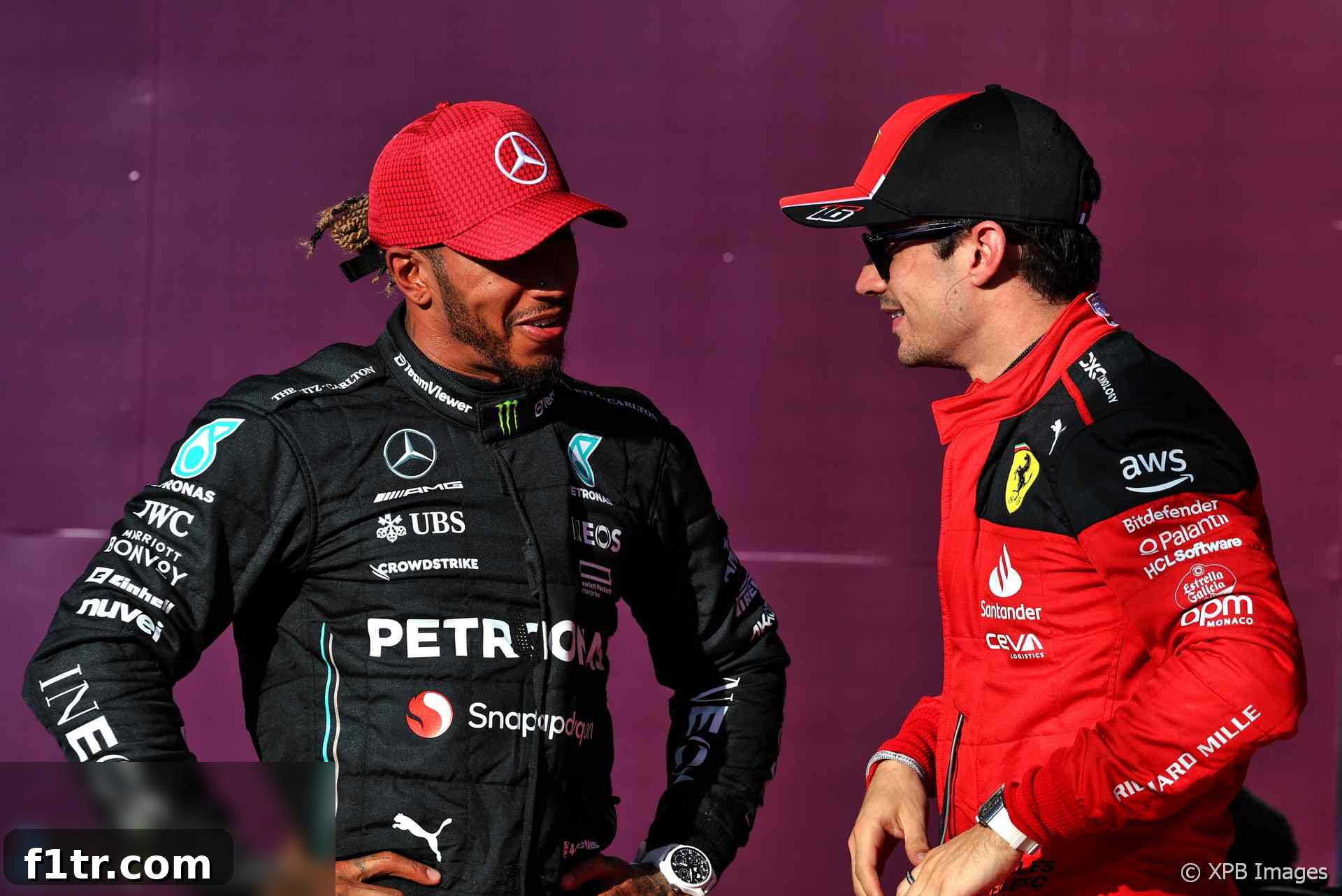
The 2023 Formula 1 United States Grand Prix in Austin, Texas, delivered an unexpected twist long after the checkered flag fell, as Mercedes’ Lewis Hamilton and Ferrari’s Charles Leclerc were dramatically disqualified from the race results. This stunning decision, stemming from post-race technical inspections, sent reverberations throughout the Formula 1 community, significantly altering the championship landscape and underscoring the FIA’s rigorous enforcement of technical regulations.
Following a thrilling race weekend at the Circuit of the Americas (COTA), the stewards confirmed that both Hamilton’s W14, which had initially crossed the line in a strong second position, and Leclerc’s SF-23, which secured sixth place, failed to comply with the stipulated minimum plank thickness requirements. This critical technical infringement, a non-negotiable aspect of Formula 1 car design and operation, led to their immediate exclusion from the official results, stripping both drivers and their respective teams of valuable points.
The Federation Internationale de l’Automobile (FIA) conducted detailed plank wear inspections on a select group of cars after the race. These targeted checks included the vehicles of Hamilton, Leclerc, race winner Max Verstappen of Red Bull, and McLaren’s Lando Norris. While only four cars were subjected to this specific scrutiny, the FIA clarified that such focused inspections are a standard part of their post-race compliance procedures. The rigorous examination uncovered that both the Mercedes and Ferrari entries had exceeded the permissible wear limits on their underbody planks, leading to one of the most impactful technical disqualifications in recent Formula 1 memory. The other classified finishers, including the teammates of Hamilton and Leclerc, were not indicated to have had their planks inspected in this specific manner.
The immediate consequence of these disqualifications was a significant reshuffle of the official race standings and, by extension, the Constructors’ and Drivers’ Championships. With Lewis Hamilton’s removal from second place, Lando Norris of McLaren was deservedly promoted to the runner-up spot, marking another impressive podium finish for the young British driver. Carlos Sainz Jnr, Charles Leclerc’s Ferrari teammate, inherited the final podium position, moving up to third. This elevation provided a crucial points boost for Sainz and Ferrari. Red Bull’s Sergio Perez also benefited, advancing to fourth place, collecting vital points in his ongoing battle for second in the Drivers’ Championship against Hamilton.
The impact of Leclerc’s disqualification also rippled through the midfield, granting several drivers a two-place promotion. Hamilton’s Mercedes teammate, George Russell, moved up to fifth place, salvaging a stronger points haul for Mercedes despite his teammate’s penalty. Alpine’s Pierre Gasly, Aston Martin’s Lance Stroll, and AlphaTauri’s Yuki Tsunoda each gained two positions, securing sixth, seventh, and eighth places respectively. These adjustments highlighted the critical nature of every single point in the fiercely competitive Formula 1 grid, where even minor changes can significantly influence championship positions and team standings.
Perhaps one of the most heartwarming stories to emerge from the revised results was for the Williams Racing team. Both of their drivers, who had initially finished outside the points, were elevated into the top ten. Alexander Albon moved up to ninth place, while American rookie Logan Sargeant was promoted to tenth. This momentous achievement meant that Sargeant officially scored the very first point of his Formula 1 career in front of his home crowd, a milestone that was initially denied but later confirmed. This single point was not only a personal triumph for Sargeant but also a valuable contribution to Williams’ Constructors’ Championship efforts, underscoring the broader implications of such technical scrutinies.
At the core of these significant disqualifications lies a fundamental piece of Formula 1 technical regulation: the wooden plank fitted to the underside of every car. This plank, often referred to as a “skid block,” was first mandated in 1994 by the FIA. Its introduction followed a period of escalating speeds and a series of high-profile accidents, prompting concerns over driver safety and the extreme aerodynamic performance achieved by running cars at excessively low ride heights. The primary objective of the plank is to act as a physical wear indicator, preventing teams from pushing their cars to ride heights that would generate maximum downforce but potentially compromise structural integrity, driver control, or create dangerous debris from the car’s floor. The regulations stipulate a minimum thickness for this plank, typically 10mm when new, and crucially, allow for a maximum wear of just 1mm during a race. Stewards meticulously measure the plank’s thickness before and after each event. If the wear exceeds the permitted tolerance, the car is deemed illegal, regardless of its on-track performance. This strict rule is a cornerstone of ensuring a level playing field and, more importantly, prioritizing driver safety by maintaining a minimum ground clearance and preventing the exploitation of extreme aerodynamic configurations.
The 2023 United States Grand Prix weekend at COTA presented unique challenges that likely contributed to these technical infringements. The Circuit of the Americas is renowned for its notoriously bumpy track surface, a characteristic that often forces teams to run slightly higher ride heights or adopt softer suspension settings to protect the car’s underbody. Adding another layer of complexity, the event was a Sprint weekend, which drastically reduced the available practice time for teams. With only a single free practice session before qualifying for both the Grand Prix and the Sprint race, engineers had a highly condensed window to fine-tune their car setups. This limited time made the task of optimizing ride height and suspension settings, balancing outright performance with strict compliance to the plank wear rule, exceptionally difficult. Both Mercedes and Ferrari team principals acknowledged these factors, suggesting that the aggressive nature of the COTA track combined with the restricted setup window pushed them to the very edge of the permissible limits, resulting in the unexpected and ultimately costly plank wear.
Such technical disqualifications, particularly involving leading teams and high-profile drivers like Hamilton and Leclerc, are relatively rare but not entirely unprecedented in the annals of Formula 1 history. The FIA maintains an unwavering stance on technical compliance, emphasizing that the rules are universally applied for fair competition and, paramountly, for the safety of all participants. The resolute enforcement of the plank wear rule sends a clear, unequivocal message across the paddock: even the slightest deviation from the technical regulations will not be overlooked, irrespective of a team’s heritage or a driver’s championship standing. This incident served as a potent reminder that success in Formula 1 is not solely about raw speed, strategic acumen, or driver talent; it also demands meticulous engineering, precise adherence to every letter of the rulebook, and the sophisticated ability to adapt to challenging track conditions without compromising legality. The integrity of the sport fundamentally rests on these stringent technical checks, ensuring that all competitors operate under the same clearly defined parameters, thereby preserving the fairness and intense competitive balance that defines elite motorsport.
The aftermath of the Austin disqualifications ignited considerable debate among fans, pundits, and within the wider Formula 1 community. While some sympathized with Mercedes and Ferrari, attributing the issue to the challenging COTA track and the restrictive sprint format, many lauded the FIA for its steadfast commitment to technical integrity. The incident reignited broader discussions about the complexity of Formula 1’s technical regulations, the razor-thin margins teams operate within, and the potential for unintended consequences in dynamic racing environments. For Mercedes and Ferrari, the loss of crucial championship points was a significant blow, impacting their standing in the Constructors’ Championship and, for Hamilton, his battle for second place in the Drivers’ standings. However, it also served as an invaluable learning experience, undoubtedly leading to more conservative and compliant setups in subsequent races, a strategic shift that was openly discussed by team principals concerning future approaches to ride height management.
In conclusion, the disqualifications of Lewis Hamilton and Charles Leclerc at the 2023 United States Grand Prix stand as one of the most defining and controversial moments of the season. It vividly underscored the relentless pursuit of performance within the strict confines of Formula 1’s technical rulebook, where even a millimeter of wear can mean the difference between triumph and disqualification. While undeniably disappointing for the affected drivers and teams, the FIA’s firm action reaffirmed the principles of fairness, safety, and regulatory adherence that form the bedrock of elite motorsport. The revised results offered unexpected joy for some, particularly Logan Sargeant, and provided a compelling narrative twist to the already enthralling 2023 Formula 1 World Championship, demonstrating that the race isn’t truly over until the final technical checks are complete.
Advert | Become a RaceFans supporter andgo ad-free
2023 United States Grand Prix: Further Reading & Analysis
- US GP was Mercedes’ best race of 2023 despite disqualification – Wolff
- Singapore and Austin retirements cost me top 10 championship place – Ocon
- United States Grand Prix result unchanged as FIA rejects Haas’ call for review
- Sargeant admits he’s ‘struggled to use all the downforce at times’ in F1
- Mercedes’ Brazilian GP set-up was “conservative” after US GP disqualification
Browse all 2023 United States Grand Prix articles