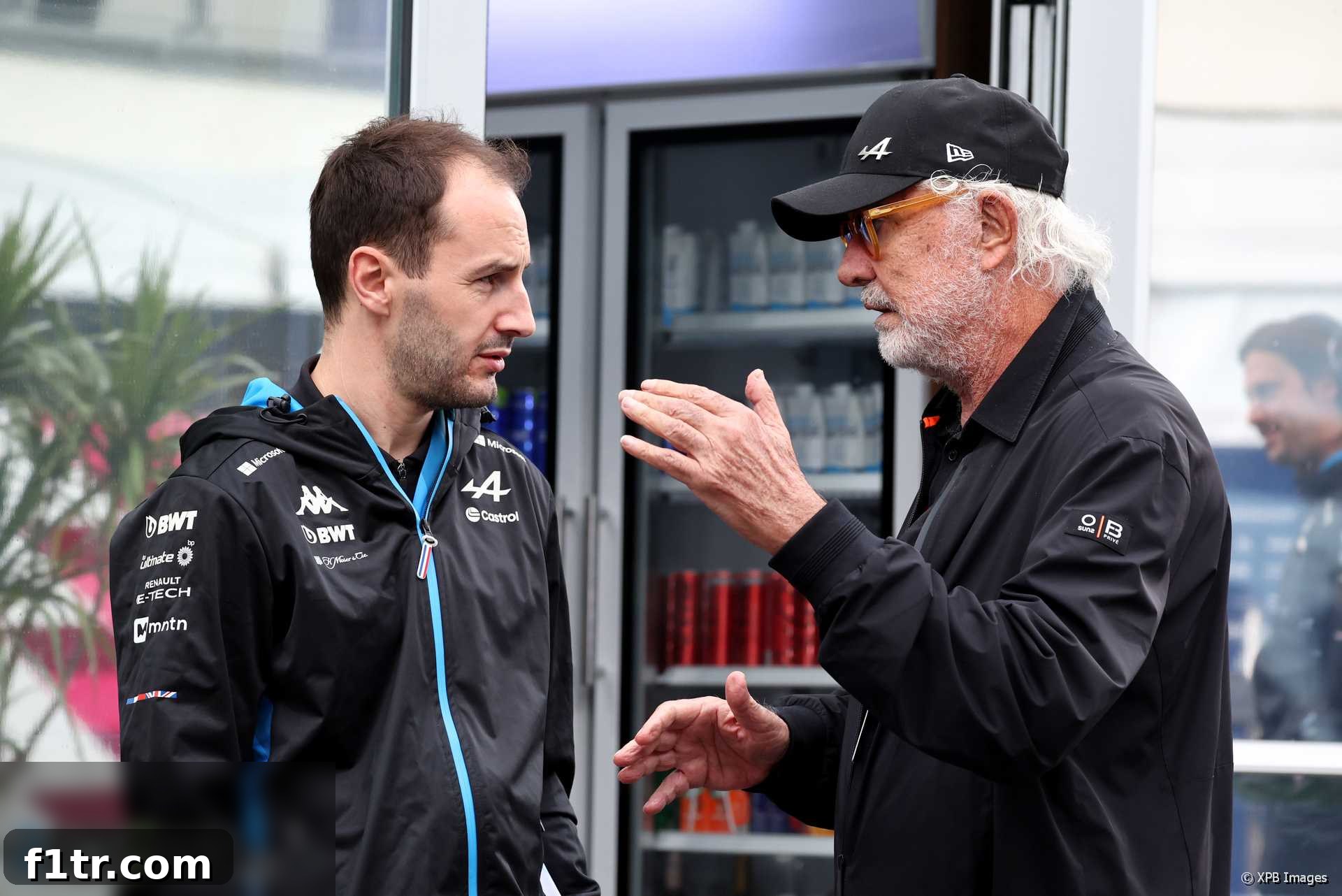
In a significant and immediate development at the heart of the BWT Alpine Formula 1 Team, Oliver Oakes has announced his resignation as Team Principal. The departure, effective immediately, marks the end of a brief nine-month tenure for Oakes, who had taken over from Bruno Famin at the close of the previous year. This latest change signals a new phase for the French-Anglo outfit, as executive advisor Flavio Briatore steps into a more prominent operational role, absorbing Oakes’ former responsibilities.
Advert | Become a Supporter & go ad-free
Alpine issued a concise statement on Tuesday evening confirming the news. “BWT Alpine Formula 1 Team announces that Oliver Oakes has resigned from his role as team principal,” the statement read. “The team has accepted his resignation with immediate effect.” The communication also clarified Briatore’s expanded duties: “The team said its executive advisor Flavio Briatore will also be covering the duties previously performed by Oliver Oakes in addition to his existing role.” Alpine extended its gratitude to Oakes, acknowledging his efforts since joining last summer and his contribution to the team’s efforts in securing sixth place in the 2024 constructors’ championship standings. The team concluded its statement by indicating that no further comments would be made on the matter.
Oliver Oakes’ Brief Stint and Alpine’s Ongoing Management Flux
Oliver Oakes’ arrival at Alpine was met with considerable anticipation. Having previously established a strong reputation in junior categories with his Hitech outfit – a team competing successfully in Formula 2, Formula 3, and other developmental series – Oakes brought a wealth of experience in nurturing talent and building competitive structures. His Hitech team had even made an unsuccessful bid to join the Formula 1 grid in 2023, showcasing his ambition and organizational capabilities. However, the transition to the demanding role of a Formula 1 team principal proved to be a different challenge altogether, especially within a team that has seen relentless change at the top. His departure after just nine months highlights the immense pressure and the constant state of flux within the Enstone-based squad.
This leadership change is not an isolated incident but rather a continuation of a pattern that has plagued Alpine in recent years. Flavio Briatore’s increased operational involvement means he effectively becomes the sixth individual to hold or significantly influence the team principal position in just five years, following Cyril Abiteboul, Davide Brivio, Otmar Szafnauer, Bruno Famin, and Oakes himself. Such frequent alterations at the helm can inevitably lead to a lack of strategic continuity, making it challenging for the team to establish a stable foundation for long-term success. While Alpine, as a factory team, benefits from significant resources from its parent company Renault, converting that investment into consistent on-track performance has remained an elusive goal. The search for a winning formula often seems to lead back to a re-evaluation of its leadership structure.
Advert | Become a RaceFans supporter andgo ad-free
The Return of Flavio Briatore: A Figure of Success and Controversy
The increased influence of Flavio Briatore is undoubtedly the most compelling aspect of this managerial shake-up. Briatore is a legendary, albeit controversial, figure in Formula 1 history. His previous stints at the helm of the team, during its Benetton incarnation in the late eighties and early nineties, and later as Renault in the noughties, were marked by spectacular success. Under his charismatic and often unorthodox leadership, the team secured multiple championship victories, first with the iconic Michael Schumacher and later with two-time world champion Fernando Alonso. His ability to spot talent, motivate staff, and navigate the complex political landscape of F1 is undisputed, making him one of the sport’s most successful strategists and team builders.
However, Briatore’s illustrious career was tarnished by the infamous ‘Crashgate’ scandal at the 2008 Singapore Grand Prix. In 2009, the FIA ruled that he, along with chief technical officer Pat Symonds, orchestrated a deliberate crash by Nelson Piquet Jnr to benefit his teammate Fernando Alonso, who subsequently won the race. This shocking revelation led to Briatore being banned indefinitely from the sport by the FIA. While he successfully overturned this ruling on appeal to the French Tribunal de Grande Instance in 2010, the incident remains a significant shadow over his legacy. His return to a more hands-on operational role raises questions and excitement in equal measure: can he rekindle the past glories, or will his controversial past prove to be a distraction? For Alpine, bringing back a figure of such magnitude signals a clear intent to shake things up and perhaps revert to a more decisive, results-driven approach.
Intensifying Driver Market Speculation
The news of Oakes’ resignation and Briatore’s expanded role arrives amidst swirling speculation regarding Alpine’s driver lineup, particularly concerning the second seat alongside Pierre Gasly. Briatore has long been perceived to favor Franco Colapinto, a promising talent, potentially at the expense of current reserve driver Jack Doohan. Doohan, who has now participated in seven Grand Prix practice sessions for the team, was last week the subject of reports from one of Colapinto’s sponsors suggesting he would make his F1 debut at the upcoming Emilia-Romagna Grand Prix.
Oliver Oakes, just last Friday in Miami, publicly stated, “As it is today, Jack is our driver along with Pierre [Gasly].” His swift departure just days later throws this statement into immediate doubt and significantly amplifies the pressure on both Doohan and Colapinto. Briatore’s history suggests he is not one to shy away from bold decisions regarding driver changes, especially if he believes it will benefit the team’s performance or commercial interests. The coming weeks will be crucial in determining Alpine’s strategy for its 2024 and 2025 driver roster, with Briatore’s increased influence likely to be a decisive factor. The Enstone-based team needs a stable and performing driver pairing to complement any leadership overhaul. Oakes joined Alpine having previously run his own single-seater team, Hitech, which competes in Formula 2, Formula 3 and other junior categories. It made an unsuccessful bid to join the Formula 1 grid in 2023, when its application was turned down by the FIA.
Advert | Become a RaceFans supporter andgo ad-free
Alpine’s Path Forward: Seeking Stability and Performance
Alpine’s consistent struggle to establish itself as a top-tier Formula 1 contender despite significant backing from Renault has been a recurring narrative. The team often shows flashes of potential but frequently lacks the consistency and development pace required to challenge giants like Red Bull, Ferrari, and Mercedes. The constant reshuffling of its leadership structure reflects a deeper search for a coherent strategy that can bridge the gap between ambition and reality.
The appointment of Flavio Briatore to a more pivotal role, therefore, is a high-stakes gamble. His track record demonstrates an unparalleled ability to win, but also a willingness to operate on the fringes of convention. For Alpine, this move could either be the catalyst for a much-needed renaissance, bringing back the winning mentality and clarity of direction that has been absent, or it could lead to further instability and questions, particularly if immediate results don’t materialize. The challenge for Briatore and the entire Alpine organization will be to unite their technical bases in Enstone (chassis) and Viry-Châtillon (power unit) under a singular, unambiguous vision, translating leadership changes into tangible improvements on the track. Only time will tell if this latest pivot will finally bring the stability and success that the BWT Alpine Formula 1 Team so desperately craves.
Miss nothing from RaceFans
Get a daily email with all our latest stories – and nothing else. No marketing, no ads. Sign up here:
Formula 1
- The crashes F1 is trying to prevent may be rare – but the danger is obvious
- F1 returning to India soon after 2027 sounds like wishful thinking
- Verstappen loathes F1’s new generation of cars – but what do his rivals reckon?
- The ‘throwback weekend’ is back in fashion. But it’s a flawed concept – especially for F1
- Is Formula 1’s double race cancellation a blessing in disguise?
Browse all Formula 1 articles