The Singapore GP Enigma: Lewis Hamilton Questions Charles Leclerc’s Puzzling Pace
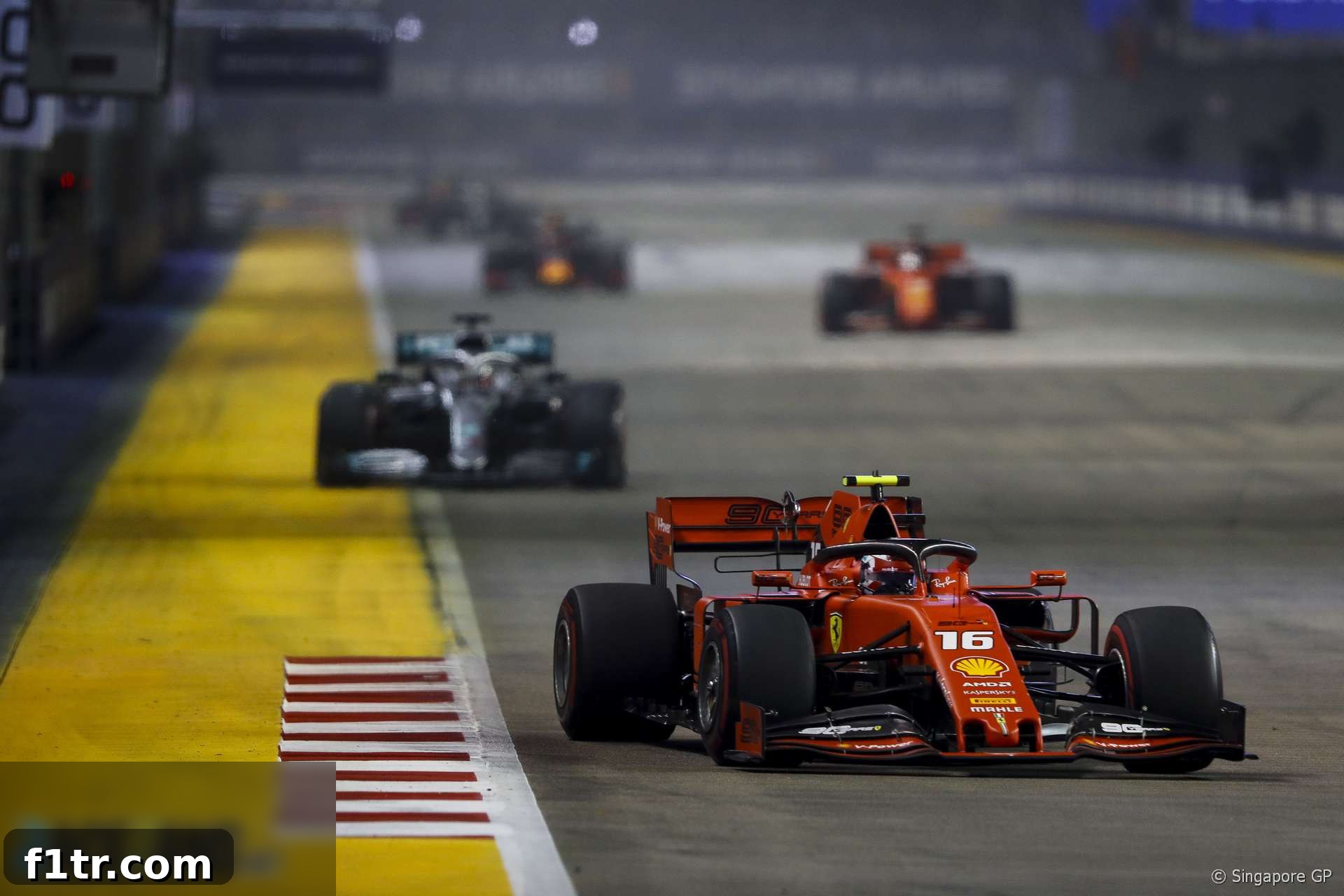
In the high-octane world of Formula 1, where every strategic call and millisecond on track can define a race’s outcome, moments of confusion and controversy are almost inevitable. The 2019 Singapore Grand Prix delivered one such moment, particularly involving Ferrari’s intriguing race management and the reactions it garnered from rival teams. Mercedes-AMG Petronas F1 Team star, Lewis Hamilton, a driver renowned for his tactical acumen and deep understanding of racecraft, openly expressed his bewilderment regarding Charles Leclerc’s unexpectedly slow pace during the critical opening phase of the grand prix. This decision ultimately set the stage for a dramatic shift in track position, allowing teammate Sebastian Vettel to execute a crucial undercut and seize victory.
The Marina Bay Street Circuit is a unique challenge on the Formula 1 calendar, a floodlit urban labyrinth where overtaking opportunities are notoriously scarce, and track position reigns supreme. Consequently, strategy plays an even more pivotal role here than at many other venues. As the race commenced, Leclerc found himself leading the pack, having secured a superb pole position. Hamilton was hot on his heels in second, with Vettel maintaining a close third. The widely accepted racing doctrine on a circuit like Singapore suggests that a leading driver should assert a strong, consistent pace. This not only allows for effective tire management but also creates a significant enough time buffer to protect against the “undercut” – a potent strategic gambit where a trailing car pits early for fresh tires, unleashes a series of rapid laps (the “overcut” is the opposite, staying out longer), and thereby emerges ahead of the car that stayed out longer on older rubber. However, Leclerc’s initial approach seemed to deviate sharply from this conventional wisdom, prompting Hamilton’s pointed observations.
“I don’t really know why he drove as slow as he did,” a visibly perplexed Lewis Hamilton stated in his post-race analysis. His comments resonated deeply within the paddock and among fans, many of whom were equally puzzled by Ferrari’s seemingly conservative tactics. Leclerc, when questioned about his strategy, later explained that his intention behind maintaining a slower pace was to bunch up the field and deny his closest competitors, especially Hamilton, a viable window to make an early pit stop. The theory behind such a tactic is to compress the strategic options for those behind, forcing them to react to the leader’s pace rather than dictating their own. While this can indeed be a legitimate and effective strategy in specific race conditions, its successful execution demands precise timing and, crucially, a subsequent acceleration of pace to establish a commanding lead and ensure the strategy doesn’t inadvertently backfire.
Hamilton delved further into his assessment of the situation, drawing parallels to strategies he himself had famously deployed in previous races. “Now, you could say that he was probably studying my race last year, or how I did what I did last year, and drove off the pace and then picked up the pace and made the gap,” Hamilton speculated. This introspection suggests Hamilton’s belief that Leclerc might have been attempting a similar strategic gambit. However, the critical flaw in Leclerc’s execution, as identified by the British champion, was his apparent inability to ever sufficiently increase his pace to build that all-important gap. Instead of strategically outmaneuvering his pursuers and creating strategic dilemmas for them, Leclerc’s approach inadvertently kept everyone tightly “bunched up.” This inadvertently created the perfect scenario for an aggressive strategic play from those behind, rather than deterring them.
This tightly condensed leading pack ultimately presented a golden, albeit unexpected, opportunity for Sebastian Vettel and the Ferrari pit wall. With the top three cars running in close proximity and struggling to break away, Ferrari made the audacious and ultimately race-winning decision to pit Vettel first. After bolting on a fresh set of tires, Vettel immediately commenced a scorching series of laps. His pace on the new tires was phenomenal, often four seconds quicker than the race leader, Charles Leclerc, who was still circulating on worn rubber. This dramatic increase in pace, which epitomizes a perfectly executed undercut, placed immense, irresistible pressure on both Leclerc and Hamilton. When they eventually made their respective scheduled pit stops, the strategic damage had already been inflicted. Vettel, by virtue of his earlier pit stop and blistering out-lap pace, successfully managed to leapfrog both his highly-rated teammate and the formidable Mercedes of Hamilton, seizing an unexpected lead that he would expertly manage to the chequered flag.
The immediate aftermath of Vettel’s successful undercut ignited a fervent debate and widespread speculation across the Formula 1 community. Was this a masterstroke of strategic brilliance orchestrated by the Ferrari team, or a calamitous misjudgment that inadvertently cost Leclerc a well-deserved victory from pole position? Lewis Hamilton, ever the astute observer and shrewd analyst, put forth a compelling hypothesis, suggesting that the entire outcome might have been “premeditated” by the Ferrari hierarchy. “Whether that was predetermined by the team, that could have been how the team worked it with first and third [positions], stopping one car earlier – maybe they knew, maybe it was premeditated. If they did, they did a great job with that,” Hamilton mused, subtly hinting at the complex internal dynamics and potential team politics that often simmer beneath the surface within a top-tier racing outfit like Scuderia Ferrari.
This provocative theory of a predetermined outcome, while never officially confirmed by Ferrari, resonated strongly with many observers. It gained traction given Ferrari’s historical tendencies and the intense, often fractious, rivalry that had characterized the relationship between their two star drivers, Vettel and Leclerc, throughout the highly competitive 2019 season. While Leclerc had undeniably showcased incredible raw speed on Saturday, securing a dominant pole position, his race pace on Sunday raised more questions than answers. Hamilton specifically noted, “Obviously Charles lost the position. But he didn’t really have great pace in that first stint. I was expecting him to light it up and get quicker. But I could keep up with him.” This astute observation by Hamilton further fueled the speculation that Leclerc’s initial slow pace might not have been merely a tactic that went awry, but perhaps an indication of underlying performance issues with his car on race day, or even a deliberate instruction to manage tires in a manner that inadvertently left him vulnerable to an aggressive strategic play from behind.
Regardless of the true intention behind the strategy, the outcome undeniably favored Sebastian Vettel, providing him with a much-needed morale boost and a significant victory at a challenging juncture in his illustrious career. For Charles Leclerc, who had shown incredible form and promise throughout the weekend, securing pole position and confidently leading the initial laps, it was undeniably a bitter pill to swallow, finishing a frustrating second place behind his teammate. Lewis Hamilton himself was ultimately relegated to third place, his Mercedes unable to fully overcome the strategic disadvantage created by Ferrari’s initial bunched-up pace and the subsequent, decisively executed undercut. The entire incident served as a potent and enduring reminder of Formula 1’s intricate and multi-layered strategic dimension, where even the slightest miscalculation, a lack of clear communication, or a deviation from optimal execution can dramatically alter the trajectory and outcome of an entire grand prix.
Ultimately, the 2019 Singapore Grand Prix continues to be a prominent talking point in Formula 1 history, encapsulating the razor-thin line that separates tactical brilliance from strategic misjudgment. Lewis Hamilton’s publicly voiced questions regarding Charles Leclerc’s early race pace perfectly encapsulated the widespread confusion and intrigue that surrounded Ferrari’s pivotal decisions that day. Whether it was a poorly executed attempt at a clever strategy, a calculated team play designed to favor one driver, or simply a driver struggling with the unique demands of the circuit and his car’s performance, the incident irrevocably shaped the outcome of a thrilling night race and added yet another complex layer to the ongoing narrative of the captivating 2019 F1 season.
2019 F1 season
- Crying in the Melbourne car park at 2019 grand prix was my career low – Ocon
- McLaren Racing reports reduced £71 million loss in 2019
- Kvyat: Hockenheim podium last year was “my biggest achievement” so far
- How the FIA’s new encrypted fuel flow meter targets Ferrari’s suspected ‘aliasing’ trick
- “He smashed my office door”: 23 must-see moments from ‘Drive to Survive’ season two
Browse all 2019 F1 season articles