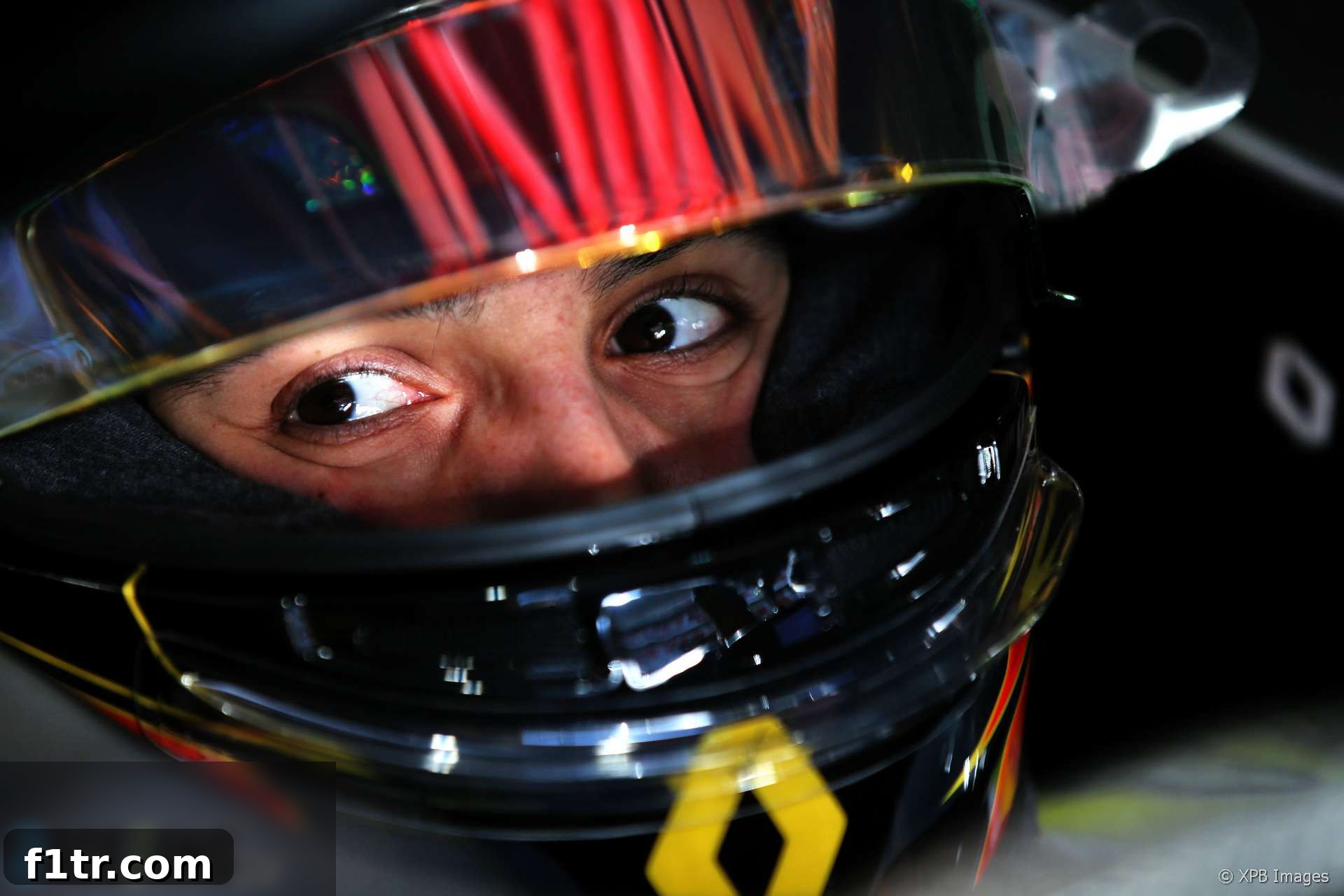
Esteban Ocon Predicts Record-Breaking Lap Times for the 2020 F1 Season with Renault RS20
Esteban Ocon, making his highly anticipated return to the Formula 1 grid, has expressed his firm belief that lap time records will undoubtedly tumble throughout the 2020 F1 season. The French driver’s optimistic prediction comes after his initial half-day of pre-season testing with Renault’s brand-new RS20 car at the iconic Circuit de Catalunya in Barcelona.
Speaking to media during the lunch break of his first official testing session, Ocon shared his overwhelmingly positive first impressions of the new Renault challenger. While acknowledging that a direct comparison to the Mercedes car he tested in the previous year was “hard to compare,” his enthusiasm for the RS20’s raw performance was palpable. His comments suggest a significant step forward in car development across the sport, foreshadowing a season of unprecedented speed.
Unprecedented Grip: The Relentless Evolution of F1 Performance
Ocon highlighted the immediate sensation of increased performance, stating, “The amount of grip there is this year already, I think if you take it into account the fastest lap time, we are already faster than the fastest lap time of last year’s first day.” This revelation underscores the relentless pursuit of speed by Formula 1 teams. Each year, engineers push the boundaries of aerodynamics, chassis design, and suspension tuning to extract even more performance from their machines. The incremental gains, while seemingly small individually, accumulate to produce a car that is noticeably quicker than its predecessor, even within a relatively stable regulatory framework.
The feeling of enhanced grip is a critical indicator of a car’s potential. It signifies improved aerodynamic efficiency, allowing the car to carry more speed through corners. Modern F1 cars generate immense downforce, effectively glueing themselves to the track at high speeds. This downforce, combined with advancements in tire technology and overall chassis rigidity, allows drivers to attack corners with an intensity that was once unimaginable. Ocon’s experience confirms this trend, as he emphatically added, “The amount of grip I feel now I think I’ve never felt before.” Such a statement from a seasoned F1 driver, even one returning after a brief hiatus, speaks volumes about the impressive capabilities of the 2020 generation of cars.
The continuous evolution in Formula 1 is a testament to the sport’s core philosophy: innovation and speed. Every component, from the front wing to the rear diffuser, is meticulously designed to optimize airflow and maximize downforce. This intricate dance between aerodynamics and mechanical grip enables these sophisticated machines to defy physics, cornering at speeds that subject drivers to immense G-forces. Ocon’s personal experience reinforces this, noting, “It’s impressive those new cars because I have to say I’ve never went that fast in some corners before. So it feels good.” This direct feedback from a driver who has sampled top-tier F1 machinery confirms that the 2020 contenders are setting new benchmarks in performance. Consequently, his prediction that “we’re going to probably break all the records, I reckon, this year, lap time,” seems not just plausible but highly probable, promising an exhilarating season for fans and competitors alike.
Mastering the RS20: Esteban Ocon’s Formidable Return to the F1 Cockpit
Esteban Ocon’s return to competitive Formula 1 driving in 2020 marks a significant chapter in his career. After a year spent on the sidelines as Mercedes’ reserve driver, the transition back into a full-time race seat with Renault presents a unique set of challenges and opportunities. While his role with Mercedes kept him immersed in the F1 environment, nothing truly replicates the intensity and physical demands of driving a car at the absolute limit during a testing session or race weekend. Ocon candidly admitted that he is still in the process of getting accustomed to pushing the RS20 to its ultimate performance ceiling, a natural adjustment period for any driver after a break from the cockpit.
The French driver openly acknowledged the need to shake off any residual “rust,” a common sentiment among athletes returning to their sport after time away. “It’s not true that I’m just not leaning on it yet,” he explained. “I’m driving, I’m trying to get the rust off of me also.” This process involves re-calibrating his senses, refining his reflexes, and re-establishing the intimate connection between driver and machine. While he remained active with simulator work and occasional testing, the sheer speed, G-forces, and split-second decision-making required in a real F1 car demand constant practice and adaptation. The nuances of brake-point judgment, throttle application, and steering inputs are honed over countless laps, and a year out, even for a talent like Ocon, means rediscovering that razor-sharp precision.
Ocon elaborated on the distinctions between his previous driving experiences and the present challenge: “It’s been it’s been some time since I properly [drove] a car, which means with somebody next to me and having references, et cetera. So I’m just trying to get back up to speed.” The presence of teammates, engineers, and competitive benchmarking provides crucial reference points that are absent during simulator sessions or individual test outings. Re-integrating into a full team environment, understanding the car’s setup philosophy, and working collaboratively to extract performance are all part of the complex puzzle. His focus on achieving “decent lap times” is not merely about showing speed, but about using those times to truly “feel how the car reacts in the race condition or in the practice conditions,” a fundamental aspect of engineering the car to perfection and maximizing its potential throughout the demanding 2020 F1 season.
Pre-Season Testing: The Crucible of Performance at Circuit de Catalunya
Pre-season testing at the Circuit de Catalunya is arguably one of the most critical phases of the Formula 1 calendar, serving as the crucible where weeks, if not months, of design and manufacturing efforts are put to their first real-world examination. Teams arrive in Barcelona with their shiny new challengers, eager to validate simulations, fine-tune setups, and uncover any unforeseen issues before the championship truly begins. The focus during these intense testing sessions extends far beyond mere lap times; it encompasses reliability runs, aerodynamic correlation, understanding tire degradation, and acclimatizing drivers to their new machinery. Every lap provides invaluable data, informing the continuous development cycle that characterizes Formula 1.
The Circuit de Catalunya itself is an ideal venue for these crucial tests, offering a comprehensive array of challenges that allow teams to thoroughly evaluate their cars. Its layout features a mix of high-speed corners like the sweeping Turn 3, technical medium-speed sections, and a demanding final sector with slower chicanes. This diverse track profile provides a broad spectrum of conditions for assessing a car’s aerodynamic balance, mechanical grip, and engine performance. The relatively consistent weather in late winter Barcelona also aids in data collection, minimizing variables and allowing for more meaningful comparisons across different setups and tire compounds. For drivers like Esteban Ocon, it’s not just about pushing the car, but about providing detailed feedback to engineers, helping to shape the car’s development path for the entire season. The early signs from Barcelona, particularly Ocon’s comments about increased grip and faster lap times, suggest that teams have indeed made significant strides in performance, setting the stage for a fiercely contested and potentially record-breaking championship.
Renault’s Ambitions and the Broader 2020 F1 Landscape
Esteban Ocon’s optimistic projections for the 2020 F1 season are not just a reflection of the general advancements in Formula 1 car design but also a crucial indicator of Renault’s own ambitions. After a somewhat challenging 2019 campaign, the French manufacturer is determined to climb up the constructors’ standings and consistently challenge the sport’s top three teams. Ocon, alongside his experienced teammate Daniel Ricciardo, forms a strong driver pairing that Renault hopes will provide the necessary feedback and on-track performance to realize these goals. The early pace shown by the RS20, as highlighted by Ocon’s comments on immediate speed gains and unprecedented grip, suggests that the team has made tangible progress in their car development, providing a solid foundation for their pursuit of podiums and improved championship positions.
If Renault’s RS20 is already demonstrating the potential for record-breaking lap times, it sends a clear signal across the paddock that the entire field is likely to be quicker in 2020. This raises exciting prospects for a thrilling and highly competitive season. The inherent stability in the technical regulations from the previous year often allows teams to refine existing concepts, optimizing every aspect of their car’s performance rather than starting from scratch. This iterative improvement typically leads to faster lap times across the board. Such an environment promises tighter qualifying sessions, more intense wheel-to-wheel racing, and an overall spectacle that will captivate fans worldwide. The anticipation for the season’s opening race grows with every positive report from testing, as teams fine-tune their machines and drivers prepare to push the boundaries of speed and skill in what promises to be a truly memorable year for Formula 1.
In conclusion, Esteban Ocon’s first stint behind the wheel of the Renault RS20 has clearly ignited a spark of excitement and confidence within the team and across the Formula 1 community. His immediate sensation of superior grip and the significant step forward in performance, already yielding faster lap times than the previous year’s testing benchmarks, paints a vivid picture of what the 2020 F1 season could bring. As Ocon continues to shake off the rust and fully integrate himself with the RS20, the prospect of breaking lap time records at circuits around the globe becomes an increasingly tangible reality. This fervent optimism, coupled with the relentless innovation of Formula 1 engineering, sets the stage for a year of breathtaking speed and intense competition, promising a truly unforgettable spectacle for fans of the sport.
More on the 2020 F1 Season
- Grosjean to make F1 test return tomorrow for first time since Bahrain horror crash
- Pictures: Wrecked chassis from Grosjean’s Bahrain fireball crash to go on display
- Bottas vs Rosberg: Hamilton’s Mercedes team mates compared after 78 races each
- F1 revenues fell by $877 million in Covid-struck 2020 season
- Hamilton and Mercedes finally announce new deal for 2021 season
Browse all 2020 F1 season articles