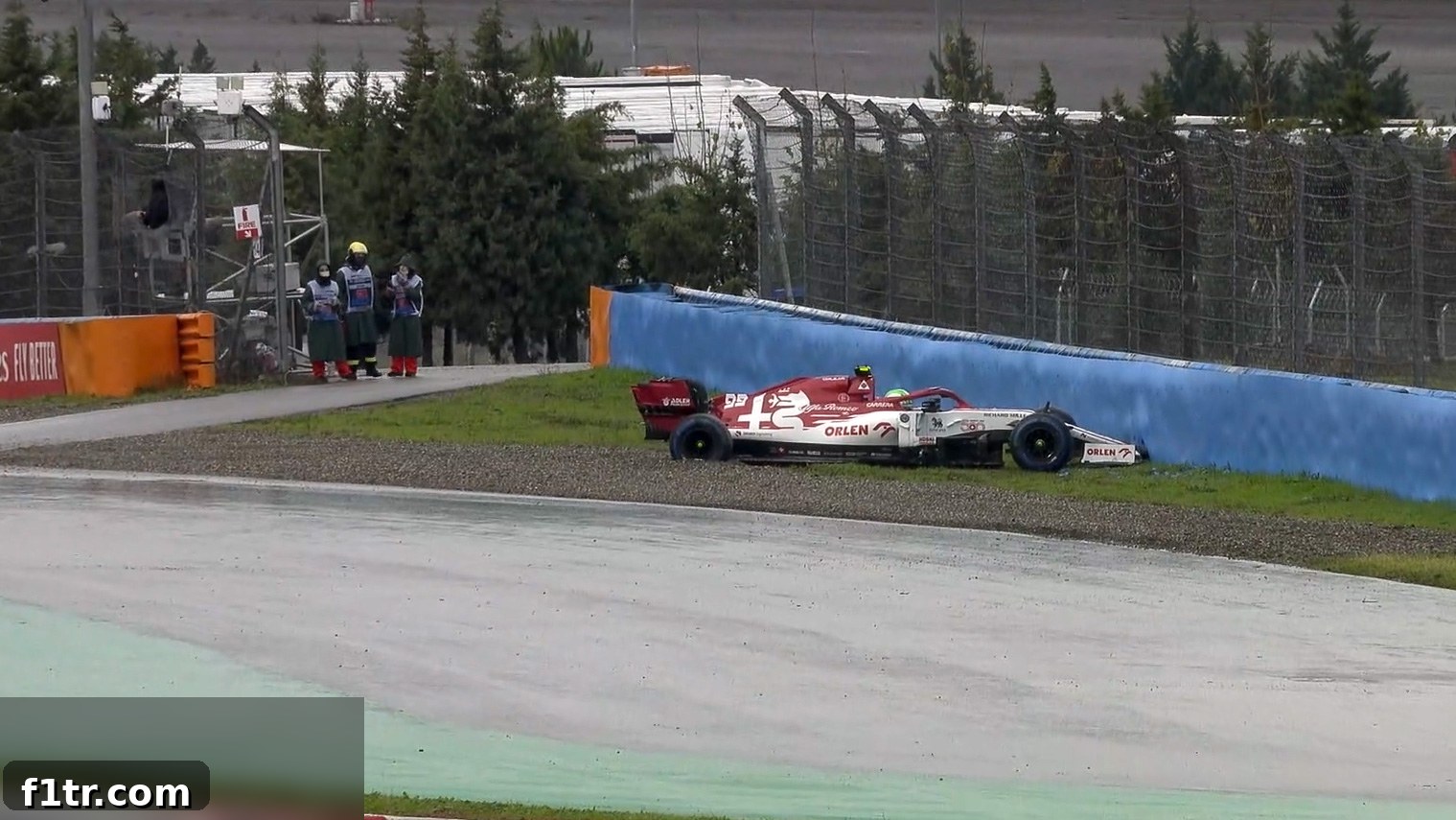
The 2020 Formula 1 Turkish Grand Prix at the iconic Istanbul Park circuit promised an exhilarating spectacle, but the drama began even before the race officially started. Under exceptionally treacherous conditions, two prominent drivers, Antonio Giovinazzi of Alfa Romeo Racing and George Russell of Williams Racing, experienced separate incidents during their critical reconnaissance laps to the starting grid. These pre-race mishaps served as a stark preview of the immense challenges awaiting the entire field on a track made perilously slippery by persistent rainfall, underscoring the raw unpredictability that wet weather racing brings to the pinnacle of motorsport.
The reconnaissance lap is far more than a mere formality; it’s a crucial opportunity for drivers to assess the track conditions, test braking points, and get a feel for the car’s balance before the pressure of the race itself. For Giovinazzi, this vital assessment took an unexpected turn at the notoriously challenging Turn 2. As he navigated the corner, his Alfa Romeo C39 lost traction on the slick surface, sending him into a spin and ultimately into the unforgiving gravel trap. While such an incident could spell an early end to a driver’s race, Giovinazzi’s swift recovery was a testament to his skill and perhaps a stroke of luck. Fortunately, preliminary checks revealed no significant suspension damage, allowing him to nurse his car back to the grid. This incident, while unnerving, meant he could still take up his P10 starting position, a commendable achievement for Alfa Romeo, albeit with an added layer of pre-race anxiety.
Meanwhile, a separate and equally dramatic incident unfolded for George Russell, the highly-rated British driver for Williams. As he made his way towards the pit lane entrance, an area typically considered safe and low-speed, his car aquaplaned unexpectedly. The momentary loss of control sent his Williams FW43 careening into the pit lane wall. The sheer surprise and frustration of the moment were palpable in his radio message to the team: “I was going at walking speed, it’s ridiculous.” This comment highlighted the extreme lack of grip, a condition far beyond what even experienced Formula 1 drivers would anticipate or tolerate under normal circumstances. The impact, though seemingly minor due to the low speed, raised immediate concerns about the integrity of his car, leading to an swift assessment by the Williams crew.
The implications of Russell’s crash were more severe than Giovinazzi’s spin. While Giovinazzi returned to his grid slot, the damage sustained by Russell’s Williams necessitated extensive repairs. Formula 1 regulations dictate that if a car requires significant repairs that cannot be completed on the grid or if it cannot reach its designated grid position, it must start the race from the pit lane. Williams Racing promptly confirmed that both its drivers—George Russell and his teammate Nicholas Latifi, whose car also required checks following a separate incident earlier in the day—would indeed commence the Turkish Grand Prix from the pit lane. This decision immediately put them at a significant disadvantage, forcing them to start at the very back of the field and requiring them to navigate the pit lane exit and the entire grid before joining the racing action, a considerable blow to their race strategy before it even began.
These pre-race incidents underscored the monumental challenge posed by the Istanbul Park circuit under heavy rain. The track, known for its flowing corners and the daunting quadruple-apex Turn 8, becomes a completely different beast when wet. The 2020 Turkish Grand Prix was particularly notorious for its newly resurfaced asphalt, which, combined with the cold temperatures and relentless rain, offered minimal grip, turning the circuit into an ice rink. Drivers reported an almost complete lack of adhesion, even on the designated wet weather tyres, making even simple maneuvers incredibly risky. The fine balance between aggression and caution became paramount, with the smallest misjudgment having potentially race-ending consequences.
Wet weather racing is a spectacle unique to Formula 1, testing the mettle of drivers, engineers, and strategists alike. The reduction in visibility due to spray, the constant threat of aquaplaning, and the critical decisions regarding tyre compounds (full wets versus intermediates) add layers of complexity unmatched in dry conditions. Historically, some of the most memorable and chaotic Grand Prix races have unfolded in the rain, often producing unexpected winners and dramatic overtakes. From Ayrton Senna’s legendary wet weather masterclasses to more recent chaotic encounters, rain has always been the great equalizer, levelling the playing field and demanding absolute precision and bravery.
For a team like Williams, already navigating a challenging period in Formula 1, a pit lane start for both cars added another layer of adversity. Their aim would immediately shift from competing for points to simply making progress through the field, hoping for safety car periods or further incidents to close the gap. The psychological impact on a driver cannot be underestimated either. While Giovinazzi was able to gather himself on the grid, Russell faced the frustration of starting from the pit lane, knowing his race had been compromised through no fault of aggressive driving, but purely due to the treacherous conditions. This mental fortitude is a hallmark of F1 drivers, but even for them, such scenarios test their limits.
The Turkish Grand Prix, having returned to the F1 calendar after a significant hiatus, was already anticipated with great excitement. Its anti-clockwise layout and elevation changes make it a truly demanding track. The infamous Turn 8, a high-speed, multi-apex left-hander, pushes cars and drivers to their limits even in the dry. In the wet, this corner, along with others, became a focal point of apprehension, requiring immense bravery and delicate car control. The pre-race crashes of Giovinazzi and Russell served as a potent warning to the rest of the grid: even the most experienced drivers could be caught out by Istanbul Park’s slick surface.
Ultimately, these early incidents set the stage for a dramatic and unpredictable Turkish Grand Prix. They highlighted not only the incredible skill required to pilot a Formula 1 car but also the fine margins between success and failure, especially when Mother Nature decides to play a starring role. For fans, it was a reminder of why F1 remains such a captivating sport: the constant challenge, the inherent danger, and the sheer audacity of pushing cutting-edge machinery to its absolute limits, come rain or shine. The lessons learned from these reconnaissance laps would undoubtedly inform every driver’s approach as the race lights prepared to go out, promising a true test of endurance and adaptability in one of the most challenging races of the 2020 season.
2020 F1 Season Highlights and Related Insights
- Romain Grosjean’s F1 Test Return: A Look Back at His Journey Since the Bahrain Horror Crash
- Behind the Scenes: Wrecked Chassis from Grosjean’s Bahrain Fireball Crash on Display
- Team Dynamics: Bottas vs. Rosberg – Hamilton’s Mercedes Teammates Compared After 78 Races Each
- Economic Impact: F1 Revenues Plummeted by $877 Million During the Covid-Affected 2020 Season
- Driver Market: Hamilton and Mercedes Officially Announce New Deal for the 2021 Season
Explore More Articles from the 2020 F1 Season