Mercedes Dominates Early Austrian Grand Prix Practice, Red Bull Close Behind
The highly anticipated 2018 Austrian Grand Prix kicked off with an electrifying Free Practice 1 session, where Mercedes showcased significant performance enhancements, securing the top two positions. Yet, the session was far from a walkover, as home team Red Bull, with Max Verstappen at the wheel, impressively closed the gap to within two-tenths of a second, setting the stage for a thrilling weekend at the Red Bull Ring.
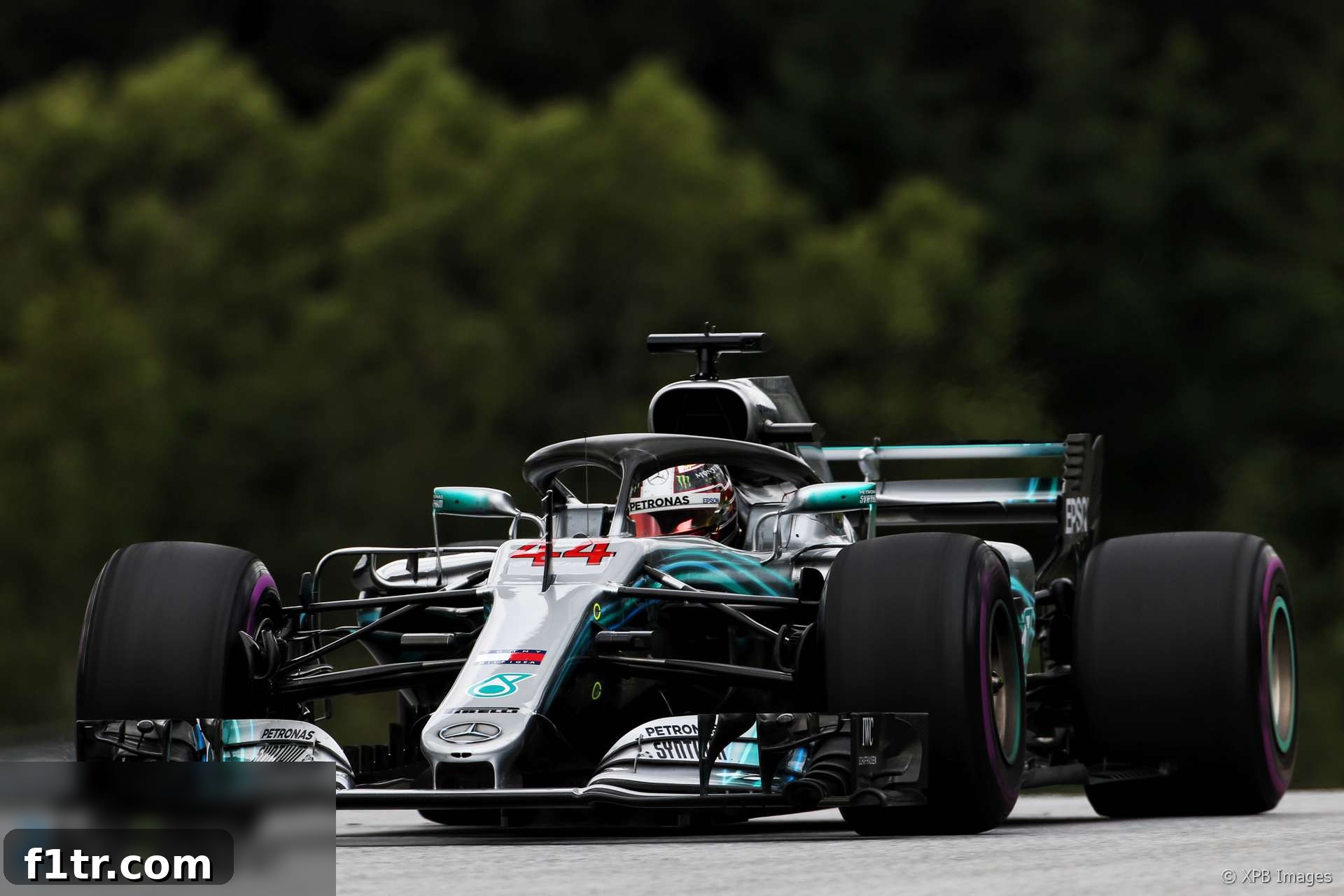
Under relatively cool track temperatures of 26 degrees Celsius, Lewis Hamilton spearheaded Mercedes’ charge, demonstrating why the team’s recent upgrades are generating considerable buzz. The Briton’s blistering pace saw him lap just six-tenths off last year’s pole position time, a remarkable feat for an opening practice session. His teammate, Valtteri Bottas, mirrored this strong performance, ensuring a dominant Mercedes 1-2 by the end of the initial 90-minute run.
Hamilton’s strategy during the session was pivotal. He initially set the benchmark times on the super-soft tyres, establishing a formidable lead. Crucially, he then extended this advantage after switching to the softer, ultra-soft compound, indicating a strong understanding of the tyre degradation and optimal performance window. This early display of speed and tactical nous signals Mercedes’ intent to firmly control the proceedings this weekend.
Valtteri Bottas, though marginally slower than his teammate, showed promising pace. After completing his best lap, which placed him a mere tenth of a second behind Hamilton, the Finn received valuable feedback from his engineering team, advising him on potential improvements in the braking zones for turns one and three. This level of meticulous detail from Mercedes highlights their commitment to extracting every ounce of performance from their W09 chassis, suggesting that Bottas has more pace to unlock as the weekend progresses.
Verstappen Challenges Mercedes on Home Turf, Ferrari Pondering
The biggest threat to Mercedes’ early dominance emerged from Red Bull Racing, particularly from the young Dutch sensation, Max Verstappen. Despite an early spin at turn four, a momentary lapse that quickly recovered, Verstappen managed to place his Red Bull RB14 in third position, impressively close to the Silver Arrows. His ability to recover and deliver a lap time within striking distance of the upgraded Mercedes cars underscores Red Bull’s potential, especially considering their strong track record at their home circuit, the Red Bull Ring. This performance hints at a possible three-way fight at the front if Red Bull can refine their package further.
Verstappen’s teammate, Daniel Ricciardo, secured fifth place, four-tenths of a second adrift of Verstappen’s pace. While a decent showing, Ricciardo will be keen to close that gap and bring both Red Bulls into contention for the leading positions. The team’s home race often brings out an extra level of motivation, and with their chassis historically strong in tight, flowing circuits like Spielberg, their true potential might yet be revealed in later sessions.
Splitting the two Red Bulls was the Ferrari of Sebastian Vettel, who slotted into fourth place. Vettel’s best lap was three-tenths of a second slower than Hamilton’s benchmark, a gap that Ferrari will undoubtedly be looking to reduce. The Scuderia’s pace appears to be slightly behind that of Mercedes and potentially Red Bull on this track, at least in FP1. His teammate, Kimi Raikkonen, had a more challenging session, experiencing a heavy lock-up on his second set of tyres. This incident, combined with a seemingly less comfortable car setup, saw him finish almost a second off the pace of the leading Mercedes, putting Ferrari under some pressure to find improvements ahead of qualifying.
Close Midfield Scramble and McLaren’s Continued Struggles
The midfield battle, a hallmark of the 2018 Formula 1 season, was as tight and competitive as ever during FP1 in Austria. Leading this fiercely contested group was Romain Grosjean for Haas, who demonstrated the American team’s strong one-lap pace by finishing just two-tenths behind Kimi Raikkonen. This performance positions Haas as a leading contender in the midfield, with Grosjean’s teammate Kevin Magnussen also showing competitive speed, ending up just behind a tightly packed cluster of cars.
The top ten featured a notable “French flavour,” with several French drivers making their mark. Esteban Ocon, in his Force India, was only a few hundredths slower than Grosjean, highlighting the incredibly close margins in this segment of the grid. Young talent Charles Leclerc continued his impressive rookie season, once again bringing his Sauber well into the top half of the field. Pierre Gasly also squeezed his Toro Rosso into the top ten by an extremely slender margin, further showcasing the depth of talent and competition.
The competitiveness of the midfield was underlined by the fact that Gasly headed a group of six cars, including Kevin Magnussen, Sergio Perez, Marcus Ericsson, and both Renaults (Carlos Sainz Jnr and Nico Hulkenberg), all covered by less than a tenth of a second. This density of performance promises an exciting fight for Q3 spots and points positions during Sunday’s race.
At the back of the grid, Williams and McLaren faced significant challenges. Lance Stroll, the sole race driver for Williams in this session (as test driver Robert Kubica took part), managed to get his car up to 16th position. Robert Kubica, making another Free Practice appearance, ended the session at the very bottom of the timesheets, indicating the struggles Williams are currently enduring with their FW41 chassis.
However, the slowest overall team performance came from McLaren. Fernando Alonso finished the session a concerning 1.8 seconds off the pace, posting a best lap of 1’06.612. He endured a lengthy spell in the pits, which the team attributed to planned changes of aerodynamic rakes on his car – a common practice during early sessions for data collection, but indicative that McLaren’s focus was not on outright performance runs. Compounding their woes, teammate Stoffel Vandoorne damaged his car’s nose on a high kerb at turn nine, further highlighting the difficulties the Woking-based outfit is facing as they continue their search for improved performance and reliability.
This opening practice session provided a fascinating glimpse into the pecking order and potential storylines for the Austrian Grand Prix weekend. While Mercedes showcased commanding pace, the close proximity of Red Bull and the fierce midfield battle promise a thrilling spectacle as teams fine-tune their setups for qualifying and the race.
Formula 1 Austrian Grand Prix 2018: Free Practice 1 Results
| Pos. | No. | Driver | Car | Best lap | Gap | Laps |
|---|---|---|---|---|---|---|
| 1 | 44 | Lewis Hamilton | Mercedes | 1’04.839 | 39 | |
| 2 | 77 | Valtteri Bottas | Mercedes | 1’04.966 | 0.127 | 39 |
| 3 | 33 | Max Verstappen | Red Bull-TAG Heuer | 1’05.072 | 0.233 | 42 |
| 4 | 5 | Sebastian Vettel | Ferrari | 1’05.180 | 0.341 | 29 |
| 5 | 3 | Daniel Ricciardo | Red Bull-TAG Heuer | 1’05.483 | 0.644 | 22 |
| 6 | 7 | Kimi Raikkonen | Ferrari | 1’05.776 | 0.937 | 31 |
| 7 | 8 | Romain Grosjean | Haas-Ferrari | 1’06.028 | 1.189 | 31 |
| 8 | 31 | Esteban Ocon | Force India-Mercedes | 1’06.055 | 1.216 | 40 |
| 9 | 16 | Charles Leclerc | Sauber-Ferrari | 1’06.215 | 1.376 | 31 |
| 10 | 10 | Pierre Gasly | Toro Rosso-Honda | 1’06.394 | 1.555 | 36 |
| 11 | 9 | Marcus Ericsson | Sauber-Ferrari | 1’06.400 | 1.561 | 32 |
| 12 | 20 | Kevin Magnussen | Haas-Ferrari | 1’06.404 | 1.565 | 23 |
| 13 | 55 | Carlos Sainz Jnr | Renault | 1’06.427 | 1.588 | 29 |
| 14 | 11 | Sergio Perez | Force India-Mercedes | 1’06.455 | 1.616 | 42 |
| 15 | 27 | Nico Hulkenberg | Renault | 1’06.479 | 1.640 | 35 |
| 16 | 18 | Lance Stroll | Williams-Mercedes | 1’06.567 | 1.728 | 32 |
| 17 | 14 | Fernando Alonso | McLaren-Renault | 1’06.612 | 1.773 | 30 |
| 18 | 2 | Stoffel Vandoorne | McLaren-Renault | 1’06.698 | 1.859 | 30 |
| 19 | 28 | Brendon Hartley | Toro Rosso-Honda | 1’06.871 | 2.032 | 45 |
| 20 | 40 | Robert Kubica | Williams-Mercedes | 1’07.424 | 2.585 | 38 |
First Practice Visual Gaps
The following visual representation illustrates the time gaps between drivers during the Free Practice 1 session, offering a clearer perspective on the relative performance differences. Each driver’s bar indicates their best lap time, with the gap to the session leader, Lewis Hamilton, displayed for quick comparison.
Lewis Hamilton – 1’04.839
+0.127 Valtteri Bottas – 1’04.966
+0.233 Max Verstappen – 1’05.072
+0.341 Sebastian Vettel – 1’05.180
+0.644 Daniel Ricciardo – 1’05.483
+0.937 Kimi Raikkonen – 1’05.776
+1.189 Romain Grosjean – 1’06.028
+1.216 Esteban Ocon – 1’06.055
+1.376 Charles Leclerc – 1’06.215
+1.555 Pierre Gasly – 1’06.394
+1.561 Marcus Ericsson – 1’06.400
+1.565 Kevin Magnussen – 1’06.404
+1.588 Carlos Sainz Jnr – 1’06.427
+1.616 Sergio Perez – 1’06.455
+1.640 Nico Hulkenberg – 1’06.479
+1.728 Lance Stroll – 1’06.567
+1.773 Fernando Alonso – 1’06.612
+1.859 Stoffel Vandoorne – 1’06.698
+2.032 Brendon Hartley – 1’06.871
+2.585 Robert Kubica – 1’07.424
Drivers more than ten seconds off the pace omitted from this visual representation for clarity.
More on the 2018 Austrian Grand Prix
- 2018 Austrian Grand Prix Star Performers
- Four wins, no poles: Verstappen equals an unusual record
- Top ten pictures from the 2018 Austrian Grand Prix
- Error-free Verstappen hands Red Bull a home win
- Why the Red Bull Ring showed Paul Ricard how to run a race
Browse all 2018 Austrian Grand Prix articles