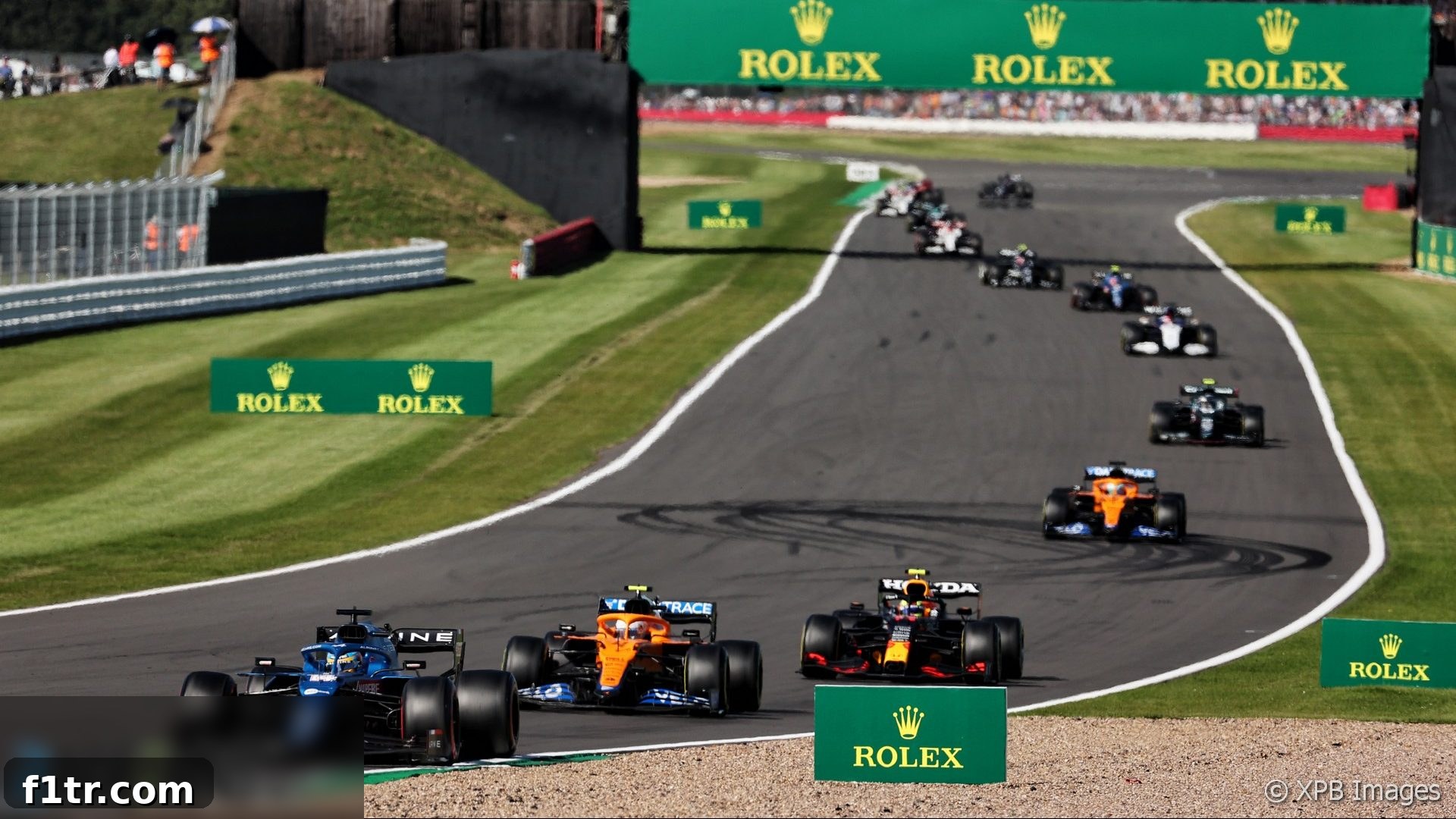
Veteran Formula 1 driver Fernando Alonso has dismissed concerns about being perceived as “on the dark side” following accusations from rival Lando Norris regarding his defensive tactics during the inaugural sprint qualifying race at Silverstone. The incident ignited debate among drivers and fans, highlighting the fine line between aggressive racing and unsportsmanlike conduct, especially in the context of F1’s then-new sprint format.
Advert | Become a Supporter & go ad-free
The controversy arose during a thrilling battle for fifth place in the sprint race. McLaren’s Lando Norris vocally expressed his displeasure over team radio, asking his team to report Alonso to race control for what he believed was an illegal movement by the Alpine driver in the braking zone. Moving under braking is a contentious issue in Formula 1, often leading to dangerous situations and being viewed as an unfair defensive maneuver that can compromise a following driver’s ability to react safely and effectively. It’s a rule designed to prevent drivers from unpredictably changing their line while braking, which can lead to collisions, particularly on high-speed circuits like Silverstone.
Despite Norris’s protests and a subsequent warning from then-race director Michael Masi, Alonso remained unperturbed, asserting that his actions were entirely within the bounds of fair racing. “I was surprised,” Alonso stated, reflecting on the accusation. “I never move under braking. I was moving at the beginning of the straight.” This distinction is crucial in F1 regulations; while changing lines during a straight is generally permissible, doing so while actively braking is often frowned upon or penalized. Alonso’s firm stance underscores his long-standing reputation as a fierce competitor who pushes the limits, often to the consternation of his rivals.
Embracing the controversy with characteristic defiance, Alonso quipped, “But I don’t care, to be honest. I have been on the other side for now, nine races. It’s going to be the same for the remaining of the year. I will be on the dark side this time.” This comment, delivered with a hint of mischievousness, reveals Alonso’s veteran mindset. After a career spanning decades and two world championships, he has experienced both the praise and scrutiny that come with being a top-tier F1 driver. His remark suggests a willingness to embrace the role of the antagonist if it means maximizing his performance and extracting every possible advantage for his team. It also hints at a perception that he has perhaps been unfairly judged or on the receiving end of complaints in previous races, now finding himself in a position where he can simply shrug off the criticism.
Indeed, Alonso was undeniably the standout performer of F1’s maiden sprint qualifying event. Starting from a relatively low grid position, he orchestrated a sensational opening lap that saw him carve through the field with remarkable precision and aggression. He gained an astounding six places, vaulting from his initial grid slot into fifth place. This phenomenal start effectively set him up to secure seventh on the grid for the main British Grand Prix, a significant improvement that dramatically boosted Alpine’s prospects for points on Sunday.
Recalling his extraordinary start, Alonso reflected, “I think the first lap was one of my best. I know there are a lot of first laps before now that are considered good ones – especially in the Renault days with very good starts – but this one was not only the start into turn one, it was turn three, turn four, six, nine. So it was a more complete lap.” His self-assessment highlights not just raw speed off the line, but a comprehensive mastery of the opening sequence of corners at a demanding circuit like Silverstone. This “complete lap” showcases his tactical brilliance, anticipating rivals’ moves, finding gaps, and executing precise overtaking maneuvers across multiple challenging sections of the track. His use of the softer, red-striped tires in the sprint undoubtedly contributed to this explosive start, providing superior initial grip compared to competitors on medium or hard compounds.
Alonso also offered insight into his strategic approach, particularly his willingness to take calculated risks during the sprint. “I guess if you are fighting for the championship, I will not make those manoeuvres because there is more to lose than to gain. But we are in a position that we can take maybe more risk and benefit also from the red tyres’ first lap performance,” he explained. This candid admission reveals a crucial aspect of his racing philosophy, adapting his aggression based on his championship standing. As Alpine was not a front-running contender for the drivers’ or constructors’ championship at that stage of the 2021 season, Alonso felt empowered to push the limits, knowing that the potential reward of a few extra grid positions outweighed the relatively lower risk of a minor incident. This contrasted sharply with drivers vying for the title, who would prioritize consistency and avoiding unnecessary damage. The soft tire choice, though offering blistering initial pace, also meant higher degradation over the sprint distance, making the early gains even more critical.
Despite his initial surge, the Alpine driver acknowledged the inherent performance gap to some of his rivals. “We were maybe a little bit out of position because we were not the fifth-quickest out there and then we had to fight a little bit with the McLarens. Then we gave up the fight, in a way, because they were too fast and we concentrated with Sebastian and P7 is better than P11, which is what we achieved yesterday,” he elaborated. This demonstrates a pragmatic understanding of his car’s capabilities versus the competition. While his initial pace was phenomenal, the McLaren cars, particularly that of Lando Norris, ultimately proved too quick over the longer sprint distance. Alonso’s decision to consolidate his position by focusing on Sebastian Vettel and securing P7, rather than risking a futile battle with faster cars, was a testament to his strategic acumen and his ability to extract the maximum possible result for his team.
Despite being the most significant beneficiary of the newly introduced Sprint Qualifying format, Alonso adopted a typically cautious tone when discussing his team’s prospects for scoring substantial points in the main race. The longer grand prix on Sunday presents a different set of challenges, including managing tire wear over many more laps, fuel conservation, and the sheer endurance required. “I think it’s going to be a long race,” he predicted. “Feet on the ground, we still have a very long race in front of us – fast cars behind us. We have the Ferrari, we have Sebastian [Vettel], we have Checo [Sergio Perez]. So the points would be hard to take anyway.”
This realistic outlook reflects the intense competition in Formula 1’s midfield. While Alpine had shown flashes of brilliance, maintaining a top-seven position against teams with inherently faster cars like Ferrari and Red Bull (represented by Perez) was always going to be an uphill battle. Alonso’s extensive experience teaches him that a strong sprint performance doesn’t automatically guarantee success on Sunday. The main race requires consistent pace, impeccable strategy, and flawless execution over a far greater distance, where the underlying performance of the car becomes even more critical. His warning about the “fast cars behind us” was a clear signal that the fight for points would be relentless and require every ounce of skill and strategic thinking from the Alpine team.
Advert | Become a RaceFans supporter andgo ad-free
2021 British Grand Prix
- Verstappen reveals “vision problems” since 2021 Silverstone crash with Hamilton
- Who was to blame for Verstappen and Hamilton’s collision at Silverstone?
- Hamilton penalty “harsh” for move within FIA’s overtaking guidance – Allison
- Why Hamilton “wasn’t seen as wholly to blame” for the Verstappen crash
- Sainz convinced he had pace to challenge for podium without British GP setbacks
Browse all 2021 British Grand Prix articles