The Domino Effect: How Daniel Ricciardo’s Renault Move Reshaped the 2019 F1 Driver Market
The announcement of Daniel Ricciardo’s unexpected departure from Red Bull Racing to join Renault for the 2019 Formula 1 season sent shockwaves through the paddock. Initially, many anticipated a straightforward replacement, particularly with Carlos Sainz Jnr appearing to be Red Bull’s heir apparent. However, the subsequent silence from the Red Bull camp regarding Sainz’s future indicated a much more complex and intriguing scenario was unfolding. Ricciardo’s move, far from being an isolated incident, became the catalyst for a significant reshuffle, opening up opportunities and creating dilemmas across multiple teams in what promised to be one of the most dynamic driver markets in recent memory.
Red Bull team principal Christian Horner had previously earmarked Sainz as the team’s “safety net” should Ricciardo ever decide to leave. Sainz had indeed proven his capabilities, delivering an outstanding performance with Toro Rosso in the preceding season, contributing significantly to their points tally before his loan spell at Renault. With Ricciardo now making the permanent switch to the French manufacturer, the natural expectation was for Red Bull to recall their promising 23-year-old talent and offer him a coveted seat in a front-running team. Yet, when Red Bull officially responded to the news of Ricciardo’s impending departure – a story first broken by RaceFans – there was a conspicuous absence of confirmation regarding Sainz’s future with the team.
Red Bull’s Unexpected Dilemma and the Search for a New Partner for Max Verstappen
Christian Horner’s public statement following Ricciardo’s announcement was telling: “We will now continue to evaluate the numerous options available to us before deciding on which driver partners Max Verstappen for the 2019 season.” This statement, devoid of any mention of Sainz, immediately signaled that Red Bull’s decision-making process was far from simple. It is highly unusual for Red Bull, a team renowned for its meticulous long-term driver planning and development through its junior program, to be caught off guard by such a significant driver announcement. Historically, the team has been proactive, as demonstrated in 2014 when they swiftly announced Daniil Kvyat as Sebastian Vettel’s replacement following his shock defection to Ferrari.
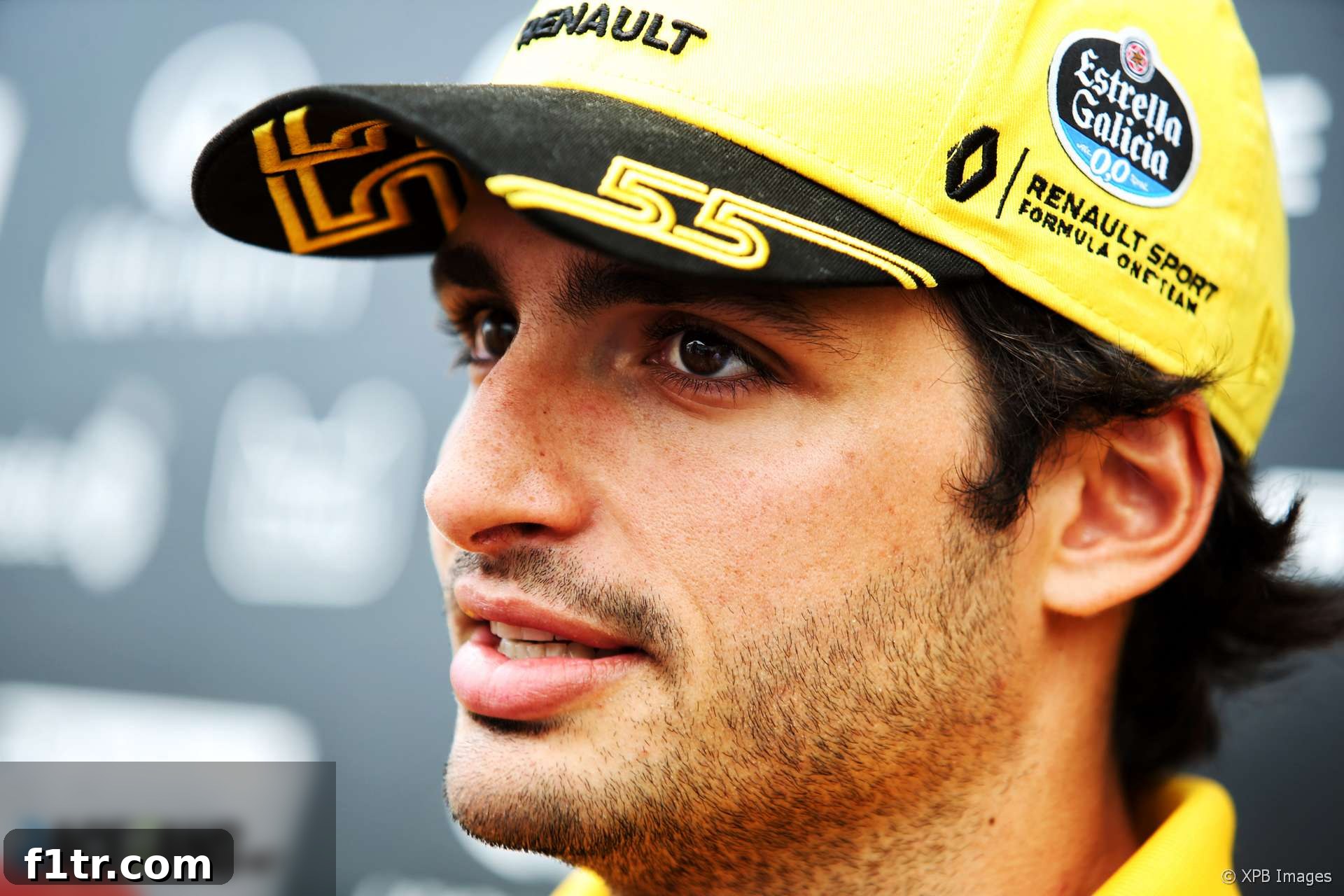
The lack of a similar, immediate announcement for Sainz strongly suggested that his distinctive number 55 would not be gracing the nose of a Red Bull-Honda RB15. This raised pertinent questions about the internal dynamics and priorities within the Red Bull organization, especially concerning their preferred driver pairing alongside star talent Max Verstappen. The implications were clear: Red Bull was exploring alternatives, indicating underlying issues preventing a straightforward reunion with Sainz.
The Complex Relationship Between Max Verstappen and Carlos Sainz Jnr
One of the primary reasons for Red Bull’s hesitation concerning Carlos Sainz reportedly stemmed from the complicated history between Sainz and Max Verstappen. Their initial stint together at Toro Rosso, spanning a year and a bit, was characterized by an intense and, at times, strained rivalry rather than a cordial partnership. This dynamic was exacerbated by circumstances surrounding their entry into Formula 1.
Sainz, a long-standing and dedicated member of the Red Bull Junior Team, had patiently climbed the ranks, expecting his shot at an F1 seat. However, Verstappen, a prodigious talent, was swiftly signed by Red Bull in 2014 and controversially promoted directly into F1 ahead of Sainz, bypassing the traditional junior categories. This decision naturally created an environment of competition and perhaps a degree of resentment. The friction escalated further in 2017 when Sainz openly discussed his future at Toro Rosso, expressing a desire for a move to a front-running team. These comments were initially and strongly rebuffed by Christian Horner, only for Sainz’s aspirations to be later validated when he was indeed loaned out to Renault, proving his strategic foresight. This history, marked by direct competition and public disagreements, made a reunion within the senior Red Bull team a potentially problematic prospect. Red Bull’s motorsport director, Helmut Marko, a key figure in their driver program, was understood to be firmly against reuniting the two drivers, particularly with Verstappen already a firmly established and long-term asset to the team. The implications for Sainz were unmistakable, pushing him towards exploring options outside the Red Bull family, specifically with McLaren.
Pierre Gasly: Red Bull’s Emerging Contender for 2019

With Carlos Sainz seemingly out of the picture for Red Bull, attention quickly shifted to Pierre Gasly as the leading candidate to replace Daniel Ricciardo. Gasly, the 2016 GP2 (now Formula Two) champion, had steadily built a strong reputation within the Red Bull family. His amiable demeanor and consistent performances had made him a well-liked figure, and crucially, he would have a full year of experience working with Honda, Red Bull’s new engine supplier, by the end of the current season. This experience was deemed invaluable for the transition, offering a smoother integration with the new powertrain partnership.
Gasly’s performances in challenging circumstances during the season had only bolstered his case. A timely sixth-place finish at the Hungaroring provided a powerful demonstration of his capabilities. Even more impressively, his stellar fourth-place finish in the Bahrain Grand Prix stood as Honda’s best result since their return to Formula 1 three years prior, a testament to his skill and adaptability. Promoting Gasly from Toro Rosso to the senior Red Bull team appeared to be the most logical and strategically sound decision, ensuring continuity and leveraging an in-house talent who had proven his mettle.
Toro Rosso’s Driver Conundrum and the McLaren Connection
While Gasly’s promotion solved Red Bull’s immediate problem, it created another for its junior team, Toro Rosso. With Gasly moving up, Toro Rosso would be left needing at least one, if not two, new drivers for the 2019 season. Red Bull’s traditionally strong junior program faced a unique challenge. Dan Ticktum, the highest-ranked driver in their current Junior Team, was considered a future prospect but lacked the necessary Superlicence points for an F1 debut in 2019. He was even unable to participate in a test due to the absence of an A Licence, highlighting the hurdles he faced.
This situation compelled Red Bull to look beyond its immediate junior talent pool, a rare occurrence. Intriguingly, it was known that Red Bull had already initiated discussions with McLaren regarding its highly-rated young talent, Lando Norris. McLaren, on their part, had a strong interest in securing the services of Toro Rosso’s technical director, James Key, with minimal delay. This mutual interest opened the door for potential negotiations involving driver exchanges. A mutually beneficial agreement could see Norris move to Toro Rosso, providing him with a much-desired F1 debut while offering McLaren a potential bargaining chip in acquiring Key.
McLaren’s Role in the Driver Market Chess Game
The unfolding driver market saga also placed McLaren squarely in the spotlight. With Carlos Sainz exploring options outside Red Bull, McLaren emerged as a strong contender for his services. McLaren Racing CEO Zak Brown openly admitted their interest in bringing Sainz onboard, stating, “He is certainly someone who, as you go down the shortlist of drivers that you consider putting in a race car, if he was free and if we had a seat, would certainly be high up on the considerations.”
Following Ricciardo’s move, Sainz was indeed ‘free’ from his Red Bull obligations, making him an incredibly attractive option for McLaren. The question then became which of McLaren’s existing drivers would have to make way for Sainz. This situation underscored the highly fluid nature of the 2019 driver market, where a single significant move could trigger a cascade of decisions, impacting multiple teams and drivers. McLaren, a team undergoing its own rebuilding phase, saw Sainz as a mature, consistent, and quick driver who could provide valuable stability and performance. The potential acquisition of Sainz, coupled with the ongoing interest in James Key, positioned McLaren as a pivotal player in this complex driver and personnel merry-go-round.
The Broader Implications for the 2019 F1 Season
Daniel Ricciardo’s decision to leave Red Bull was more than just a driver transfer; it was a defining moment that irrevocably shaped the landscape of the 2019 F1 season’s driver line-ups. It forced Red Bull to confront its internal driver dynamics and make tough choices regarding its future alongside Max Verstappen. It provided a crucial opportunity for Pierre Gasly to step up to a top team and prove his potential. Simultaneously, it freed Carlos Sainz from his Red Bull ties, making him one of the most sought-after talents in the market and drawing McLaren deeper into the unfolding drama.
The ripple effect extended to Toro Rosso, which faced the challenge of rejuvenating its driver roster, potentially by looking outside its conventional junior program. The entire scenario highlighted the intricate web of relationships, contracts, and strategic decisions that define Formula 1’s driver market. With key figures like Christian Horner and Helmut Marko making critical calls, and team principals like Zak Brown actively pursuing new talents, the pre-season period became a captivating chess game. The uncertainty surrounding multiple seats meant that the final grid for 2019 would be a product of these interconnected decisions, promising a season where not just the on-track action, but also the off-track driver movements, would be fiercely debated and scrutinized.
Conclusion: An Unpredictable Season Ahead
The initial perception of Daniel Ricciardo’s transfer having a “limited impact” quickly dissipated. His move ignited a chain reaction, proving that in Formula 1, even a single driver decision by a prominent figure can trigger an elaborate sequence of events, creating unexpected opportunities and challenges across the grid. The saga involving Carlos Sainz, Pierre Gasly, McLaren, and Toro Rosso became a testament to the unpredictable and highly competitive nature of the F1 driver market. As teams finalized their line-ups, the reverberations of Ricciardo’s choice continued to be felt, setting the stage for a 2019 F1 season that promised to be as compelling off-track as it was on it, with new partnerships, renewed rivalries, and fresh talent vying for supremacy.
Further Reading: The 2019 F1 Season
- Crying in the Melbourne car park at 2019 grand prix was my career low – Ocon
- McLaren Racing reports reduced £71 million loss in 2019
- Kvyat: Hockenheim podium last year was “my biggest achievement” so far
- How the FIA’s new encrypted fuel flow meter targets Ferrari’s suspected ‘aliasing’ trick
- “He smashed my office door”: 23 must-see moments from ‘Drive to Survive’ season two
Browse all 2019 F1 season articles